Chef Knife Steel Hardness: What HRC Means for Your Knife
Quick Answer
Chef knife steel hardness is measured on the Rockwell C scale (HRC). Most Western-style chef knives fall around 54–58 HRC for toughness and easy maintenance, while Japanese-style knives often reach 60–63 HRC for better edge retention and a finer edge—at the cost of brittleness. There is no single “best” number; the right hardness depends on whether you prioritize durability or a keen, long-lasting edge.
A chef knife’s hardness number tells you something specific: how resistant the steel is to deformation. It does not tell you the whole story of a knife’s quality, but it does predict how the edge will behave, how often you will need to sharpen, and how carefully you need to treat the blade.
What Chef Knife Steel Hardness Actually Measures
Hardness is measured with the Rockwell C scale, usually written as HRC. A higher HRC means the steel resists scratching, denting, and rolling at the edge more effectively. A lower HRC means the steel is softer and more forgiving.
The number comes from a controlled test: a diamond indenter is pressed into the steel under a specific load, and the depth of the indentation is measured. Harder steel leaves a shallower mark. This is why HRC is treated as a reliable comparative number rather than a marketing label—though heat treatment and steel composition still determine what that number means in practice.
Carbon content is the main driver of hardness. More carbon generally allows a higher HRC after heat treatment. Chromium adds corrosion resistance but can reduce hardness if used in large amounts, which is why stainless knife steels balance carbon and chromium carefully.
The Trade-Off Nobody Can Escape: Hardness vs. Toughness
 Save
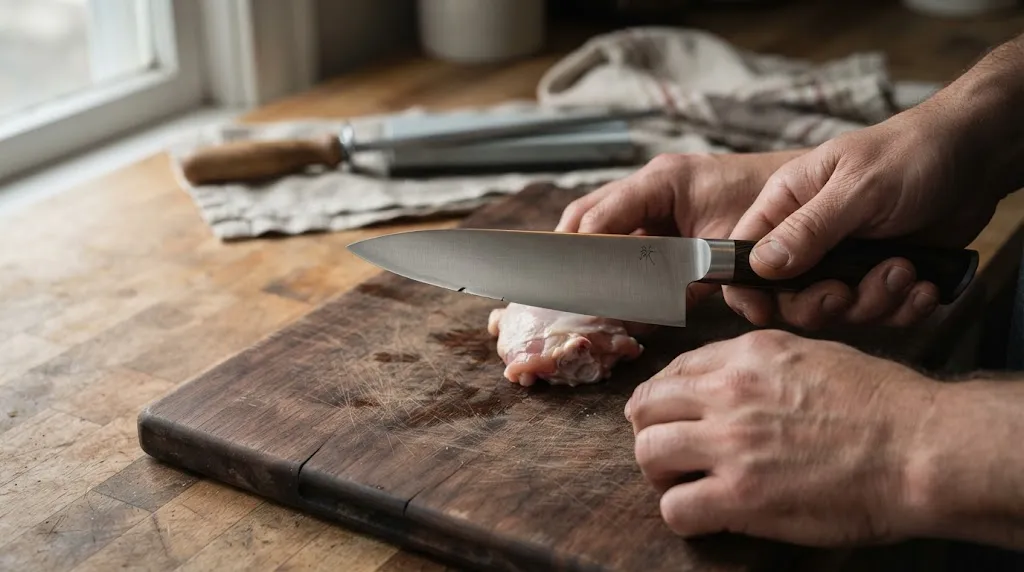
Hardness and toughness pull against each other. A harder blade holds a sharp edge longer, but it chips more easily if it hits bone, frozen food, or a hard cutting board. A softer blade resists chipping and is easier to sharpen, but it dulls faster.
This is not a flaw in manufacturing. It is a fundamental property of steel. The practical consequence is that a very hard knife rewards careful use and punishes careless use. A moderately hard knife tolerates everyday kitchen abuse but asks for more frequent honing or sharpening.
Key Insight
A higher HRC does not automatically mean a better knife. It means the knife was designed for a specific use pattern: precise cutting, careful handling, and a willingness to sharpen on a stone rather than a honing steel.
What HRC Ranges Mean for a Chef Knife
Most chef knives cluster into three practical hardness bands. The boundaries are not absolute, but they describe the experience of using and maintaining the knife.
| HRC Range | Typical Style | Practical Behavior |
|---|---|---|
| 52–56 | Many Western / German-style knives | Tough, forgiving, easy to sharpen, dulls faster |
| 56–60 | Hybrid and mid-range steels | Balanced edge retention and durability |
| 60–63+ | Many Japanese-style knives; harder specialty steels | Excellent edge retention, finer edge, more brittle, harder to sharpen |
The table describes tendencies, not guarantees. A well-treated 58 HRC knife from a careful manufacturer can outperform a poorly treated 61 HRC blade. Heat treatment is the step that converts steel composition into actual performance, and it is where reputable makers separate themselves.
Why German and Japanese Chef Knives Sit at Different Hardness Levels
German-style chef knives commonly use steels such as X50CrMoV15 (also written 1.4116), hardened to roughly 54–57 HRC. This range is chosen deliberately: the blade survives contact with harder ingredients, resists chipping, and can be maintained with a honing steel between sharpenings. The trade-off is that the edge rolls or dulls sooner than a harder blade.
Japanese-style chef knives often use steels like VG-10, hardened to around 60–61 HRC, or harder specialty steels that can reach 62–63 HRC. The higher hardness allows a thinner edge geometry and better edge retention. It also makes the blade less tolerant of lateral force, bone contact, and twisting motions.
Neither approach is more “correct.” They reflect different kitchen cultures and different assumptions about how a knife will be used and maintained. A cook who regularly breaks down chickens or cuts through squash benefits from the toughness of a softer German-style blade. A cook who spends most of their time on precise vegetable work and delicate proteins may prefer the edge retention of a harder Japanese-style blade.
How to Choose a Hardness That Matches Your Cooking
Start with the tasks you perform most often, not with a single HRC number. The right hardness follows from use patterns.
Choose a lower-hardness blade (roughly 54–57 HRC) if:
- You regularly cut through squash, poultry joints, or other resistant ingredients.
- You prefer to maintain the edge with a honing steel rather than sharpening on stones.
- You want a knife that tolerates occasional contact with a plastic board or a less-than-perfect technique.
- You sharpen infrequently and prefer a forgiving blade.
Choose a higher-hardness blade (roughly 60–62 HRC) if:
- Your cutting is mostly vegetables, herbs, boneless proteins, and precise slicing.
- You are willing to sharpen on a whetstone and avoid honing steels that can damage a hard, brittle edge.
- You accept that the knife requires deliberate care: no frozen food, no bones, no twisting in the cut.
- You value a thin, keen edge and long intervals between sharpenings.
A mid-range blade around 58–59 HRC often serves as a practical compromise for home cooks who want better edge retention than a typical German knife without the fragility of a very hard Japanese blade.
What HRC Does Not Tell You
Hardness is one variable among several. Two knives at the same HRC can behave differently because of differences in steel composition, carbide structure, blade geometry, and heat treatment quality.
For example, a steel with large, coarse carbides may hold a toothy edge but resist polishing, while a steel with fine carbides can take a cleaner edge. Edge geometry—the angle and thickness behind the edge—also determines how the knife cuts far more than hardness alone. A thin knife at 58 HRC can feel sharper in use than a thick knife at 61 HRC.
This is why hardness numbers should guide your expectations, not dictate your purchase. A knife is a system, and the HRC value is one signal within that system.
Tip
If you are unsure which hardness suits you, start with a mid-range stainless steel around 57–59 HRC. It gives you enough edge retention to notice the difference from a soft blade without demanding the careful maintenance of a 62 HRC knife.
Common Misunderstandings About Knife Hardness
“Higher HRC always means a sharper knife.” Not exactly. Higher hardness allows a thinner edge to survive, which can make the knife feel sharper. But sharpness out of the box depends on the grinder’s angle and finishing, not the HRC number alone.
“Hard knives never need sharpening.” Hard knives need sharpening less often, but they still dull. When they do, they usually require a whetstone rather than a pull-through sharpener or a honing steel, because aggressive tools can chip a brittle edge.
“Soft steel is low quality.” Soft steel is a design choice. Many professional butchers and cooks prefer softer blades because they tolerate hard use and can be brought back to a working edge quickly. Quality depends on how well the steel is treated and how well the knife’s design matches its intended task.
How to Maintain a Knife Based on Its Hardness
 Save
Maintenance should follow hardness, not habit. Using the wrong tool on a hard edge can do more damage than leaving it slightly dull.
- Softer blades (under ~58 HRC): A honing steel can realign the edge between sharpenings. Sharpen with a rod, stone, or guided system when honing no longer restores performance.
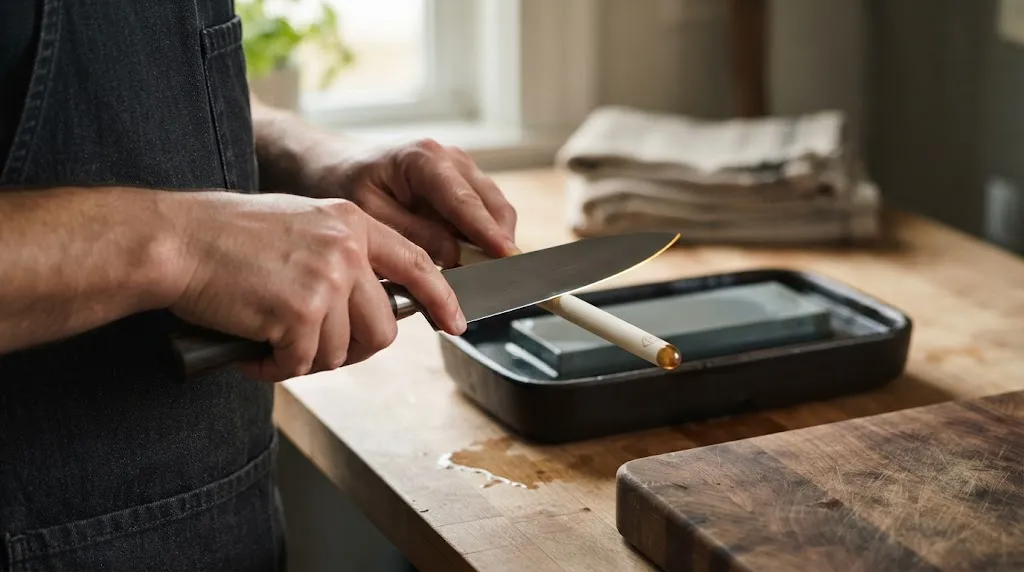
- Harder blades (60+ HRC): Skip the honing steel. Use a fine ceramic rod lightly, or sharpen on a whetstone. Avoid pull-through carbide sharpeners, which remove too much metal and can chip a brittle edge.
- All hardness levels: Use a wood or soft plastic board. Avoid glass, stone, and ceramic cutting surfaces, which dull any edge quickly and increase chipping risk on hard blades.
If you are choosing between two knives and the hardness difference is only one or two points, prioritize the maker’s reputation for heat treatment and the blade’s geometry over the HRC number itself.
Frequently Asked Questions
Is 58 HRC good for a chef knife?
Yes. 58 HRC is a practical middle ground for many home cooks. It offers better edge retention than a typical 54–56 HRC German-style blade while remaining more forgiving and easier to sharpen than a 61–62 HRC Japanese-style blade.
Is a harder chef knife always better?
No. Harder steel holds an edge longer and can support a thinner edge, but it is more brittle and less forgiving of bone, frozen food, and lateral twisting. A harder knife is better only if your cutting tasks and maintenance habits match its requirements.
What hardness are most German chef knives?
Most German-style chef knives fall in the range of roughly 54–57 HRC. Steels such as X50CrMoV15 are commonly used at this hardness to prioritize toughness, corrosion resistance, and ease of maintenance over maximum edge retention.
Can I use a honing steel on a 61 HRC knife?
Generally, no. A honing steel is intended to realign softer edges. On a hard, brittle edge, it can cause micro-chipping or fail to have the intended effect. A fine ceramic rod used with very light pressure, or a whetstone, is a safer maintenance choice for high-hardness knives.
Does higher HRC mean the knife will rust more easily?
Not directly, but there is an indirect relationship. Many very hard knife steels are high-carbon steels with less chromium, which makes them more prone to rust and staining. Stainless steels can also be hard, but the alloying balance affects corrosion resistance independently of the HRC number.
What is the hardest steel used in chef knives?
Some specialty Japanese steels and powder metallurgy steels can reach the low-to-mid 60s HRC, and a few exceed that. However, very high hardness comes with very low toughness. Practical chef knives rarely exceed roughly 63–64 HRC because beyond that point the blade becomes too fragile for normal kitchen use.
Conclusion
Chef knife steel hardness is a trade-off, not a ranking. A 55 HRC blade and a 62 HRC blade are both capable of excellent performance, but they ask different things of the cook. The softer blade tolerates hard use and returns to a working edge easily; the harder blade rewards precision with longer edge life and a finer edge.
Match the hardness to your cooking and maintenance habits, and the number becomes useful rather than confusing. If you cut carefully and sharpen on stones, a harder blade can serve you well. If you want a knife that shrugs off everyday kitchen reality, a moderate HRC is the more practical choice.

