Chef Knife Butt: What It Is, Purpose & Care Guide
Quick Answer
The chef knife butt is the very back end of the handle, farthest from the blade tip. It finishes the handle, can influence grip comfort and balance, and may contain a metal end cap or the exposed end of the tang. It is not a cutting surface or a tool designed for pounding.
The butt of a chef knife is easy to overlook. It is a small part, yet its shape and construction can affect how comfortably the knife sits in your hand.
Some chef knives have a simple rounded handle end. Others feature a square profile, a curved hook, or a weighted metal cap. These differences become noticeable when you grip the knife, make repeated cuts, or inspect an older handle for damage.
Understanding this part helps you recognize good handle construction and avoid using your knife in ways that could damage it.
What Is the Butt of a Chef Knife?
The butt is the terminal end of a chef knife’s handle. It sits at the opposite end from the blade tip, behind the area where your fingers normally wrap around the handle.
Imagine placing a chef knife flat on a cutting board with the blade pointing to your left. The butt is the rightmost end of the handle.
It may be made from the same material as the handle or finished with a separate metal component. Its appearance depends on the knife’s design.
The term describes a location rather than one specific component. This distinction matters because a knife can have a butt without having a separate metal cap or pommel.
The Cleveland Clinic’s chef knife anatomy illustration identifies the butt along with the handle, tang, bolster, heel, and blade.
Where Is the Butt Located on a Chef Knife?
Look at the end of the handle that faces away from the cutting blade. That is the butt.
You can identify it without touching the sharp edge:
- Place the knife on a stable surface with the edge facing away from you.
- Find the pointed tip at the front of the blade.
- Follow the knife backward toward the handle.
- Locate the very end of the handle, farthest from the tip.
- Inspect its shape and finish without bringing your fingers near the cutting edge.
On a traditional Western-style chef knife, the butt may show a strip of metal between two handle scales. That visible metal can be part of a full tang.
On a knife with a hidden tang, the butt may appear to be entirely wood or another handle material. Neither appearance alone establishes the overall quality of the knife.
What Does the Butt of a Chef Knife Do?
 Save
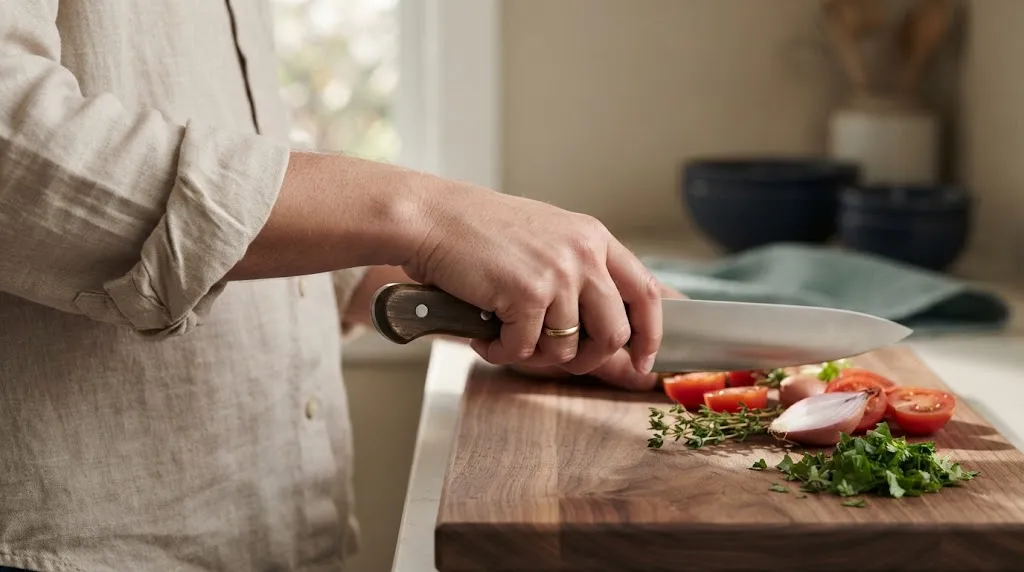
SaveThe knife butt has three main practical roles: finishing the handle, influencing how the grip feels, and sometimes contributing to the distribution of weight.
1. Provides a Comfortable Handle Ending
A rounded or smoothly shaped butt can reduce uncomfortable pressure against the palm during repeated cutting motions.
A sharp corner or projecting metal edge, however, may rub against the hand. This matters particularly when the handle is short relative to your hand size.
A comfortable knife should let you hold it securely without the handle end digging into your skin.
2. Helps Define the Rear Grip Boundary
Some knife handles have a slight flare or downward curve at the butt. This shape provides a physical reference for where the handle ends.
It may also help certain users feel the position of the handle during cutting. However, it is not a substitute for a secure grip.
For more information about controlled cutting techniques, see our guide to essential knife skills for beginners.
3. Can Influence Knife Balance
The weight at the rear of a knife contributes to the balance of the entire tool.
A substantial metal end cap may shift some weight toward the handle. A lighter handle end may contribute to a more blade-forward feel.
However, the butt alone does not determine balance. Blade dimensions, tang construction, handle materials, and bolster design all contribute.
Two knives with similarly shaped butts may feel completely different because their overall weight distribution differs.
How Is the Butt Different From the Heel, Bolster, and Tang?
These parts are commonly confused because several are located toward the rear of the knife. Their functions are different.
| Part | Location | Main Role |
|---|---|---|
| Butt | Very end of handle | Handle finish, grip feel, possible weight contribution |
| Heel | Rear of cutting edge | Cutting with controlled force |
| Bolster | Blade-handle junction, when present | Support, comfort, weight distribution |
| Tang | Steel extending into handle | Structural attachment and weight |
The key distinction is that the heel belongs to the blade, while the butt belongs to the handle.
The butt may also be called the pommel in general knife terminology, although technically a pommel can refer to a separate fitting located at the butt rather than the entire handle end.
Does Every Chef Knife Have the Same Butt Design?
No. Every conventional chef knife has a rear handle end, but its shape, materials, and construction can vary considerably.
Rounded Handle Butt
A rounded butt has smooth edges and a curved finish. It can feel comfortable against the palm, especially when the handle length suits the user’s hand.
Rounded ends appear on many contemporary kitchen knife handles.
Squared Handle Butt
A squared butt has a flatter, more angular end. It can create a distinct handle profile and may be found on traditional or modern designs.
Its comfort depends on how the corners are finished and where the handle contacts the hand.
Metal-Capped Butt
Some knives have a separate metal end cap. The cap may protect the handle material, provide a decorative finish, or contribute weight.
A metal cap does not automatically make a knife stronger. Its attachment and the underlying handle construction matter more than its appearance.
Wa-Handle Butt
Some Japanese-style chef knives use a traditional wa-handle with an oval, D-shaped, or octagonal profile.
The rear end may be relatively simple, without a separate weighted cap. This can contribute to a different handling feel compared with heavier Western-style handles.
These designs are alternatives rather than automatic indicators of better or worse quality.
How Does the Butt Affect the Way a Chef Knife Feels?
The butt affects comfort primarily through shape, position, and weight.
For example, a cook with large hands may find that a short handle places the butt directly against the palm. If the end has sharp corners, repeated chopping can become uncomfortable.
Another cook using the same knife may have smaller hands and never experience that pressure.
The rear weight also influences handling. But more weight at the butt is not automatically better. A knife that feels stable to one person may feel awkwardly handle-heavy to another.
A simple way to assess comfort is to hold the knife in a normal cutting grip, over a clear work surface, without making a cut.
Check whether:
- The butt presses uncomfortably into your palm.
- The handle feels secure without excessive squeezing.
- Your fingers have enough room.
- The knife feels controlled rather than awkwardly front- or rear-heavy.
- Any end cap or handle corner creates a pressure point.
If the handle feels uncomfortable immediately, longer preparation tasks are unlikely to improve that fit.
For context on how different blade sections are used during food preparation, see our chef knife uses guide.
Can You Use a Chef Knife Butt to Crush Ingredients?
It is better not to use the butt of an ordinary chef knife as a pounding tool.
Although the end may look solid, the handle assembly is not necessarily designed to withstand repeated impacts.
Striking garlic, nuts, or other ingredients with the butt may damage handle scales, loosen fasteners, or affect the connection between the handle and tang.
Warning
Do not strike hard objects with the handle butt or use it as a hammer. Use a mortar and pestle, suitable crushing tool, or another method intended for the ingredient.
A damaged handle may shift unexpectedly while cutting. Preserving its structural integrity is more important than finding an extra use for the handle end.
How Can You Tell if the Knife Butt Is Damaged?
 Save
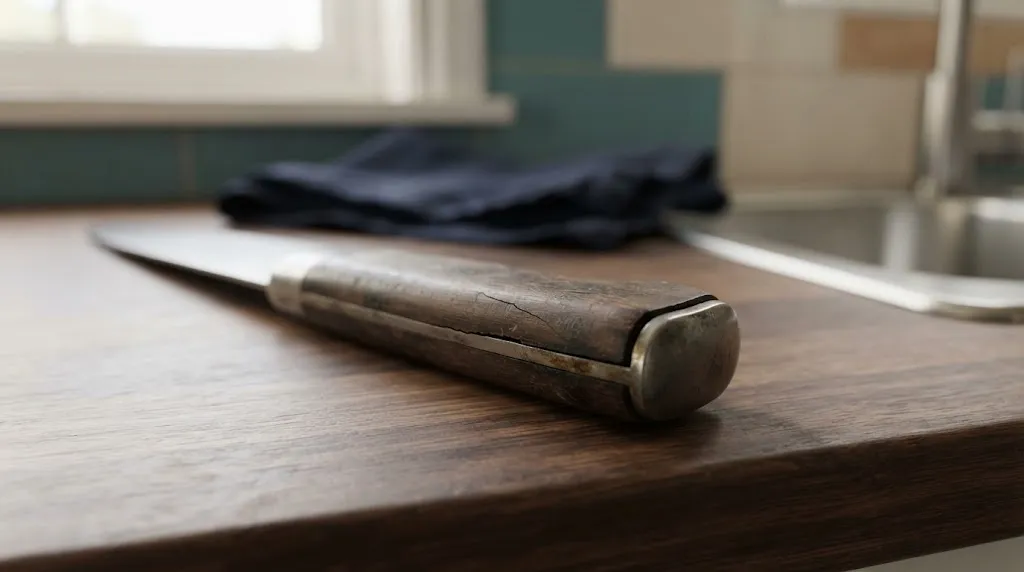
SaveInspect the butt when cleaning your knife, particularly if it has been dropped or the handle has started feeling different.
Look for these signs:
- Cracks: Splits in wood or synthetic handle material near the rear.
- Loose end cap: A metal fitting that moves or separates from the handle.
- Visible gaps: Openings where moisture or food residue may collect.
- Sharp edges: New burrs, raised metal, or broken corners.
- Handle movement: Any rocking or movement between the handle and blade.
Cosmetic marks are not always serious. A small surface scratch differs from a crack that runs into the handle structure.
If the butt or handle moves, stop using the knife until it has been assessed and repaired appropriately.
Do not assume glue will safely repair every damaged handle. The correct repair depends on whether the knife uses rivets, screws, adhesive, or a hidden tang.
How Do You Clean and Maintain the Knife Butt?
Basic cleaning and careful storage help protect both the butt and the rest of the handle.
- Wash by hand. Use mild dish soap, warm water, and a soft cloth or sponge.
- Clean around the end cap. Gently remove visible residue from accessible joints without prying components apart.
- Rinse briefly. Avoid prolonged soaking, particularly with wooden handles.
- Dry thoroughly. Wipe the butt, handle seams, and blade before storage.
- Inspect the finish. Check for cracks, looseness, rough spots, and moisture damage.
- Store securely. Keep the knife in suitable storage where it will not strike other utensils.
Wooden handles may require care appropriate to their finish. Follow the knife manufacturer’s instructions before applying oil or other treatments.
For broader cleaning and upkeep methods, refer to our guide on cleaning, sharpening, and maintaining kitchen knives.
Practical Tip
After a knife is dropped onto a hard floor, inspect the butt and the blade-handle connection before using it again. Damage at the handle end may be easier to miss than a chipped blade.
What Should You Look for in a Well-Made Knife Butt?
A well-finished butt should feel smooth, remain securely attached, and suit the shape of the handle.
When examining a chef knife, consider these practical details:
- Smooth finishing: No uncomfortable corners, burrs, or protruding parts.
- Secure construction: No loose caps or movement between assembled components.
- Suitable shape: The end should not dig into your palm during normal gripping.
- Appropriate balance: The complete knife should feel manageable for your cutting style.
- Easy maintenance: Accessible surfaces should be reasonably easy to clean and dry.
Do not judge the entire knife by whether its butt has a metal cap. A simple, carefully finished wooden handle may be comfortable and durable, while an elaborate metal end cap can still be poorly fitted.
What matters is the quality of the complete handle assembly and how it works with the blade.
Frequently Asked Questions
Is the butt of a chef knife sharp?
No. The butt is the rear end of the handle, not a cutting edge. However, damage or poor finishing can create sharp corners or metal burrs that should be addressed.
Is the knife butt the same as the pommel?
The terms are sometimes used interchangeably. More precisely, the butt is the handle’s rear end, while a pommel can refer to a separate fitting located there.
Does a heavier knife butt improve balance?
Not necessarily. Additional weight at the butt may shift the balance toward the handle, but comfort and control depend on the entire knife and the user’s preferences.
Can the butt of a chef knife be replaced?
Sometimes. A separate end cap may be repairable or replaceable, depending on its attachment. A damaged one-piece handle may require more extensive repair or replacement.
Does a full-tang chef knife have a butt?
Yes. Every conventional full-tang chef knife has a butt. The tang may extend to that end, sometimes appearing as exposed metal between handle scales.
Should you stop using a knife with a loose butt?
Yes, if the looseness affects the handle or its structural connection. Stop cutting with the knife until the damage has been properly assessed and repaired.
Conclusion
The chef knife butt is simply the back end of the handle, but its shape, finish, and construction deserve attention. A comfortable butt helps the handle feel natural in your hand, while its weight may contribute to the knife’s overall balance.
Remember that the butt is different from the heel, bolster, and tang. It should not be used as a hammer or crushing tool.
When inspecting a chef knife, look for smooth edges, secure construction, and a comfortable grip. Keep the handle clean and dry, and take any cracks or looseness seriously. These small checks help you maintain a safer, more reliable kitchen knife.

