Chef Knife Edge Angle Guide: 15 vs 20 Degrees Explained
Quick Answer
Most Western chef knives feature an edge angle of 20 degrees per side, prioritizing durability and chip resistance. Japanese-style and high-performance chef knives typically use a sharper 15-degree angle per side, delivering superior slicing precision with harder steel.
Understanding Chef Knife Edge Angles
The edge angle of a chef knife defines how acutely the primary bevels meet to form the cutting edge. Measured in degrees per side from the centerline, this angle dictates everything from initial slice resistance to long-term edge durability.
When you research kitchen knives, you will frequently encounter two standard angle tiers: the 20-degree Western standard and the 15-degree Asian or modern hybrid standard. Choosing between them involves balancing cutting performance with maintenance frequency and blade toughness.
Understanding this geometry helps you select the right knife for your cooking habits, choose correct sharpening tools, and avoid damaging expensive blades on hard ingredients or improper stones.
The 20-Degree Edge Angle: Western Tradition
 Save
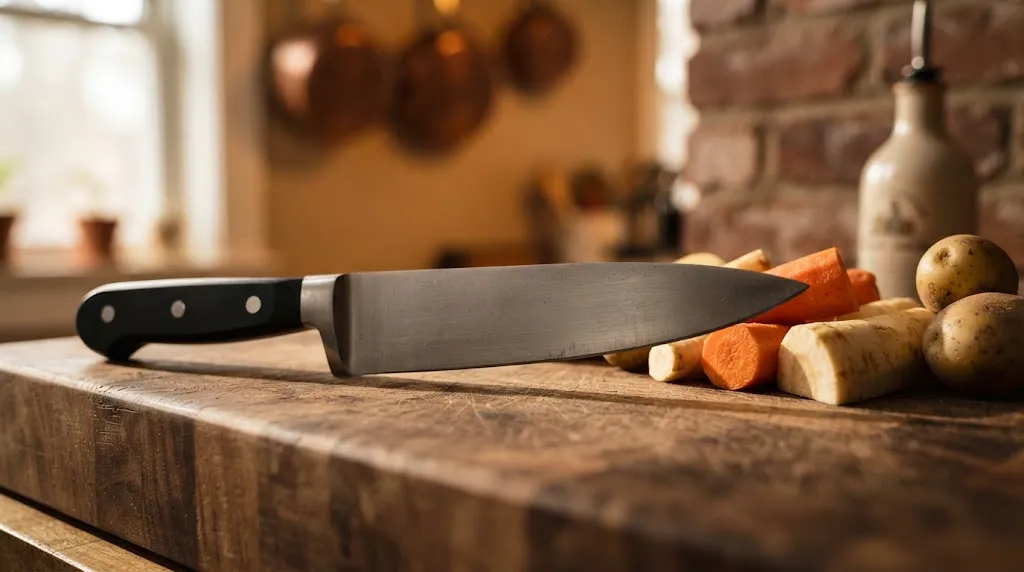
Traditional European and American chef knives—such as classic German designs from brands like Wüsthof or Zwilling—typically feature an edge angle of approximately 20 degrees per side, resulting in a total included angle of 40 degrees.
This wider geometry creates a robust wedge profile behind the cutting edge. The extra steel mass directly supports the apex, reducing the risk of chipping when cutting through dense produce, small bones, or frozen foods.
Kitchens that handle heavy-duty prep work, heavy rocking cuts, and high-volume daily cooking benefit immensely from this forgiving design. While it requires slightly more force to initiate a cut compared to a thinner blade, the edge maintains its integrity much longer under rigorous commercial conditions.
Key Insight
A wider 20-degree edge angle is not a sign of poor quality. It represents an intentional engineering choice focused on structural reliability and resistance to edge rolling or chipping in busy environments.
The 15-Degree Edge Angle: Precision and Performance
Japanese chef knives, Santokus, and modern high-performance Western hybrid knives often utilize a sharper 15-degree angle per side, creating a total included angle of 30 degrees.
This narrower profile slices through cell walls rather than crushing them. Ingredients like ripe tomatoes, delicate herbs, and boneless proteins separate cleanly with minimal friction, reducing user fatigue during long meal prep sessions.
Achieving and sustaining a 15-degree angle requires harder, high-carbon stainless steels or powder metallurgy steels that maintain structural strength even when ground thin. Softer German steels would fold or deform quickly at this acute angle.
Comparison: 15-Degree vs. 20-Degree Chef Knives
Evaluating how these two popular angles compare across essential performance categories helps clarify which style matches your kitchen routine.
| Feature | 15-Degree Edge | 20-Degree Edge |
|---|---|---|
| Primary Style | Japanese / Modern Hybrid | Traditional Western / German |
| Initial Slicing Effort | Extremely low and effortless | Moderate, requires slight push |
| Chip Resistance | Lower; prone to micro-chipping | Higher; highly forgiving |
| Steel Requirement | Harder steel (HRC 60+) | Tougher steel (HRC 55-58) |
| Sharpening Frequency | Less frequent, but precise | Frequent honing, easy upkeep |
Reviewing these differences shows that neither angle is universally superior. Your choice depends entirely on what you cut and how you maintain your tools.
How Steel Hardness Dictates Edge Angles
You cannot successfully grind a soft steel knife to a 15-degree angle and expect it to hold up. Steel composition and heat treatment impose strict physical limits on how thin an edge can be.
Traditional German knives use softer, highly stain-resistant stainless steel alloys rated around 55 to 58 on the Rockwell C scale (HRC). These steels bend rather than snap under lateral stress, making them ideal for a robust 20-degree bevel.
Conversely, high-end Japanese knives utilize hard carbon steels or advanced stainless alloys like SG2, VG-10, or ZDP-189, often reaching HRC 60 to 64. This extreme hardness allows the steel to support a steep 15-degree bevel without folding over during normal cutting tasks.
Warning
Attempting to sharpen a soft Western kitchen knife to a 15-degree angle often results in immediate edge rolling because the softer steel lacks the tensile strength to support such a thin apex.
Single-Bevel vs. Double-Bevel Edge Angles
Most Western and modern Japanese chef knives feature symmetric double-bevel edges, where both sides are ground to an identical angle (e.g., 15° or 20° per side).
However, traditional specialty Japanese blades—such as sashimi knives, debas, and usubas—employ single-bevel construction. One side is ground flat or slightly concave, while the other side forms a steep single bevel.
Single-bevel knives achieve microscopic cutting precision, allowing chefs to slice raw fish with flawless separation. They require specialized sharpening techniques and distinct handling skills because the blade naturally drifts toward the beveled side during cuts.
How to Determine Your Knife’s Factory Angle
 Save
Before attempting to sharpen or re-profile a chef knife, you must identify its factory edge angle. Guessing the angle leads to uneven bevels and wasted steel.
Consult the manufacturer documentation or official product specifications. Most reputable knife makers explicitly list whether their chef knives are ground to 15 degrees or 20 degrees per side.
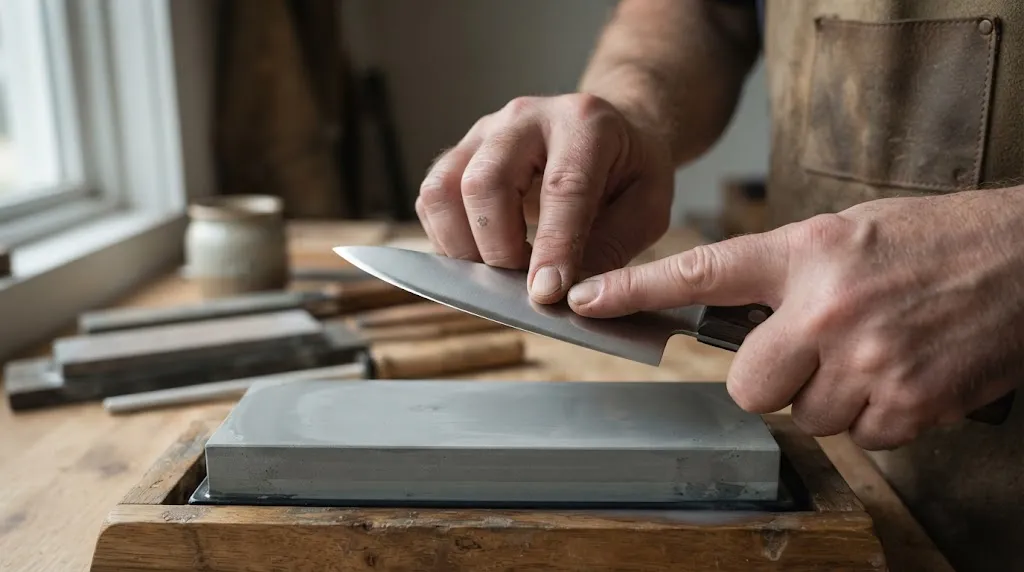
If manufacturer data is unavailable, use the classic sharpie test. Color the entire bevel with a black permanent marker, place the knife against your sharpening stone or ceramic rod at your estimated angle, and take a single light stroke. Inspect where the marker ink was removed to verify if your angle matches the existing bevel.
Maintaining and Re-Profiling Edge Angles
Maintaining your knife’s edge angle requires consistent technique, whether you use whetstones, guided rod systems, or electric sharpeners.
Honing rods straighten a curled edge between sharpening sessions. A traditional steel honing rod must be held at the exact matching angle—20 degrees for Western knives or 15 degrees for Asian blades—to avoid rounding over the apex.
When sharpening on whetstones, maintaining a stable muscle memory angle is critical. Many home cooks use angle guides that clip onto the spine of the knife to ensure consistent feedback across coarse, medium, and fine grit stones.
Tip
If you prefer effortless upkeep, consider converting a durable steel knife from 20 degrees to 15 degrees only if the steel hardness permits, or stick strictly to the factory angle to ensure maximum longevity.
Common Mistakes When Choosing and Sharpening Edge Angles
Home cooks frequently make avoidable errors when dealing with knife edge angles:
- Assuming sharper is always better: A 15-degree angle cuts effortlessly, but it chips easily if used on hard squash, bones, or frozen ingredients.
- Ignoring the honing rod angle: Using an incorrect angle on a honing steel flattens or rolls the apex rather than realigning it.
- Mixing sharpening systems: Switching between pull-through sharpeners and whetstones creates erratic bevel angles that degrade cutting performance.
- Relying on guesswork: Freehand sharpening without verifying angles leads to convex or rounded bevels that dull quickly.
Avoiding these pitfalls ensures your kitchen cutlery performs reliably and lasts for decades.
Related Product
Kitchen Knife Sharpening Stone Set
Maintain precise 15-degree and 20-degree edge angles at home using dual-grit whetstones and an included angle guide.
As an Amazon Associate, we earn from qualifying purchases.
Frequently Asked Questions
What is the standard chef knife edge angle?
The standard edge angle is 20 degrees per side for Western and German knives, and 15 degrees per side for Japanese and high-performance chef knives.
Can I sharpen a 20-degree knife to 15 degrees?
You can re-profile the edge, but only if the steel is hard enough (HRC 60+) to support the thinner angle. Softer Western steels will roll and dull rapidly at 15 degrees.
How often should I sharpen my chef knife?
Frequency depends on usage, but most home cooks benefit from regular honing every few uses and professional or whetstone sharpening once or twice a year.
Do electric sharpeners ruin knife edge angles?
Cheap pull-through sharpeners remove excessive steel and lock you into a fixed factory angle that may not match your blade. High-end adjustable electric sharpeners offer better control.
What is a compound bevel edge?
A compound bevel features a primary thinning grind combined with a secondary micro-bevel at a slightly wider angle, maximizing cutting efficiency while reinforcing the apex.
Does knife blade thickness affect the edge angle?
Yes. A thick spine combined with an acute 15-degree edge creates a wedge effect that can crack rigid ingredients like carrots or potatoes before the edge fully passes through.
Conclusion
Choosing the correct chef knife edge angle comes down to balancing cutting precision with blade durability. Whether you prefer the rugged durability of a 20-degree Western blade or the effortless slicing performance of a 15-degree Japanese knife, understanding your blade’s steel composition ensures proper maintenance. Keep your sharpening angle consistent, match your maintenance tools to your bevel specs, and enjoy superior kitchen performance.

