Chef Knife Sizes: 6, 8 & 10 Inch Size Guide
Quick Answer
Chef knife sizes usually describe blade length, not the entire knife. Common choices are 6, 8, and 10 inches. An 8-inch (about 20 cm) chef knife is a practical starting point for most home cooks; 6 inches favors compact preparation, while 10 inches provides more reach for large ingredients and batch cooking. Choose according to your cutting board, grip, and usual ingredients—not hand size alone.
A chef knife that feels comfortable for dicing one onion may feel awkward when slicing a large cabbage. The difference often comes down to blade length, but a number on the label never tells the whole story. Blade height, weight, handle shape, and available workspace also influence how well a knife fits your cooking.
What Do Chef Knife Sizes Actually Measure?
The advertised size normally refers to the blade, measured from its tip to the heel near the handle. It does not include the handle. Exact measurement conventions can vary slightly between manufacturers, so consult a product’s published dimensions when fit is critical.
An 8-inch chef knife therefore measures roughly 8 inches across the blade, but the complete knife is several inches longer. This distinction matters when checking drawer organizers, knife guards, storage blocks, and counter space.
The heel is the back end of the cutting edge closest to the handle. The tip is the forward point. Their positions, together with the curved belly, explain how a long or short chef knife moves on a board. For a closer look at these features, see our guide to chef knife tip uses.
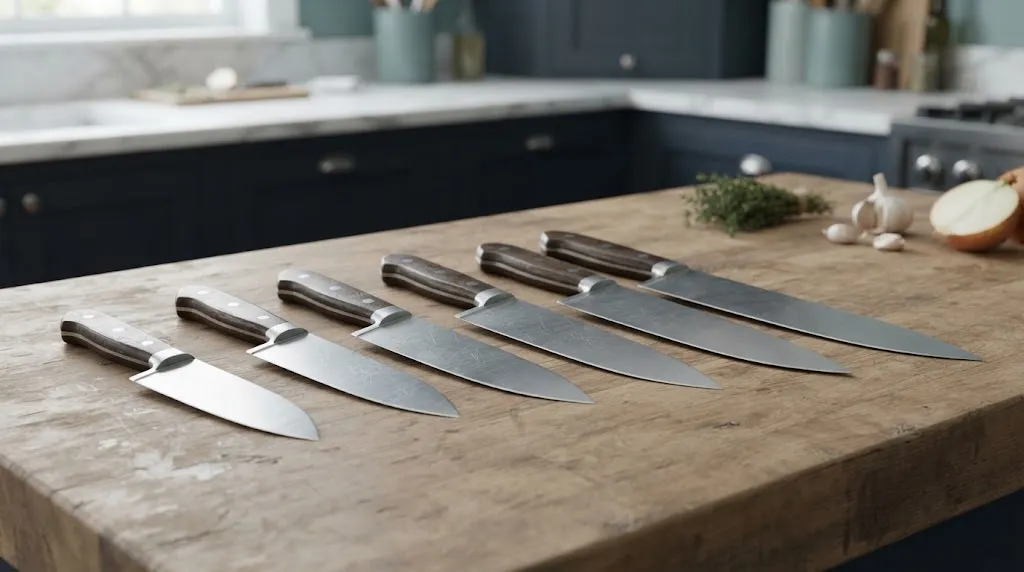
Chef Knife Size Chart: 6, 7, 8, 9, 10, and 12 Inches
 Save
SaveThese are practical size categories, not rigid standards. Different knife designs can feel quite different even when their advertised blade lengths match.
| Blade size | Approx. metric length | Practical advantage | Main tradeoff |
|---|---|---|---|
| 6 inches | 15 cm | Compact, maneuverable | Less reach across large foods |
| 7 inches | 18 cm | Middle ground for smaller workspaces | Still shorter for wide ingredients |
| 8 inches | 20 cm | Versatile everyday length | May feel long on a tiny board |
| 9 inches | 23 cm | More slicing reach | More room needed |
| 10 inches | 25 cm | Efficient for big items and batches | Less nimble in tight spaces |
| 12 inches | 30 cm | Extended reach for specialized high-volume work | Requires substantial space and control |
Most households can focus on the middle of this range. Smaller and larger sizes become useful when they solve a specific handling or workload problem. Manufacturer guidance from ZWILLING’s chef knife size overview similarly distinguishes compact, general-purpose, and long-blade applications.
How Do 6-, 8-, and 10-Inch Chef Knives Compare?
6-inch: easier movement, shorter cuts
A 6-inch chef knife is useful for chopping small quantities, slicing modest vegetables, and working on a compact cutting board. The tip stays relatively close to your guiding hand, which some cooks find less intimidating.
Its limitation appears with broad food. A large melon, cabbage, or squash may require more repositioning and additional cutting strokes. A shorter knife does not automatically mean a safer knife: a cramped grip or low blade can still make it uncomfortable.
8-inch: useful reach without excessive length
An 8-inch chef knife has enough cutting edge for ordinary slicing, chopping, dicing, and mincing. It can handle everyday vegetables, herbs, fruit, and boneless proteins without requiring an especially large work surface.
This makes it a sensible first size to try rather than a rule everyone must follow. Our guide to what a chef’s knife is used for explains the types of prep where a general-purpose blade earns its place.
10-inch: better reach, greater space requirements
A 10-inch chef knife can travel farther through food in one stroke. That extra edge is especially helpful when preparing repeated batches, cutting broad vegetables, or making longer slices through boneless meat.
The tradeoff is handling. The point sits farther from the hand, the knife may weigh more, and a crowded board leaves less room to move safely. For occasional small meals, the extra length may provide little benefit.
How to Choose the Right Chef Knife Length
Start with what you cut and where you cut it. Then check whether the actual knife feels balanced and secure in your grip.
- Look at your usual ingredients. Onions, carrots, herbs, and small portions rarely demand a 10-inch blade. Whole cabbages, substantial squash, and large batches make extra reach more worthwhile.
- Check your cutting board. Place a ruler or an existing knife across the usable work area. You need space for the food, the blade’s full movement, and both hands—not merely enough room for the blade to fit diagonally.
- Consider the handle. Small hands do not automatically require a 6-inch blade. Handle circumference, shape, and the available room for a pinch grip can matter more than length alone.
- Check balance and weight. A light 8-inch knife may feel easier to maneuver than a heavy 6-inch model. Compare individual knives rather than assuming a size predicts weight.
- Practice your normal motion. With a safe, stationary knife demonstration, check whether your wrist stays comfortable and your guiding hand has enough room. The blade should not feel difficult to steer.
Tip
If two blade lengths both seem workable, compare their handles and weight before choosing. A comfortable grip and stable cutting motion are more useful than an extra inch you seldom use.
Why Blade Height, Shape, and Weight Matter Too
Blade length affects reach, but blade height—the distance from the spine to the cutting edge—affects space for your guiding knuckles. A relatively tall, short knife may offer more clearance than a long, narrow knife.
Blade shape changes technique. A pronounced curve can support rocking, while a flatter profile often favors push cutting. Our explanation of the chef knife belly and rocking motion covers that distinction.
Weight and balance influence how the knife feels over a long prep session. A heavier knife may feel substantial during repeated cuts, but some cooks prefer a lighter knife to reduce effort. Blade thickness and construction also change how a knife moves through dense ingredients.
Two knives labeled 8 inches can therefore feel surprisingly different. If one seems uncomfortable, another knife of the same length may still be a good fit.
Which Chef Knife Size Works for Different Foods?
These suggestions describe common handling advantages, not strict rules. The safest usable knife is one that fits the ingredient, your technique, and a stable work surface.
- Small vegetables and fruit: A 6- to 8-inch chef knife provides enough edge for routine prep without excessive reach.
- Herbs and garlic: A 6- to 8-inch knife is often comfortable; edge shape and sharpness matter as much as length.
- Large cabbage or squash: An 8- to 10-inch blade offers greater reach, provided the ingredient is stable and the work surface is spacious.
- Boneless meat: An 8-inch knife handles general portioning; longer blades can help make extended slicing strokes.
- High-volume prep: A 9- or 10-inch knife may reduce the need for repeated short strokes when handling large batches.
Longer does not mean suitable for every hard ingredient. A standard chef knife should not be forced through hard bones or frozen foods. When preparing poultry, the correct cut location matters more than blade size; our guide to cutting chicken with a chef knife explains its appropriate limits.
Chef Knife Inches vs. Japanese Knife Millimeters
Western-style chef knives are commonly described in inches, while Japanese knives are frequently labeled in millimeters. The measurements are directly convertible: 1 inch equals exactly 25.4 millimeters.
That means an 8-inch blade is approximately 203 mm, while a 210 mm gyuto is approximately 8.3 inches. The two sit in a similar practical length category, although their shapes, heights, and weights may be different.
Common Japanese labels include 180 mm (about 7.1 inches), 210 mm (about 8.3 inches), and 240 mm (about 9.4 inches). A 240 mm knife is not exactly 10 inches; it is a little shorter.
A santoku is often sold around 165–180 mm and typically has a different tip and edge profile from a Western chef knife. Do not assume that similarly long santoku and chef knives are interchangeable in how they rock, slice, or feel against the board.
Common Size-Selection Mistakes to Avoid
- Using height or hand size as a fixed formula. There is no universal body-measurement rule that identifies the correct chef knife length. Handle fit, board room, and preference are more reliable checks.
- Ignoring overall length. An 8-inch blade does not mean an 8-inch knife. Verify complete dimensions before choosing storage.
- Buying long for prestige. A 12-inch knife is not automatically more capable in a typical home kitchen.
- Assuming short means lightweight. Materials and construction can make shorter knives surprisingly heavy.
- Choosing length without checking sharpness. A dull 10-inch blade will not compensate for a poorly maintained cutting edge.
Warning
Do not compensate for a blade that cannot comfortably span an ingredient by forcing the knife or cutting on an unstable board. Reposition the food, create a flat stable surface when appropriate, or switch to a suitable tool.
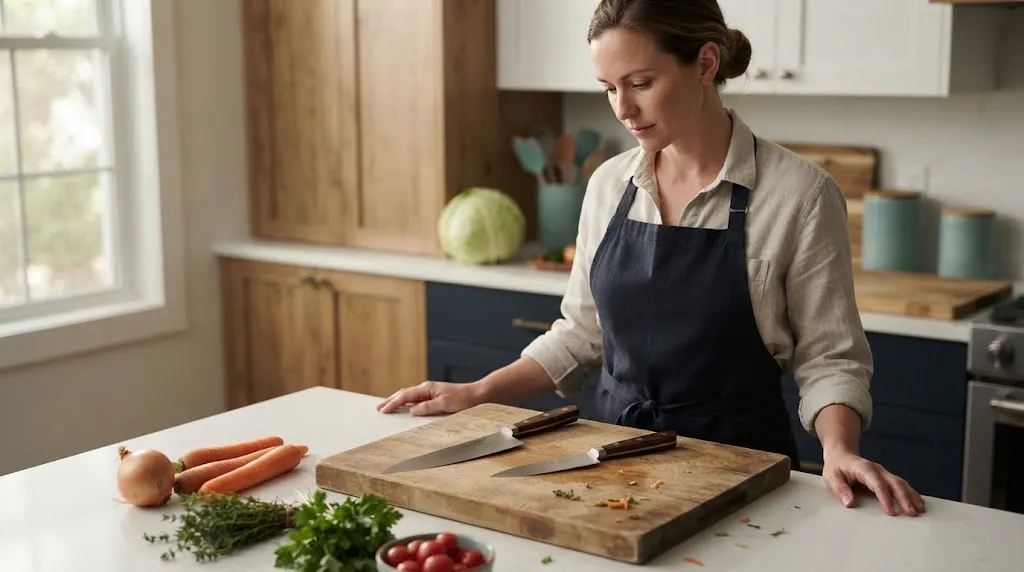
A Simple Way to Decide Between Two Sizes
 Save
SaveIf you are deciding between 6 and 8 inches, choose 6 when maneuverability and limited counter space are your main constraints. Choose 8 when one knife must comfortably handle both small ingredients and larger family meals.
If you are deciding between 8 and 10 inches, ask how often you process large ingredients or substantial batches. Occasional large projects usually do not require changing your everyday knife. Repeated high-volume preparation gives the longer blade a clearer purpose.
It is also reasonable to keep one versatile chef knife and use a small paring knife for fine handwork. You do not need to own every chef knife size. The important outcome is a blade that feels controllable during the work you actually do.
Related Product
8-Inch Chef Knives
An 8-inch chef knife is a useful reference size if you want to compare handle shapes, weights, and blade profiles before settling on a length.
As an Amazon Associate, we earn from qualifying purchases.
Frequently Asked Questions
Is a 7-inch chef knife a good middle ground?
Yes. A 7-inch blade can be a useful compromise when 6 inches feels too short and 8 inches feels too long. Check its actual blade height and handle fit, because those features affect control.
Is an 8-inch chef knife too big for a beginner?
Not necessarily. Many beginners find an 8-inch chef knife manageable with a stable board and proper grip. A shorter knife is reasonable if an 8-inch blade feels awkward or the available work area is limited.
Does a bigger chef knife cut faster?
A longer edge may reduce strokes on large foods or repeated batches, but it does not guarantee faster preparation. Control, sharpness, food stability, and technique also matter.
Are chef knife blade length and cutting-edge length identical?
Not always. Advertised blade length may follow a maker’s measurement convention, while a curved cutting edge has a different path length. Check the published specifications for precise comparisons.
Can I use a 10-inch chef knife on a small cutting board?
You may be able to make limited cuts, but a board that restricts your full cutting motion is a poor match. Use a larger stable board or a shorter knife with adequate room for both hands.
Do I need different chef knife sizes for meat and vegetables?
Usually not. One well-suited chef knife handles many vegetables and boneless proteins. Specialized jobs such as deboning, bread slicing, and cutting hard bones call for different knife designs rather than simply a different chef knife length.
Final Takeaway
For most home kitchens, start by considering an 8-inch chef knife and adjust only when your space, grip, or workload gives you a clear reason. A 6-inch blade trades reach for compact handling; a 10-inch blade trades maneuverability for longer cuts. The right size is the one you can use comfortably and predictably on your own cutting board.

