Chef Knife Facts: Size, Shape, Uses, and Construction
Quick Answer
A chef knife is a broad, versatile kitchen knife designed for chopping, slicing, dicing, mincing, and many other food-preparation tasks. Most are about 6 to 10 inches long, with an 8-inch blade being a common all-purpose size. Its usefulness comes from the relationship between blade shape, edge geometry, steel, handle, and construction—not from length alone.
A chef knife is often described as the main general-purpose knife in a kitchen, but that description becomes more useful when you understand what the knife is built to do. Its size affects control and cutting capacity, its curved profile supports different cutting motions, and its construction determines how the knife feels and how it must be maintained.
This guide explains the practical facts behind chef knives: common sizes, blade shape, everyday uses, important parts, materials, construction methods, and the tasks for which another knife is a better choice.
What Is a Chef Knife Designed to Do?
A chef knife is a multipurpose kitchen knife with a relatively broad blade, a sharp cutting edge, a pointed tip, and enough length to prepare a wide range of ingredients. It is designed to move through food rather than perform one specialized job.
Typical tasks include:
- Chopping vegetables and herbs
- Dicing onions, peppers, carrots, and other produce
- Slicing boneless meat and cooked proteins
- Mincing garlic, herbs, and spices
- Cutting larger fruits and vegetables
- Breaking down some poultry and other boneless ingredients
The knife is most effective when paired with a stable cutting board and a controlled cutting motion. It is not intended to replace every knife in the kitchen. Hard bones, frozen food, very small precision work, and delicate filleting generally require a different blade.
For a basic definition, see this guide to what a chef knife is. That article covers the knife’s general role, while this guide focuses on how size, shape, and construction affect that role.
What Sizes Do Chef Knives Come In?
 Save
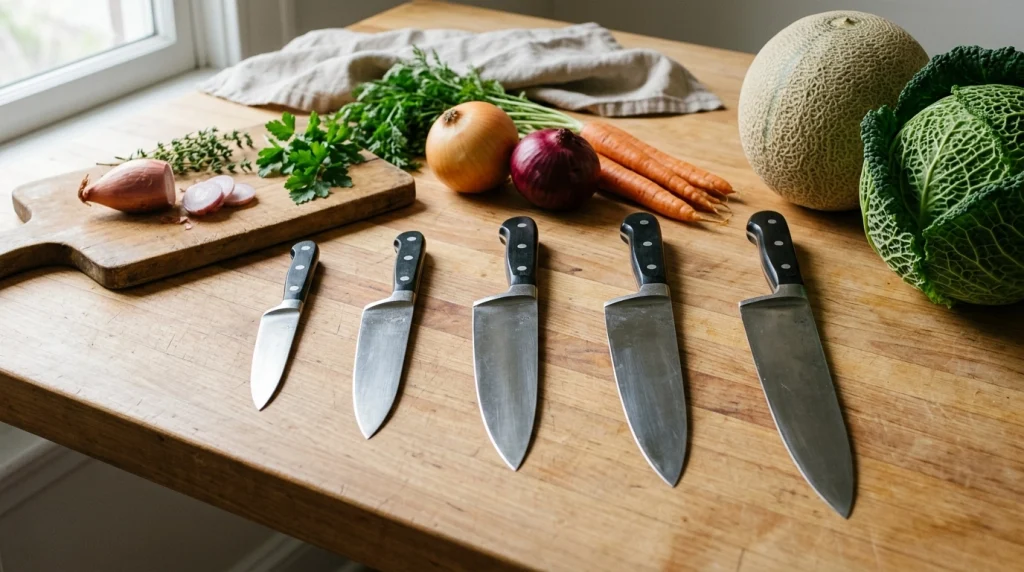
SaveChef knives are commonly available with blades around 6, 7, 8, 9, and 10 inches long. The measurement normally refers to the blade, not the complete knife from tip to handle end.
| Blade size | Typical character | Often suits |
|---|---|---|
| 6 inches | Compact and easy to control | Small workspaces, smaller ingredients, or users who prefer shorter blades |
| 7 inches | Balanced middle ground | Cooks wanting maneuverability without a very short blade |
| 8 inches | Common all-purpose size | General home cooking and a wide range of ingredients |
| 9–10 inches | More cutting length and board coverage | Large ingredients, larger hands, and cooks comfortable with a longer blade |
An 8-inch chef knife is popular because it offers useful cutting length without feeling excessively large for many home kitchens. However, the best size depends on the user’s hand position, cutting board space, ingredient size, and comfort with the knife.
A longer blade can make large onions, melons, cabbages, and other ingredients easier to handle because fewer strokes may be needed. A shorter blade can provide more confidence and control, especially on a small board or during detailed preparation. Blade length should therefore be treated as a fit decision, not a quality ranking.
How Does a Chef Knife’s Shape Affect Cutting?
The blade is not simply a flat piece of metal. Its profile determines how the edge contacts the cutting board and how the knife moves through food.
The Belly and Blade Profile
Many Western-style chef knives have a noticeable curve, often called the belly, toward the tip. This supports a rocking motion: the tip can remain near the board while the handle rises and falls. The flatter section near the heel is useful for downward chopping and controlled cuts.
Some chef knives have a flatter profile. These encourage a push-cutting or slicing motion in which the blade moves forward or backward rather than rocking continuously. Neither profile is automatically better. The important question is whether the blade shape matches the motion that feels controlled and natural to the user.
The Tip, Heel, Spine, and Edge
The tip is useful for smaller cuts and tasks that need precision. The heel is the broad rear portion of the edge and is useful for firm downward cuts. The spine is the thick, unsharpened back of the blade. A thicker spine can add rigidity, while a thinner blade may pass through food with less resistance.
The cutting edge may be straight, slightly curved, or shaped with a profile that combines both. Edge thickness and bevel angle also affect performance. A thinner edge can feel more precise but may require more careful use, while a thicker edge can tolerate rougher work but may not feel as nimble.
Blade Width and Clearance
A broad blade provides knuckle clearance above the cutting board and gives the knife more surface area for transferring chopped food. It can also feel substantial when cutting large ingredients. A narrower blade may feel faster and lighter but can provide less clearance and less room for scooping food.
These details are why two knives with the same 8-inch length can feel completely different. Length is only one part of the design.
Key Insight
A chef knife’s practical performance comes from the interaction of length, profile, width, thickness, edge geometry, and handle design. Comparing blade length alone misses most of the features that affect control.
What Are the Main Parts of a Chef Knife?
Understanding knife anatomy makes product descriptions and care instructions easier to interpret. The main parts are:
- Blade: The sharpened metal portion used to cut food.
- Edge: The sharpened side that makes contact with the ingredient.
- Tip: The front point used for precision work.
- Heel: The rear section of the edge, often used for forceful cuts.
- Spine: The thick, unsharpened back of the blade.
- Bolster: A transition area between blade and handle, present on some designs.
- Tang: The part of the blade steel that extends into the handle.
- Handle: The section held by the user.
- Rivets or fasteners: Hardware that may secure handle scales to the tang.
A bolster can add weight and create a smooth transition into the handle, although it may also make sharpening the entire edge more difficult if it extends all the way to the heel. A full tang can contribute to strength and balance, but it is not a guarantee that every aspect of a knife is high quality. Steel, heat treatment, geometry, handle fit, and manufacturing consistency still matter.
For a more detailed vocabulary reference, use this internal guide to chef knife terminology for beginners.
What Materials and Construction Methods Are Used?
Most chef knife blades are made from stainless steel, carbon steel, or a combination of properties associated with both. Stainless steel generally offers better resistance to staining and corrosion. Carbon-rich steels can be capable of excellent sharpness and edge performance, but some require more careful drying and maintenance.
Steel type alone does not tell the whole story. Heat treatment affects hardness and how the blade holds an edge. Blade thickness, grinding, edge angle, and the manufacturer’s quality control also influence how the knife performs.
Chef knives are commonly described as either forged or stamped:
- Forged knives are formed from a piece of steel using pressure and heat, although manufacturing methods vary. They are often associated with a substantial feel and a visible transition near the handle.
- Stamped knives are cut or pressed from a sheet of steel. They can be lighter, flexible in design, and highly capable when properly made.
Forged does not automatically mean better, and stamped does not automatically mean cheap or ineffective. The finished geometry and heat treatment matter more than the label by itself. This comparison of forged and stamped knives explains the distinction in greater detail.
Handles may use wood, composite materials, plastic, stainless steel, or other synthetics. The best handle is one that provides a secure grip, fits the user’s hand, and remains comfortable during repeated cutting. A visually attractive handle is not necessarily safer or more ergonomic.
Which Foods Should You Cut With a Chef Knife?
A chef knife is a strong choice for most routine preparation involving firm, boneless ingredients. It can chop onions, slice vegetables, mince herbs, cut meat into portions, and prepare fruit. The broad blade can also help transfer ingredients from the board to a pan or bowl.
Use a different knife when the task demands a specialized shape or edge. A paring knife is usually easier for small peeling and trimming tasks. A serrated knife is better for crusty bread and soft foods with delicate interiors. A boning knife is designed for separating meat from bones, while a fillet knife is made for flexible, delicate cuts through fish.
Do not use a chef knife to cut through hard bones, frozen food, or other materials that can damage the edge or cause the blade to slip. A chef knife can be versatile without being indestructible.
Warning
A dull or poorly maintained knife can require more force and may be harder to control. Keep the edge maintained, use a stable cutting board, and avoid twisting the blade through hard food.
How Should You Judge a Chef Knife?
 Save
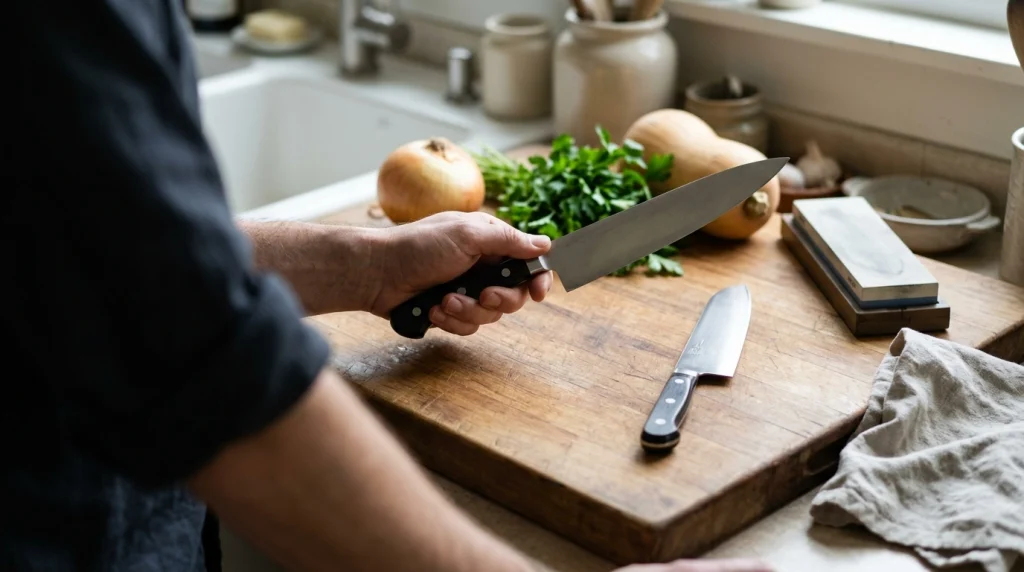
SaveStart with the tasks you perform most often, then assess the knife’s fit rather than focusing on one specification. Check whether the blade length suits the board, whether the profile matches your preferred cutting motion, and whether the handle feels secure without forcing your wrist into an awkward position.
Next, consider maintenance. Stainless steel may be more forgiving for cooks who want easy cleanup, while reactive carbon steel may require prompt drying and more care. A thin, highly refined edge may cut smoothly but demand more careful treatment than a robust, thicker edge.
Finally, inspect the complete construction. Look for a securely fitted handle, a clean transition between blade and handle, an edge that is even from heel to tip, and a design that feels balanced when held correctly. A reliable chef knife is not defined by a single feature; it is the result of several features working together.
Related Product
Chef Knife Category
A chef knife can be a practical next step if you need one versatile blade for everyday chopping, slicing, dicing, and mincing.
As an Amazon Associate, we earn from qualifying purchases.
Frequently Asked Questions
Is an 8-inch chef knife a good general-purpose size?
Yes. An 8-inch blade provides a useful balance between cutting capacity and control for many home cooks. A 6- or 7-inch knife may feel easier to maneuver, while a 9- or 10-inch knife can suit larger ingredients and larger cutting boards.
What is the difference between a chef knife and a santoku?
A chef knife commonly has a more pronounced curved belly and pointed tip, which supports rocking and several cutting motions. A santoku usually has a flatter edge and a rounded or lowered tip, encouraging a more up-and-down or push-cutting style.
Does a full tang make a chef knife better?
A full tang can support strength and may improve balance, but it does not guarantee superior performance. Blade geometry, steel, heat treatment, handle quality, and edge consistency are also important.
Are forged chef knives always better than stamped knives?
No. Forging and stamping describe manufacturing methods, not a complete performance rating. A well-made stamped knife can perform very well, while a poorly designed forged knife may not suit a particular user.
Can a chef knife cut through bones?
A standard chef knife should not be used to cut through hard bones. The impact can chip or damage the edge and may make the blade slip. Use an appropriate cleaver or butcher’s tool when a task involves bones.
What is the most important chef knife feature?
There is no single feature that matters in every kitchen. The best match depends on comfortable size, controllable shape, suitable edge geometry, secure handle fit, and a steel and construction level that matches the maintenance the user is willing to provide.
Conclusion
A chef knife is a general-purpose tool whose usefulness comes from its complete design. Common sizes range from compact 6-inch blades to longer 10-inch versions, with 8 inches serving as a practical middle ground for many cooks. The blade profile affects cutting motion, while width, thickness, edge geometry, steel, tang, and handle shape influence control and maintenance.
Choose based on the foods you prepare, the cutting motion you prefer, the space available on your board, and the level of care you are prepared to provide. A well-matched knife is more useful than one selected only because it has a certain length or construction label.