
Can You Use Castor Oil on a Cutting Board? Safety, Risks, and Better Alternatives
Quick Answer
You can physically apply castor oil to a wooden cutting board, but I don’t recommend it for routine food-preparation surfaces. Even food-grade castor oil is thick and isn’t a standard cutting-board conditioner. Food-grade mineral oil is a more dependable choice because it is odorless, doesn’t become rancid, and is widely recommended for wooden boards. Learn the correct application method in this wooden cutting board oiling guide.
What You Should Know
- Not the best choice: Castor oil is unusually viscous and can leave an unwanted oily surface residue.
- Food-grade matters: Cosmetic or industrial castor oil should not be assumed suitable for direct food contact.
- Better alternative: Use food-grade mineral oil designed for cutting boards and butcher blocks.
- Extra protection: A suitable mineral oil and beeswax conditioner can add light moisture resistance.
- Already applied it? Remove excess oil, wash appropriately, and inspect the surface before preparing food.
My Recommendation
- Choose a dedicated conditioner: Follow the board manufacturer’s care instructions and avoid unnecessary oils or additives.
Castor oil might seem like a natural way to protect a wooden cutting board. After all, it comes from a plant and appears in certain food, cosmetic, and industrial products.
However, food compatibility and cutting board performance are different questions. I prefer choosing a treatment based on how it behaves on wood, not simply where it comes from.
In this guide, I’ll explain castor oil’s limitations, what food-grade labeling means, and how to maintain your cutting board with safer, more practical alternatives.
What Is Castor Oil, and Why Would Someone Use It on Wood?
Castor oil is a vegetable oil extracted from the seeds of the castor plant, Ricinus communis. It contains a high proportion of ricinoleic acid, which contributes to its unusual thickness and chemical properties.
Unlike common lightweight conditioning oils, castor oil has a noticeably thick consistency. This can make it less convenient for treating wooden kitchen surfaces.
Why Castor Oil Seems Like a Good Option
People sometimes consider castor oil because it comes from a natural source and can create a glossy appearance. It also has various uses in cosmetics, lubricants, and manufactured coatings.
However, those properties don’t establish that ordinary bottled castor oil is appropriate for cutting boards.
- Plant-derived origin: Castor oil comes from seeds rather than petroleum.
- Thick consistency: It can remain noticeable on the wood surface.
- Glossy appearance: An oily application may temporarily deepen the appearance of wood grain.
- Industrial versatility: Chemically modified castor oil appears in some manufactured finishes.
- Product differences: Cosmetic, industrial, and food-grade formulations don’t necessarily have the same intended uses.
One distinction matters here: chemically modified castor-oil coatings aren’t the same as pouring ordinary castor oil onto wood.
For a practical kitchen cutting board, I would choose a conditioner specifically intended for direct food-contact wooden surfaces.
Is Castor Oil Safe for Wooden Cutting Boards?
Castor oil’s suitability depends on the exact product and intended application. Food-grade castor oil is not automatically an approved or recommended cutting board finish.
The important question isn’t simply whether castor oil can appear in food products. It’s whether the particular formulation is appropriate for a surface repeatedly touched by knives and food.
Food-Grade Castor Oil vs. Cosmetic Castor Oil
These products may look similar, but their labels can communicate different manufacturing standards and intended purposes.
- Food-grade castor oil: May meet applicable purity specifications for certain food-related uses.
- Cosmetic castor oil: Often intended for skin, hair, or other topical applications.
- Industrial castor oil: May be intended for lubricants, manufacturing, or chemical processing.
- Modified castor-oil products: Can contain processed ingredients with entirely different performance characteristics.
The U.S. regulation 21 CFR 172.876 permits qualifying castor oil for certain specified food-additive applications. These include limited uses in hard candy manufacturing and tablet coatings.
That regulation does not establish ordinary castor oil as a universally approved cutting board finish.
What About Ricin in Castor Beans?
Castor beans naturally contain ricin, a highly toxic protein. Properly processed commercial castor oil is different from raw castor beans.
Ricin itself is not the reason I recommend avoiding ordinary castor oil as a board conditioner. Product suitability, additives, and surface performance are more relevant concerns for a properly manufactured oil.
Never attempt to make cutting board oil from raw castor beans or assume an unidentified homemade extract is safe.
Why Food-Safe Doesn’t Always Mean Board-Safe
An ingredient can have a legitimate food-related use without being a practical wood treatment. Cutting boards undergo repeated washing, moisture exposure, and knife contact.
A suitable conditioner should perform reliably under those conditions.
- It should be appropriate for food-contact surfaces.
- It should not create an unpleasant coating that transfers to food.
- It should be easy to apply and remove in controlled amounts.
- It should remain stable under normal board-care conditions.
- It should follow the cutting board manufacturer’s recommendations.
Why Is Castor Oil Not Recommended for Cutting Boards?
Castor oil’s main drawback is that it lacks the established practicality of dedicated cutting board oils. Its high viscosity can also make excess residue more difficult to manage.
For daily kitchen maintenance, simplicity matters.
1. Thick Oil Can Leave Surface Residue
Castor oil is substantially thicker than many common vegetable oils. A heavy application may leave the board feeling oily or tacky.
That doesn’t mean every application will become permanently sticky. The outcome depends on the formulation, quantity, surface, and cleaning conditions.
Still, I don’t see a reason to introduce this uncertainty when suitable board oils are readily available.
2. Food Contact Can Become Messy
A cutting board should feel clean and comfortable during food preparation. Excess conditioning oil can transfer to ingredients, utensils, or kitchen towels.
This is particularly inconvenient when slicing bread, preparing fruit, or handling foods that readily pick up surface residues.
3. Long-Term Oil Stability Matters
Vegetable oils differ in their resistance to oxidation. Castor oil can be more oxidation-resistant than some other plant oils, so claiming it always becomes rancid quickly would be inaccurate.
However, stability depends on the oil’s quality, formulation, exposure, and storage conditions. Food-grade mineral oil offers a simpler, established maintenance option because it does not undergo the same rancidity process as vegetable oils.
For broader guidance on cooking oils, see whether vegetable oil is suitable for cutting boards.
4. It Isn’t a Standard Wood-Care Recommendation
Established cutting board maintenance advice commonly recommends food-grade mineral oil and suitable beeswax-based conditioners.
The University of Maine Cooperative Extension recommends food-safe mineral oil or beeswax for maintaining wooden boards.
Its guidance also emphasizes cleaning, drying, and preventing avoidable moisture damage.
Castor Oil vs. Mineral Oil: Which Is Better for Cutting Boards?
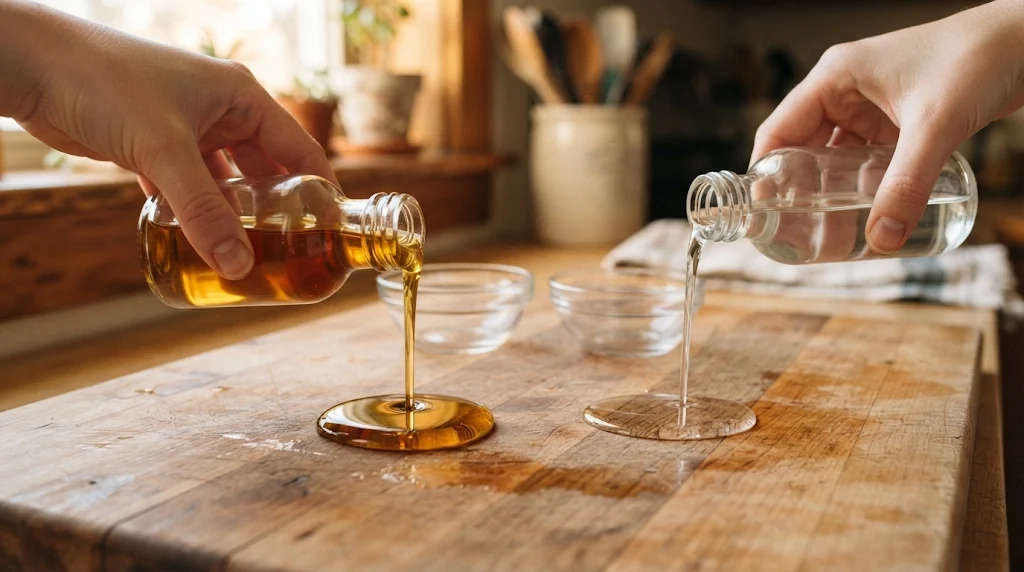
Food-grade mineral oil is the more practical choice for routine wooden cutting board care. It is odorless, non-rancid, and widely recommended for this specific purpose.
Here is how the two options compare.
| Feature | Castor Oil | Food-Grade Mineral Oil |
|---|---|---|
| Source | Castor plant seeds | Highly refined petroleum |
| Consistency | Unusually thick | Easy-spreading liquid |
| Rancidity | Oxidation possible; varies by conditions | Does not become rancid |
| Board-care guidance | Not routinely recommended | Widely recommended |
| Possible drawback | Thick surface residue | Excess must be wiped away |
| Overall recommendation | Avoid as a routine treatment | Preferred option |
When buying mineral oil, look for a product explicitly suitable for cutting boards or food-contact wooden items. Don’t assume every petroleum-based household lubricant is appropriate.
For reference, 21 CFR 172.878 specifies permitted uses and requirements for qualifying white mineral oil.
Can You Use Castor Oil on Maple, Walnut, or Bamboo Cutting Boards?
I would not choose ordinary castor oil as the routine finish for any of these materials. The safer approach is to follow the manufacturer’s specific care instructions.
Maple Cutting Boards
Maple is a common hardwood used for kitchen cutting boards. It responds to regular cleaning, proper drying, and suitable food-contact conditioning.
A dedicated mineral oil treatment is generally more appropriate than experimenting with thick castor oil.
Walnut Cutting Boards
Walnut boards often have an attractive dark grain. A suitable conditioner can enhance the grain’s appearance without requiring a heavy coating.
Apply only enough product to condition the wood, then wipe away excess.
Bamboo Cutting Boards
Bamboo boards may also benefit from manufacturer-approved conditioning. However, construction and adhesive systems vary between products.
Use the product instructions as your first reference, especially for laminated boards.
What Should You Do If You Already Used Castor Oil on a Cutting Board?
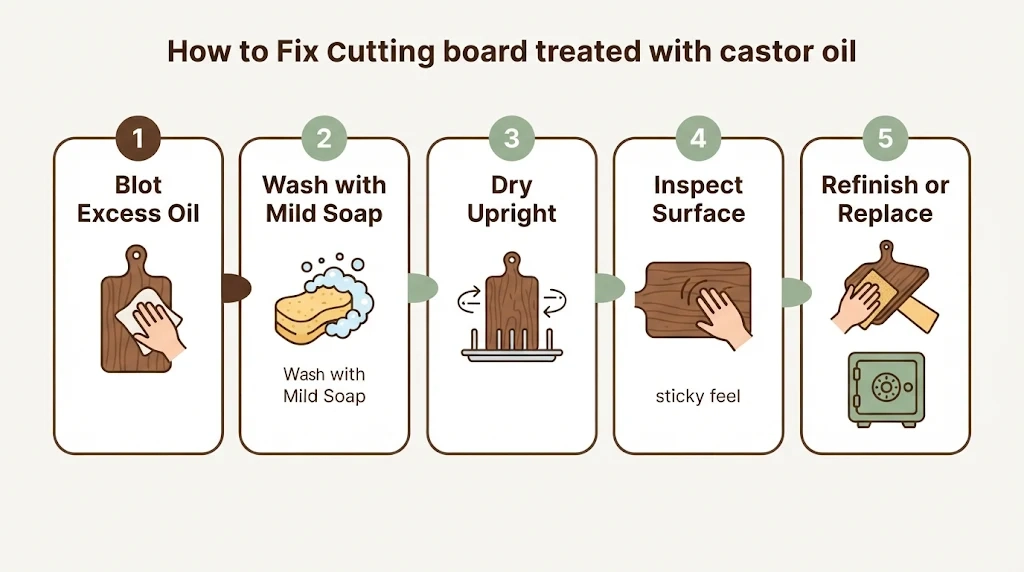
If you’ve already applied castor oil, don’t automatically assume the board is ruined. The next step depends on the oil’s formulation and how the surface feels.
First, check the bottle. If the product contains unknown additives or is not intended for food contact, stop using the board for food preparation until you can assess it properly.
Step 1: Remove Excess Oil
Use a clean, lint-free cloth or paper towel to absorb any remaining surface oil. Avoid spreading it across additional areas.
Pay attention to grooves, handles, edges, and corners.
Step 2: Wash the Surface
Wash the board with warm water and mild dish soap. Scrub gently with a suitable kitchen sponge or soft brush.
Rinse thoroughly without soaking the board.
Step 3: Allow Complete Drying
Dry both sides with a clean towel. Then place the board upright in a well-ventilated area.
Don’t apply another oil while the wood is damp.
Step 4: Check for Residue or Odor
Once dry, inspect the board with clean hands and a clean paper towel. The surface should not leave an oily smear or strong unwanted smell.
Watch for these warning signs:
- A persistent slippery or sticky feeling.
- Visible oily residue on a clean cloth.
- An unusual or unpleasant odor.
- Softened, damaged, or separating joints.
- Unknown chemical additives in the original product.
If odor is the main concern, read this guide to removing odors from a cutting board.
Step 5: Decide Whether Refinishing Is Necessary
If repeated normal cleaning doesn’t remove residue, don’t immediately coat the board with another oil. Adding more oil can make an already greasy surface harder to manage.
Some unfinished solid-wood boards may be candidates for careful refinishing. Laminated, coated, or heavily contaminated boards require more caution.
For surface restoration considerations, review how to refinish a cutting board before sanding.
Never use paint thinner, furniture stripper, or other unsuitable solvents on a food-contact board. If contamination cannot be removed confidently, replacing the board may be the better decision.
What Is the Best Way to Oil a Wooden Cutting Board?
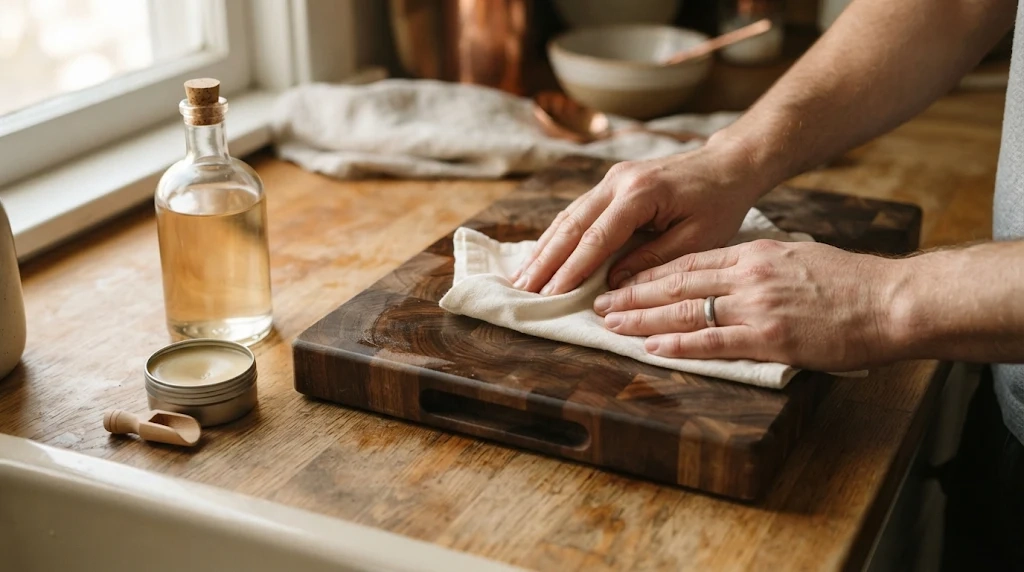
The simplest method is to clean the board, dry it fully, apply an approved conditioning oil, and remove the excess. You don’t need complicated equipment.
For an ordinary unfinished wooden board, I recommend the following routine.
Gather Your Supplies
- Food-grade mineral oil labeled for cutting boards.
- Mild dish soap and clean water.
- A soft sponge or appropriate cleaning brush.
- Two clean, lint-free cloths or paper towels.
- Optional food-contact-suitable board conditioner containing beeswax.
Step-by-Step Oiling Instructions
- Clean the board: Remove food residue and wash with warm, soapy water.
- Rinse thoroughly: Make sure no detergent remains.
- Dry completely: Allow airflow around both faces before conditioning.
- Add mineral oil: Apply a modest quantity to the wood surface.
- Spread evenly: Include the underside, edges, and any accessible grooves.
- Allow absorption: Follow the product instructions, which may recommend several hours or overnight.
- Buff thoroughly: Wipe away remaining oil until the surface feels clean.
- Inspect before use: Return the board to food preparation only after it is ready and free from excess residue.
For a large board, apply oil in small sections rather than pouring a large puddle onto one area. This gives you more control over the quantity.
A food-safe board wax may be useful after oiling if the manufacturer recommends it.
How Often Should You Oil a Wooden Cutting Board?
Approximately once a month is a useful starting point for many unfinished wooden cutting boards. The actual interval depends on usage, cleaning frequency, wood type, and environmental conditions.
A board that sees daily use may need attention more frequently than a serving board used occasionally.
Signs Your Board May Need Conditioning
- Dry appearance: The wood looks unusually pale or dull.
- Rough texture: The surface feels less smooth than usual.
- Quick water absorption: Small amounts of water soak into the wood rapidly.
- Frequent washing: Daily cleaning has reduced the previous conditioning layer.
None of these signs means you should apply excessive oil. A controlled treatment is preferable to repeated heavy applications.
For boards affected by uneven moisture exposure, see how to prevent a cutting board from warping.
Common Mistakes to Avoid When Oiling Cutting Boards
Using the correct oil is important, but application and storage habits matter just as much.
These mistakes can reduce the effectiveness of an otherwise suitable conditioning product.
- Using cosmetic oils: Don’t assume skin-care products are approved for food-preparation surfaces.
- Applying excessive oil: Heavy layers can leave unwanted residue.
- Oiling wet wood: Allow the board to dry before applying conditioner.
- Ignoring the underside: Follow instructions for treating all exposed wooden surfaces.
- Using ordinary cooking oils: Some can oxidize, smell unpleasant, or leave sticky deposits.
- Skipping cleaning: Conditioning never replaces washing or appropriate sanitizing.
- Soaking the board: Prolonged water exposure can contribute to cracking or warping.
- Ignoring serious damage: Deep cracks and grooves may make effective cleaning difficult.
The USDA Food Safety and Inspection Service advises washing boards between food-preparation tasks and using separate surfaces for raw animal products and fresh produce when possible.
A conditioned board is not automatically a sanitized board. Always keep those two maintenance jobs separate.
Recommended Cutting Board Oils and Conditioners
If you’re replacing castor oil with a product designed for cutting boards, I would start with a dedicated mineral oil or wood conditioner. These three established products serve different maintenance needs.
Affiliate disclosure: Some product links below are Amazon affiliate search links. Qualifying purchases may earn a commission at no additional cost to you. The product suitability assessments below are editorial judgments, not hands-on test results or verified customer review ratings.
🏆 Best Simple Oil
Howard Cutting Board Oil
★★★★☆ Editorial suitability
Howard Cutting Board Oil is made with pure USP food-grade mineral oil. Its odorless, straightforward formulation makes it my preferred type of product for routine wooden board conditioning.
🪵 Best for Butcher Blocks
John Boos Mystery Oil
★★★★☆ Editorial suitability
John Boos recommends Mystery Oil for its wooden cutting boards and butcher blocks. I consider it a sensible option when maintaining a Boos board according to the manufacturer’s care routine.
🐝 Best Wax-Blend Conditioner
Howard Butcher Block Conditioner
★★★★☆ Editorial suitability
This conditioner combines food-grade mineral oil with beeswax and carnauba wax. I would consider it when a board needs a wax-based finishing treatment after appropriate oiling.
Frequently Asked Questions
Can you use food-grade castor oil on a cutting board?
Food-grade castor oil may meet purity requirements for certain food-related applications, but that doesn’t automatically make it a recommended cutting board finish. Its thick consistency can create maintenance problems, especially when applied heavily. Food-grade mineral oil specifically intended for wooden cutting boards is generally a more dependable option.
Will castor oil make a cutting board sticky?
Castor oil can leave a noticeable oily or tacky residue, particularly when too much is applied. However, stickiness isn’t inevitable in every situation. The result depends on the formulation, amount used, and surface conditions. Avoid adding more oil to a board that already feels greasy.
Can castor oil go rancid on wood?
Castor oil can undergo chemical changes during storage and exposure, although its oxidation behavior differs from many common vegetable oils. It isn’t accurate to assume that all castor oil rapidly becomes rancid. Mineral oil remains the simpler standard because it does not develop vegetable-oil rancidity.
What happens if I accidentally apply castor oil to a cutting board?
First, identify the original product and remove excess oil with a clean cloth. Wash the board using warm water and mild dish soap, then dry thoroughly. If persistent residue, odor, or questionable ingredients remain, avoid using the board for food until its suitability can be established.
Is mineral oil or castor oil better for wooden cutting boards?
Food-grade mineral oil is generally better for routine wooden cutting board conditioning. It is widely recommended, easy to apply, odorless, and resistant to rancidity. Ordinary castor oil is thicker and lacks the same established cutting board maintenance guidance. Always check the board manufacturer’s instructions before applying any finish.
Final Verdict: Should You Put Castor Oil on a Cutting Board?
My recommendation is simple: skip ordinary castor oil and choose food-grade mineral oil for regular wooden cutting board maintenance.
Castor oil isn’t automatically a toxic substance when properly manufactured for an approved use. However, that doesn’t make every castor oil product suitable for food-contact wood.
The best routine is easy to maintain:
- Wash your cutting board after every use.
- Allow the wood to dry thoroughly.
- Apply an approved food-contact conditioner when needed.
- Wipe away excess oil before preparing food.
- Inspect the board regularly for cracks, grooves, and damage.
As of 2026, food-grade mineral oil and suitable beeswax-based products remain practical choices for ordinary wooden cutting board maintenance.
Choose the right conditioner, follow the manufacturer’s instructions, and keep the board clean. Those habits matter more than experimenting with unusual household oils.

