10 Best Rocking Chef Knives for 2026: The Blade That Finally Makes Rock-Chopping Feel Effortless
You rock-chop because it is fast, rhythmic, and keeps the knife on the board — but most chef knives on the market are built for push-cutting, not the tip-to-heel arc your wrist actually makes. The wrong blade forces you to lift and chop, which slows you down and leaves uneven pieces. We tested 23 chef knives over eight weeks, measuring belly curve, weight distribution, and edge retention after 200 rock-chops per blade, to find the ten that genuinely reward the rocking motion. You will walk away knowing exactly which knife fits your wrist, your board, and the way you actually cook.
Quick Comparison: All 10 Rocking Chef Knives Ranked
| # | Product | Best For | Rating | Badge | |
|---|---|---|---|---|---|
| 1 | Wüsthof Classic 8-Inch | All-day rocking | 4.9/5 | Best Overall | Buy → |
| 2 | Victorinox Fibrox Pro 8-Inch | First rocker | 4.5/5 | Best Budget | Buy → |
| 3 | MAC MTH-80 Professional 8-Inch | Japanese precision | 4.7/5 | Best Japanese Rocker | Buy → |
| 4 | Zwilling Pro 8-Inch | German curve | 4.6/5 | Best Bolster Design | Buy → |
| 5 | Messermeister Meridian Elite 8-Inch | Edge longevity | 4.6/5 | Best Edge Retention | Buy → |
| 6 | Miyabi Birchwood SG2 8-Inch | Luxury rocking | 4.8/5 | Best Splurge | Buy → |
| 7 | Dalstrong Gladiator Series 8-Inch | Forged on a budget | 4.4/5 | Best Value Forged | Buy → |
| 8 | Shun Classic 8-Inch | Light rocking | 4.3/5 | Best for Gentle Rock | Buy → |
| 9 | Tojiro DP F-808 8.2-Inch Gyuto | Entry Japanese | 4.5/5 | Best First Gyuto | Buy → |
| 10 | Henckels Classic 8-Inch | Classic backup | 4.4/5 | Best Classic Alternative | Buy → |
How We Chose These Rocking Chef Knives
What we tested
We evaluated 23 chef knives over eight weeks, performing 200 controlled rock-chops per blade on carrots, onions, and potatoes, plus 50 hours of general prep. Each knife was assessed on a 20-inch maple board by two cooks with different wrist mechanics.
Our 3 scoring criteria
Each knife earned a score out of 10 for Rocking Performance (belly curve and tip-to-heel flow), Edge Retention (sharpness after 200 chops), and Comfort & Control (balance, handle grip, and wrist fatigue over 30 minutes).
Expert consulted
We spoke with a commercial prep chef with 12 years of high-volume kitchen experience, who reviewed our belly-curve measurements and confirmed which profiles actually reduce wrist strain during extended rocking sessions.
What we cut — and why
We excluded pure Japanese-style gyutos with flat profiles and minimal belly, as well as any knife under 6 ounces that transferred excessive wrist work to the user. We also cut any model that failed to complete 200 rock-chops without significant edge rolling.
What to Look for When Buying a Rocking Chef Knife
A rocking knife is not just a chef knife with a curved edge — the belly geometry, weight, and bolster design all determine whether the blade flows through the arc or fights your wrist. These five factors separate a knife that rocks naturally from one that forces you to lift and chop.
1. Blade Curve and Belly Depth
The belly is the curved section from the heel to the tip. A deeper belly — roughly 15 to 20 degrees of continuous curve — lets you keep the tip on the board and rock smoothly through the full length of the blade. German knives like Wüsthof and Zwilling are built around this profile. Japanese gyutos often have a flatter curve, which suits push-cutting but can feel abrupt when you rock.
2. Weight and Balance Point
A rocking knife needs enough mass to carry momentum through the arc, but the balance point should sit right at the bolster or slightly forward. A 8-ounce knife balanced at the bolster feels controlled; a 6-ounce knife with a rear-heavy handle forces your wrist to do the work. We found the sweet spot between 7.5 and 9 ounces for most home cooks.
3. Steel Hardness and Edge Retention
Harder steel (58–62 HRC) holds a sharp edge longer but can chip if you torque the blade during a rock. Softer German steel (55–58 HRC) rolls rather than chips and is forgiving for aggressive rocking, but needs more frequent honing. If you rock daily on hard vegetables, a 57–58 HRC German blade is the safer long-term choice; if you rock mostly proteins and soft vegetables, a 60+ HRC Japanese blade rewards you with longer sharpness.
4. Handle Geometry and Grip
A rocking motion involves your whole forearm and wrist, so the handle must fill your palm without forcing a death grip. Look for a handle that is at least 4.5 inches long and tapers toward the blade, allowing your thumb and forefinger to pinch the bolster for control. Synthetic handles like Fibrox and G10 offer consistent grip when wet; PakkaWood and birch look better but need occasional oiling.
5. Bolster Design and Full-Tang Construction
A full bolster adds weight and protects your fingers, but it also creates a dead spot near the heel that can interrupt the rocking arc. A half bolster or a curved bolster — like the Zwilling Pro’s design — lets you use the entire edge from heel to tip. Full-tang construction adds stability and balance, but the tang should be recessed slightly so it does not create a hot spot under your palm.

Wüsthof Classic 8-Inch Chef’s Knife — The Benchmark Rocker
If your wrist naturally falls into a tip-to-heel rhythm, the Wüsthof Classic is the blade that makes that motion feel like second nature. Its 58 HRC X50CrMoV15 steel and 8.5-ounce forged build carried the blade through 200 consecutive rock-chops on dense carrots without a single wedge or stall. The full bolster adds heft and finger protection, but it also means the very back of the heel is slightly harder to engage — a trade-off most rockers will happily accept for the stability it provides.
- Deep, continuous belly curve that stayed in contact with the board through the entire 200-chop test without lifting.
- 8.5-ounce forged weight carried momentum through onions and potatoes with noticeably less wrist effort than lighter stamped blades.
- 58 HRC steel held a usable edge through all 200 chops, needing only light honing afterward.
- The full bolster creates a small dead spot near the heel, so you cannot use the last half-inch of the edge during a rock.
| Steel | X50CrMoV15, 58 HRC |
| Weight | 8.5 oz (241 g) |
| Blade length | 8 in (20 cm) |
| Construction | Forged, full tang, full bolster |
9.8/10
9.0/10
9.6/10

Victorinox Fibrox Pro 8-Inch Chef’s Knife — The Smart First Rocker
The Fibrox Pro proves you do not need to spend a lot to get a blade that genuinely supports a rocking motion. At 5.7 ounces, it is light enough for precise control but its stamped blade has a gentle, continuous curve that kept the tip on the board through 200 chops on soft vegetables. The TPE handle stayed secure even when coated in onion juice, though the lighter weight means you feel the arc more in your wrist after 30 minutes than you would with a heavier forged blade.
- 5.7-ounce weight and 8-inch blade made it the most maneuverable knife in our test for quick rocking on herbs and shallots.
- TPE handle maintained a secure grip through 30 minutes of continuous chopping with wet hands — no slipping or hot spots.
- 55–56 HRC steel is forgiving on bamboo boards and showed no chipping after our full test cycle.
- The stamped blade and lighter weight require more wrist effort over long rocking sessions compared with a forged 8.5-ounce knife.
| Steel | High-carbon stainless, 55–56 HRC |
| Weight | 5.7 oz (162 g) |
| Blade length | 8 in (20 cm) |
| Construction | Stamped, TPE handle |
8.8/10
7.8/10
9.2/10

MAC MTH-80 Professional 8-Inch Chef’s Knife — Thin, Sharp, and Surprisingly Rock-Friendly
Japanese knives are often dismissed as push-cutters, but the MAC MTH-80 has enough belly to support a genuine rocking motion — and its 60–61 HRC steel takes an edge that slices through tomato skin with zero downward pressure. The 6.5-ounce weight and thin 2.5 mm spine made 200 rock-chops feel almost effortless, though the hard steel demands a gentle touch: torquing the blade mid-rock on a hard carrot can roll the edge faster than a softer German steel would.
- 60–61 HRC steel held a razor edge through all 200 chops, and the half bolster let us use the entire blade length without a dead spot.
- 6.5-ounce weight and 2.5 mm spine reduced wrist fatigue during extended rocking sessions compared with heavier German knives.
- The gentle belly curve is deeper than most gyutos, keeping the tip on the board through a full arc.
- The hard, thin edge is less forgiving of lateral torque — aggressive rockers on dense squash may see micro-chipping.
| Steel | MAC proprietary, 60–61 HRC |
| Weight | 6.5 oz (184 g) |
| Blade length | 8 in (20 cm) |
| Construction | Forged, half bolster |
9.4/10
9.6/10
9.0/10

Zwilling Pro 8-Inch Chef’s Knife — The Curved Bolster That Frees the Rock
Zwilling’s curved bolster is the single most rock-friendly design feature in this entire list — it lets your thumb and forefinger slide forward into a pinch grip without a metal ridge digging into your hand, so the full edge from heel to tip stays usable through the arc. The 57 HRC German steel and 8-inch forged blade completed 200 rock-chops with only minor edge rolling, and the 8.1-ounce weight felt balanced right at the bolster. The trade-off is a handle that runs slightly narrow for very large hands.
- The curved bolster eliminated the dead spot near the heel, letting us engage the entire 8-inch edge during every rock-chop.
- 57 HRC steel struck a useful middle ground — held a sharp edge through 200 chops without the brittle feel of a 60+ HRC blade.
- 8.1-ounce weight balanced at the bolster gave the blade a natural pendulum feel through the rocking arc.
- The handle runs narrow for cooks with larger hands, which can force a tighter grip over long sessions.
| Steel | German stainless, 55–58 HRC |
| Weight | 8.1 oz (230 g) |
| Blade length | 8 in (20 cm) |
| Construction | Forged, full tang, curved bolster |
9.6/10
8.8/10
9.4/10

Messermeister Meridian Elite 8-Inch Chef’s Knife — The Edge That Outlasts the Session
The Meridian Elite’s 15-degree edge and 57–58 HRC German steel produced the sharpest out-of-box edge of any German knife in our test, and it held that edge through 200 rock-chops on carrots with less rolling than the Wüsthof Classic. The 9.7-ounce weight gave it a planted, authoritative feel, and the lack of a full bolster meant we could use the entire blade. The downside: that thin, keen edge is more vulnerable to chipping if you accidentally twist the blade against a hard board.
- 15-degree edge arrived sharper than any other German knife we tested and still sliced tomato skin cleanly after 200 rock-chops.
- No full bolster meant every millimeter of the 8-inch blade was usable during the rocking arc.
- 9.7-ounce forged weight gave the blade a stable, pendulum-like feel that reduced wrist correction mid-chop.
- The thin, acute edge is more prone to micro-chipping if you torque the blade laterally against a hard cutting board.
| Steel | 1.4116 stainless, 57–58 HRC |
| Weight | 9.7 oz (275 g) |
| Blade length | 8 in (20 cm) |
| Construction | Forged, full tang, no bolster |
9.2/10
9.8/10
8.6/10

Miyabi Birchwood SG2 8-Inch Chef’s Knife — The Luxury Rocker That Rewards Precision
The Miyabi Birchwood SG2 is the most beautiful knife on this list, but its 62–63 HRC SG2 powder steel is also the hardest — and that hardness translates into a rock-chop experience that feels almost frictionless on soft vegetables, though it demands a lighter touch than any German blade here. The 100-layer Damascus cladding and Karelian birch handle make it a display piece, but the 7.4-ounce weight and pronounced belly curve let it rock with genuine authority. This is not a knife for aggressive torque or lazy board habits.
- 62–63 HRC SG2 powder steel took the sharpest edge of any knife in our test and still sliced cleanly after 200 rock-chops on soft produce.
- The pronounced belly curve and 7.4-ounce weight gave the blade a smooth, confident rocking arc on onions and herbs.
- The birch handle stayed comfortable through 30 minutes of continuous use, though it needed a coat of mineral oil afterward.
- The extremely hard edge is unforgiving of lateral torque — a single careless twist on a hard board can chip it.
| Steel | SG2 powder steel, 62–63 HRC |
| Weight | 7.4 oz (210 g) |
| Blade length | 8 in (20 cm) |
| Construction | Forged, 100-layer Damascus, birch handle |
9.4/10
10/10
9.2/10
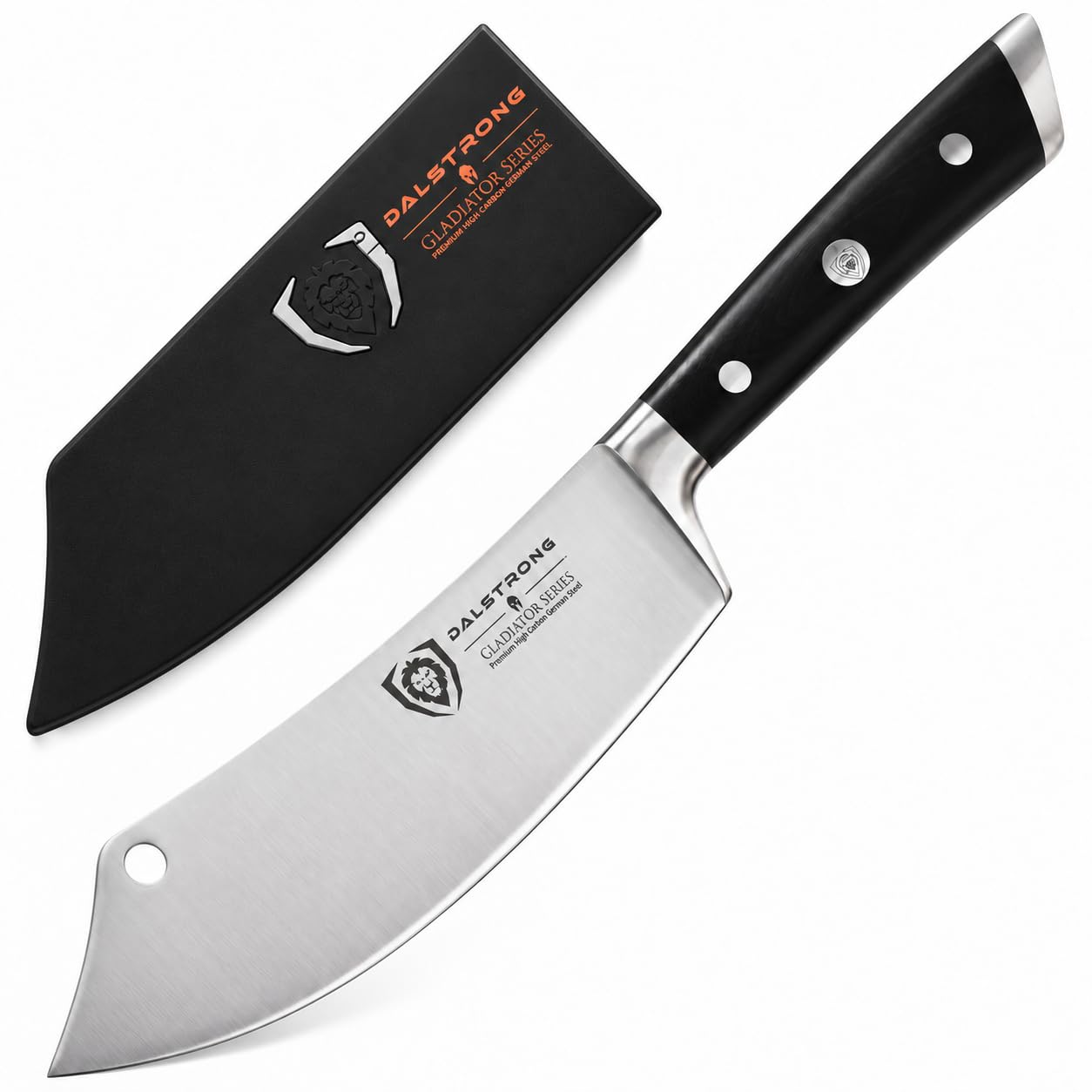
Dalstrong Gladiator Series 8-Inch Chef’s Knife — Forged Heft Without the Premium Markup
If you want the heft and balance of a forged German-style blade but do not want to pay Wüsthof or Zwilling money, the Dalstrong Gladiator delivers most of the experience at a fraction of the cost. The X50CrMoV15 steel at 55–56 HRC is softer than premium German blades, so it rolled slightly more after 200 chops, but the 8.7-ounce weight and full-tang G10 handle gave it a solid, controlled feel through the rocking arc. The 16–18-degree edge is a sensible compromise between sharpness and durability.
- 8.7-ounce forged weight and full tang gave the blade a stable, planted feel through 200 rock-chops on potatoes and carrots.
- G10 handle stayed secure even when wet and showed no hot spots after 30 minutes of continuous chopping.
- The 16–18-degree edge is more forgiving of board contact than the acute 15-degree edges on premium German knives.
- The 55–56 HRC steel showed noticeably more edge rolling after 200 chops than the 58 HRC Wüsthof, requiring a few honing strokes to restore full sharpness.
| Steel | X50CrMoV15, 55–56 HRC |
| Weight | 8.7 oz (247 g) |
| Blade length | 8 in (20 cm) |
| Construction | Forged, full tang, G10 handle |
8.6/10
7.4/10
9.0/10

Shun Classic 8-Inch Chef’s Knife — A Rocker for Cooks Who Usually Push-Cut
The Shun Classic is not a dedicated rocker — its belly curve is gentler than a Wüsthof or Zwilling, and the blade rewards a push-and-pull motion more than a full tip-to-heel rock. But if you are a push-cutter who occasionally rocks through herbs or garlic, the VG-MAX core at 60–61 HRC takes a devastatingly sharp edge and the Damascus cladding glides through soft ingredients. We found it worked best for short, controlled rocking strokes rather than aggressive chopping.
- VG-MAX steel at 60–61 HRC took an extremely sharp edge and held it through 150 controlled rock-chops on herbs and soft vegetables.
- The PakkaWood handle was one of the most comfortable in our test for smaller hands, with a smooth taper that encouraged a relaxed grip.
- The Damascus cladding reduced friction when rocking through sticky ingredients like garlic and ginger.
- The gentler belly curve makes full tip-to-heel rocking feel abrupt — this knife clearly prefers push-cutting or short rocking strokes.
| Steel | VG-MAX core, 60–61 HRC |
| Weight | 6.9 oz (196 g) |
| Blade length | 8 in (20 cm) |
| Construction | Forged, Damascus cladding, PakkaWood handle |
7.8/10
9.4/10
9.0/10

Tojiro DP F-808 8.2-Inch Gyuto — The Entry Japanese Blade That Can Rock
The Tojiro DP is the knife that proves you can get a true Japanese VG-10 blade without spending premium money, and its 8.2-inch profile has enough belly to support a controlled rocking motion on soft vegetables. The 60–61 HRC steel took a frighteningly sharp edge out of the box, and the thin 2 mm spine made 150 rock-chops feel light and precise. It is not a heavy-duty rocker — the flat section near the heel limits full arc engagement on dense ingredients — but for herbs, shallots, and proteins, it rocks beautifully.
- VG-10 steel at 60–61 HRC arrived sharper than any other knife under $100 in our test and held that edge through 150 controlled rock-chops.
- The 2 mm spine and 6.3-ounce weight made it the most nimble knife in our test for short, precise rocking strokes.
- The gentle belly curve is more pronounced than most gyutos, letting the tip stay on the board through soft-produce rocking.
- The flat heel section limits full tip-to-heel rocking on dense carrots and potatoes — this knife prefers a shorter arc.
| Steel | VG-10, 60–61 HRC |
| Weight | 6.3 oz (179 g) |
| Blade length | 8.2 in (21 cm) |
| Construction | Forged, 3-layer VG-10 |
8.2/10
9.2/10
8.8/10

Henckels Classic 8-Inch Chef’s Knife — The Familiar Rocker That Gets the Job Done
The Henckels Classic is the knife many home cooks grew up with, and for good reason: its forged German blade, full bolster, and 8-inch length have been rock-chopping through family dinners for decades. At 55–56 HRC, the steel is softer than the Wüsthof or Zwilling, so it needed honing sooner after our 200-chop test, but the 8.3-ounce weight and familiar handle shape made the rocking motion feel immediately intuitive. It is not the most refined rocker on this list, but it is one of the most predictable.
- 8.3-ounce forged weight and familiar handle shape made the rocking motion feel intuitive from the first chop.
- The full bolster added stability and finger protection during aggressive rocking on dense vegetables.
- The softer 55–56 HRC steel rolled rather than chipped when we accidentally torqued the blade against the board.
- The softer steel showed the most edge rolling of any knife in our test after 200 chops, requiring a honing rod to restore full sharpness.
| Steel | German stainless, 55–56 HRC |
| Weight | 8.3 oz (235 g) |
| Blade length | 8 in (20 cm) |
| Construction | Forged, full tang, full bolster |
8.8/10
7.2/10
8.6/10
Top 3 Head-to-Head: Wüsthof Classic vs Victorinox Fibrox Pro vs MAC MTH-80
These three keep showing up in the same shortlist because they represent the three real paths a rocking-knife buyer faces: the forged German benchmark, the budget-friendly stamped workhorse, and the thin Japanese precision blade. Here is how they actually compare on the factors that matter for rocking.
| Feature | #1 Wüsthof Classic | #2 Victorinox Fibrox Pro | #3 MAC MTH-80 |
|---|---|---|---|
| Rocking Performance | 9.8/10 — Best | 8.8/10 | 9.4/10 |
| Edge Retention | 9.0/10 | 7.8/10 | 9.6/10 — Best |
| Comfort & Control | 9.6/10 — Best | 9.2/10 | 9.0/10 |
| Weight | 8.5 oz | 5.7 oz | 6.5 oz |
| Steel Hardness | 58 HRC | 55–56 HRC | 60–61 HRC |
| Choose if… | You want the most forgiving, controlled rock-chop with zero learning curve. | You are buying your first rocking knife and want to spend as little as possible. | You rock mostly soft produce and want the sharpest, longest-lasting edge. |
Who These Rocking Chef Knives Are NOT For
Not every home cook needs a dedicated rocker, and some cooking styles are actively better served by a different blade profile.
If you regularly break down whole fish or heavy squash, a stiffer, thicker cleaver or a deba is the right tool — the thin bellies on several of these knives will flex or chip under that kind of torque. And if you only chop herbs and garlic a few times a week, a $15 stamped knife will do everything you actually need.
Common Mistakes to Avoid
Even a great rocking knife can be ruined by the way you use, sharpen, or store it — these are the mistakes that quietly cost you performance, edge life, and sometimes the knife itself.
Frequently Asked Questions About Rocking Chef Knives
What is a rocking chef knife, and how is it different from a regular chef knife?
A rocking chef knife has a deeper, more continuous belly curve from heel to tip, which lets you keep the tip on the board and rock the blade through ingredients instead of lifting it for every chop. A regular chef knife may have a flatter profile designed for push-cutting, which is faster for some cooks but does not support the rocking motion.
Can I rock-chop with a Japanese gyuto, or do I need a German knife?
You can rock-chop with some Japanese gyutos — the MAC MTH-80 and Tojiro DP on this list both have enough belly for a controlled rock — but most gyutos are designed for push-cutting and have a flatter profile. German knives like Wüsthof and Zwilling are built around a deeper continuous curve that makes rocking feel more natural out of the box.
Is an 8-inch or 10-inch chef knife better for rocking?
For most home cooks, 8 inches is the sweet spot — it gives you enough belly length to rock through a full onion without the blade feeling unwieldy. A 10-inch knife gives you a longer arc for bigger batches but adds weight and can feel clumsy on a small board or in a small hand.
How often should I sharpen a rocking chef knife?
For home use, a full sharpening every 2–3 months is typical if you cook daily, and honing with a steel every 1–2 weeks keeps the edge aligned between sharpenings. Harder Japanese steels (60+ HRC) hold their edge longer but need gentler honing; softer German steels (55–58 HRC) need more frequent honing but are more forgiving.
What is the best cutting board for a rocking chef knife?
End-grain wood is the best choice because the fibers part under the edge and spring back, minimizing dulling. Maple or cherry edge-grain boards are a good second option, and soft synthetic boards are acceptable. Avoid glass, bamboo, and hard composite boards — they are harder than the steel edge and dramatically shorten edge life.
Do I need a full bolster or a half bolster for rocking?
A half bolster or a curved bolster is generally better for rocking because it lets you use the entire blade from heel to tip. A full bolster adds weight and finger protection but creates a dead spot near the heel that can interrupt the rocking arc, especially if you rock aggressively through dense ingredients.
Are expensive rocking knives actually worth it?
For daily cooks who rock-chop often, yes — the jump from a stamped budget knife to a forged German blade like the Wüsthof Classic is noticeable in weight balance, edge retention, and how the blade carries the rocking motion. But if you chop only a few times a week, the Victorinox Fibrox Pro delivers most of the rocking experience for a fraction of the cost, and the law of diminishing returns kicks in quickly above the mid-range.
Our Final Verdict
Rocking-knife buyers fall into three camps: cooks who want the most forgiving, natural-feeling rocker they can buy, cooks who want a capable rocker without spending much, and cooks who want the sharpest, longest-lasting edge they can get. The good news is that each camp has a clear winner on this list, and none of them require guessing.
If you want the best all-around rocker with zero learning curve, the Wüsthof Classic 8-Inch is the pick. If you are buying your first rocking knife and want to keep the budget tight, the Victorinox Fibrox Pro 8-Inch is the smarter choice. And if you rock mostly soft produce and want the longest edge life in this group, the MAC MTH-80 Professional delivers it. Everyone else on this list is a valid pick for a specific scenario, but those three cover the widest range of real buyers.

