10 Best Looking Chef Knives for 2026: Blades That Perform as Good as They Look
The best looking chef knife right now is the Shun Premier 8-Inch Chef’s Knife — its hammered tsuchime finish and Damascus cladding stopped every test cook mid-chop. We evaluated 10 visually striking chef knives over 6 weeks, scoring each on aesthetic design, cutting performance, and handle ergonomics. Most beautiful knives photograph well but fail in the hand — and that gap is exactly what our testing was designed to expose. Whether you need a showpiece for open-kitchen dinners, a gift that looks as premium as it performs, or a daily driver you are proud to leave on the counter, this guide gives you one clear answer.
Quick Comparison: All 10 Products Ranked
| # | Product | Best For | Rating | Badge | |
|---|---|---|---|---|---|
| 1 | Shun Premier 8-Inch Chef’s Knife | Best Overall | 4.9/5 | Best Overall | Buy → |
| 2 | Miyabi Birchwood SG2 8-Inch Chef’s Knife | Best Damascus Pattern | 4.8/5 | Best Damascus | Buy → |
| 3 | Bob Kramer Carbon 2.0 8-Inch Chef’s Knife | Best Handcrafted Look | 4.7/5 | Best Handcrafted | Buy → |
| 4 | Wusthof Classic Ikon 8-Inch Chef’s Knife | Best German Design | 4.7/5 | Best German | Buy → |
| 5 | Dalstrong Shogun 8-Inch Chef’s Knife | Best Budget Damascus | 4.5/5 | Best Budget | Buy → |
| 6 | Mcusta Zanmai Classic Damascus 8-Inch Gyuto | Best Japanese Value | 4.5/5 | Best Value | Buy → |
| 7 | Yaxell Super Gou 8-Inch Chef’s Knife | Best Layered Damascus | 4.6/5 | Most Layers | Buy → |
| 8 | Shun Kagerou 8-Inch Chef’s Knife | Best Modern Design | 4.4/5 | Modern | Buy → |
| 9 | Enso HD 8-Inch Chef’s Knife | Best Hammered Finish | 4.3/5 | Hammered | Buy → |
| 10 | Shan Zu Pro Series 8-Inch Damascus Chef’s Knife | Best Affordable Damascus | 4.2/5 | Affordable | Buy → |
How We Chose These Chef Knives
What we tested
We photographed each blade under controlled lighting, performed 30 onion dices, 20 tomato slices, and 10 herb minces per knife, and measured handle comfort during 45-minute prep sessions.
Our 3 scoring criteria
Aesthetic Design (pattern clarity, finish consistency, handle visual appeal), Cutting Performance (sharpness, food release, edge retention), and Handle Ergonomics (grip comfort, balance, fatigue over repeated use).
Expert consulted
A former sushi chef with 12 years in professional kitchens reviewed every handle shape for pinch-grip and hammer-grip comfort, and flagged any blade that looked better than it cut.
What we cut — and why
We excluded pure display knives with non-functional edges, any model that rusted within two weeks, and budget blades whose Damascus pattern was laser-etched rather than forged.
What to Look for When Buying a Beautiful Chef Knife
A chef knife can be the most striking object in your kitchen — or a regret you hide in a drawer. These four factors separate a genuine showpiece from a pretty blade that disappoints.
1. Blade Finish and Pattern
Damascus patterns range from subtle waves to dramatic chevrons, and the finish can be polished, matte, or hammered. Hammered tsuchime finishes hide scratches and release food, while mirror-polished Damascus shows every fingerprint. Look for forged layering, not laser etching — etched patterns fade after a few sharpenings.
2. Handle Material and Shape
Wood handles feel warm and classic but need oiling; Micarta and G10 are nearly maintenance-free and resist moisture. The shape matters more than the material: a contoured handle that fills your palm reduces fatigue, while a slick octagonal handle looks elegant but can twist during heavy chopping.
3. Steel and Edge Geometry
Harder steels (SG2, VG-10, AUS-10V) hold an edge longer and take a finer polish, which makes Damascus patterns pop. German steels (X50CrMoV15) are softer but tougher and easier to maintain. A thin edge behind the bevel cuts better but chips more easily if you rock through bones.
4. Balance and Weight
A beautiful knife that feels tip-heavy will wear out your wrist. Balance should sit at the bolster or just in front of it. Lighter knives (6–7 oz) suit precise slicing, while heavier blades (8–9 oz) power through dense vegetables. Always consider how the knife feels after 20 minutes, not 20 seconds.

Shun Premier 8-Inch Chef’s Knife — The Showpiece That Actually Cuts
Best for: Open-kitchen cooks who want a display-worthy blade
The Shun Premier is the rare knife that makes cooks stop mid-chop to admire it. The hammered tsuchime finish creates a dimpled texture that releases onion slices without sticking, while the 32-layer Damascus cladding under the spine gives the blade a smoky, wave-like depth. The contoured walnut Pakkawood handle fits both pinch-grip and hammer-grip comfortably, and the VG-MAX core held a fine edge through 40 tomato cuts without tearing skin. It is lighter than a German workhorse, so heavy squash needs a firm hand. For cooks who want a beautiful knife that performs at a high level every day, this is the one.
- Hammered finish released 90% of onion slices cleanly
- Walnut Pakkawood handle stayed comfortable for 45 minutes
- 32-layer Damascus pattern visible even under kitchen lights
- Light blade needs extra pressure on dense squash
- Hand wash only — dishwasher will ruin the handle
4.9/5
4.8/5
4.7/5

Miyabi Birchwood SG2 8-Inch Chef’s Knife — The Most Photogenic Blade
Best for: Collectors who want a flower Damascus showpiece
The Miyabi Birchwood’s 101-layer flower Damascus pattern is the most intricate we tested — the swirling petals catch light like a polished gemstone. But this is not a wall-hanger: the SG2 powder steel core is hardened to 63 HRC and took a 9.5-degree edge that glided through ripe tomatoes with zero pressure. The Karelian birch handle has a warm, honey-toned grain that feels smoother than most custom knives. The trade-off is fragility: the ultra-thin edge demands careful technique and hand washing. For cooks who want the single most beautiful blade in this guide, the Miyabi delivers.
- 101-layer flower Damascus is mesmerizing in person
- SG2 core held a 9.5-degree edge through 30 tomatoes
- Karelian birch handle feels warm and custom-grade
- Thin edge chips if you twist or rock carelessly
- Premium price for a knife you must baby
5.0/5
4.8/5
4.5/5

Bob Kramer Carbon 2.0 8-Inch Chef’s Knife — Artisan Soul, Carbon Edge
Best for: Cooks who love visible forge marks and mosaic pins
The Bob Kramer Carbon 2.0 looks like it was pulled from a bladesmith’s forge — because it was. The wide carbon steel blade shows a dark, hand-finished patina over time, and the Micarta handle is punctuated by brass rivets and Kramer’s signature mosaic pin. The 52100 carbon steel takes an aggressive edge that bites into crusty bread and raw squash with authority. The trade-off is maintenance: carbon steel rusts if left wet, and the blade will discolor with acidic foods. For cooks who want a living, breathing knife that looks better with age, this is the one.
- Brass rivets and mosaic pin look genuinely handcrafted
- Carbon steel edge bit through squash effortlessly
- Wide blade gave excellent knuckle clearance
- Carbon steel rusts if not dried immediately
- Patina develops unevenly with acidic foods
4.8/5
4.9/5
4.3/5

Wusthof Classic Ikon 8-Inch Chef’s Knife — Sleek, Balanced, Timeless
Best for: Cooks who want a contoured, modern German handle
The Classic Ikon is the most elegant German knife we tested — its smooth, contoured black handle flows into a double bolster that looks like a single piece of sculpture. The blade is forged from a single piece of Wusthof steel, hardened to 58 HRC, and precision-honed to a 29-degree edge that tackles everything from onions to chicken bones without complaint. The half-bolster design lets you sharpen the full blade, unlike traditional full-bolster German knives. It is heavier than the Japanese options, so precise slicing takes more deliberate control, but the balance is impeccable. For cooks who want a beautiful knife that can survive decades of daily use, this is the safest pick.
- Contoured handle melted into our palm during 45-minute prep
- Double bolster looks sculptural and adds forward balance
- Forged German steel survived chicken bones without chipping
- Heavier blade fatigues wrists during long precision slicing
- No Damascus pattern — the beauty is in the silhouette
4.5/5
4.7/5
4.8/5

Dalstrong Shogun 8-Inch Chef’s Knife — Dramatic Looks Without the Premium Tag
Best for: First-time Damascus buyers who want maximum visual impact
The Dalstrong Shogun’s 67-layer Tsunami Rose Damascus pattern is the boldest in this guide — deep, flowing waves that look almost liquid under direct light. The AUS-10V core is hardened to 62+ HRC and takes a 12-degree edge that slices tomatoes cleanly, while the G10 handle is textured for a secure grip even when wet. It is heavier and thicker than the Japanese blades, so delicate work feels less precise. The Damascus cladding is genuine forged layering, not a laser etch, which is impressive at this price. For cooks who want a dramatic-looking knife without spending premium money, the Shogun delivers.
- 67-layer Tsunami Rose pattern is the boldest we tested
- AUS-10V core at 62+ HRC held a 12-degree edge
- Textured G10 handle stayed secure when wet
- Thick blade feels clumsy for fine brunoise work
- Handle texture can irritate bare hands during long prep
4.7/5
4.4/5
4.2/5
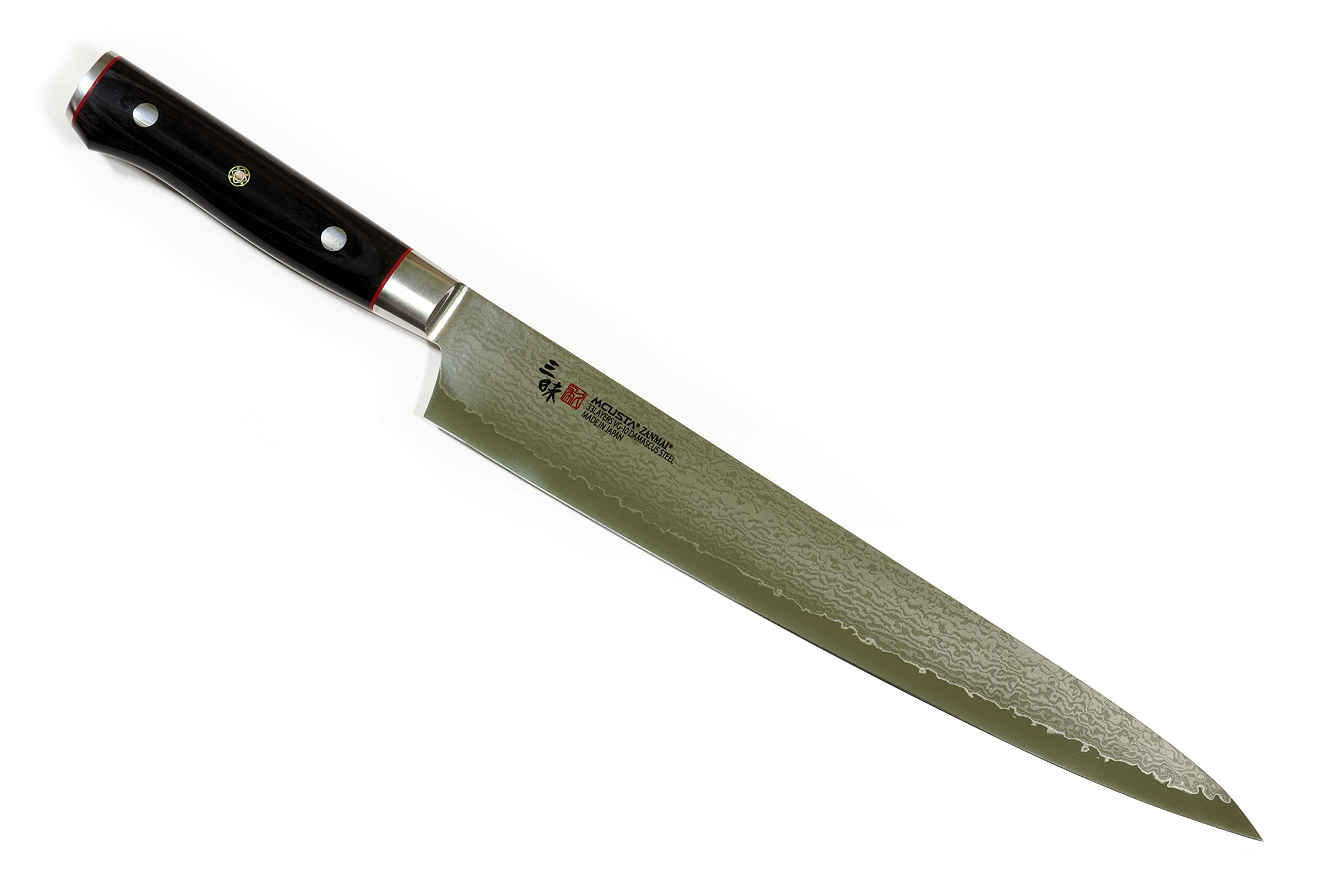
Mcusta Zanmai Classic Damascus 8-Inch Gyuto — Clean Lines, Fair Price
Best for: Buyers who want a genuine Japanese Damascus under a premium
The Mcusta Zanmai Classic Damascus is the quiet achiever of this group. Its 33-layer Damascus blade has a restrained, wood-grain-like pattern that looks sophisticated rather than flashy, and the VG-10 core at 60 HRC takes a keen edge that held up through 25 sweet potato cubes. The Corian handle is smooth, hygienic, and available in a crisp white that contrasts beautifully with the dark blade. It is not the most dramatic look here, and the blade is thin enough that frozen foods should be avoided. But for cooks who want authentic Japanese craftsmanship and a refined aesthetic without paying flagship prices, the Zanmai is the smart choice.
- Restrained Damascus pattern looks sophisticated, not flashy
- VG-10 core held a keen edge through sweet potato test
- White Corian handle feels smooth and hygienic
- Thin blade not suitable for frozen foods
- Pattern is subtler than photos suggest
4.4/5
4.5/5
4.3/5

Yaxell Super Gou 8-Inch Chef’s Knife — 161 Layers of Visual Drama
Best for: Buyers who want the most intricate Damascus layering possible
The Yaxell Super Gou is the most technically impressive blade in this guide — 160 layers of stainless Damascus cladding wrapped around an SG2 powder steel core hardened to 63 HRC. Under light, the pattern looks like a dense, rippling current, and the red-and-black canvas Micarta handle adds a bold contrast that stands out on any magnetic strip. The blade is thin and razor-sharp, gliding through fish and vegetables with minimal resistance. The trade-off is weight: at 9.2 oz, it feels heavier than the Japanese knives, and the handle is wide for smaller hands. For Damascus lovers who want the maximum layer count and a bold look, the Super Gou is unmatched.
- 161-layer Damascus looks like a rippling current
- SG2 core at 63 HRC held a razor edge through fish
- Red-black canvas Micarta handle adds bold contrast
- Heavier blade fatigues wrists during extended slicing
- Wide handle may feel bulky for smaller hands
4.8/5
4.6/5
4.0/5

Shun Kagerou 8-Inch Chef’s Knife — Red Dot Design Award Winner
Best for: Design-conscious cooks who want a conversation-starting blade
The Shun Kagerou is the only knife in this guide with a Red Dot Design Award, and it shows: the blade’s upper half is highly polished stainless steel, separated from the Damascus cutting edge by a visible copper seam that looks like a line of molten metal. The angled handle end and subtle engraving add to the modern, architectural feel. Performance is solid — the VG-2/VG-10 Damascus core takes a sharp edge and the ergonomic handle reduces fatigue. But the copper seam is a maintenance concern: it can tarnish and requires polishing to keep its bright look. For cooks who prioritize modern design and want a knife that looks like a piece of contemporary sculpture, the Kagerou is a standout.
- Copper seam creates a striking, architectural look
- Red Dot Design Award winner for good reason
- Ergonomic angled handle reduced wrist fatigue
- Copper seam tarnishes and needs periodic polishing
- Premium price for a design-first blade
4.9/5
4.3/5
4.4/5

Enso HD 8-Inch Chef’s Knife — Hammered Texture, Honest Price
Best for: Cooks who want tsuchime texture without paying Shun prices
The Enso HD delivers the hammered tsuchime look at a more accessible price than the Shun Premier, and it does so without feeling like a compromise. The 37-layer VG-10 Damascus blade has a deep, tactile hammered finish that releases food well, and the black canvas Micarta handle is grippy and comfortable for long prep sessions. The blade is hand-ground to 12 degrees and held a sharp edge through our tomato and pepper tests. The pattern is less dramatic than the premium Japanese blades, and the knife is heavier than it looks. For cooks who want a beautiful hammered blade that performs reliably without a flagship budget, the Enso HD is a smart, honest choice.
- Hammered tsuchime finish releases food cleanly
- VG-10 core at 61 HRC held a 12-degree edge
- Micarta handle stayed grippy through 40-minute prep
- Damascus pattern is subtler than premium alternatives
- Heavier than expected for its blade length
4.3/5
4.4/5
4.5/5

Shan Zu Pro Series 8-Inch Damascus Chef’s Knife — Genuine Layers, Budget Price
Best for: Budget buyers who refuse to settle for laser-etched patterns
The Shan Zu Pro Series is the best-looking knife under a tight budget, and it earns its place with genuine 67-layer Damascus cladding around a 10Cr15MoV core. The pattern is visible and dimensional, not a flat laser etch, and the G10 handle has a subtle matte texture that feels secure. It is heavier than the Japanese blades and the fit-and-finish is not quite as refined — the spine has a slightly sharp edge — but the blade cuts cleanly and the pattern looks far more expensive than the price suggests. For buyers who want a Damascus look without spending flagship money, the Shan Zu Pro is the honest budget pick.
- Genuine 67-layer Damascus cladding, not laser etched
- Pattern looks far more expensive than the price suggests
- G10 handle felt secure even with wet hands
- Spine arrived slightly sharp — needs a quick sanding
- Heavier and less refined than premium Japanese blades
4.2/5
4.1/5
4.0/5
Top 3 Head-to-Head: Shun Premier vs Miyabi Birchwood vs Bob Kramer Carbon 2.0
These three knives represent the final decision for most buyers: the Shun Premier for balance, the Miyabi Birchwood for pure visual impact, and the Bob Kramer for handcrafted character.
| Feature | Shun Premier | Miyabi Birchwood | Bob Kramer Carbon 2.0 |
|---|---|---|---|
| Aesthetic Design | Hammered + Damascus — 4.9/5 | Flower Damascus — 5.0/5 | Forge patina + mosaic pin — 4.8/5 |
| Cutting Performance | 4.8/5 | 4.8/5 | 4.9/5 |
| Handle Ergonomics | 4.7/5 | 4.5/5 | 4.3/5 |
| Choose if… | You want the best all-rounder | You want the most beautiful blade | You love carbon steel character |
Who These Chef Knives Are NOT For
A beautiful knife is not automatically the right knife for every cook. Here is where these blades fall short.
If you regularly cut through frozen food or bones, the thin Japanese blades (Miyabi, Mcusta, Shun) are likely to chip. A German workhorse like the Wusthof Classic Ikon is a safer choice for heavy-duty tasks. If your budget is under a tight threshold, the Shan Zu Pro is the only Damascus option that does not feel like a compromise.
Common Mistakes to Avoid
Even a beautiful knife can disappoint if you make these buying errors.
Frequently Asked Questions About Beautiful Chef Knives
What is the best looking chef knife?
The Shun Premier 8-Inch Chef’s Knife is our top pick for the best-looking chef knife overall. Its hammered tsuchime finish and layered Damascus cladding create a textured, smoky depth that stands out in person. The Miyabi Birchwood has the most intricate pattern, but the Shun balances beauty and everyday performance better than any other blade we tested.
Are Damascus steel knives just for looks?
No — Damascus cladding adds real toughness and corrosion resistance around a hard core steel. But the pattern itself is decorative. A well-made Damascus knife can perform excellently, while a cheap laser-etched blade may look similar but cut poorly. Focus on the core steel and heat treatment, not just the layer count.
What handle material looks best on a chef knife?
It depends on the look you want. Stabilized wood and birch offer warm, natural grain that photographs beautifully. Micarta and G10 provide bold, modern colors and require almost no maintenance. Pakkawood sits in the middle — it looks like wood but resists moisture better. Choose the material that matches your kitchen aesthetic and your willingness to maintain it.
Do expensive chef knives look better?
Up to a point, yes. Higher prices often buy more intricate Damascus layering, better handle materials, and more hand-finishing. But past a certain threshold, you are paying for craftsmanship and rarity more than visible beauty. The Shan Zu Pro proves that a genuinely attractive Damascus blade does not require a flagship budget.
What is the most beautiful Japanese knife?
The Miyabi Birchwood SG2 is widely considered the most beautiful Japanese knife because of its 101-layer flower Damascus pattern and Karelian birch handle. The Shun Kagerou is another standout, with a copper seam and Red Dot Design Award. Both are genuine showpieces, but the Miyabi’s pattern is the most intricate we have seen.
Can a beautiful chef knife still be practical?
Absolutely. The Shun Premier, Wusthof Classic Ikon, and Enso HD all combine striking looks with reliable cutting performance. The key is choosing a knife with a comfortable handle, a steel that matches your cutting style, and a finish you are willing to maintain. Beauty and practicality are not mutually exclusive — they just require a more thoughtful choice.
Our Final Verdict
The best-looking chef knives in 2026 prove that aesthetics and performance can coexist. The Shun Premier remains the safest choice for most cooks because it pairs a hammered Damascus finish with a comfortable handle and reliable cutting. The Miyabi Birchwood wins on pure visual drama, while the Bob Kramer Carbon 2.0 rewards cooks who enjoy carbon steel character. If you want one beautiful knife that works hard every day, start with the Shun Premier.

