How to Hold a Chef’s Knife: The Pro Pinch Grip Guide
Quick Answer
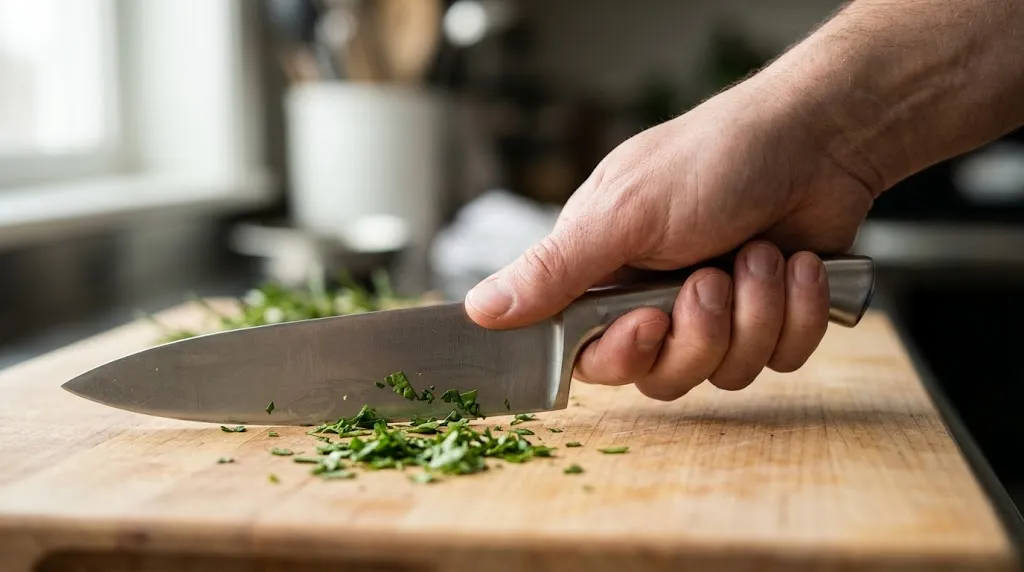
To hold a chef’s knife correctly and safely, use the “pinch grip”: place your thumb and index finger securely on the sides of the blade just ahead of the handle, while wrapping your remaining three fingers firmly around the handle. This provides maximum control, reduces hand fatigue, and prevents the knife from twisting in your hand.
Understanding the Foundation: Why Grip Matters
Mastering how to hold a chef’s knife is the single most important skill in kitchen preparation. A proper grip transforms a heavy, unpredictable tool into an extension of your hand, giving you precise control over every slice, chop, and mince.
Many home cooks instinctively grab a chef’s knife the same way they would hold a hammer—wrapping all fingers tightly around the wooden or composite handle. While this feels secure at first glance, it actually robs you of dexterity. A handle-only grip pushes your hand too far back, making the heavy blade feel unbalanced and increasing the likelihood of accidental slips.
Adopting a professional grip changes the fulcrum point of the knife, shifting the weight balance closer to your hand. This simple adjustment minimizes wrist strain during long prep sessions and drastically improves cutting accuracy.
How to Execute the Professional Pinch Grip
 Save
The pinch grip is the industry standard for professional chefs and culinary instructors. Executing it correctly takes only a few seconds, but it requires breaking old habits.
Step-by-Step Execution
- Position your index finger and thumb: Take your dominant hand and gently pinch the sides of the knife blade right where the metal meets the handle, just forward of the bolster (the thick junction where the blade transitions into the handle). Your thumb rests flat against one side of the blade, while the pad of your index finger rests flat against the opposite side.
- Wrap your remaining fingers: Curl your middle, ring, and pinky fingers naturally around the handle. They should provide a supportive cradle, but the actual steering and stabilization come from your pinched thumb and index finger.
- Lock your wrist and arm: Keep your wrist relatively firm and initiate your cutting movement from the elbow or shoulder for larger ingredients, relying on smooth rocking motions for fine mincing.
Key Insight
When using a proper pinch grip, your hand controls the blade itself rather than just the handle. This eliminates the “whip” effect common in long chef’s knives and ensures the edge goes precisely where you intend.
Common Knife Grip Variations and When to Use Them
While the pinch grip is ideal for 90% of kitchen cutting tasks, understanding alternative grips helps you handle specialized culinary situations safely.
- The Full Handle Grip: Wrapping all four fingers entirely around the handle. While discouraged for precision cutting, it is acceptable for heavy-duty tasks like breaking down large squash or cutting through tough root vegetables where maximum pulling force is required.
- The Point-Forward Grip: Extending the index finger along the spine of the blade. This variation is sometimes used for scoring bread dough or making delicate, shallow cuts, but it reduces lateral stability and is generally avoided during rapid vegetable chopping.
Pairing Your Knife Grip with the Guide Hand (The Claw)
A correct knife grip is only half of safe cutting technique. Your non-dominant hand—the guide hand—must protect your fingers while holding the food steady.
Form the “claw grip” by curling the fingertips of your guide hand inward toward your palm, resting your knuckles lightly against the flat side of the knife blade. Your thumb and pinky tuck safely behind your middle fingers. As you slice downward, the flat of the blade guides smoothly against your second knuckles, ensuring the knife can never connect with your fingertips.
Warning
Never flatten your fingers out on top of ingredients like garlic cloves or cherry tomatoes. Always keep your fingertips curled under in a claw shape to maintain a safe barrier between the sharp edge and your skin.
Common Mistakes When Learning a Chef’s Knife Grip
 Save
Transitioning from an improper hammer grip to a professional pinch grip can feel awkward at first. Recognizing common pitfalls helps you adjust faster.
- Holding too far back on the handle: Gripping the very tail end of the handle creates leverage against your wrist, making the knife feel heavier and harder to steer.
- Stiffening the wrist completely: While stability is necessary, a completely rigid wrist prevents smooth rocking motions, resulting in jagged cuts and torn ingredients.
- Failing to maintain contact with the board: Lifting the tip of the knife entirely off the cutting board during rocking chops reduces efficiency and increases fatigue.
Maintaining Your Knife and Workspace for Safe Cutting
Proper technique relies on a stable, well-maintained environment. Even the best grip cannot compensate for a dull blade or a sliding cutting board.
Always place a damp paper towel or non-slip mat underneath your cutting board to prevent it from shifting during prep work. Furthermore, keep your chef’s knife regularly honed with a steel and sharpened on whetstones. A sharp knife requires significantly less downward pressure, reducing the risk of slipping off hard vegetable skins.
Related Product
Kitchen Knife Sharpener & Maintenance Tools
Keeping your chef’s knife properly sharpened ensures clean cuts and reduces the force needed during meal preparation.
As an Amazon Associate, we earn from qualifying purchases.
Frequently Asked Questions
Is the pinch grip safe for beginners?
Yes. While it may feel unfamiliar during your first few attempts, the pinch grip actually offers significantly more control and stability than holding the handle alone, making accidental slips much less likely once muscle memory develops.
Should left-handed cooks use a different grip?
The mechanics of the pinch grip remain identical for left-handed and right-handed cooks. However, if your chef’s knife has a chisel grind (sharpened exclusively on one side for right-handed users), left-handed cooks may want to look for ambidextrous 50/50 balanced blades for cleaner cuts.
Why does my hand cramp when using a chef’s knife?
Hand cramps usually occur from gripping the handle too tightly. When you use the proper pinch grip, your thumb and index finger bear the steering weight while your other fingers relax, preventing muscle fatigue.
Can I use a pinch grip with a paring knife or Santoku?
The pinch grip works exceptionally well with Santoku knives and medium-to-large utility knives. For smaller paring knives, a modified grip with your index finger resting along the spine is often more comfortable due to the lighter weight of the blade.
How do I transition away from holding the handle like a hammer?
Start slowly by consciously placing your thumb and index finger onto the blade before every chopping session. With deliberate practice over a few days, the pinch grip will become second nature.
What should I do if my knife feels too heavy for a pinch grip?
If a knife feels excessively top-heavy, you may be pinching too far forward on the blade or using a knife that is poorly balanced. Adjust your fingers slightly closer to the bolster where the manufacturer intended the balance point to be.
Conclusion
Mastering the correct way to hold a chef’s knife is an essential step toward safer, more efficient kitchen preparation. By ditching the traditional hammer grip in favor of the professional pinch grip, you instantly gain superior control, reduce hand strain, and improve cutting precision. Pair this technique with a safe guide hand and a well-maintained, sharp blade to transform your daily cooking experience and build lasting kitchen confidence.

