Chef Knife Blade Width: Sizes, Measurements & Fit
Quick Answer
A chef knife’s blade height, often called blade width, commonly falls around 40–55 mm (1.6–2.2 inches) near the heel, although designs vary. For many home cooks, a height around 45–50 mm is a useful starting point. Choose based on knuckle clearance, grip, cutting style, and comfort rather than a single universal measurement.
When comparing chef knives, blade length usually gets the most attention. However, the distance from the cutting edge to the spine can make just as much difference to how a knife feels on a cutting board. This dimension affects finger clearance, the amount of blade surface available for moving chopped ingredients, and how the knife fits your natural cutting motion.
One important distinction: blade height is not the same as blade thickness. Height measures the blade from edge to spine, while thickness measures the steel from one side of the blade to the other. Understanding both measurements helps you compare knives accurately.
What Is the Standard Width of a Chef Knife Blade?
 Save
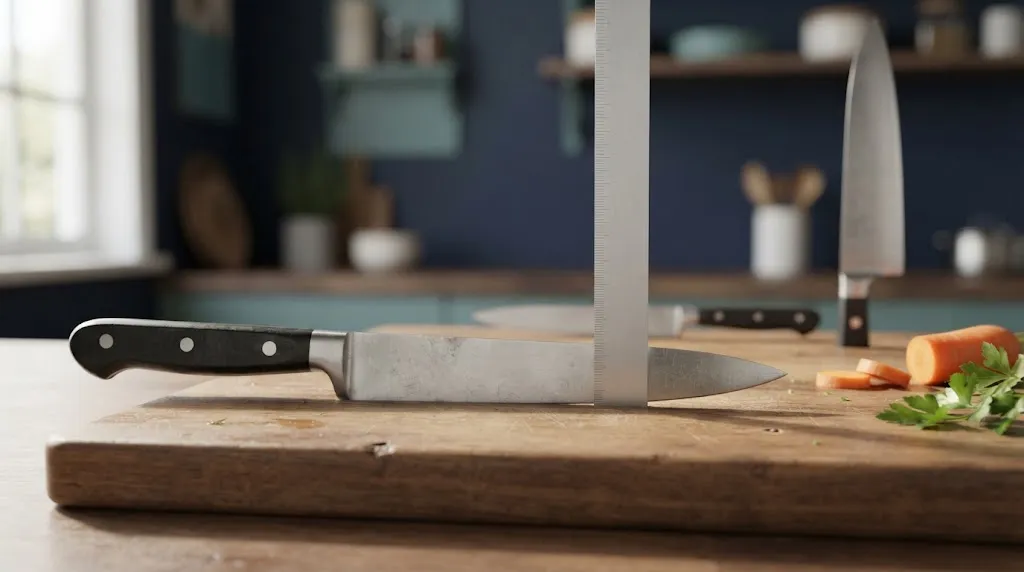
SaveMany conventional chef knives have a blade height of approximately 40–55 mm (1.6–2.2 inches) at the heel. This is a practical reference range, not an official standard that every manufacturer follows. Some compact or Japanese-style chef knives have a lower profile, while taller Western-style designs may provide more clearance.
In knife specifications, this dimension is often called blade height rather than width. The terminology can be confusing because width may also describe the blade’s side-to-side thickness or another overall dimension in a manufacturer’s product listing.
For example, the Victorinox Swiss Modern 20 cm chef knife is listed with a 55 mm width in its product dimensions. That illustrates how a manufacturer may describe a relatively tall blade, although specifications should always be checked for the exact model.
Use these approximate measurements as a starting point when comparing conventional chef knives:
- Below 40 mm: A relatively low-profile blade that may suit precise cutting, depending on its shape and your grip.
- 40–45 mm: A moderate height that can work well for compact handling and many everyday tasks.
- 45–50 mm: A useful middle ground for cooks seeking a balance of clearance and control.
- 50–55 mm: A taller profile that can provide more knuckle room and a larger surface for transferring chopped food.
- Above 55 mm: A particularly tall design that may offer generous clearance but can feel bulky to some users.
These categories describe geometry, not quality. A shorter blade is not automatically less capable, and a taller blade is not automatically more comfortable. Your grip, hand size, cutting technique, and the knife’s overall shape determine whether a particular height works for you.
How Do You Measure Chef Knife Blade Width?
To measure blade height accurately, measure the distance from the cutting edge to the top of the spine at the heel, where the blade is generally tallest. A ruler is sufficient for a practical home measurement, while calipers can help when comparing dimensions more precisely.
- Place the knife on a stable, flat surface. Keep the cutting edge pointed away from your hands and handle the blade carefully.
- Locate the heel. This is the rear portion of the blade nearest the handle, where the cutting edge begins.
- Measure perpendicular to the edge. Measure from the cutting edge to the spine, rather than diagonally along the blade.
- Record the result. Write down the measurement in millimeters or inches and use the same unit for other knives.
- Repeat if necessary. Check another point along the blade if you want to understand how its height changes toward the tip.
Take care not to confuse the spine’s thickness with its position above the cutting edge. The spine is the unsharpened back of the blade; its thickness is a separate measurement taken across the steel.
When comparing specifications online, check the manufacturer’s diagram or dimensions table to confirm what the word “width” means. A number listed as the knife’s overall width may not describe the vertical blade height at all.
Why Does Blade Height Matter When Chopping?
Blade height changes how much space your fingers have above the cutting board, how easily you can move chopped ingredients, and how substantial the blade feels during preparation. Its effect is practical rather than simply cosmetic.
Knuckle clearance and grip comfort
During a controlled chopping motion, your guiding hand holds the food while your knife hand moves the blade. A taller blade can give your knuckles more room above the board, particularly when you use a pinch grip and keep your fingertips curled away from the cutting edge.
If your knuckles touch the board before the blade completes its intended movement, the knife’s height or your grip may be a poor match. You might find that a slightly taller blade feels more natural. However, hand position, cutting technique, and the blade’s curve also affect clearance, so height alone does not explain every problem.
Moving chopped food
A taller blade provides more surface area for gathering chopped onions, carrots, herbs, and other ingredients. Many cooks use the broad side of the blade to transfer food from the cutting board to a bowl or pan. A lower-profile blade can still perform this task, but it offers less surface area.
If you use the knife to scoop ingredients, turn the blade sideways and use its broad side carefully. Avoid dragging the sharpened edge sideways across the board, because that motion can wear the edge prematurely.
Control and perceived bulk
A taller blade can feel substantial and stable, while a shorter blade may feel more compact and easier to maneuver. Neither sensation is universal: weight distribution, spine thickness, handle design, and the blade’s taper also affect how a knife behaves.
For detailed cuts in a small workspace, a tall blade may feel unnecessarily bulky. For repeated vegetable preparation, the extra clearance and broad surface may be welcome. The best choice is the one that supports a controlled motion without forcing your wrist or fingers into an awkward position.
Is a Wider Chef Knife Better Than a Narrower One?
Not necessarily. A taller blade can improve clearance and make transferring ingredients easier, while a narrower blade may feel more agile and take up less visual and physical space. The better option depends on your hand position, typical ingredients, and preferred cutting technique.
| Feature | Taller blade | Lower blade |
|---|---|---|
| Knuckle clearance | Usually more room | May provide less room |
| Moving chopped food | More blade surface | Less blade surface |
| Compact handling | Can feel bulkier | May feel more compact |
| Best fit | Cooks wanting extra clearance | Cooks preferring a lower profile |
The table describes common tendencies rather than guaranteed outcomes. Two knives with the same height can feel quite different because their handles, curves, weights, and grinds are not identical.
Blade height also does not tell you how easily a knife will cut through dense ingredients. That depends on other aspects of its geometry, including blade thickness, the grind, and how thick the steel is immediately behind the cutting edge.
How Should You Choose Blade Width for Your Hand and Kitchen?
Start with the way you actually cut, then check whether the blade provides enough clearance and feels comfortable. A measurement is useful, but the fit test matters more than choosing the largest number.
- If your knuckles touch the board: Compare taller blades and check your grip. Do not force your hand into an uncomfortable position simply to use a particular knife.
- If you have smaller hands: Consider a moderate-height blade that allows a relaxed grip and good visibility. A very tall blade is not automatically unsuitable, so try it if possible.
- If you prepare vegetables frequently: Look for enough clearance for your cutting motion and a broad blade surface if you regularly transfer chopped ingredients.
- If you work on a small board: Consider the knife’s total length as well as its height. A taller blade will not compensate for a knife that feels too long for your available workspace.
- If you prefer precise, compact movements: A lower-profile blade may suit you, provided your fingers remain clear of the board during normal cutting.
For a practical comparison, hold each candidate with your usual grip and simulate a gentle chopping movement above a stable board. Keep the blade controlled and your guiding fingertips curled away from the edge. Check whether your knuckles have room, your wrist stays comfortable, and you can see and control the cutting area.
Tip
When possible, compare two knives with similar blade lengths but different heights. Keeping length roughly constant makes it easier to notice how blade height changes knuckle clearance, visibility, and handling.
Does Blade Length Determine Blade Width?
No. Blade length and blade height are separate dimensions. Length describes how far the blade extends from heel to tip, while height describes the distance from the cutting edge to the spine at a particular point, usually the heel.
A 20 cm chef knife may have a taller or shorter blade than another 20 cm model. The difference comes from the manufacturer’s design rather than the length designation alone. A longer blade may also be relatively low-profile, while a shorter knife may have a tall, broad shape.
That is why two knives labeled as the same size can feel different. Check blade height, length, spine thickness, weight, handle shape, and overall balance when the specification is available. No single dimension tells the whole story.
Common Mistakes When Comparing Chef Knife Dimensions
 Save
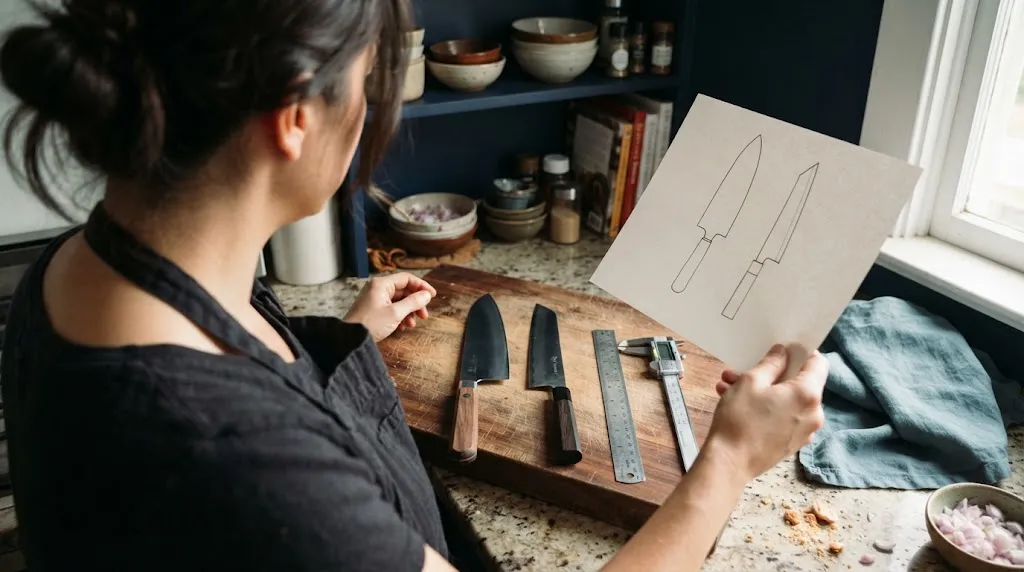
Save- Confusing height with thickness: Height runs from edge to spine; thickness runs across the blade’s steel.
- Assuming there is one standard: Typical dimensions vary by maker, model, and knife style.
- Choosing the tallest blade automatically: Extra clearance is useful only if the knife still feels controlled and comfortable.
- Ignoring blade shape: The curve and taper influence the way the knife contacts the board and moves through food.
- Judging comfort by numbers alone: Handle fit, grip, balance, and technique also matter.
These distinctions are particularly helpful when buying online, where product descriptions may emphasize blade length but give little attention to blade height. If the measurement is missing, consult the manufacturer’s specifications or request clarification rather than treating an overall-width figure as confirmed blade height.
Frequently Asked Questions
1. Is a 50 mm chef knife blade wide enough?
Yes. A blade height of 50 mm (about 2 inches) is a reasonable choice for many cooks, offering useful knuckle clearance and a broad surface for transferring ingredients. Comfort still depends on your hand, grip, and cutting style.
2. Is a 40 mm chef knife blade too narrow?
Not necessarily. A 40 mm blade can work well for cooks who prefer a lower-profile knife or compact handling. Check that your knuckles clear the board during your normal cutting motion.
3. What is the difference between blade width and blade thickness?
Blade width in this context means the height from the cutting edge to the spine. Blade thickness is the distance across the steel from one side to the other, often measured at the spine. They describe different aspects of knife geometry.
4. Does a taller blade make a chef knife safer?
A taller blade may provide more knuckle clearance, but height alone does not guarantee safety. A controlled grip, stable cutting board, sharp and well-maintained edge, and proper handling remain important.
5. Are Japanese chef knives usually narrower than Western chef knives?
Some Japanese-style chef knives have a lower profile than many Western-style models, but this is not universal. Blade height varies by individual design, so compare the published dimensions rather than relying on the knife’s country or style alone.
6. Can I measure blade height with a regular ruler?
Yes. Carefully measure from the cutting edge to the top of the spine at the heel, keeping the measurement perpendicular to the edge. Calipers can provide a more precise reading, but a ruler is generally adequate for a practical comparison.
Conclusion
For many conventional chef knives, a blade height of roughly 40–55 mm is a useful reference, with 45–50 mm offering a practical starting point for everyday cooking. The right measurement is the one that provides comfortable knuckle clearance without making the knife feel cumbersome.
Before choosing a knife, confirm what the manufacturer’s dimensions actually measure, compare blade height alongside length and thickness, and consider your grip and available cutting space. A well-fitting knife supports controlled movements and comfortable preparation; the largest blade is not automatically the best one.

