Chef Knife Handle Uncomfortable? Causes and Practical Fixes
Quick Answer
A chef knife handle can feel uncomfortable because it is too thick, too thin, too short, poorly shaped for your hand, slippery, or difficult to balance. Start by cleaning and drying the handle, checking for damage, and trying a relaxed grip with your wrist in a neutral position. If discomfort continues, consider a different handle shape or a shorter, lighter knife rather than forcing yourself to adapt.
Common signs of a poor handle fit
- Finger pressure: The handle presses against your knuckles or fingertips.
- Palm discomfort: The handle end digs into the center of your palm.
- Grip fatigue: Your hand tires because you must squeeze too tightly.
- Wrist strain: The handle encourages an awkward wrist angle.
- Slipping: Moisture, grease, or a smooth surface makes the grip unreliable.
Check before cutting again
- Stop using the knife if its handle is loose, cracked, or slippery.
- Compare your grip and wrist position with the ergonomic guidance from OSHA’s hand-tool design guidance.
If your chef knife handle feels uncomfortable, even simple meal preparation can become frustrating. You might notice pressure around your fingers, a sore palm, or a wrist that tires before you finish chopping vegetables.
The problem is not always your grip. Handle dimensions, surface texture, knife weight, and the way you hold the blade can all affect comfort.
This guide explains how to identify the cause, make safe adjustments, and decide when another chef knife would be a better fit.
What Does an Uncomfortable Chef Knife Handle Mean?
An uncomfortable chef knife handle is a grip that creates excessive pressure, requires unnecessary gripping effort, encourages awkward wrist positioning, or prevents you from controlling the knife comfortably.
Comfort is personal. A handle that suits one cook may feel awkward to someone with smaller hands, broader palms, or a different cutting technique.
A properly fitting handle should let you maintain a secure grip without squeezing excessively. Your fingers should have enough room, and the handle should not force your wrist into an uncomfortable angle.
Why Does My Chef Knife Handle Feel Uncomfortable?
The most common causes are a mismatch between the handle and your hand, a slippery surface, an awkward grip, or a knife that feels poorly balanced.
Identifying the specific problem helps you choose the right fix instead of replacing a perfectly serviceable knife unnecessarily.
1. The Handle Is Too Thick or Too Thin
A handle that is too thick can make it difficult to wrap your fingers around the grip. One that is too thin may encourage you to squeeze harder to feel secure.
Hand-tool ergonomics guidance recognizes that handle dimensions affect grip and effort. The ideal shape depends on the task and the person using the tool.
- Too thick: Your fingers struggle to close comfortably around the handle.
- Too thin: Your fingers curl tightly, and the handle feels difficult to stabilize.
- Better fit: Your fingers rest naturally without excessive pressure.
Don’t assume that a larger handle is automatically more ergonomic. Compare several shapes in a safe setting before choosing a replacement.
2. The Handle Is Too Short
A short handle can concentrate pressure in the middle of your palm, especially if your hand is large or your grip extends beyond the handle’s usable length.
Check whether the handle’s end presses into your palm or whether your fingers feel crowded. If either happens, try a longer handle that gives your hand more room.
3. The Handle Shape Creates Pressure Points
Some handles have pronounced ridges, sharp transitions, or contours that do not match your fingers. These features can create uncomfortable contact points during repeated chopping.
Other handles have rounded or gently contoured shapes that distribute contact more evenly. Neither design is automatically best; the important factor is how the shape fits your hand.
For example, a strongly contoured handle may feel secure to one person but press against another person’s knuckles. A simpler oval handle may suit that second person better.
4. The Handle Is Slippery
Grease, water, food residue, or a polished surface can make a chef knife harder to hold securely. Trying to compensate by squeezing harder may increase fatigue.
Stop cutting if the grip feels unreliable. Wash and dry your hands, clean the knife according to its care instructions, and dry the handle completely before reassessing it.
Handle texture matters because it affects friction between your hand and the grip. Guidance from the Canadian Centre for Occupational Health and Safety discusses handle shape, material, length, and surface texture as factors in hand-tool ergonomics.
5. The Knife Is Too Heavy or Poorly Balanced for You
A heavy knife can feel tiring during extended preparation, particularly if you must repeatedly adjust your grip to control the blade. Balance also affects how the knife feels as you lift, lower, and guide it.
Some cooks prefer a blade that feels substantial, while others find a lighter knife easier to manage. Your preferred balance depends on your strength, technique, and typical cutting tasks.
If the handle itself seems comfortable but your wrist or forearm tires quickly, consider testing a lighter knife before assuming the handle material is the problem.
How Can You Tell What Is Making Your Knife Handle Uncomfortable?
 Save
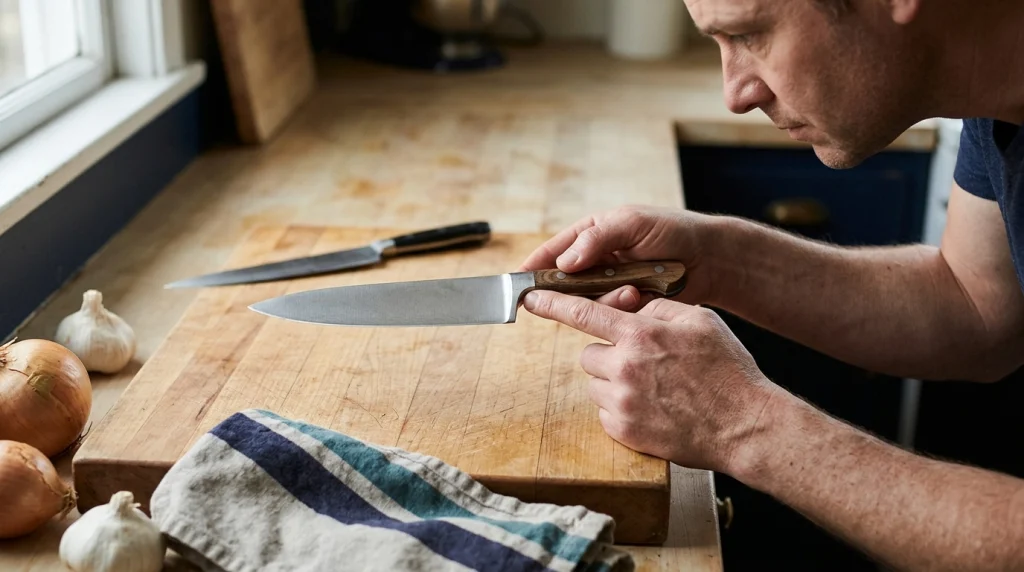
You can narrow down the cause by noticing where discomfort starts and what happens during normal, low-pressure handling. Do not continue cutting through pain just to complete a test.
| What you notice | Possible cause | What to check |
|---|---|---|
| Fingers feel cramped | Handle too thick or poorly shaped | Compare slimmer or more rounded handles. |
| Handle digs into palm | Short grip or uncomfortable handle end | Check handle length and end shape. |
| Hand gets tired quickly | Excessive gripping or heavy knife | Review grip, blade sharpness, and weight. |
| Wrist feels strained | Awkward wrist angle or poor balance | Check posture and try another knife shape. |
| Grip feels slippery | Moisture, grease, or unsuitable texture | Clean and dry the knife and your hands. |
| A sharp edge or crack catches your hand | Handle damage or a manufacturing defect | Stop using it and seek qualified repair or replacement. |
These clues help narrow down the possibilities, but they cannot establish a medical diagnosis. Persistent hand or wrist pain may have causes unrelated to the knife.
How Can You Make a Chef Knife Handle More Comfortable?
Start with simple, reversible changes. If the handle is structurally sound, you may be able to improve comfort without buying another knife.
1. Clean and Dry the Handle
Remove grease and food residue using the cleaning method recommended by the knife’s manufacturer. Dry the handle before using it again.
A clean, dry grip is easier to assess because surface contamination can make a comfortable handle feel insecure. Never handle a knife with wet or greasy hands while cutting.
2. Adjust Your Grip
For many kitchen tasks, a pinch grip offers good control. You place your thumb and index finger on opposite sides of the blade near where it meets the handle, while the remaining fingers hold the handle.
This technique may reduce the need to grip the handle tightly, although it can feel unfamiliar at first. If it causes discomfort or does not suit your knife, use a secure grip that keeps your hand clear of the cutting edge.
For guidance on common knife grips and safe cutting techniques, see the University of Kentucky’s knife-skills guide.
3. Reduce Unnecessary Gripping Force
A secure grip does not require maximum squeezing. Hold the knife firmly enough to control it without clenching your hand unnecessarily.
Repeated, forceful gripping can contribute to fatigue. If the knife requires a tight grip to remain stable, reassess its surface texture, balance, and fit rather than simply trying harder.
4. Check Your Cutting Technique
Your wrist position and cutting motion can influence how comfortable a handle feels. Repeatedly bending your wrist or forcing the blade through food may increase strain.
- Keep your cutting board stable on the work surface.
- Use a knife suited to the size and type of food.
- Let a sharp, properly maintained blade do the cutting.
- Keep your fingers curled away from the cutting edge on your guiding hand.
- Pause when your grip becomes tired or uncomfortable.
A stable cutting board matters too. Place a damp towel underneath it if the board lacks sufficient grip, as recommended in the University of Kentucky’s knife-skills guidance.
5. Avoid Improvised Handle Modifications
Adding bulky tape, cutting into the handle, or fitting an improvised sleeve can change the knife’s balance and make the grip less predictable. Materials may also trap moisture or loosen during use.
If you want a modified grip, consult the manufacturer or a qualified knife repairer about suitable options. Never use a knife with a loose, cracked, or unstable handle.
Which Chef Knife Handle Material Is Most Comfortable?
No single handle material is best for everyone. Shape, dimensions, texture, maintenance requirements, and the way the knife fits your hand often matter as much as the material itself.
| Handle material | Potential advantages | What to consider |
|---|---|---|
| Textured synthetic | Often easy to clean and designed for a secure grip. | Texture and shape still need to suit your hand. |
| Smooth plastic | Usually straightforward to maintain. | Some finishes may feel slippery when contaminated. |
| Wood | Can provide a comfortable, natural-feeling surface. | Care requirements vary; prolonged soaking may damage some handles. |
| Metal | Can be durable and easy to wipe clean. | Smooth finishes can be difficult to hold securely when wet or greasy. |
| Rubber-like or elastomer | May offer useful friction and a less slippery feel. | Texture, firmness, and handle dimensions vary by model. |
Material alone does not guarantee comfort or safety. Try to assess the complete handle and the knife’s balance rather than choosing based on a material label.
Should You Replace an Uncomfortable Chef Knife?
Replace the knife if its handle cannot provide a comfortable, secure grip, or if the handle has damage that could affect control. You may also prefer a different knife if its weight or blade length consistently causes fatigue.
Before buying, consider these features:
- Handle diameter: Choose a size that lets your fingers rest naturally.
- Handle length: Make sure your hand has enough room without pressure against the end.
- Surface texture: Look for a finish that provides a secure grip when clean and dry.
- Overall weight: Consider whether a lighter knife would be easier to control.
- Blade length: A shorter chef knife may feel easier to manage in a small workspace or with a smaller hand.
- Handle shape: Compare rounded, oval, and contoured designs instead of assuming one style suits everyone.
If possible, hold a few knives before purchasing. Check how your fingers wrap around each handle and whether your wrist remains comfortable in a natural position.
For further guidance on knife selection, the Institute of Culinary Education’s kitchen-knife guide discusses blade features, handle materials, and the importance of evaluating a knife before choosing it.
Chef Knives to Consider if Your Current Handle Feels Uncomfortable
 Save
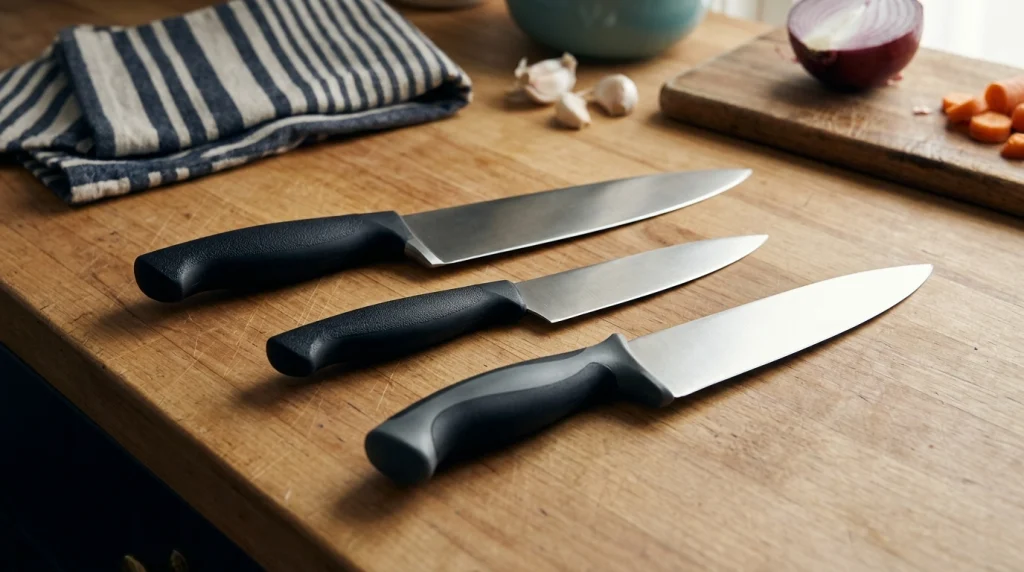
If your current knife remains uncomfortable after cleaning and adjusting your technique, comparing alternative designs may help. These models illustrate different options, but their suitability depends on your hand and grip preferences.
Textured-handle option
Victorinox Fibrox Pro 8-Inch Chef’s Knife
This model has a textured Fibrox handle and an 8-inch blade. Consider it if your current knife has a smooth grip, but check the handle’s thickness and shape before choosing it.
Shorter-blade option
Victorinox Fibrox 6-Inch Chef’s Knife
A 6-inch chef knife is worth considering if a full-size blade feels unwieldy. A shorter blade does not automatically mean a more comfortable handle, so assess both features.
Alternative handle design
Mercer Culinary Millennia 8-Inch Chef’s Knife
This is another widely available chef-knife model to compare when exploring different handle designs. Confirm the exact model specifications and assess its grip in person if possible.
These are starting points for comparison, not a guarantee that any particular handle will solve your discomfort. I have not conducted hands-on testing for this guide, so the recommendations are based on design considerations rather than personal test results.
When Should You Stop Using the Knife or Seek Help?
Stop using a knife immediately if the handle is loose, cracked, sharp at an unexpected edge, or slippery enough to compromise your control. Do not attempt to compensate for a damaged handle by gripping harder.
Persistent pain, tingling, numbness, swelling, or weakness deserves attention beyond a knife adjustment. Stop the activity and seek appropriate medical advice if symptoms persist, recur, or interfere with everyday tasks.
If the knife has a structural problem, contact the manufacturer or a qualified knife repairer. Replacing a damaged knife is safer than relying on an improvised repair.
Frequently Asked Questions
Why does my chef knife handle hurt my hand?
Your handle may be too thick, too thin, too short, or poorly shaped for your hand. Excessive gripping, an awkward wrist angle, and a heavy knife can also contribute. Identify where discomfort begins, stop if pain develops, and compare a better-fitting handle before continuing regular use.
Can a chef knife handle be too big for my hand?
Yes. A handle that is too large may prevent your fingers from resting naturally around it and can make secure control more difficult. Compare handles of different diameters and shapes, choosing one that allows a comfortable grip without excessive squeezing.
Does a rubber handle make a chef knife more comfortable?
A rubber-like or elastomer handle may provide useful friction and a secure feel, but the material alone cannot guarantee comfort. Handle shape, diameter, length, and knife balance also matter. Compare the complete design and keep the grip clean and dry.
Can I wrap tape around a chef knife handle to make it softer?
Improvised tape can loosen, trap moisture, change the handle’s shape, or interfere with control. Avoid modifications that could compromise safety. Ask the manufacturer or a qualified repairer whether a suitable handle modification is possible for your specific knife.
Should I buy a new knife if the handle feels uncomfortable?
Not necessarily. Cleaning the handle, improving your grip, and reassessing your cutting technique may resolve the issue. However, replace a damaged knife or consider another model if the handle remains uncomfortable or the knife is difficult to control safely.
Final Takeaway
An uncomfortable chef knife handle is usually a sign that something about the fit, surface, grip, or overall knife design needs attention. Start by identifying the cause instead of assuming that you need a more expensive knife.
Keep the handle clean and dry, use a secure grip, and choose a knife that suits your hand and cutting tasks. If discomfort persists or the handle is damaged, stop using the knife and consider a safer alternative.

