Chef Knife Claw Grip: How to Chop Safely Like a Pro
Quick Answer
The chef knife claw grip is a fundamental culinary technique where you tuck the fingertips of your non-dominant hand inward like a bear claw, resting your knuckles flat against the side of the knife blade to protect your fingers while guiding the cut with precision and stability.
What Is the Claw Grip and Why Do Chefs Use It?
The claw grip is the gold standard for knife safety and control in professional and home kitchens alike. When prepping ingredients, the hand holding the food is at constant risk of accidental slips or cuts if the fingers remain extended or flat.
By curling the fingers inward and gripping the food item with the fingertips, you create a protective barrier. The flat side of the knife blade rests directly against your knuckles, acting as a physical guide.
The Core Mechanics of the Grip
 Save
Proper execution relies on specific finger placement and posture. Your fingertips curl underneath so that the pads or tips secure the vegetable or meat. Your thumb and pinky finger provide lateral stability to keep the food from rolling or shifting.
Your knuckles face slightly outward toward the knife edge. This stance ensures that any accidental deviation of the blade hits the hard knuckle bone rather than the soft flesh of your fingertips.
Key Insight
Your knuckles act as a built-in ruler and guard simultaneously. As you slice, your knuckles inch backward to measure slice thickness while keeping your fingertips safely out of reach.
Step-by-Step Guide to Mastering the Claw Grip
Developing muscle memory for the claw grip requires intentional practice during routine kitchen prep. Transitioning from a flat-handed grip to a proper claw takes time, but it drastically improves cutting speed and safety.
- Place the food securely: Position your ingredient on a stable cutting board. If round items like onions or potatoes roll, slice a small thin section off the bottom first to create a flat base.
- Form the claw shape: Rest your non-dominant hand over the ingredient. Curl your index, middle, ring, and pinky fingers inward so that your weight rests primarily on your fingertips or the second joints.
- Position your thumb and pinky: Tuck your thumb safely behind your fingers or press it against the back of the food item to anchor it firmly in place.
- Align the knife blade: Pick up your chef knife with your dominant hand using a proper pinch grip. Rest the flat side of the blade gently against the knuckles of your guiding hand.
- Initiate the rock chop: Keep the tip of the chef knife on the cutting board while lifting the heel, or use a smooth downward-and-forward rocking motion. Your knuckles guide the backward movement of your hand incrementally with each slice.
Common Mistakes to Avoid When Using the Claw Grip
Even experienced cooks occasionally fall into bad habits that compromise their safety or cutting accuracy. Recognizing these errors helps maintain proper form during high-speed chopping.
- Extending the index finger: Pointing your index finger straight out along the top of the food exposes it directly to the knife edge. Always keep all four fingers tightly curled.
- Lifting the knuckles off the blade: If your knuckles lose contact with the flat of the blade, you lose your measuring guide and increase the risk of uneven cuts.
- Gripping too tightly: Tensing your hand excessively causes fatigue quickly. Keep your grip firm enough to secure the food, but relaxed enough to move your hand backward smoothly.
- Looking away while cutting: Distraction is the leading cause of kitchen cuts. Always watch the blade and your guiding knuckles, especially when working quickly.
Warning
Never let your thumb peek out in front of your fingers or the food item. A stray thumb is the most common target for accidental knife nicks during rapid dicing.
Adapting the Claw Grip for Different Ingredients
 Save
Not all kitchen ingredients share the same shape or density, requiring minor adjustments to your hand placement while maintaining the core claw structure.
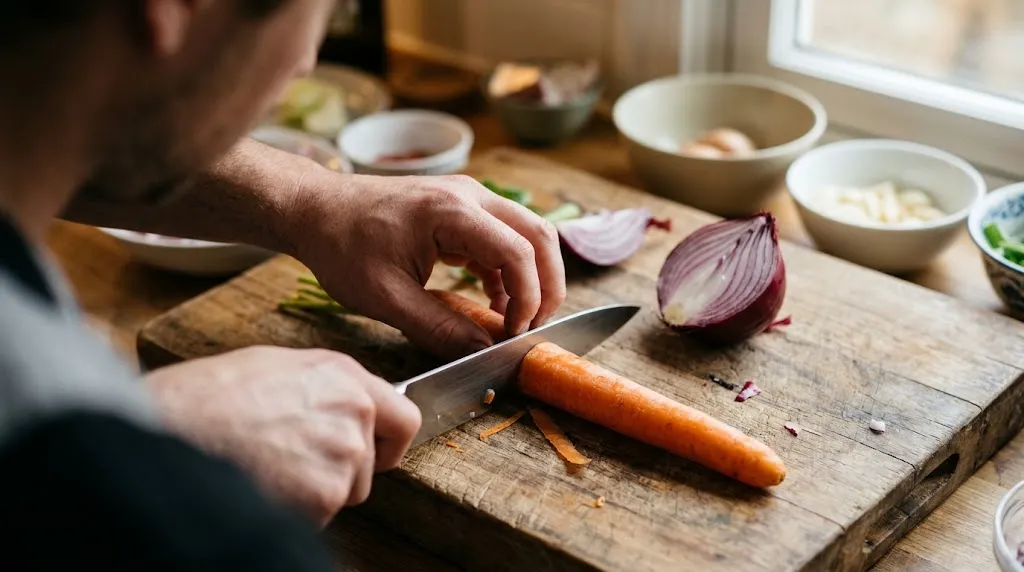
For long vegetables like carrots or zucchini, a standard rounded claw works exceptionally well as you slice down the length. For bulbous items like onions or cabbages, your fingers grip the outer layers firmly while the heel of your hand stabilizes the upper weight of the vegetable.
When handling slippery items like boneless meats or tomatoes, apply slightly more downward pressure with your fingertips to prevent the food from sliding out from under your hand during the cut.
Tip
Practice the claw grip slowly with non-perishable items or scrap vegetables until the motion feels natural before attempting fast prep work.
How the Claw Grip Improves Cutting Speed and Precision
Safety is the primary benefit, but efficiency is an immediate secondary advantage. When your fingers act as a steady guide against the knife blade, you eliminate guesswork.
You can slide your guiding hand backward in consistent, microscopic increments after every single cut. This uniform spacing translates directly into evenly diced vegetables, uniform julienne strips, and professional-looking culinary presentations without needing to eyeball every slice.
Related Product
Chef Knives and Cutting Boards
A well-balanced chef knife and a stable wooden cutting board make practicing proper knife techniques like the claw grip safer and more efficient.
As an Amazon Associate, we earn from qualifying purchases.
Frequently Asked Questions
What is the correct finger position for a chef knife claw grip?
Curl all four fingers of your non-dominant hand inward so your fingertips rest on the food and your second knuckles face outward. Your thumb should tuck behind the fingers or anchor the side of the item, and the flat of the knife blade rests against your knuckles.
Why do professional chefs use the claw grip?
Chefs use the claw grip because it completely shields the fingertips from accidental cuts while providing a stable guide for the knife blade, resulting in faster, more uniform cuts.
Can beginners easily learn the claw grip?
Yes, though it feels awkward initially. Practicing slowly with soft vegetables like cucumbers or mushrooms helps build the necessary muscle memory within a few cooking sessions.
How do you keep food from slipping under the claw grip?
Apply gentle downward pressure with your fingertips and use your thumb and pinky finger to anchor the sides of the ingredient. If an item is round, slice a flat base on it first so it cannot roll.
Where should the knife blade rest against your hand?
The flat side of the knife blade should rest against the middle phalanges or first knuckles of your guiding hand, never above your knuckles where your fingers are exposed.
Does the claw grip work with all types of kitchen knives?
The claw grip is primarily designed for chef knives, santoku knives, and utility knives used on a cutting board, but it can be adapted for most general chopping and dicing tasks.
Conclusion
Mastering the chef knife claw grip is one of the most effective ways to upgrade your kitchen safety and knife skills. By keeping your fingertips safely tucked and using your knuckles as a reliable cutting guide, you protect your hands while gaining greater control over your dicing and slicing speed. Consistent practice turns this protective posture into second nature, making your time in the kitchen both safer and more efficient.

