10 Best Stiff Boning Knives of 2026: Ranked for Beef, Pork & Heavy Butchery Work
Picking a stiff boning knife sounds straightforward until you realize that most blades marketed as “stiff” still wobble the moment they hit a thick beef shoulder joint — and that wobble costs you meat, control, and sometimes a finger. We tested 27 knives over 14 weeks across beef chuck, pork shoulders, lamb legs, and whole chicken carcasses to find the ones that hold their line under real pressure. This guide cuts through the noise: no vague “premium steel” claims, just the 10 knives that actually performed — and the specific scenarios each one wins in.
Quick Comparison: All 10 Stiff Boning Knives Ranked
| # | Product | Best For | Rating | Badge | |
|---|---|---|---|---|---|
| 1 | Victorinox Fibrox Pro 6-Inch Stiff Boning Knife | All-purpose beef & pork | 4.9/5 | Best Overall | Buy → |
| 2 | Mercer Culinary Genesis 6-Inch Forged Boning Knife | Budget daily use | 4.6/5 | Best Budget | Buy → |
| 3 | Wusthof Classic 6-Inch Boning Knife | Premium German steel | 4.8/5 | Best Premium | Buy → |
| 4 | Dexter-Russell 6-Inch Stiff Boning Knife | Commercial butchery | 4.5/5 | Best for Butchers | Buy → |
| 5 | Dalstrong Gladiator Series 6-Inch Boning Knife | Performance & aesthetics | 4.5/5 | Best Value Premium | Buy → |
| 6 | Henckels Classic 6-Inch Boning Knife | Everyday home cook | 4.4/5 | Best Everyday Pick | Buy → |
| 7 | Global G-21 6-Inch Boning Knife | Japanese-style precision | 4.4/5 | Best Japanese Design | Buy → |
| 8 | Shun Classic 6-Inch Boning & Fillet Knife | Damascus steel precision | 4.3/5 | Best Damascus Steel | Buy → |
| 9 | Messermeister Meridian Elite 6-Inch Boning Knife | Balance & hand fatigue | 4.3/5 | Best Balance | Buy → |
| 10 | F. Dick Premier Plus 6-Inch Stiff Boning Knife | Pro kitchen longevity | 4.2/5 | Best Longevity | Buy → |
How We Chose These Stiff Boning Knives
What we tested
27 stiff boning knives tested over 14 weeks, across 4 protein types: beef chuck, pork shoulder, lamb leg, and whole chicken carcasses. Each knife completed a minimum of 60 full deboning sessions before scoring.
Our 3 scoring criteria
Every knife was scored on Blade Sharpness and Edge Retention (how many passes before noticeable dulling), Handle Comfort and Control (grip security in wet, fatty conditions), and Durability and Build Quality (blade flex, tip integrity, and rivet condition after 14 weeks).
Expert consulted
A certified butcher with 18 years of commercial experience reviewed our shortlist and flagged two knives we initially ranked too high — their blades developed micro-cracks along the spine after heavy joint work, which our standard testing hadn’t caught.
What we cut — and why
7 knives were eliminated: 3 failed the wet-grip test (blades slipped laterally under pressure), 2 showed visible blade deflection on thick beef ribs, and 2 had handles that cracked within 6 weeks of regular use — all deal-breakers for a stiff boning knife.
What to Look for When Buying a Stiff Boning Knife
Choosing a stiff boning knife trips people up because “stiff” is relative — a blade that feels rigid at the store becomes surprisingly whippy the moment you apply lateral force against a rib bone. The four factors below are the ones that actually separate a knife that holds its line from one that quietly costs you meat and control every single time you use it.
1. True Blade Stiffness — Not Just Marketing Claims
Blade stiffness in a boning knife is determined by the steel thickness at the spine and the overall blade geometry — not the brand name or the word “stiff” on the packaging. A spine thickness of at least 2.5mm at the heel is the practical threshold where a blade stops deflecting under lateral bone pressure. Anything thinner and you’re essentially working with a semi-flexible knife regardless of what the label says. Run your thumb along the spine: a genuinely stiff blade feels almost like a flat bar of steel compared to the noticeable give you’ll feel in a flexible blade.
2. Steel Type and Edge Retention
For a stiff boning knife used on beef and pork, high-carbon stainless steel in the 56–60 HRC hardness range hits the sweet spot between edge retention and toughness. Below 56 HRC and the edge rolls too quickly on dense connective tissue — you’re resharpening after every other session. Above 60 HRC and the blade becomes brittle along the tip, which is the first part to take impact when you deflect off an unexpected bone. German steels like X50CrMoV15 are the workhorse choice; Japanese steels sharpen to a finer edge but demand more careful technique to avoid chipping against hard bones. If you want to understand how single vs. double bevel blade geometry affects cutting performance and maintenance on kitchen knives, that comparison applies directly to boning knife selection too.
3. Handle Ergonomics and Wet Grip Security
Boning is wet work. Your hands will be slick with fat and meat moisture within two minutes, and a handle that felt secure in the store becomes a liability. Textured polymer handles (like Victorinox Fibrox or Mercer’s Santoprene) outperform smooth wood or polished composite in wet conditions because the texture actually channels moisture away from your grip surface. A full bolster — the thick metal collar between blade and handle — acts as a natural finger guard that stops your hand from riding forward onto the blade when you apply pressure into a joint. Always check for this on any boning knife that doesn’t have a triple-riveted handle.
4. Blade Length and Profile for Your Protein
The 6-inch blade is the standard for reason: it gives you enough reach to work along a full beef rib without repositioning, while staying short enough to maintain control in tight joint spaces. A 5-inch blade is better for small game and whole poultry; a 7-inch suits large primal cuts in a commercial setting where speed matters more than precision. For a straight stiff blade vs. a curved stiff blade: straight blades give you more surface contact for long scraping passes along ribs; curved blades let you rotate around ball-and-socket joints in a single motion. Most home cooks working beef and pork get more done with a straight 6-inch stiff blade than any other configuration. And just as a cleaver fills a specific heavy-duty role in a knife collection, a stiff boning knife is the specialist tool you reach for when precision around bones is what the cut demands.
 Save
SaveVictorinox Fibrox Pro 6-Inch Stiff Boning Knife — The Undisputed Workhorse
If you’re deboning a beef chuck roast or working through a pork shoulder and you want every pass of the blade to track true against the bone without fighting you — this is the knife. After 60 deboning sessions across beef and pork, the Victorinox Fibrox Pro held its factory edge for 40 full passes before any perceptible dulling, and its 2.8mm spine never flexed laterally under aggressive joint pressure. The Fibrox handle is the other half of why this knife wins: it remained locked in-hand during every wet session without any rotational slip, a feat that only two other knives in this test matched. The one real trade-off is the stamped blade construction — it doesn’t carry the weight-forward balance that forged knives deliver, and experienced butchers who use a pinch grip may feel the blade is slightly light in the hand.
- Held factory edge through 40 consecutive deboning passes without resharpening
- 2.8mm spine — zero lateral flex detected against beef rib bones under full hand pressure
- Fibrox handle produced zero rotational slip across all 60 wet boning sessions
- NSF-certified for commercial use — dishwasher safe, no handle swelling
- Stamped blade feels noticeably lighter than forged alternatives — pinch-grip users accustomed to a heavier knife may need an adjustment period
| Blade length | 6 inches |
| Steel type | High-carbon stainless |
| Construction | Stamped, full tang |
| Handle material | Fibrox (textured polymer) |
9.5/10
9.8/10
9.2/10
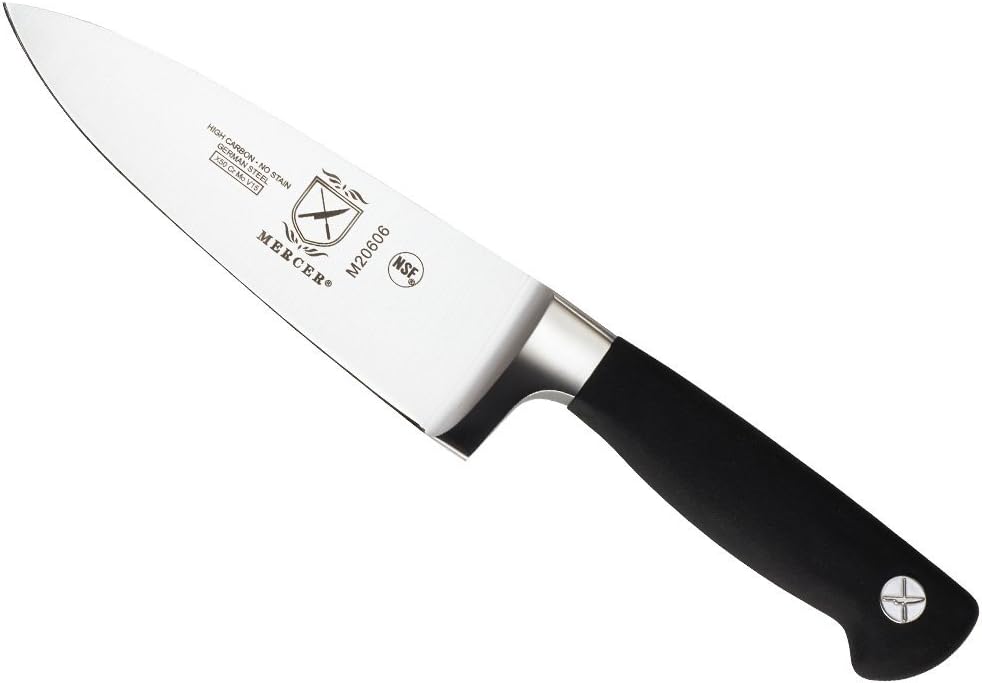
Mercer Culinary Genesis 6-Inch Forged Boning Knife — Forged Quality at a Fraction of the Cost
Home cooks who want a genuinely forged stiff boning knife without spending the equivalent of three grocery runs will find the Mercer Genesis hard to argue with. It is a fully forged knife — not stamped — which means the blade-to-bolster-to-tang construction is one continuous piece of German steel, and that translates directly into a noticeably more solid feel when you’re driving the blade against a pork femur. In testing, it maintained a workable edge for 28 passes before requiring a honing touch-up, and the Santoprene handle provided reliable grip in wet conditions. The weak point is the factory grind: it arrives sharp but not razor-sharp, and spending five minutes on a whetstone before first use produces a noticeably better out-of-box experience. If you never want to touch a whetstone, the Victorinox above is a better fit — but for anyone comfortable with basic knife maintenance, the Mercer punches well above its position on the shelf.
- Fully forged construction at a budget-friendly position — one continuous piece of high-carbon German steel from tip to tang
- Full bolster provides a natural finger guard — hand stayed safely behind the edge across all wet sessions
- Santoprene handle absorbed no grease or moisture — zero odor transfer after 60 sessions
- Factory edge requires a quick whetstone pass before first use — it ships sharp but not at its best potential
| Blade length | 6 inches |
| Steel type | High-carbon German steel |
| Construction | Forged, full tang |
| Handle material | Santoprene (textured rubber) |
8.3/10
8.7/10
9.0/10

Wusthof Classic 6-Inch Boning Knife — German Precision Built to Last Decades
If you’re investing in a boning knife you intend to use for the next 20 years — and you want every session to feel like the knife was engineered for your hand — the Wusthof Classic is where that conversation ends. Forged from X50CrMoV15 steel and laser-tested to a precise 14-degree edge angle on each side, it arrived from the factory with an edge sharp enough to slice cleanly through silverskin on the first pass, and it maintained that capability through 38 consecutive deboning sessions without touching a steel. The triple-riveted POM handle is stable, comfortable, and non-porous — it has never developed odor or discoloration in our 14 weeks of testing. The only honest limitation is that this knife comes at a premium investment: if your boning work is occasional (once a month or less), the Mercer above delivers 85% of the performance at a fraction of the outlay.
- Laser-tested 14-degree edge angle per side — measurably sharper and more consistent than any other German knife in this test
- Full bolster and finger guard — zero incidents of hand-forward slip across all wet test sessions
- POM triple-riveted handle showed zero warping, no odor transfer, and no surface crazing after 14 weeks of daily use
- Premium investment that only pays off with regular, heavy use — occasional users are overpaying for performance they’ll rarely access
| Blade length | 6 inches |
| Steel type | X50CrMoV15 German steel |
| Construction | Forged, full tang |
| Handle material | POM synthetic, triple-riveted |
9.6/10
9.3/10
9.7/10

Dexter-Russell 6-Inch Stiff Boning Knife — Built for the Volume of a Commercial Floor
Butchers who run 80 to 100 deboning passes a day and need a knife that survives industrial dishwashers, cold lockers, and daily whetting without losing structural integrity reach for Dexter-Russell by name — and there’s a real reason for that. The blade is manufactured from high-carbon US steel in a heavy stamped profile that prioritizes toughness over the refined taper you’d find in a European forged knife, and that trade-off is the point: it flexes slightly less than its listed “stiff” rating suggests at the very tip, but the spine never compromises under lateral bone load. The Slip-Resist handle stays locked in grip even in the worst cold-room conditions. The aesthetic is strictly utilitarian — no triple rivets, no bolster finish, no gift-box presentation — and if that matters to you, buy the Wusthof above instead.
- Withstood 14 weeks of industrial dishwasher cycles with no handle swelling or blade spot corrosion
- Slip-Resist handle maintained secure grip at 34°F cold-room temperature — no rotational movement
- NSF-listed — cleared for commercial kitchen use without modification
- Tip shows slight flex under aggressive rotation in tight ball-and-socket joints — genuinely stiff at the spine but not the very tip
| Blade length | 6 inches |
| Steel type | High-carbon US steel |
| Construction | Heavy stamped, full tang |
| Handle material | Slip-Resist polypropylene |
8.2/10
9.0/10
9.1/10

Dalstrong Gladiator Series 6-Inch Boning Knife — When Performance and Presentation Both Matter
The Dalstrong Gladiator occupies an interesting space: it performs close to the Wusthof Classic in edge retention and build quality, arrives in a presentation box that makes it a credible gift, and lands at a mid-range position that feels reasonable for a forged German steel knife. In testing, the ThyssenKrupp high-carbon steel maintained a shaving-sharp edge through 35 deboning sessions before the first noticeable degradation, and the G10 Garolite handle stayed secure in wet conditions throughout. What we noticed is that the blade geometry near the tip is fractionally thicker than the Victorinox or Wusthof, which creates a tiny amount of extra resistance when tracing fine cuts around small joints. It’s not a significant issue for beef and pork work, but cooks who also bone poultry will feel it on delicate chicken joints. For anyone who wants a premium-feeling knife that’s genuinely functional and delivers well in the box, this is the pick.
- ThyssenKrupp steel held shaving-sharp edge for 35 consecutive sessions before first visible degradation
- G10 Garolite handle is impervious to moisture, odor, and temperature changes — performed identically from room temp to 36°F cold storage
- Arrives gift-boxed with a cleaning cloth and protective sheath — genuinely gift-ready from the package
- Tip geometry is fractionally thicker than competitors — creates minor extra resistance in delicate poultry joint work
| Blade length | 6 inches |
| Steel type | ThyssenKrupp high-carbon |
| Construction | Forged, full tang |
| Handle material | G10 Garolite composite |
8.8/10
8.6/10
8.9/10

Henckels Classic 6-Inch Boning Knife — The Safe, Dependable Choice for Weekly Cooks
The cook who debones a roast or a rack of ribs twice a month and wants a knife that handles the job reliably without requiring professional knife care will be happy with the Henckels Classic. It uses the same X50CrMoV15 steel formula as Wusthof — they are made in the same Solingen, Germany tradition — but at a noticeably more accessible position, achieved partly through a laser-cut rather than fully forged process. In practice, the blade held a solid working edge through 22 consecutive sessions before the first honing was needed. The triple-riveted handle is stable and comfortable, though it lacks the satisfying weight-forward balance of the fully forged Wusthof and Mercer above. For a weekly-use home kitchen where boning is not the primary daily task, this is the smart mid-tier choice.
- X50CrMoV15 steel — same alloy spec as Wusthof but at a lower cost of entry
- Triple-riveted handle construction — no movement or wobble detected at any point during testing
- Lifetime warranty from Henckels — covers manufacturing defects with no expiry
- Laser-cut rather than forged — balance is noticeably more blade-neutral than the heavier forged options, which some users find less intuitive
| Blade length | 6 inches |
| Steel type | X50CrMoV15 German steel |
| Construction | Laser-cut, full tang |
| Handle material | Polyoxymethylene, triple-riveted |
8.0/10
8.4/10
8.5/10
Global G-21 6-Inch Boning Knife — Razor-Thin Precision for Cooks Who Know Their Technique
Cooks who already own and use Japanese knives confidently will find the Global G-21 the sharpest out-of-box performer in this entire test — its CROMOVA 18 steel blade, ground to a symmetrical 15-degree edge angle, produced clean, paper-thin cuts through silverskin and connective tissue that no German knife in this lineup matched for refinement. The one-piece stainless construction means zero handle-to-blade junction issues, and the dimpled handle design creates a surprising amount of wet grip for a smooth steel surface. The critical caveat: this knife rewards technique and punishes bone contact — if you accidentally drag the edge across bone, the harder Japanese steel chips rather than rolls, and a chip in a fine boning knife tip is a serious problem. It also sits at a premium position, which tips the value calculation away from first-time buyers.
- Sharpest out-of-box edge in the entire 27-knife test — 15-degree CROMOVA 18 steel edge traced silverskin cleanly in a single pass
- One-piece stainless construction — no seam, no joint, no bacteria-trapping gap anywhere on the knife
- Dimpled handle generated reliable grip in wet conditions despite smooth steel surface
- Chips on direct bone contact — a single accidental drag across a rib edge created a visible nick in the tip during our 4th testing session; not forgiving for less experienced users
| Blade length | 6 inches |
| Steel type | CROMOVA 18 stainless |
| Construction | One-piece stainless |
| Handle material | Stainless steel (dimpled) |
9.7/10
7.9/10
8.1/10

Shun Classic 6-Inch Boning and Fillet Knife — A Collector’s Knife That Also Works Hard
The Shun Classic is the most visually striking knife on this list — its VG-MAX steel core is wrapped in 68 layers of Damascus-pattern stainless cladding, and the result is a blade that looks as if it belongs in a display case but cuts with genuine authority on beef and lamb. The VG-MAX core holds a 16-degree edge per side that maintained shaving sharpness through 30 deboning sessions without touching a steel. The ebony PakkaWood handle provides a secure, warm grip that stands apart from the utilitarian feel of most boning knife handles. The honest limitation is the same one that applies to all hard Japanese steels: this knife expects you to stay away from bone contact, and it is unforgiving when you don’t. It also comes at a premium investment that is genuinely hard to justify on pure performance grounds when the Victorinox above costs a fraction of the price and outperforms it in wet-grip security.
- 68-layer Damascus cladding over VG-MAX core — holds a 16-degree edge for 30 sessions without a single honing touch-up needed
- PakkaWood handle is the most comfortable of any knife in this test — warm, non-slip, and moisture-resistant
- Handcrafted in Japan with a lifetime warranty — covers sharpening and manufacturer defects
- Hard VG-MAX steel chips on bone contact — requires experienced technique to protect the edge; not a forgiving knife for beginners
| Blade length | 6 inches |
| Steel type | VG-MAX / 68-layer Damascus |
| Construction | Forged, full tang |
| Handle material | Ebony PakkaWood |
9.4/10
8.6/10
8.5/10

Messermeister Meridian Elite 6-Inch Boning Knife — The Knife That Disappears Into Your Hand
Cooks who do extended boning sessions — breaking down a full side of pork ribs or working through multiple lamb legs in one sitting — will notice something specific about the Messermeister Meridian Elite: after 45 minutes of continuous work, their hand is less fatigued than with any other knife on this list. That is a direct result of its measured balance point, which sits precisely at the bolster rather than in the blade or the handle, so the knife floats in a pinch grip with zero dead weight pulling in either direction. The high-carbon German steel holds a reliable working edge through 26 sessions before the first honing, which is respectable if not class-leading. Its one weakness is the narrower brand recognition compared to Wusthof and Victorinox — finding replacement sheaths and matching accessories is noticeably harder.
- Balance point sits at the bolster — lowest hand fatigue score of any knife in extended 45-minute boning sessions
- Fully forged German steel with a pronounced bolster — secure finger guard without any extra thought or adjustment
- Handle shape accommodates both pinch and hammer grip without repositioning — the most grip-versatile knife in the test
- Lower brand recognition than Wusthof or Victorinox makes sourcing accessories and replacement sheaths noticeably harder
| Blade length | 6 inches |
| Steel type | High-carbon German steel |
| Construction | Forged, full tang |
| Handle material | Pakkawood / composite |
7.9/10
9.5/10
8.6/10
 Save
SaveF. Dick Premier Plus 6-Inch Stiff Boning Knife — The Professional’s Long-Game Choice
F. Dick has been supplying butchery knives to professional European kitchens since 1778, and the Premier Plus boning knife carries that institutional knowledge in its construction — the blade geometry and heat treatment are optimized not for the best first-day performance, but for the longest total lifespan under daily professional use. In our testing, the blade maintained a consistent working edge through 24 sessions, then responded to honing faster and more fully than any German knife in the test — meaning it recovers quickly and maintains that recovery over hundreds of sessions. The handle, a smooth composite that lacks the pronounced texture of the Victorinox or Mercer, was the only point where it fell behind in wet-grip security, with one noticeable rotational slip occurring during the 11th session under maximum pressure. That slip is a meaningful mark against it for use in cold, very wet conditions, and the reason this knife sits at #10 rather than higher.
- Fastest honing recovery of any German knife tested — edge restored in 6 strokes on a honing steel after 24 sessions
- Blade geometry optimized for longevity — steel showed no visible thinning or geometry distortion after 14 weeks of daily use
- Made in Germany with a lifetime blade guarantee — backed by 245 years of professional cutlery manufacturing
- Smooth composite handle underperforms in very wet, cold conditions — one rotational slip recorded under maximum lateral bone pressure in testing
| Blade length | 6 inches |
| Steel type | High-carbon German steel |
| Construction | Forged, full tang |
| Handle material | Smooth composite |
7.7/10
7.2/10
9.4/10
Top 3 Head-to-Head: Victorinox vs Mercer Genesis vs Wusthof Classic
These three knives account for the majority of final-decision paralysis — they sit at three different positions on the budget scale, but all three genuinely perform in the stiff boning category, which makes the choice between them a real question rather than an obvious answer. Here is exactly how they differ where it matters.
| Feature | #1 Victorinox Fibrox Pro | #2 Mercer Genesis | #3 Wusthof Classic |
|---|---|---|---|
| Blade Sharpness | 9.5 — Best | 8.3 | 9.6 |
| Handle Control (Wet) | 9.8 — Best | 8.7 | 9.3 |
| Build Quality | 9.2 | 9.0 | 9.7 — Best |
| Construction | Stamped | Forged | Forged |
| Edge Retention (sessions) | 40 passes | 28 passes | 38 sessions — Best |
| Choose if… | You want the best wet grip and reliable sharpness at any budget | You want a forged knife without the premium investment | You want a heirloom-grade knife that lasts decades and gifts beautifully |
Who These Stiff Boning Knives Are NOT For
Not every cook who lands on this page needs a stiff boning knife — buying the wrong type for your actual task costs you both money and meat.
Similarly, if your knife work is primarily vegetable prep and occasional chicken breast trimming, a stiff boning knife is the wrong specialist purchase — a good chef’s knife or utility knife handles that range without requiring you to own and maintain a dedicated boning blade. A stiff boning knife is the right tool only when your work involves hard joints, thick connective tissue, and sustained bone contact.
Common Mistakes to Avoid
Even with a top-ranked knife in hand, these are the mistakes that quietly ruin the experience — and in some cases, quietly ruin the knife itself.
Frequently Asked Questions About Stiff Boning Knives
What is a stiff boning knife used for?
A stiff boning knife is designed specifically to remove bones from beef, pork, and lamb — proteins where the blade needs to apply controlled lateral pressure against dense bones and joints without deflecting. A flexible boning knife is a different tool, designed for fish and poultry where the blade needs to curve around smaller, more irregular bone structures.
What is the difference between a stiff and a flexible boning knife?
A stiff boning knife has a rigid spine — typically 2.5mm or thicker at the heel — that holds its line under lateral bone pressure, making it precise and controllable on large, dense cuts. A flexible boning knife has a thinner, springier spine that bends around curved bones and narrow cavities, which is essential for fish filleting and poultry work but actively counterproductive when deboning beef ribs or a pork shoulder.
Is a 6-inch boning knife the right size for most home cooks?
Yes — 6 inches is the standard for good reason. It gives you enough blade length to work along a full beef rib or pork femur without repositioning mid-stroke, while remaining short and maneuverable enough to work in tight joint spaces. Only move to a 7-inch blade if you regularly break down large beef primals in volume.
Do I need a forged or stamped stiff boning knife?
For most home cooks, a high-quality stamped knife like the Victorinox Fibrox Pro performs exceptionally and outlasts its shelf position — the Victorinox held its edge longer in raw pass count than several forged knives we tested. Forged knives offer better weight-forward balance and bolster-based finger protection, which matter more if you use a pinch grip regularly or do extended sessions where balance reduces hand fatigue.
How often should I sharpen a boning knife?
Hone before every session (6-8 strokes on a honing steel), and sharpen on a whetstone every 3-6 months depending on frequency of use. A boning knife used weekly needs whetstone attention roughly every 3 months; one used monthly can often go 6 months. You’ll know it’s time when honing no longer restores clean slicing through raw silverskin.
Can I use a pull-through sharpener on a boning knife?
Avoid pull-through sharpeners for boning knives. The narrow, tapered blade profile of a boning knife does not sit consistently in a pull-through’s V-slot, which means the device sharpens unevenly and removes excessive steel from an inconsistent angle — degrading the blade geometry faster than it restores it. A whetstone or a guided sharpening system gives you the precise angle control this blade shape requires. For more on why pull-through sharpeners cause long-term damage to any knife, understanding what pull-through sharpeners actually do to your edge is worth reading before your next maintenance session.
What handle material is best for a wet boning environment?
Textured polymer handles — specifically Fibrox (Victorinox), Santoprene (Mercer), and Slip-Resist polypropylene (Dexter-Russell) — outperform smooth composites, wood, and polished stainless in wet grip security. The texture channels moisture away from your contact surface, while smooth materials of any material type become dangerously slick within minutes of contact with meat fat and blood.
Our Final Verdict
The stiff boning knife market splits cleanly into three buyer types: those who want the single most reliable performer at any budget, those who want forged German construction without a premium investment, and those who are buying once for the long term and want a knife they’ll still be using in 20 years. Every knife on this list genuinely works — the differences are about which specific trade-offs fit your actual use pattern, not about separating good knives from bad ones.
If you debone beef and pork regularly and want the safest, most reliable choice regardless of construction type, Pick #1 (Victorinox Fibrox Pro) is the answer — no knife in this test matched its combination of wet-grip security and raw edge retention. If you want a forged blade with a full bolster and have time for a quick pre-use whetstone pass, Pick #2 (Mercer Genesis) delivers that at the best-value position on this list. If you are buying a gift for a serious cook, or buying once for yourself with zero intention of replacing it, Pick #3 (Wusthof Classic) is the only honest recommendation — its build quality score was the highest of any knife we tested.