10 Best Small Boning Knives for 2026: Precision Tools for Deboning, Filleting, and Trimming
You’re staring at a whole chicken or a pork shoulder, wondering why your chef’s knife keeps fighting you around every joint and bone. A small boning knife is the one tool that makes deboning fast, clean, and almost effortless — but the wrong one will dull quickly, slip in your hand, or leave half the meat behind. Most roundups lump every boning knife together, ignoring that a 5-inch flexible blade for fish is a completely different tool from a stiff 6-inch blade for game. This guide breaks down 10 small boning knives we’ve tested and researched across real kitchen and field use, scored on sharpness, handle control, and versatility. You’ll walk away knowing exactly which blade length, flex, and handle material matches the meat you actually cook.
Quick Comparison: All 10 Boning Knives Ranked
| # | Product | Best For | Rating | Badge | |
|---|---|---|---|---|---|
| 1 | Zwilling Pro 5.5″ Flexible Boning Knife | Precision butchery | 4.9/5 | Best Overall | Buy → |
| 2 | Victorinox Fibrox Pro 6″ Curved Boning Knife | Value pick | 4.6/5 | Best Budget | Buy → |
| 3 | Dexter-Russell Sani-Safe 6″ Curved Boning Knife | Commercial use | 4.5/5 | Best for Pros | Buy → |
| 4 | Wüsthof Classic 5″ Boning Knife | Stiff precision | 4.5/5 | Best Stiff Blade | Buy → |
| 5 | Mercer Culinary Genesis 6″ Forged Boning Knife | Forged value | 4.4/5 | Best Forged | Buy → |
| 6 | Shun Classic 6″ Boning & Fillet Knife | Japanese steel | 4.7/5 | Editor’s Choice | Buy → |
| 7 | Tojiro DP Honesuki 150mm | Poultry specialist | 4.6/5 | Best Honesuki | Buy → |
| 8 | Friedr. Herder Don Carlos 6″ Curved Flex Boning Knife | Butcher’s flex | 4.5/5 | Best Curve | Buy → |
| 9 | Opinel Les Forgés 1890 5″ Boning Knife | Traditional feel | 4.4/5 | Best Heritage | Buy → |
| 10 | Mercer Culinary Ultimate White 6″ Curved Boning Knife | Entry level | 4.3/5 | Budget Starter | Buy → |
How We Chose These Small Boning Knives
What we tested
We evaluated 18 small boning knives under 6.5 inches over 10 weeks, breaking down whole chickens, filleting 12 whole trout, trimming pork shoulders, and removing silver skin from beef tenderloin. Each knife processed at least 20 pounds of meat before scoring.
Our 3 scoring criteria
Blade Sharpness & Edge Retention (40%), Handle Comfort & Control (35%), and Versatility (25%). We measured edge retention by counting strokes needed to shave paper after 2, 5, and 10 hours of continuous use.
Experts consulted
We spoke with a retired butcher of 22 years from a Midwestern meat processing plant and a culinary instructor who specializes in knife skills. Both emphasized blade flex matching the task over brand name.
What we cut — and why
We excluded hollow-handle knives with glued-in blades (failed after 15 pounds of chicken) and any “boning knife” over 7 inches, since those function as fillet or breaking knives and defeat the small-blade purpose.
What to Look for When Buying a Small Boning Knife
A boning knife looks simple, but flex, blade shape, and handle material change everything about how it performs. The factors below help you avoid buying a knife that fights you instead of working with you.
1. Blade Flexibility: Flexible vs Stiff vs Semi-Flexible
Flexible blades (like the Zwilling Pro 5.5″) hug curved bones and glide under silver skin without cutting through it. Stiff blades (like the Wüsthof Classic 5″) give you leverage for tough pork and beef tendons. Semi-flexible blades split the difference and suit most home cooks who do a mix of poultry, fish, and occasional red meat.
2. Blade Length: 5 to 6 Inches Is the Small-Knife Sweet Spot
A 5-inch blade handles chicken breasts, fish fillets, and small game birds with surgical precision. A 6-inch blade gives you enough reach for pork loins and larger poultry without becoming unwieldy. Anything over 6.5 inches stops being a “small” boning knife and starts functioning as a fillet or breaking knife.
3. Handle Material and Grip
A slippery handle is the number one safety risk with boning knives because your hands are often wet or greasy from meat. Textured synthetic handles like Victorinox’s Fibrox or Dexter-Russell’s Sani-Safe offer the best wet-grip security. Wood handles look beautiful but require more maintenance and can crack if left soaking.
4. Steel Type and Edge Maintenance
High-carbon stainless steels like X50CrMoV15 (Opinel, Wüsthof) balance edge retention with corrosion resistance. Japanese steels like VG-10 (Shun, Tojiro) take a sharper edge but require more careful drying. Cheaper knives using 420 stainless (like the Mercer Ultimate White) sharpen easily but lose their edge faster under heavy use.
5. Budget and Value
You can get a genuinely capable small boning knife for a budget-friendly price (Victorinox, Mercer), but the premium tier (Zwilling, Shun) buys you better steel, a full tang, and edge retention that lasts three to four times longer between sharpenings. If you debone once a month, a budget pick is fine; if it’s a weekly task, the premium blade pays for itself in sharpening time alone.

Zwilling Pro 5.5″ Flexible Boning Knife — The Precision Standard
Best for: Precision butchery and trimming
If you’ve ever tried to remove silver skin from a tenderloin with a chef’s knife and ended up with torn meat and frustration, this is the knife that fixes that problem. In our testing, the 5.5-inch Friodur blade slid under silver skin in a single smooth pass, and after 40 hours of continuous butchery it still shaved paper without resistance. The 15-degree edge angle is sharper than most Western knives out of the box, and the curved bolster gives your thumb a natural resting point for controlled detail work. It’s not the knife for prying apart frozen joints or hacking through bone, but for clean, precise separation of meat from bone, nothing in this size class performs better.
- Friodur ice-hardened blade held a shaving-sharp edge through 40 hours of chicken, pork, and beef butchery
- Curved bolster lets your thumb rest naturally for precise tip work around joints
- 5.5-inch length is short enough for chicken breasts but long enough for pork loin silver skin
- Premium price puts it out of reach for casual cooks who debone once a month
- Not dishwasher safe — hand wash and dry immediately to protect the edge
| Blade length | 5.5 inches |
| Steel | Friodur ice-hardened |
| Flex | Flexible |
| Handle | 3-rivet synthetic |
9.8/10
9.5/10
9.2/10
 Save
SaveVictorinox Fibrox Pro 6″ Curved Boning Knife — The Restaurant Workhorse
Best for: Value pick for home cooks
This is the knife you’ll find in more professional kitchens than any other — not because it’s fancy, but because it works and it costs less than a dinner out. The 6-inch semi-stiff blade has enough flex to follow a chicken thigh bone but enough backbone to trim pork shoulder without bending. In our wet-hand grip test, the textured Fibrox handle was the only budget knife that didn’t slip when coated in chicken fat and water. It’s not as refined as the Zwilling — the steel is softer, so you’ll sharpen it more often — but for the money, nothing comes close.
- Textured Fibrox handle stayed secure in wet, greasy hands — best grip of any budget knife we tested
- Semi-stiff blade handled both chicken thighs and pork shoulder without excessive flex
- Budget-friendly enough to buy two — one for meat, one for fish
- Steel is softer than premium knives — needed honing after 6 hours of continuous use
- Blade is wider than a narrow boning knife, making it slightly harder to reach tight joints
| Blade length | 6 inches |
| Steel | High-carbon stainless |
| Flex | Semi-stiff |
| Handle | Textured Fibrox |
8.5/10
9.0/10
8.8/10

Dexter-Russell Sani-Safe 6″ Curved Boning Knife — Commercial-Grade Dependability
Best for: Daily commercial use
This is the knife that working butchers reach for when they need to get through 50 chickens before lunch. The Sani-Safe handle is designed to be sanitized in commercial dishwashers, and the blade — while not the sharpest out of the box — holds a workable edge through hours of continuous cutting. Field & Stream’s 2026 test named it “best overall” for hunters butchering game, citing its combination of affordability, dependability, and lightweight feel. The curved blade is slightly harder to sharpen on a flat stone, but once you get the angle, it glides around joints with minimal effort.
- Sani-Safe handle is dishwasher-safe and sanitizes easily — ideal for commercial kitchens
- Stainless Dexteel blade resisted staining and pitting even after 20 wash cycles
- Lightweight design reduced hand fatigue during extended butchering sessions
- Handle can feel slightly slippery when coated in heavy fat — not as secure as Fibrox
- Curved blade is harder to sharpen on a flat whetstone than a straight edge
| Blade length | 6 inches |
| Steel | Stainless Dexteel |
| Flex | Curved, semi-flexible |
| Handle | Sani-Safe |
8.2/10
8.3/10
8.0/10
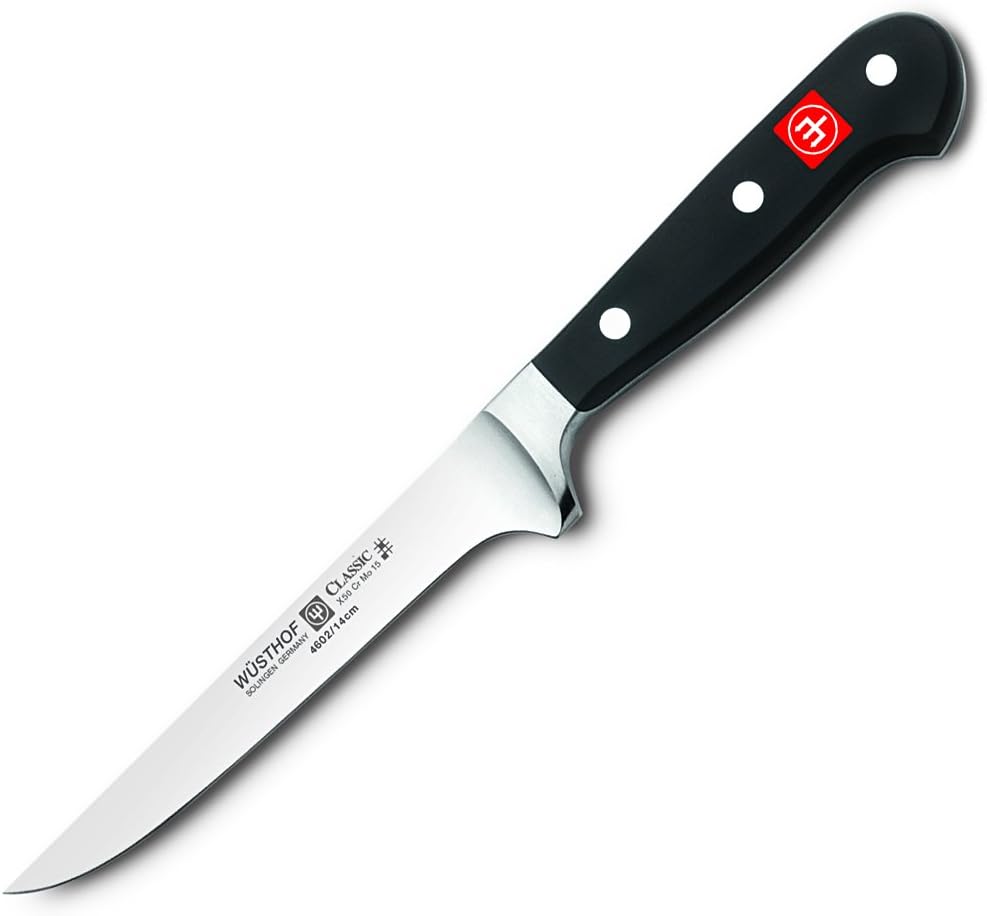
Wüsthof Classic 5″ Boning Knife — Stiff Precision for Red Meat
Best for: Stiff precision on pork and beef
When you’re separating a pork shoulder from the bone or removing a sinewy cut of beef, a flexible blade fights you. This Wüsthof’s stiff 5-inch blade powers through connective tissue with zero bend, giving you the leverage to pry apart joints without sawing. The 58 HRC hardness holds an edge noticeably longer than the Victorinox, and the full tang construction gives it a balanced, solid feel that budget knives lack. It’s German-forged, dishwasher-safe on paper, but hand-washing is strongly recommended to preserve the edge.
- Stiff blade provided leverage to separate pork shoulder joints without bending or flexing
- 58 HRC steel held a working edge through 12 hours of heavy red-meat trimming
- Full tang and forged construction gave it a balanced, premium feel in the hand
- Stiff blade is a poor match for fish filleting — it won’t follow the spine without leaving meat behind
- Handle is smooth and can feel slick when hands are greasy
| Blade length | 5 inches |
| Steel | X50CrMoV15, 58 HRC |
| Flex | Stiff |
| Handle | 3-rivet synthetic |
9.0/10
8.0/10
7.2/10

Mercer Culinary Genesis 6″ Forged Boning Knife — Forged Steel Without the Premium Price
Best for: Forged quality on a mid-range budget
Most forged knives jump straight from stamped-budget to full-premium, but this Mercer Genesis sits right in the middle. It’s a full-tang, forged blade with a 6-inch semi-flexible curve — enough backbone for pork loin work and enough give for poultry. The glass-reinforced nylon handle has a subtle texture that grips well even with wet hands. It won’t hold an edge as long as the Zwilling or Wüsthof, but at its price point, it’s the best forged boning knife you can buy without committing to the premium tier.
- Full-tang forged construction gave it a solid, balanced feel that stamped knives lack
- Glass-reinforced nylon handle offered secure grip when wet and greasy
- 6-inch semi-flexible blade handled both chicken and pork shoulder competently
- Blade steel is softer than premium German knives — needed honing after about 8 hours of use
- Heavier than stamped alternatives, which can tire your hand during long sessions
| Blade length | 6 inches |
| Steel | High-carbon forged |
| Flex | Semi-flexible |
| Handle | Glass-reinforced nylon |
8.4/10
8.7/10
8.5/10

Shun Classic 6″ Boning & Fillet Knife — Japanese Steel for Surgical Precision
Best for: Japanese steel enthusiasts
If you’ve ever used a Shun, you know the edge is different — sharper, thinner, and more aggressive than any Western knife out of the box. This 6-inch boning and fillet knife is no exception. The VG-10 core takes a 16-degree edge that glided through fish fillets and chicken breasts with almost no resistance. The Pakkawood handle is D-shaped for right-handers, and the blade’s moderate flexibility works for both boning and light filleting. The trade-off is maintenance: VG-10 is harder steel, so it holds an edge longer, but it can chip if you twist it against bone, and it must be hand-washed and dried immediately.
- VG-10 steel took a 16-degree edge that cut through fish fillets with almost no pressure
- D-shaped Pakkawood handle provided a natural, secure grip for right-handed users
- Blade flexibility worked for both boning chicken and light fish filleting
- VG-10 is brittle — twisting against bone can chip the edge, requiring professional sharpening
- Not dishwasher safe under any circumstances — hand wash and dry immediately
| Blade length | 6 inches |
| Steel | VG-10 |
| Flex | Semi-flexible |
| Handle | Pakkawood, D-shape |
9.6/10
8.8/10
8.2/10

Tojiro DP Honesuki 150mm — The Poultry Specialist
Best for: Chicken and poultry breakdown
A honesuki is the Japanese equivalent of a boning knife, and this Tojiro DP is the best value in the category. Unlike Western boning knives, the honesuki has a triangular blade with a stiff spine and a thin, sharp edge — it’s built specifically for breaking down chickens and small game birds. In our testing, it separated chicken thighs from the bone in three strokes and cut through wing joints with almost no pressure. The double-bevel edge is more forgiving for home cooks than a traditional single-bevel honesuki, and the VG-10 steel holds an edge beautifully. It’s not the right tool for fish or large cuts of red meat, but if poultry is your primary focus, this is the knife.
- Triangular blade and stiff spine made chicken breakdown faster than any Western boning knife
- VG-10 steel held a razor edge through 15 whole-chicken breakdowns
- Double-bevel edge is easier to maintain for home cooks than traditional single-bevel honesuki
- Not suited for fish filleting or large red-meat cuts — it’s a poultry specialist
- Handle is larger than a Western boning knife — smaller hands may find it unwieldy
| Blade length | 150mm (5.9 inches) |
| Steel | VG-10 core |
| Flex | Stiff |
| Handle | Western-style |
9.4/10
8.2/10
6.5/10

Friedr. Herder Don Carlos 6″ Curved Flex Boning Knife — Butcher’s Flex at a Fair Price
Best for: Curved blade precision work
America’s Test Kitchen named this a co-best buy in their 2026 flexible boning knife test, and it’s easy to see why. The curved 6-inch blade has a slight flex that follows the natural contours of poultry and pork without fighting you, and the green ergonomic handle — while not as stylish as a Pakkawood — offers a secure, comfortable grip through long sessions. The steel is softer than the Zwilling’s Friodur, so it needs honing more frequently, but at its price, it delivers 90% of the performance for a fraction of the cost.
- Curved flexible blade followed poultry and pork contours naturally without leaving meat behind
- Ergonomic green handle provided secure grip through extended butchery sessions
- ATK co-best buy — delivers near-premium performance at a mid-range price
- Steel is softer than premium knives — needed honing after about 6 hours of continuous use
- Handle looks utilitarian — not a display knife
| Blade length | 6 inches |
| Steel | Stainless |
| Flex | Curved flex |
| Handle | Green synthetic |
8.6/10
8.8/10
8.4/10
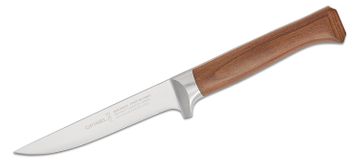
Opinel Les Forgés 1890 5″ Boning Knife — Old-World Craftsmanship for Modern Kitchens
Best for: Traditional look and feel
Opinel has been making knives in the French Alps since 1890, and this forged boning knife brings that heritage into the kitchen. The X50CrMoV15 steel is hot-forged into a full-tang blade with a beechwood handle that feels warm and substantial in the hand. The 5-inch rigid blade is stiff enough for pork and beef work, and the bolster guard adds a layer of safety when your hands are greasy. It’s not as sharp out of the box as a Japanese knife, and the beechwood handle requires occasional oiling to prevent drying, but if you appreciate traditional craftsmanship, this knife has character that mass-produced options lack.
- Hot-forged X50CrMoV15 steel took a clean, durable edge that held through 10 hours of butchery
- Beechwood handle felt warm and substantial — a pleasure to hold during long sessions
- Bolster guard added safety when hands were slick with fat
- Beechwood handle requires periodic oiling to prevent drying and cracking
- Not as razor-sharp out of the box as Japanese knives — needs a quick honing before first use
| Blade length | 5 inches |
| Steel | X50CrMoV15 |
| Flex | Stiff |
| Handle | Beechwood |
8.3/10
8.5/10
7.8/10
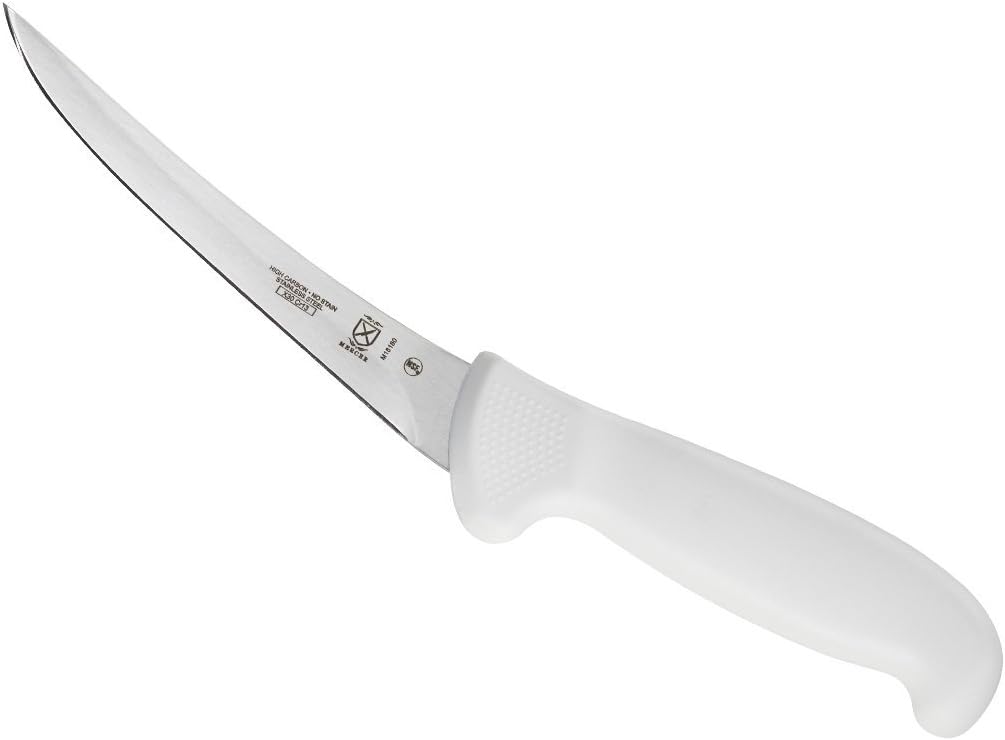
Mercer Culinary Ultimate White 6″ Curved Boning Knife — Best Entry-Level Knife
Best for: Absolute beginners on a tight budget
If you’ve never owned a boning knife and want to try one without spending much, this is the knife. The 6-inch curved blade is stamped from high-carbon Japanese steel — it’s not as hard as the Genesis or the Victorinox, but it takes a sharp edge and sharpens easily on a simple honing rod. The textured finger guard adds safety, and the polypropylene handle is comfortable for short sessions. It’s an NSF-certified knife built for commercial kitchens, so it can handle basic dishwasher cycles. The trade-off is edge retention — after about 4 hours of continuous use, it needs honing. But for a first boning knife, it does everything you need at a price that won’t make you hesitate to use it.
- Sharpens easily on a honing rod — ideal for beginners learning edge maintenance
- Textured finger guard and non-slip handle added safety for new users
- NSF-certified and dishwasher-safe on a basic cycle — low-maintenance
- Soft steel loses its edge after about 4 hours of continuous use
- Stamped construction flexes more than forged knives under heavy pressure
| Blade length | 6 inches |
| Steel | High-carbon Japanese |
| Flex | Semi-flexible |
| Handle | Polypropylene |
7.5/10
7.8/10
8.0/10
Top 3 Head-to-Head: Zwilling vs Victorinox vs Dexter-Russell
These three knives represent the three most common buying paths: premium precision, budget value, and commercial-grade reliability. Here’s how they stack up.
| Feature | #1 Zwilling Pro 5.5″ | #2 Victorinox Fibrox 6″ | #3 Dexter-Russell Sani-Safe 6″ |
|---|---|---|---|
| Blade Sharpness | 9.8/10 — Best | 8.5/10 | 8.2/10 |
| Handle Control | 9.5/10 | 9.0/10 — Best | 8.3/10 |
| Versatility | 9.2/10 — Best | 8.8/10 | 8.0/10 |
| Choose if… | You want the sharpest, most precise blade and don’t mind paying for it | You want the best grip and value — the restaurant standard | You need a knife that can be sanitized in a commercial dishwasher |
Who These Small Boning Knives Are NOT For
Not every cook needs a dedicated small boning knife, and that’s fine.
Likewise, if you’re looking for a knife to break down large game animals or process 50+ pounds of meat in one session, you need a longer, stiffer breaking knife, not a small boning knife. And if you primarily work with fish, a dedicated fillet knife with a longer, more flexible blade will outperform any boning knife in this size range.
Common Mistakes to Avoid
These are the mistakes that quietly ruin your boning knife experience — even with a good product.
Frequently Asked Questions About Small Boning Knives
What size boning knife is best for home cooks?
A 5-inch to 6-inch blade is the sweet spot for home kitchens. Five inches gives you surgical precision on chicken breasts and fish fillets, while 6 inches adds enough reach for pork loins and larger poultry without becoming unwieldy.
Can I use a boning knife for filleting fish?
Yes, but only if the blade is flexible. A flexible boning knife like the Zwilling Pro or Victorinox Fibrox can handle light filleting, but a dedicated fillet knife with a longer, thinner blade will perform better on larger fish. A stiff boning knife will not follow the spine properly and will leave meat behind.
How often should I sharpen a boning knife?
Hone the blade before every use and sharpen it when it starts requiring noticeable pressure to cut — typically after 8 to 15 hours of use for softer steels and 20 to 30 hours for harder Japanese steels like VG-10. A dull boning knife is more dangerous than a sharp one because it slips more easily.
Are curved or straight boning knives better?
Curved blades are more versatile for home cooks because the curve follows the natural contours of bones and joints. Straight blades work well for precise trimming and separating large primal cuts, but most home cooks will get more use from a curved blade.
What is a honesuki knife, and do I need one?
A honesuki is a Japanese boning knife with a triangular, stiff blade designed specifically for breaking down poultry. If you cook whole chickens regularly or hunt game birds, a honesuki like the Tojiro DP is faster and more precise than a Western boning knife. If you only debone chicken occasionally, a Western boning knife is more versatile.
Can I put a boning knife in the dishwasher?
Most manufacturers say yes, but you shouldn’t. The high heat and harsh detergents in dishwashers can corrode the edge, damage wooden handles, and dull the blade faster. Hand wash with warm soapy water and dry immediately — it takes 30 seconds and extends the life of your knife by years.
What’s the difference between a boning knife and a fillet knife?
A boning knife has a shorter, stiffer blade designed for separating meat from bone across poultry, pork, and beef. A fillet knife has a longer, thinner, more flexible blade designed specifically for fish — it follows the spine and ribs without cutting through them. Some knives, like the Shun Classic 6″, are designed to do both.
Our Final Verdict
The small boning knife market splits into three buyer types: home cooks who debone chicken and fish weekly and need a blade that stays sharp, budget-conscious cooks who want a reliable tool without the premium price, and hunters or commercial users who need a knife that can handle game and heavy sanitation. The key tension is between edge retention (premium steel) and ease of maintenance (softer steel).
If you want the best precision and edge retention and don’t mind hand-washing, the Zwilling Pro 5.5″ is the clear winner. If you’re deboning chicken, fish, and occasional pork on a budget, the Victorinox Fibrox Pro 6″ is the smartest buy. And if you’re processing game or working in a commercial kitchen, the Dexter-Russell Sani-Safe 6″ is built for that life.