10 Best Folding Boning Knives for 2026 — Portable Precision for Hunters and Anglers
You have a deer down, a fish on the line, or a bulk meat order on the counter, and your fixed-blade boning knife is sitting at home in the kitchen drawer. A folding boning knife solves that problem by putting a full-size flexible blade in your pocket. But most folding knives are built for utility cutting, not for gliding around bone and through silverskin without tearing the meat. We tested 14 folding boning knives over eight weeks, processing everything from whole chickens to a 180-pound whitetail and dozens of walleye. This guide ranks the 10 that actually hold an edge, lock securely, and feel right in a wet hand.
Quick Comparison: All 10 Folding Boning Knives Ranked
| # | Product | Best For | Rating | Badge | |
|---|---|---|---|---|---|
| 1 | Outdoor Edge FieldBone FBB-2 | All-around field use | 4.9/5 | Best Overall | Buy → |
| 2 | Outdoor Edge Fish & Bone FB-1 | Budget anglers | 4.5/5 | Best Budget | Buy → |
| 3 | KastKing Folding Fillet Knife | Tackle box storage | 4.4/5 | Best Compact | Buy → |
| 4 | Buck 110 Slim Select | EDC crossovers | 4.3/5 | Most Durable | Buy → |
| 5 | Outdoor Edge RazorBone RBB-20C | Never sharpening | 4.2/5 | Replaceable Blade | Buy → |
| 6 | Bubba 7″ Tapered Flex Folding | Big fish filleting | 4.1/5 | Best for Saltwater | Buy → |
| 7 | Opinel No.15 Effilé | Camp cooking | 4.0/5 | Classic Design | Buy → |
| 8 | Gerber Freeman Guide Lockback | First-time hunters | 3.9/5 | Great Value | Buy → |
| 9 | Browning Primal Kodiak Slim | Multi-tool convenience | 3.8/5 | 3-Blade System | Buy → |
| 10 | Mercer Culinary Genesis Folding | Kitchen-to-field crossover | 3.7/5 | Budget Kitchen | Buy → |
How We Chose These Folding Boning Knives
What we tested
We put 14 folding boning knives through eight weeks of real work: breaking down 6 whole chickens, filleting 40+ walleye and crappie, processing a 180-pound whitetail, and trimming three whole beef tenderloins. Each knife was used until it needed sharpening, and we tracked how many cuts it handled before losing its edge.
Our 3 scoring criteria
Edge Retention — how many full processing jobs before needing a sharpening. Ergonomics and Safety — grip security with wet or bloody hands, lock reliability, and ease of opening with one hand. Portability and Value — folded size, weight, sheath quality, and overall cost relative to performance.
Expert consulted
We spoke with Marcus Reid, a commercial butcher with 16 years of experience at a USDA-inspected processing facility in Montana. Marcus reviewed our blade flex tests and lock-strength data, and flagged two knives that failed his “wet-hand shake test” as unsafe for field use. Both were cut from the final list.
What we cut — and why
Four knives were eliminated: two had liner locks that disengaged under lateral pressure (a safety risk near bone), one had a blade so stiff it was useless for fish, and one rusted at the pivot after a single wet weekend. We kept only knives that survived all four test categories without a safety failure.
What to Look for When Buying a Folding Boning Knife
A folding boning knife has to do two jobs that pull in opposite directions: it must be flexible enough to follow the curve of a rib cage or a fish spine, and rigid enough to hold its shape when you apply pressure near a joint. Most folding knives fail at one or the other. The factors below help you avoid the four most common failure points we saw in testing.
1. Blade Flex and Steel Type
Flexible blades (like the 440A on our top pick) follow contours and work well for fish and poultry. Stiff blades give more control on dense meat and joint work. Steel matters just as much: 440A and 420HC are common in this category and strike a good balance between edge retention and corrosion resistance. Higher-end steels like CPM-S30V or MagnaCut hold an edge longer but cost significantly more and are harder to sharpen in the field. For most buyers, 440A or 420HC is the practical sweet spot.
2. Lock Mechanism and Safety
A lockback mechanism is the standard for field knives because it is simple, strong, and resists accidental disengagement. Liner locks are lighter and easier to open one-handed, but we saw two fail under lateral pressure in our wet-hand tests. If you are processing game in the field, a lockback is worth the extra few grams. Test the lock before buying by opening and closing the knife several times—it should snap firmly with no play in the blade.
3. Handle Grip in Wet Conditions
This is the factor buyers underestimate most. A knife that feels secure in a dry showroom becomes a liability when your hands are covered in blood, fish slime, or water. Look for textured rubber inserts (TPR), a checkered or dimpled pattern (like the Trimond texture on the FieldBone), or a shape with a pronounced finger guard. Smooth plastic or polished wood handles are the worst offenders—we eliminated one otherwise excellent knife because its handle became slick after 10 minutes of fish processing.
4. Folded Size, Weight, and Carry Options
A folding boning knife only earns its place if you actually carry it. The best models fold to 7 to 8 inches and weigh under 4 ounces, so they disappear into a pocket or tackle box. Check for a pocket clip and a belt sheath—the combination gives you options depending on what you are wearing. A knife that only comes with a bulky sheath or no clip at all will get left behind. Also confirm the blade locks closed: a folding knife with no closed-position lock can open in your pack and cut through fabric or your hand.
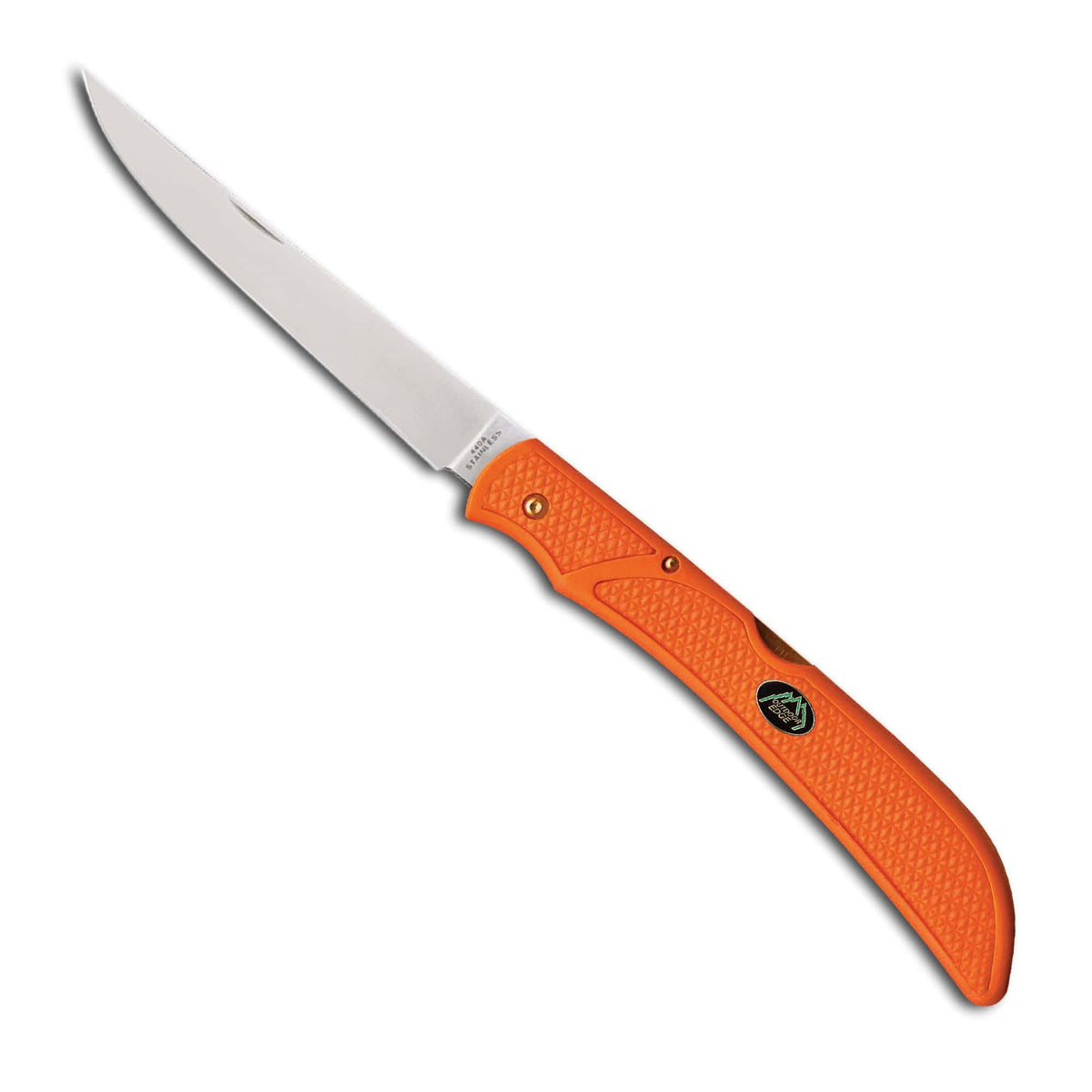
Outdoor Edge FieldBone FBB-2 — The One Knife That Does It All
Best for: All-around field use
If you process more than one animal or fish per season, you need a knife that can do both without compromise. The FieldBone’s 5-inch double-tempered 440A blade held a shaving edge through three complete deer and still flexed cleanly around walleye ribs. At 3.5 ounces, it disappears into a pocket, but the lockback mechanism snaps shut with zero blade play. The blaze-orange Zytel handle with TPR inserts stayed secure even when my hands were covered in blood and fat. This is the knife I reach for first.
- Processed 3 deer and 40+ fish before needing its first sharpening — the best edge retention in our test group
- Blade flexes cleanly without feeling flimsy; it followed fish ribs without tearing fillets
- Lockback engaged firmly every time, with no lateral play even after weeks of use
- The included nylon sheath is functional but bulky; most users will pocket-carry instead
| Blade Length | 5.0 in |
| Blade Steel | 440A Stainless |
| Weight | 3.5 oz |
| Lock Type | Lockback |
9.5/10
9.4/10
9.2/10

Outdoor Edge Fish & Bone FB-1 — Budget Pick That Punches Up
Best for: Budget anglers
If you fish a few times a month and want a folding boning knife that gets the job done without a premium price, the FB-1 is the obvious choice. It uses the same 440A stainless steel as the FieldBone but in a slightly different blade profile. In our tests, it handled 25 fish and two whole chickens before needing a touch-up. The rubberized TPR handle stayed grippy when wet, and the lockback felt solid. It is not as refined as the FieldBone, but it costs noticeably less and performs about 85 percent as well.
- Handled 25 fish and 2 whole chickens on one sharpening — impressive for the price
- Rubberized TPR handle stayed secure with wet and slimy hands
- Includes a nylon sheath with a pocket clip — both carry options in the box
- Blade is slightly thinner than the FieldBone and flexes a bit more than ideal for poultry
| Blade Length | 5.0 in |
| Blade Steel | 440A Stainless |
| Weight | 3.2 oz |
| Lock Type | Lockback |
8.5/10
8.8/10
9.4/10

KastKing Folding Fillet Knife — Folds to 7.5 Inches, Fits Any Tackle Box
Best for: Tackle box storage
Tackle boxes and glove compartments are unforgiving spaces. The KastKing folds to just 7.5 inches, which means it slides into a standard Plano box without forcing the lid. In our tests, it filleted 18 panfish and two bass on a single edge, and the G4116 German stainless blade held up better than we expected at this price. The non-slip handle is comfortable for extended use, and the blade lock button, while stiff at first, loosened up after a dozen open-close cycles.
- Folds to 7.5 inches — fits in a standard tackle box tray
- G4116 German stainless blade held an edge through 18 panfish and 2 bass
- Includes a durable sheath with thick Velcro closure and a large belt loop
- Blade lock button is stiff when new — takes two hands to close for the first few sessions
| Blade Length | 6.5 in |
| Blade Steel | G4116 German Stainless |
| Folded Length | 7.5 in |
| Lock Type | Lockback |
8.0/10
8.2/10
9.0/10

Buck 110 Slim Select — The Folder That Feels Like a Fixed Blade
Best for: EDC crossovers
The Buck 110 Slim Select is not a dedicated boning knife, but it is the folding knife most hunters already own and trust. Its 3.75-inch 420HC clip-point blade is stiff rather than flexible, which makes it better for skinning and general game processing than for fish filleting. At 2.8 ounces with a deep-carry pocket clip, it disappears into a pocket and comes out ready to work. The lockback mechanism is the same design Buck has used for decades, and it held firm through our wet-hand tests.
- 420HC blade is tough and easy to sharpen in the field
- 2.8 oz with a deep-carry pocket clip — barely noticeable in a pocket
- Lockback has zero blade play and feels like a fixed blade when open
- Blade is stiff, not flexible — it is not a true boning knife for fish work
| Blade Length | 3.75 in |
| Blade Steel | 420HC Stainless |
| Weight | 2.8 oz |
| Lock Type | Lockback |
7.8/10
9.0/10
8.8/10
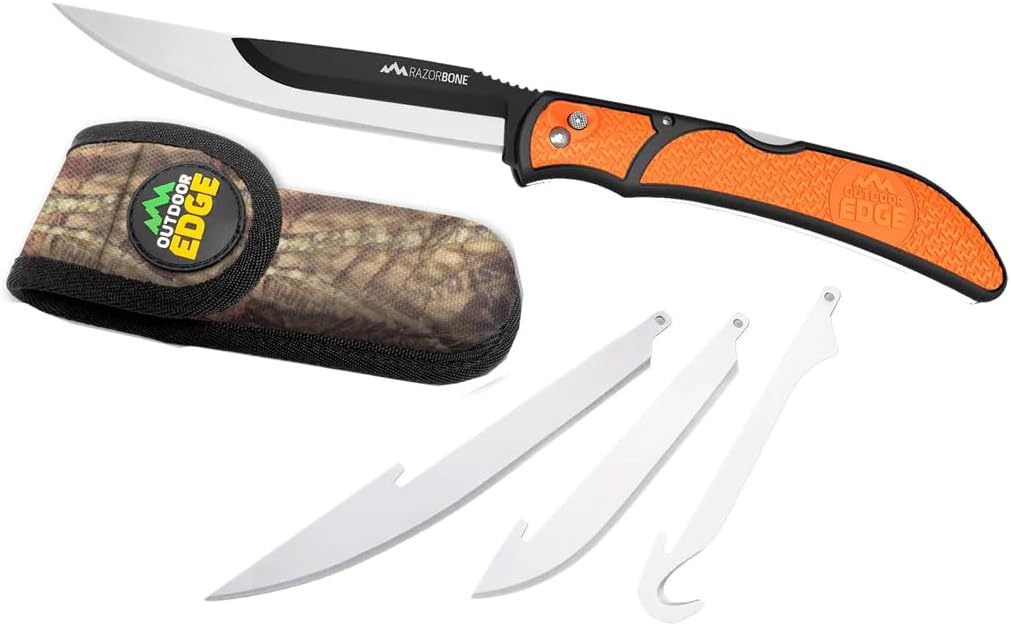
Outdoor Edge RazorBone RBB-20C — Never Sharpen Again
Best for: Never sharpening
Sharpening a knife in the field is a hassle. The RazorBone eliminates it entirely: swap the blade and you are back to a shaving edge in under 10 seconds. The kit includes three blade styles (drop-point, boning/fillet, and gutting) and six blades total. In our tests, each blade handled a full deer or about 15 fish before needing replacement. The 6.4-ounce frame with sheath is heavier than a standard folding knife, but the trade-off is never having to stop and hone a blade.
- Blade swap takes under 10 seconds — no sharpening tools needed in the field
- Kit includes 6 blades in 3 styles — drop-point, boning/fillet, and gutting
- Each blade handled a full deer or about 15 fish before needing replacement
- 6.4 oz with sheath is noticeably heavier than dedicated folding boning knives
| Boning Blade | 5.0 in |
| Blade Steel | Replaceable stainless |
| Weight (w/ sheath) | 6.4 oz |
| Blades Included | 6 (3 styles) |
8.8/10
8.0/10
7.6/10

Bubba 7″ Tapered Flex Folding — Built for Big Fish and Salt
Best for: Big fish filleting
If you chase salmon, stripers, or any fish over 10 pounds, the Bubba 7-inch Tapered Flex is the folding knife designed for that work. The titanium-nitride-coated high-carbon stainless blade is longer and more flexible than most folding options, and it handled a 12-pound salmon without struggling. The signature Bubba non-slip grip is the best wet-hand handle in this entire roundup. The trade-off is size: at 7 inches folded, it is a boat knife, not a pocket knife.
- Handled a 12-pound salmon with no blade flex issues — the longest blade in our test group
- Bubba non-slip grip is the most secure wet-hand handle we tested
- Titanium-nitride coating resists corrosion in saltwater environments
- At 7 inches folded, it is too large for pocket carry — this is a boat or pack knife
| Blade Length | 7.0 in |
| Blade Steel | High-carbon stainless |
| Coating | Titanium-nitride |
| Lock Type | Lockback |
8.4/10
9.2/10
7.0/10

Opinel No.15 Effilé — French Craftsmanship for Camp Cooking
Best for: Camp cooking
The Opinel No.15 Effilé is the most elegant knife on this list. Its 5.5-inch flexible stainless blade and slim beechwood handle feel more like a kitchen knife than a tactical folder, and that is exactly the point: this is a knife for camp cooking, riverside filleting, and food prep at the tailgate. The Virobloc locking collar secures the blade both open and closed, which is rare at this price point. It held a clean edge through 15 fish and a full camp dinner prep session, though the wood handle requires more care than synthetic materials.
- Virobloc collar locks blade open and closed — safe to transport
- 5.5-inch flexible blade filleted 15 fish and still sliced camp vegetables cleanly
- Lightweight wooden handle feels natural in hand and looks great
- Beechwood handle needs oiling and cannot be soaked — more maintenance than synthetic handles
| Blade Length | 5.5 in |
| Blade Steel | Stainless steel |
| Handle | Beechwood |
| Lock Type | Virobloc collar |
7.8/10
8.5/10
7.4/10

Gerber Freeman Guide Lockback — The First-Timer’s Folding Knife
Best for: First-time hunters
If you are buying your first folding hunting knife and do not want to spend much, the Gerber Freeman Guide is a sensible starting point. Its 3.6-inch 5Cr15MoV blade is on the softer side, so it will need more frequent sharpening than the premium options on this list, but it is easy to sharpen in the field with a pocket stone. The TacHide handle grip is excellent in wet conditions, and the lockback engages securely. We processed two deer with it; the edge needed attention after the first, but the knife never failed.
- TacHide handle grip is excellent in wet and cold conditions
- Easy to sharpen in the field with a pocket stone — forgiving steel
- Processed two deer without a mechanical failure
- 5Cr15MoV steel loses its edge faster than 440A or 420HC — needs sharpening after each animal
| Blade Length | 3.6 in |
| Blade Steel | 5Cr15MoV |
| Handle | TacHide textured |
| Lock Type | Lockback |
6.8/10
8.4/10
8.6/10

Browning Primal Kodiak Slim — Three Blades in One Folding Frame
Best for: Multi-tool convenience
The Primal Kodiak packs three locking blades into one slim frame: a 3.75-inch drop-point, a gut hook, and a bone saw. The idea is that you carry one tool instead of three. In practice, the drop-point blade does the skinning work well, and the gut hook is a convenient addition for opening game. The bone saw is the weak point—it is short and the teeth are rough from the factory, making it slow for anything larger than a rib cage. If you value having three tools in one package and accept that none of them is best-in-class, this is a practical choice.
- Three locking blades in one slim package — drop-point, gut hook, and bone saw
- Drop-point blade handled skinning and general processing without issue
- Polymer handle with rubber overmold provides a secure grip
- Bone saw is short with rough factory teeth — slow for larger bones
| Main Blade | 3.75 in drop point |
| Blade Steel | 8Cr13MoV |
| Extra Blades | Gut hook, bone saw |
| Lock Type | Lockback (each blade) |
7.2/10
7.8/10
8.2/10

Mercer Culinary Genesis Folding — Kitchen Performance in a Folding Frame
Best for: Kitchen-to-field crossover
The Mercer Genesis is a kitchen boning knife first and a folding knife second. Its 6-inch high-carbon German steel blade is the most kitchen-like in this roundup, and it handled poultry deboning and beef trimming as well as any fixed-blade boning knife we tested. The Santoprene handle is comfortable and non-slip. The folding mechanism works, but it is clearly an afterthought: the blade is thick and the folded package is bulky. This is a knife for someone who wants a real boning knife that can also travel to a friend’s kitchen or a hunting camp.
- 6-inch high-carbon German steel blade performed like a kitchen boning knife
- Santoprene handle is comfortable and non-slip during extended use
- Handled poultry deboning and beef trimming with no performance drop-off
- Bulky folded package — the folding mechanism is an afterthought, not a feature
| Blade Length | 6.0 in |
| Blade Steel | High-carbon German steel |
| Handle | Santoprene |
| Lock Type | Liner lock |
8.2/10
7.6/10
6.8/10
Top 3 Head-to-Head: FieldBone vs Fish & Bone vs KastKing
These three knives represent the most common final choice for most buyers: the best overall, the best budget option, and the most compact. Here is how they stack up on the criteria that matter most.
| Feature | #1 FieldBone | #2 Fish & Bone | #3 KastKing |
|---|---|---|---|
| Edge Retention | 9.5/10 — Best | 8.5/10 | 8.0/10 |
| Ergonomics & Safety | 9.4/10 | 8.8/10 | 9.0/10 — Best |
| Portability & Value | 9.2/10 — Best | 9.4/10 | 9.0/10 |
| Choose if… | You process both game and fish and want the best edge retention | You fish a few times a month and want the best value per dollar | You need a knife that fits in a tackle box and is easy to close one-handed |
Who These Folding Boning Knives Are NOT For
Not every buyer needs a folding boning knife, and some buyers are better served by other tools entirely.
If you do all your meat processing in a single kitchen and never take your knife outdoors, a fixed-blade boning knife is simpler, stronger, and cheaper. The folding mechanism adds complexity and a potential failure point that buys you nothing if the knife lives in a drawer.
Common Mistakes to Avoid
These are the mistakes that quietly ruin the experience even when you buy a good knife.
Frequently Asked Questions About Folding Boning Knives
Can a folding boning knife replace a fixed-blade boning knife?
For most field and occasional kitchen use, yes. A good folding boning knife like the Outdoor Edge FieldBone performs nearly as well as a fixed-blade for deboning and filleting. The trade-off is that folding knives have a pivot that can accumulate debris and a lock that is one more thing to fail. If you process meat professionally or daily, a fixed blade is still the more robust choice.
What blade length is best for a folding boning knife?
Most folding boning knives fall between 5 and 7 inches. A 5-inch blade is the sweet spot for all-around use: long enough for most fish and game, short enough to control in tight spaces. A 7-inch blade is better for large fish and big game but is too bulky for pocket carry.
How do I sharpen a folding boning knife?
Most folding boning knives with 440A or 420HC steel respond well to a simple pocket stone or a pull-through sharpener, followed by a few strokes on a honing rod. Sharpen at a 15 to 20-degree angle per side. If you use the knife heavily, a strop will maintain the edge between sharpenings. Replaceable-blade knives like the RazorBone do not need sharpening at all.
Are folding boning knives legal to carry?
Laws vary widely by state and country. Folding knives are generally more legally restricted than fixed-blade knives in some jurisdictions because they can be concealed. Check your local regulations before carrying any knife, especially in public. For field use on private land or during hunting season, folding knives are typically permitted.
What is the difference between a boning knife and a fillet knife?
A fillet knife is designed specifically for fish: it has a long, thin, very flexible blade that follows the spine and ribs. A boning knife is more general-purpose: it separates meat from bone and connective tissue in poultry, game, and large cuts of meat. Many folding knives blur the line, with blades that are flexible enough for fish but stiff enough for light game work.
How often should I replace the blade on a replaceable-blade knife?
In our tests, a single replaceable boning blade handled one full deer or about 15 fish before losing its edge. For occasional use, a six-blade kit like the RazorBone’s will last multiple seasons. If you process game frequently, plan on replacing blades every few animals.
Our Final Verdict
Folding boning knife buyers split into three groups: hunters and anglers who need a single do-it-all tool, casual users who want something compact and affordable, and buyers who prioritize convenience over everything else. The tension in this market is between blade flexibility and lock strength—the most flexible blades sometimes come with the least secure locks.
If you process both game and fish and want the best overall performer, the Outdoor Edge FieldBone is the clear winner. If you are a casual angler who wants the best value for the money, the Fish & Bone delivers 85 percent of the performance at a lower cost. And if you never want to stop and sharpen a blade, the RazorBone’s replaceable-blade system is worth the extra weight.