What Is the Tip of a Chef Knife Used For? 7 Uses
Quick Answer
The tip of a chef knife is used for precise cutting, making small incisions, scoring ingredients, and guiding the blade during rocking cuts. Its narrow, pointed shape provides control when working with garlic, shallots, herbs, and other small ingredients. During rock chopping, the tip can remain against the cutting board while the rest of the blade moves up and down.
A chef knife is designed to perform several cutting jobs, but not every part of its blade works the same way. The pointed front section handles controlled movements that would be awkward with the wider portion near the handle.
Learning how to use the tip makes everyday preparation easier. It also helps you understand when to use the middle or heel of the blade instead of forcing the point through an unsuitable ingredient.
Where Is the Tip of a Chef Knife?
The tip is the pointed end at the front of the blade, farthest from the handle. Immediately behind it is a narrow section of the cutting edge that gradually widens toward the middle.
Although the point itself is useful for beginning small cuts, most precision work uses the short sharpened section directly behind it. This distinction matters because the very point is not designed to absorb heavy downward force.
A typical chef knife has three useful cutting regions:
- Tip: Controls small cuts, starts shallow incisions, and guides rocking movements.
- Middle: Handles general slicing, chopping, and dicing.
- Heel: Provides greater leverage for cutting larger or firmer ingredients.
These regions work together. A smooth chopping stroke may begin near the tip and continue through the middle or heel without requiring you to change knives.
7 Practical Uses of the Chef Knife Tip
 Save
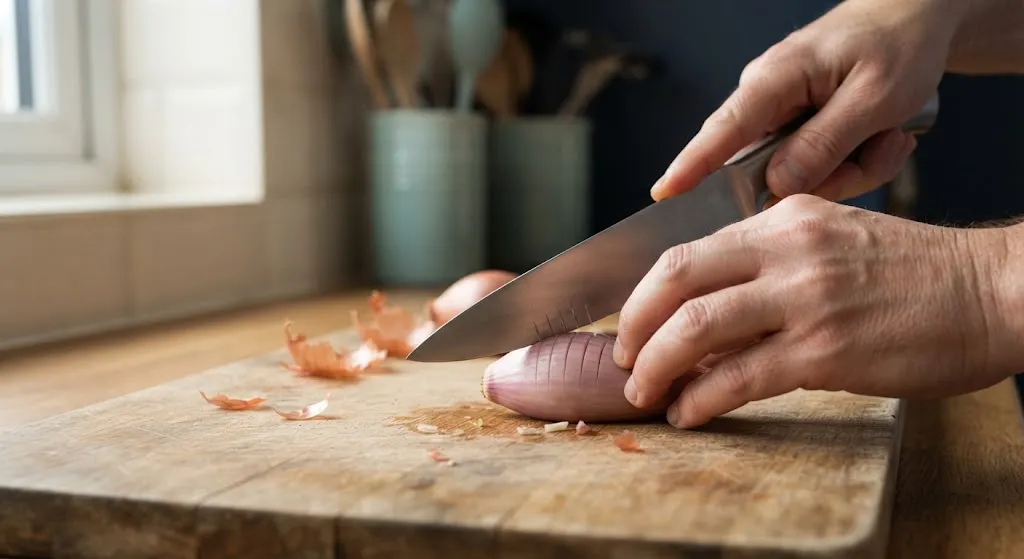
SaveThe tip is most useful when the task requires accurate blade placement or a controlled cutting motion rather than substantial force.
1. Making Precise Cuts in Small Ingredients
The narrow front section helps you make short cuts in garlic, shallots, scallions, and other small foods. You can see exactly where the blade will enter, which makes it easier to control spacing.
For example, when preparing a shallot for fine dicing, the tip can help begin a series of closely spaced cuts while the shallot rests securely on its flat side.
Use gentle, deliberate strokes instead of pressing the point straight downward with excessive force. The goal is to guide the cutting edge through the ingredient, not stab it.
2. Mincing Garlic and Fresh Herbs
One of the most practical uses of a chef knife tip is helping maintain a pivot point during mincing.
After roughly chopping garlic or herbs, gather the pieces into a small pile. Keep the front part of the blade near the cutting board while moving the handle up and down in controlled rocking strokes.
The curved cutting edge repeatedly passes through the ingredients, reducing them to smaller pieces. Move the knife across the pile gradually so the ingredients are chopped evenly.
This method works particularly well with a chef knife that has a noticeable curve toward its tip.
3. Guiding Rock Chopping
Rock chopping is a cutting technique in which the knife moves through a smooth, seesaw-like motion.
The front portion stays close to the cutting board while the handle rises and lowers. As the blade rocks, different sections of the cutting edge contact the food.
The University of Nebraska–Lincoln knife skills guide describes keeping the tip against the cutting board while mincing ingredients such as herbs and garlic.
However, the tip does not have to remain completely fixed for every cutting task. Some slicing techniques work better with a forward movement that allows the point to travel across the board.
4. Scoring Vegetable Surfaces
Scoring means making shallow cuts in the surface of an ingredient without cutting completely through it.
The tip can start controlled score lines in suitable vegetables, such as making a shallow crosshatch pattern on the cut face of an eggplant before cooking.
The useful feature is depth control. Instead of pushing the entire blade into the food, you guide the front cutting edge through a shallow, deliberate path.
Keep the vegetable stable on the cutting board and avoid placing fingers directly behind the area being scored.
5. Starting Fine Dicing Cuts
Fine dicing becomes easier when the initial cuts are accurate. The tip can help position and begin short, closely spaced cuts before the rest of the blade finishes them.
Consider an onion half resting cut-side down. When making lengthwise cuts, begin each stroke carefully so the pieces remain controlled and the root end continues to hold much of the onion together.
Finish with crosswise cuts using an appropriate portion of the cutting edge. You do not need to perform the entire process with the tip alone.
Uniform pieces are useful because similar-sized ingredients generally cook more consistently.
6. Trimming Small Edges and Imperfections
The front cutting edge can remove a small blemish or trim a thin protruding section from an ingredient when that ingredient can be held securely against the board.
For example, you might carefully trim a small remaining piece of stem from a prepared vegetable.
A paring knife is usually more convenient for intricate work on tiny or irregularly shaped ingredients. Avoid using a large chef knife tip for detailed cuts while holding food in your palm.
7. Creating Short Starter Incisions
Sometimes a cut must begin in a small, clearly defined location. The pointed shape can help you start a controlled incision in a stable, relatively soft ingredient.
For example, a small starter cut may help establish the beginning of a decorative vegetable cut before continuing with the cutting edge.
However, the tip should not be used to stab into hard squash, frozen food, bone, or other resistant materials. Such tasks can cause the knife to slip, twist, or damage its point.
Key Insight
The chef knife tip is primarily a precision and control feature, not a power-cutting tool. For successful cutting, choose the part of the blade that matches the ingredient and movement.
How to Use the Tip for Rock Chopping
Rock chopping is a helpful technique to practice because it shows how the tip cooperates with the curved cutting edge.
- Prepare a stable cutting surface. Place your board on a nonslip surface. If it moves, secure it with a damp towel underneath.
- Position the ingredients. Gather a small amount of previously chopped garlic or herbs near the center of the board.
- Hold the knife correctly. Use a pinch grip, with your thumb and index finger holding the blade near the handle and your remaining fingers around the handle.
- Position the tip. Rest the front edge against the board just beyond the ingredient pile.
- Rock the blade. Lift the handle slightly and lower it in a smooth cutting motion while the front of the blade remains close to the board.
- Work across the ingredients. Shift the cutting path gradually until the pieces reach the desired size.
Keep your free hand away from the moving cutting edge. Stop and set the knife down before gathering scattered pieces.
Beginners should concentrate on smooth, predictable movements rather than speed. A slower stroke that follows the same cutting path is easier to control than rapid, irregular chopping.
Practical Tip
Practice the rocking motion with a small pile of soft herbs before attempting finely diced vegetables. Start with short movements, keep the board stable, and build consistency before increasing speed.
Chef Knife Tip vs. Middle vs. Heel: Which Should You Use?
Using the correct blade section helps you avoid unnecessary force and makes cutting movements more predictable.
| Blade Section | Best Uses | Main Advantage |
|---|---|---|
| Tip | Small incisions, scoring, fine cutting, rocking guidance | Precise placement and control |
| Middle | General slicing, vegetable chopping, dicing | Balanced cutting movement |
| Heel | Firm vegetables and cuts requiring extra leverage | Greater leverage near the handle |
If you are cutting a large carrot into sections, the middle or heel is generally more suitable than the delicate point. If you are beginning a shallow score or carefully positioning a small cut, the tip becomes more useful.
A chef knife is versatile because these sections complement one another, not because every section should perform every task.
Does the Shape of the Knife Tip Affect Its Use?
Yes. Blade profile influences how naturally a knife performs rocking and precision cutting.
A Western-style chef knife often has a gradually curved cutting edge toward the point. That curve allows a comfortable rocking motion while the handle rises and falls.
A Japanese-style gyuto may have a different curvature depending on its design. Some profiles favor smooth slicing and smaller rocking movements rather than exaggerated rocking strokes.
A santoku typically has a flatter cutting edge and a downward-curving spine near its front. Many santoku designs work particularly well with push cutting and controlled chopping.
Neither shape is automatically superior. The most useful technique depends on the individual knife’s blade geometry and the ingredient being prepared.
If rocking feels awkward because the edge is relatively flat, avoid forcing the movement. A controlled forward-and-down slicing stroke may work better.
What Should You Avoid Doing With a Chef Knife Tip?
The point is relatively narrow and can be damaged or slip when used incorrectly. Several mistakes are particularly worth avoiding.
- Prying: Never use the point to open lids, lift stuck objects, or separate rigid materials.
- Twisting in hard food: Avoid inserting the tip into a firm ingredient and turning the handle sideways.
- Cutting bones: Use a suitable knife or tool rather than trying to force the point through bone.
- Stabbing frozen ingredients: Thaw or prepare ingredients appropriately rather than using the point to break them apart.
- Cutting toward your hand: Keep the cutting path directed toward the board and away from your body.
- Working on a moving board: Stabilize the surface before beginning precision work.
The Virginia Tech knife skills guidance emphasizes securing the food with a claw grip, controlling the blade, and using appropriate cutting techniques.
Safety Warning
Never use the tip as a screwdriver, lever, or ice pick. If the point bends, chips, or breaks, stop using the knife until it has been appropriately assessed or repaired. Do not continue preparing food with a damaged cutting point.
When Is a Paring Knife Better Than a Chef Knife Tip?
A paring knife is generally the better choice for delicate tasks involving very small ingredients, especially when a full-sized chef knife feels cumbersome.
Examples include removing the hull from a strawberry, trimming a small blemish, or carefully peeling an awkwardly shaped piece of produce.
The chef knife tip is more convenient when you want precise cutting while keeping ingredients on the cutting board. It lets you switch between fine detail and ordinary chopping without changing tools.
A paring knife offers a shorter blade and more compact handling, making certain intricate tasks easier to control.
For beginners, a useful decision rule is simple: use the chef knife for board-based cutting and choose a paring knife when the task requires genuinely delicate, close-range control.
How to Keep the Chef Knife Tip Sharp and Undamaged
 Save
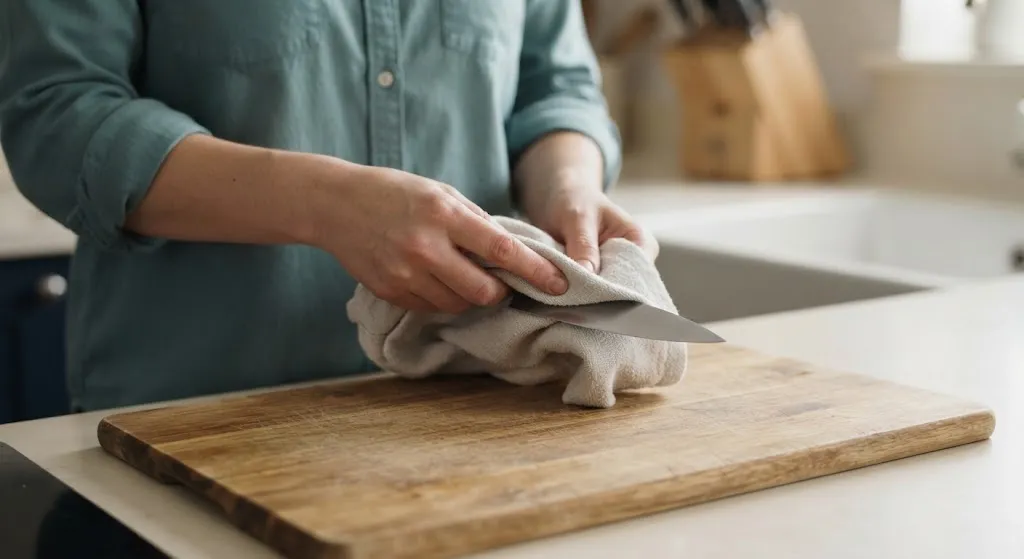
SaveMaintaining the tip means caring for the entire cutting edge while avoiding actions that place unnecessary lateral pressure on the point.
Use a wooden or suitable plastic cutting board instead of hard glass, stone, or ceramic surfaces. Wash the knife carefully by hand, dry it promptly, and store it in a way that protects the cutting edge.
Honing and sharpening are different maintenance processes. Honing helps realign an edge where appropriate, while sharpening removes metal to restore cutting geometry.
If the front edge begins tearing herbs instead of slicing cleanly, the knife may need sharpening. A damaged or significantly bent tip may require professional repair rather than ordinary honing.
Inspect the point visually before delicate work. An intact, appropriately sharpened cutting edge gives you better control without requiring excessive pressure.
Related Product
Chef Knife for Everyday Precision Cutting
A well-maintained chef knife with a comfortable handle and suitable blade curve can help with controlled slicing, mincing, and rocking techniques. Choose a size and blade profile that feel manageable in your hand.
As an Amazon Associate, we earn from qualifying purchases.
Frequently Asked Questions
Is the tip of a chef knife supposed to be sharp?
Yes. On most chef knives, the cutting edge continues toward the pointed end. The tip should be properly maintained, although the exact shape and sharpness depend on the knife’s design.
Can you use a chef knife tip to pierce food?
The point can begin small, controlled incisions in suitable ingredients, but it should not be forced into hard food or used for stabbing. Keep the ingredient stable and use the cutting edge whenever possible.
Should the tip always touch the cutting board?
No. Keeping the tip near or on the cutting board is common during rock chopping, but slicing and other cutting techniques may require the front of the knife to move forward or lift off the surface.
Can you chop vegetables with only the tip?
Small, delicate cuts can use the front cutting edge, but larger vegetables are usually easier to chop with the middle or heel of the knife. Use the entire blade according to the cutting task.
Why does my chef knife tip get stuck in food?
The ingredient may be too firm, the knife may be entering at an awkward angle, or the point may be used where a slicing motion would be better. Stop and reposition the food rather than twisting the knife free.
Can a broken chef knife tip be repaired?
Some small tip breaks can be repaired by carefully reshaping and sharpening the blade. The feasibility depends on how much material is missing and the blade’s construction. Significant damage should be assessed by a qualified knife sharpening professional.
Final Thoughts
The tip of a chef knife is most valuable for accurate blade placement, fine cutting, scoring, and guiding rocking movements. It works with the middle and heel to make one knife suitable for many everyday kitchen tasks.
Use the point for control rather than force, keep the blade properly maintained, and match your cutting technique to the ingredient. These habits make precision work more manageable while protecting both your knife and your hands.

