What Is the Spine of a Chef Knife? Explained
Quick Answer
The spine of a chef knife is the thick, unsharpened upper edge of the blade, opposite the sharp cutting edge. It provides structural support, helps determine blade stiffness and weight, and can influence comfort when handling the knife. Unlike the heel, which is part of the cutting edge near the handle, the spine is not designed for slicing food.
Where Is the Spine on a Chef Knife?
 Save
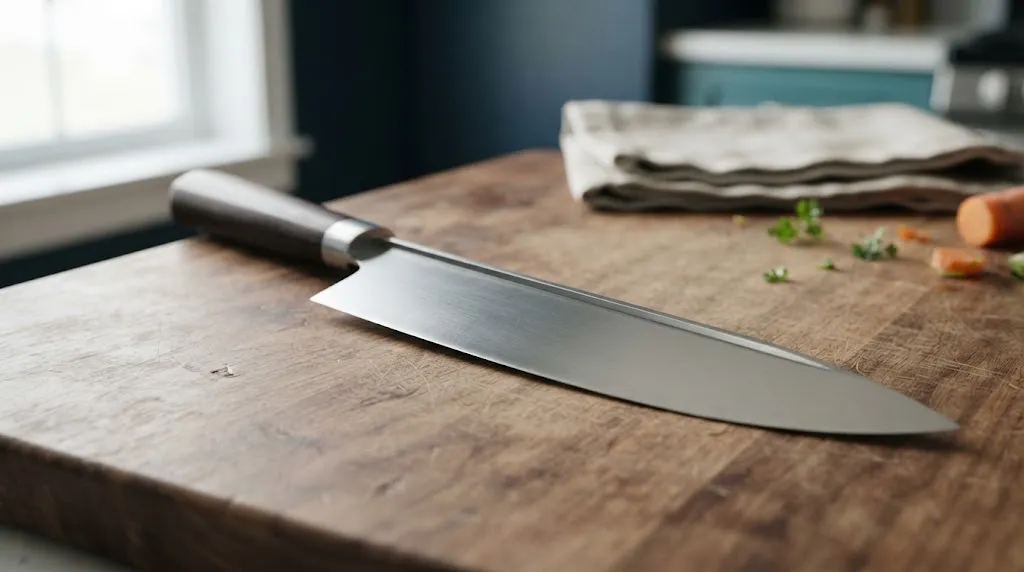
SaveThe spine runs along the upper back of a chef knife’s blade, generally extending from near the handle toward the tip. When you hold a conventional chef knife with its cutting edge facing downward, the spine is the upper edge facing away from the cutting board.
On many knives, it appears as a narrow, flat strip of metal. Viewed from above, this strip reveals the blade’s thickness and whether it becomes thinner toward the tip.
The spine is easy to identify using three features:
- Location: It sits opposite the sharpened cutting edge.
- Shape: It is usually thicker and less pointed than the cutting edge.
- Surface: It is normally unsharpened, although its corners may be rounded or left relatively square.
A spine is not necessarily comfortable or completely free of sharp corners. Some inexpensive or unfinished knives have square spine edges that feel unpleasant against the fingers.
Knowing where the spine sits helps you understand knife anatomy, evaluate blade construction, and recognize which surfaces are intended for cutting.
What Does the Spine of a Chef Knife Do?
The spine primarily supports the blade’s structure. Its thickness, shape, and finish influence how the knife feels and performs, even though the spine itself does not normally cut food.
1. Supports Blade Strength and Stiffness
The spine is part of the blade’s main metal structure. A thicker spine can increase resistance to bending, depending on the steel, blade height, cross-sectional geometry, and heat treatment.
This helps explain why a robust Western-style chef knife often feels different from a thin Japanese-style gyuto. The Western knife may feel more substantial, while a thinner blade may move through suitable ingredients with less resistance.
However, a thicker spine does not automatically mean a better or safer knife. Blade strength depends on the complete construction, not one measurement.
2. Influences Weight and Balance
The spine contributes to the amount and distribution of metal in the blade. A thicker spine generally adds material, although blade length, height, taper, handle construction, and overall geometry also influence weight.
A knife with more mass near the handle may feel substantial during chopping. A lighter, thinner knife may feel more responsive during delicate vegetable preparation.
Neither characteristic is universally superior. The most comfortable option depends on the cutting task, knife design, and user’s preferences.
3. Affects Handling Comfort
The spine’s finish matters when fingers come near the upper part of the blade. A smoothly rounded spine is generally more comfortable to touch than one with abrupt, square corners.
This becomes especially noticeable during repeated preparation work or specialized cutting techniques.
For ordinary chef knife use, a pinch grip typically places the thumb and index finger against the sides of the blade near the handle, rather than directly on top of the spine.
A comfortable spine is therefore useful, but it does not replace a secure grip or correct cutting technique.
4. Helps Define Blade Geometry
The spine forms the upper boundary of the blade’s overall profile. Along with the blade faces, edge geometry, and taper, it affects how the knife interacts with food.
Two knives can have equally sharp edges but perform differently because one has a thicker blade behind its cutting edge.
For example, a thin knife may pass smoothly through a firm carrot, while a thicker knife can create more wedging resistance. The result depends on the entire blade geometry, not the spine thickness alone.
Does Spine Thickness Affect Cutting Performance?
Yes, spine thickness can affect cutting performance, but it is only one part of the blade’s design.
A thicker spine generally provides more material for structural stiffness. A thinner spine may contribute to a lighter, more agile blade, especially when combined with a thin grind behind the edge.
Consider these common differences:
| Feature | Thicker Spine | Thinner Spine |
|---|---|---|
| Blade stiffness | Generally greater with otherwise similar construction | May allow more flexibility |
| Weight | Often heavier | Often lighter |
| Cutting resistance | May increase with a thicker overall grind | May decrease with a thinner overall grind |
| Common preference | Substantial, robust handling | Lightweight, precise handling |
The useful distinction is between spine thickness and cutting-edge geometry. A knife can have a substantial spine near the handle yet taper into a fine tip and relatively thin cutting geometry.
For that reason, judging slicing performance from spine thickness alone can be misleading.
What Is Distal Taper on a Chef Knife?
Distal taper describes a blade that gradually becomes thinner along its length, usually from the handle area toward the tip.
On a tapered chef knife, the spine may appear thicker near the heel and progressively narrower toward the point. This design allows different regions of the same blade to have different characteristics.
The rear may offer greater stiffness and mass, while the forward section may feel lighter and more maneuverable.
Not every knife has a pronounced distal taper. Some have relatively consistent thickness through much of the blade, while others thin more noticeably.
Key Insight
A chef knife does not need the same spine thickness along its entire length. A tapered spine can combine a relatively sturdy rear section with a thinner, lighter tip. Examine the whole blade rather than relying on one thickness measurement.
Spine vs. Heel: What Is the Difference?
The spine and heel are different parts of a chef knife. The spine is the unsharpened upper edge, while the heel is the rear portion of the sharpened cutting edge nearest the handle.
This distinction matters because each part performs a different function.
What Is the Heel of a Chef Knife Used For?
The heel is commonly used for controlled, forceful cutting because it is close to the user’s hand. It is particularly useful when chopping firm ingredients, such as carrots, potatoes, and some squash.
Its position allows the cook to apply downward force with relatively good control. On many chef knives, the heel also has a straighter cutting-edge section than the curved belly.
However, the heel is not a substitute for a cleaver. A standard chef knife should not be forced through hard bones, frozen food, or materials outside its intended use.
How Is That Different From the Spine?
The heel makes cuts with its sharpened edge. The spine provides structural support and defines part of the blade’s shape.
The spine may help with certain non-cutting tasks on appropriately designed knives, but it is not the part you normally use to chop vegetables.
The chef knife anatomy guide from The Kitchn also identifies the spine and heel as separate blade components, with different roles in knife construction and cutting.
Can You Use the Spine of a Chef Knife?
Yes, the spine can be useful for selected tasks, provided the knife is designed appropriately and the task does not risk damaging the blade or causing injury.
One practical use is gently scraping chopped ingredients together on a cutting board. Using the blunt spine instead of dragging the sharpened edge sideways can help reduce unnecessary edge contact with the board.
For collecting large amounts of chopped food, a dedicated bench scraper is usually easier and safer than turning a knife around.
Some cooks also use the backs of suitable knives for light food preparation tasks. However, repeatedly striking hard objects with the spine is not a general recommendation for ordinary chef knives.
Do not assume the spine is intended for hammering, cracking hard bones, prying, or applying force that could damage the knife.
Is It Safe to Put Your Finger on the Knife Spine?
Placing a finger on the spine is not automatically dangerous, but it is generally not the preferred grip for routine chopping with a standard chef knife.
Extending the index finger straight along the spine can make some knives harder to control sideways. It may also create uncomfortable pressure during repeated cutting.
For many people, the pinch grip offers more reliable control:
- Place your thumb against one side of the blade just ahead of the handle.
- Rest your bent index finger against the opposite side.
- Wrap your remaining fingers comfortably around the handle.
- Keep the wrist relaxed and the blade aligned with the cutting motion.
Individual grip needs vary. Certain specialized cutting techniques use different finger positions, and a comfortable handle-focused grip may be appropriate for some users.
The goal is controlled movement without unnecessary squeezing or strain.
Safety Reminder
Do not slide your fingers along the blade to locate its spine, and never assume every unsharpened surface is smooth. Identify the parts visually with the knife stationary on a secure surface. Keep your supporting hand away from the cutting edge.
What Makes a Well-Finished Knife Spine?
A well-finished spine generally has smooth, consistent edges without rough machining marks or uncomfortable corners.
It should feel appropriate for the knife’s intended use and grip style. A spine does not need to be dramatically rounded, but rough burrs and unexpectedly sharp corners are undesirable.
When inspecting a chef knife, look for these characteristics:
- Smooth finishing: The upper corners should not have obvious rough burrs.
- Consistent construction: Changes in thickness should appear intentional rather than irregular.
- Comfortable geometry: The spine should not create painful pressure during a normal grip.
- Appropriate thickness: The blade should match the type of cutting work for which it was designed.
- No visible damage: Avoid blades with unexplained cracks, severe deformation, or other structural problems.
A squared spine is not necessarily defective. Some knives intentionally retain relatively crisp corners. The important question is whether that finish is suitable and comfortable for normal use.
If the spine is uncomfortably sharp, professional finishing may be possible. Do not casually grind or reshape an expensive knife without understanding how the work could affect its finish, corrosion resistance, or geometry.
Does the Spine Need Sharpening?
No. The spine of a conventional chef knife is not a cutting edge and does not require normal sharpening.
Knife sharpening focuses on the bevels that meet to form the cutting edge. Honing or sharpening these surfaces maintains cutting performance, depending on the knife and the maintenance method.
The spine may occasionally need attention if rough finishing or damage creates an uncomfortable edge, but that is different from sharpening the knife for cutting.
Some specialized knives have unusual blade profiles or additional sharpened areas. Always identify the particular knife design before assuming that every upper surface is safe to handle.
How to Check the Spine Before Choosing a Chef Knife
 Save
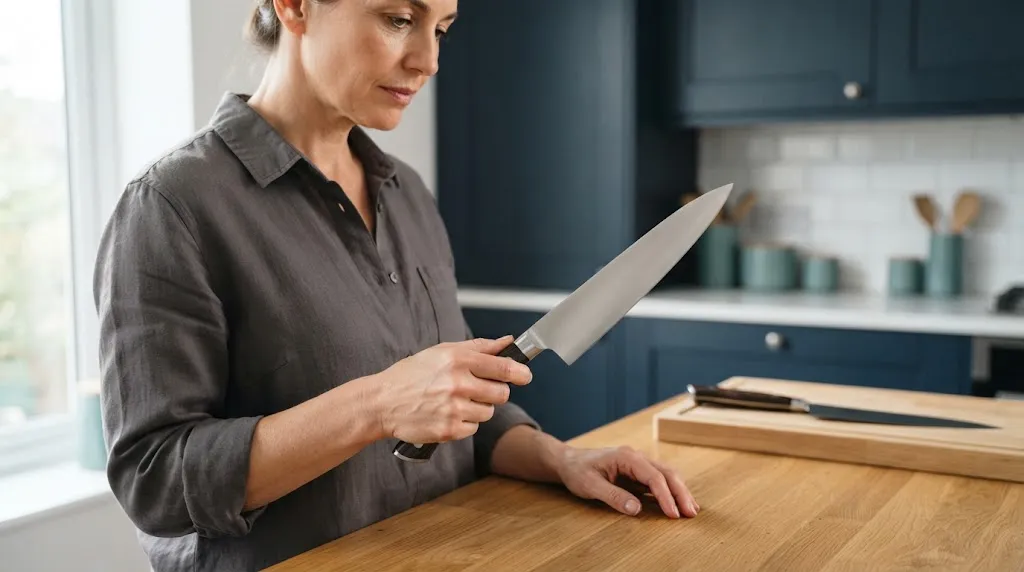
SaveIf you are comparing chef knives, the spine can reveal useful details about construction, but it should be evaluated alongside the handle, cutting edge, overall weight, and blade geometry.
A practical inspection involves four checks:
- Look from above: Observe whether the spine maintains a consistent thickness or tapers toward the tip.
- Inspect the finish: Look for rough corners, visible burrs, or obvious irregularities.
- Evaluate blade proportions: Consider the spine thickness relative to the blade’s height and overall design.
- Assess comfortable handling: If possible, hold the knife safely using your normal grip and check whether its shape feels secure and balanced.
For routine vegetable slicing, a thinner overall blade geometry may feel more efficient. For users who prefer a substantial Western-style knife, a somewhat thicker construction may be desirable.
Do not select a knife solely because a specification advertises a thicker or thinner spine. The complete design matters much more than an isolated number.
Frequently Asked Questions
Is the Spine the Same as the Back of a Knife?
Yes. On a conventional chef knife, the spine is commonly called the back of the blade. It is the unsharpened edge opposite the cutting edge, although unusual knife designs may have different configurations.
Can a Knife Spine Be Sharp?
The spine is normally unsharpened, but its corners can feel sharp if they have not been smoothed. A crisp metal corner is different from a purposefully sharpened cutting edge.
Do Japanese Chef Knives Have Spines?
Yes. Japanese chef knives, including gyuto and santoku designs, have spines. Their thickness, taper, and finishing vary depending on the model and intended cutting performance.
Why Is My Chef Knife Thicker Near the Handle?
Some chef knives have a distal taper, meaning the blade gradually becomes thinner toward the tip. Greater thickness near the handle can contribute to stiffness and weight distribution.
Can You Use the Knife Spine to Move Chopped Vegetables?
Yes, the blunt spine can gently gather chopped food on a suitable cutting board. However, a bench scraper is often a more convenient tool for transferring larger quantities.
Does a Thicker Spine Mean a More Durable Knife?
Not necessarily. A thicker spine can contribute to stiffness, but durability also depends on steel properties, heat treatment, edge geometry, blade construction, and appropriate use.
Final Thoughts
The spine of a chef knife is more than its blunt upper edge. It contributes to blade stiffness, weight distribution, handling comfort, and overall geometry.
Understanding how the spine differs from the heel and sharpened edge makes it easier to use a chef knife appropriately and evaluate its construction. The best spine design is not necessarily the thickest or thinnest, but one that complements the knife’s intended purpose and feels comfortable during use.

