What Is the Belly of a Chef Knife? Uses Explained
Quick Answer
The belly of a chef knife is the curved portion of its sharpened cutting edge, usually most noticeable as the edge rises toward the tip. This curve lets the blade rock smoothly against a cutting board, making it useful for chopping herbs, mincing garlic, and cutting vegetables. A more pronounced belly favors rocking cuts, while a flatter edge generally suits push cutting and straight downward chopping.
Where Is the Belly on a Chef Knife?
The belly is located along the lower, sharpened edge of the blade. On a typical Western chef knife, look at the cutting edge from the heel near the handle toward the pointed tip. The section that curves upward is the belly.
Unlike the spine, which forms the unsharpened upper boundary of the blade, the belly is part of the cutting edge itself. It is not a separate attachment, raised surface, or thick section of metal.
The exact boundaries are not rigid. Some knife descriptions use “belly” for the central portion of the edge, while others use it specifically for the pronounced curve toward the front. Both usages refer to the blade’s cutting-edge profile.
Belly vs. Heel, Tip, and Spine
These four knife parts have different functions, although they work together during normal food preparation.
| Knife part | Location | Main function |
|---|---|---|
| Belly | Curved cutting edge | Rocking, chopping, and mincing |
| Heel | Rear edge near the handle | Controlled, forceful cuts |
| Tip | Front end of the blade | Detail work and precise cuts |
| Spine | Unsharpened upper edge | Blade structure and rigidity |
One useful distinction is that the belly describes the shape of an edge section, while the heel and tip describe particular blade regions. A knife can have a pronounced belly without being especially thick or heavy.
Why Does a Chef Knife Have a Curved Belly?
The belly creates a rolling path for the cutting edge. Instead of requiring the entire edge to rise from the board and return simultaneously, the curved profile lets different portions of the blade contact the cutting surface as the knife moves.
Imagine a gently curved rocking chair resting on a flat floor. Its contact point shifts as it rocks. A curved knife edge works on a related geometric principle, although the actual cutting movement also involves forward and downward motion.
This is particularly useful when preparing small ingredients that need repeated cuts. With a suitable chef knife, a cook can maintain a controlled rhythm while moving the edge through a pile of herbs or vegetables.
The curve also affects how high the handle needs to rise to move the cutting edge through an ingredient. A blade with greater curvature generally offers more rocking travel before the motion feels restricted.
However, more belly does not automatically mean better cutting. The ideal profile depends on the ingredients, cutting method, blade sharpness, and user preference. A flatter edge may provide more simultaneous board contact during straight downward cuts.
Knife manufacturer WÜSTHOF explains German knife geometry in terms of a curved blade profile that supports a steady rocking chopping motion.
How to Use the Belly of a Chef Knife for Rock Chopping
 Save
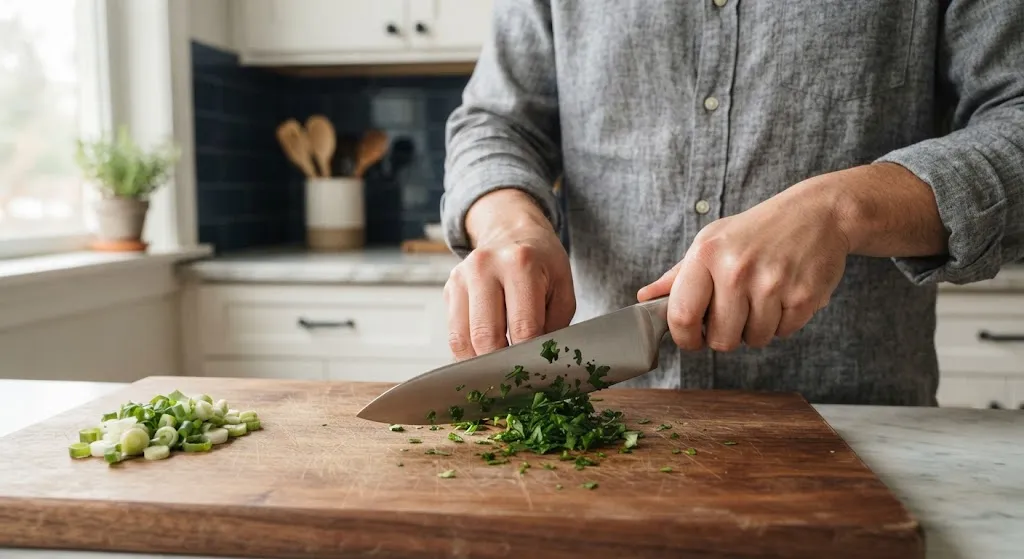
SaveRock chopping is the cutting method most closely associated with a pronounced knife belly. The technique combines a controlled grip with a smooth movement of the curved edge against the cutting board.
Start with a stable cutting board, a sharp knife, and ingredients that are appropriately sized for controlled cutting. For practice, chopped parsley or a small pile of sliced green onions is easier to manage than a large, unstable vegetable.
- Hold the knife securely. Use a comfortable grip that provides control. A pinch grip places the thumb and index finger on opposite sides of the blade near the handle.
- Position the front of the edge. Place the forward section of the knife near the cutting board, with the ingredient beneath the cutting path.
- Protect the guiding hand. Curl your fingertips inward and let the knuckles guide the blade while keeping fingertips away from the edge.
- Raise and move the handle. Lift the rear portion of the knife while maintaining gentle control of the front section.
- Rock through the ingredient. Move the blade forward and downward in a smooth motion so the curved belly passes through the food.
- Reset and repeat. Move the guiding hand gradually as the ingredient becomes smaller. Keep the cutting motion deliberate rather than forcing speed.
The forward edge does not have to remain perfectly motionless against the board on every stroke. The objective is controlled cutting, not forcing the knife into an exaggerated pivot.
ZWILLING’s guide to kitchen cutting techniques also describes using a smooth rocking movement and a properly positioned guiding hand.
Practical Tip
If pieces of herbs remain connected after each rocking stroke, check whether enough of the edge is reaching the board. Slow down, adjust the motion, and avoid forcing the knife or striking the board harder.
Which Cutting Tasks Benefit Most From a Curved Belly?
A curved belly is especially useful when repeated cutting movements are needed over a relatively small area of the board.
Mincing Fresh Herbs
Parsley, cilantro, and similar herbs are common examples. Once the herbs are gathered into a manageable pile, the curved edge can move through them repeatedly without a complete reset between every cut.
The important detail is consistency. A sharp edge and controlled movement produce cleaner cuts than aggressive rocking with a dull blade.
Chopping Garlic and Small Vegetables
After garlic has been sliced or roughly chopped, the belly helps refine it into smaller pieces. The same technique can be used for small amounts of onion, shallot, or similar ingredients.
For larger vegetables, the knife may need a different motion. Rock chopping is not automatically the most efficient choice for every stage of preparation.
Repeated Cuts During Everyday Prep
A moderate belly can make a general-purpose chef knife versatile because it supports rocking alongside ordinary slicing and chopping.
Yet a heavily curved profile can feel less natural when someone prefers to bring a long section of the edge straight down onto the board. Understanding that tradeoff is more useful than treating one profile as universally superior.
More Belly vs. Less Belly: What Changes?
The degree of curvature influences how the knife moves, but it does not determine overall quality. Both curved and relatively flat knives can perform well when used with appropriate technique.
| Blade characteristic | Pronounced belly | Flatter edge |
|---|---|---|
| Rock chopping | Usually more natural | May feel limited |
| Push cutting | Possible with adjustment | Often well suited |
| Full-edge board contact | Less contact at once | More contact at once |
| Typical preference | Rocking rhythm | Push or downward cuts |
A common misconception is that a flatter knife is unsuitable for chopping. In reality, many cooks use flatter knives effectively, simply with a different motion.
Another mistake is judging curvature from the spine. A knife can have a visually distinctive upper profile without having an equally pronounced cutting-edge belly. Look at the sharpened edge itself.
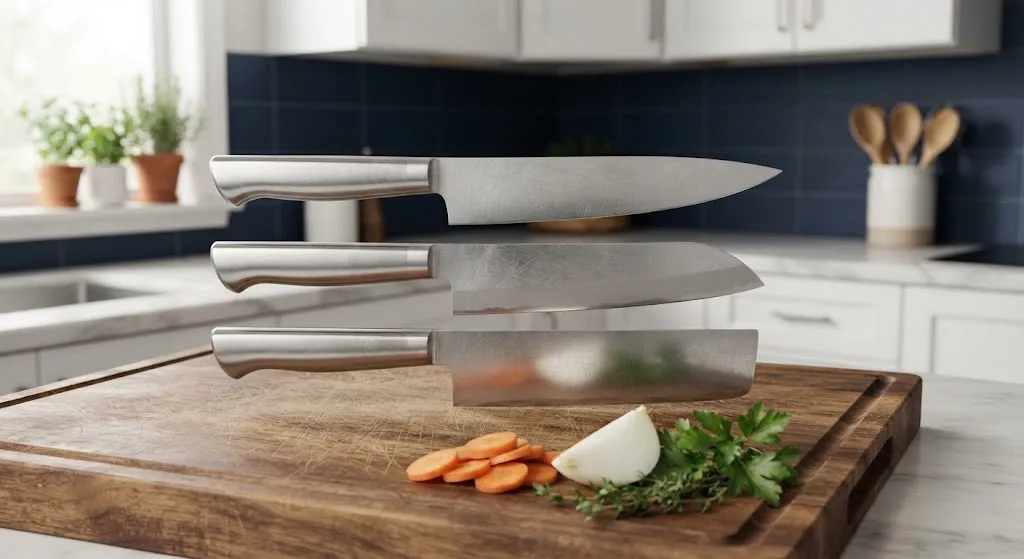
How Does Belly Shape Differ Between Chef Knives, Santokus, and Nakiris?
Knife categories provide useful clues about blade profiles, but individual models vary enough that the actual cutting edge should always be examined.
Western Chef Knives
Many European-style chef knives, especially traditional German designs, have a noticeably curved edge toward the front. This geometry supports the rocking movements associated with Western knife skills.
Not every Western chef knife has the same amount of curve. Some designs are comparatively flat, particularly through the rear and middle sections.
Santoku Knives
Many santoku knives have a relatively straighter cutting edge, making them comfortable for push cuts and straightforward chopping. Their shorter, broad blade shape also differs from many conventional chef knives.
However, a santoku is not necessarily flat. Some models incorporate deliberate curvature for rocking cuts. The blade profile matters more than the category name alone.
Nakiri Knives
A nakiri typically has a nearly straight cutting edge designed for vegetable preparation. Its profile favors controlled downward and forward cutting instead of a large rocking arc.
This makes it different from a curved chef knife, not inherently less capable. Each shape supports a different movement.
How to Tell Whether Your Chef Knife Has Enough Belly
 Save
SaveYou do not need specialized measuring equipment. A simple visual and practical check can reveal whether the blade profile suits your preferred cutting style.
- Examine the edge from the side. With the knife safely positioned, notice where the cutting edge begins curving toward the tip.
- Check the blade against a flat board. Set the clean edge gently on the board without sliding your fingers along it. Observe which sections naturally touch.
- Try a slow rocking motion. With a stable board and safe hand position, see whether the curved edge moves comfortably through its cutting path.
- Notice incomplete cuts. If ingredients repeatedly remain attached, determine whether the problem is technique, insufficient edge contact, or a dull blade.
- Consider your usual ingredients. A knife used frequently for rock-mincing herbs may benefit from a more pronounced curve than one primarily used for push-cut vegetable prep.
There is no single ideal belly measurement for every cook. Blade length, handle clearance, overall balance, and personal technique all influence what feels natural.
Key Insight
Choose blade curvature according to the cutting motion you actually use. A well-sharpened, moderately curved knife that feels controllable is often more useful than a dramatically curved profile chosen only for its appearance.
Can Sharpening Change the Belly of a Chef Knife?
Yes. Sharpening gradually removes metal, so repeated or uneven sharpening can alter the cutting-edge profile over time.
Normal, careful sharpening should preserve the blade’s intended shape. Problems are more likely when excessive material is removed from one section while other sections receive too little attention.
For example, repeatedly grinding the middle section more heavily can create an irregular edge. A blade that no longer meets the board smoothly may leave ingredients partially attached during cutting.
Some knives with a full bolster can also develop a practical problem near the heel as the cutting edge wears down but the bolster remains comparatively prominent.
If an older knife no longer cuts cleanly along its full length, inspect the edge profile before assuming that ordinary sharpening alone will solve it. Major shape corrections are better handled by someone experienced in knife sharpening and reprofiling.
Do not attempt to create a dramatically larger belly simply by grinding away large amounts of steel. Unnecessary reshaping can shorten the blade’s useful life and change how it handles.
Common Mistakes When Using a Knife’s Belly
Most problems associated with the belly are really problems of technique, edge condition, or matching the knife to the task.
- Forcing a rocking motion: A nearly straight blade may work better with push cuts than exaggerated rocking.
- Lifting too high: Large, uncontrolled movements are unnecessary when making small repeated cuts.
- Using a dull edge: Curvature cannot compensate for an edge that crushes ingredients rather than cutting cleanly.
- Twisting during contact: Lateral force against the cutting board can damage a fine cutting edge.
- Ignoring board stability: A slipping cutting board makes any cutting technique harder to control.
- Confusing belly with bevel: The belly describes the curved edge profile; the bevel refers to the ground geometry leading toward the sharpened edge.
Keeping these distinctions clear helps you diagnose cutting problems without incorrectly blaming the blade design.
Relevant Product
Curved-Belly Chef Knife
If you regularly rock-chop herbs and vegetables, a traditional chef knife with a gently curved cutting edge may suit your technique. Compare the actual blade profile, handle comfort, and overall control rather than relying on the knife’s name alone.
As an Amazon Associate, we earn from qualifying purchases.
Frequently Asked Questions
Is the belly of a chef knife sharp?
Yes. The belly is part of the sharpened cutting edge, so it should be treated with the same care as the rest of the blade. Its curved shape does not make it safer to touch.
Does every chef knife have a belly?
Most conventional chef knives have some degree of cutting-edge curvature, but the amount varies. Some are noticeably rounded toward the tip, while others have a relatively flat profile.
Is a bigger knife belly better for beginners?
Not necessarily. A pronounced belly can make rocking cuts feel natural, but beginners also need comfortable balance, a secure grip, and a manageable blade length. A moderate curve is often a practical starting point.
Can you rock chop with a flat knife?
A knife with a slightly curved edge may allow limited rocking, but a nearly straight blade generally works better with push or downward cutting. Forcing a large rocking motion is unnecessary.
Does the belly affect how sharp a knife is?
The belly affects the blade’s cutting path, not sharpness by itself. Sharpness depends on the condition and geometry of the edge. A curved knife can be dull, and a flat-edged knife can be extremely sharp.
Is the belly the same as the cutting edge?
Not exactly. The cutting edge extends along the sharpened length of the knife, while the belly usually refers to its curved section. Some knife guides use the terms more broadly, but this distinction is useful when discussing blade shape.
Final Thoughts
The belly of a chef knife is the curve along its sharpened edge that helps make smooth rocking cuts possible. A pronounced belly generally favors rock chopping, while a flatter profile is often better suited to push cutting. Understanding this difference helps you use your current knife more effectively, recognize cutting problems, and choose blade geometry that matches how you prepare food.

