How Do You Measure a Chef Knife? A Simple Step-by-Step Guide
Quick Answer
To measure a chef knife, place it on a flat surface and use a ruler or tape measure to measure the blade from the tip to the heel, where the blade meets the handle. Measure the handle separately if you need the overall knife length. A typical chef knife has an 8-inch blade, although 6-inch, 10-inch, and other sizes are also common.
Steps to measure a chef knife correctly
- Prepare the knife: Place it flat on a stable cutting board or countertop with the cutting edge facing away from you.
- Find the tip: Identify the pointed end of the blade.
- Locate the heel: Find the back end of the blade nearest the handle.
- Measure the blade: Align the ruler with the blade’s length from tip to heel.
- Check overall length: Measure from the blade tip to the far end of the handle if you need the complete knife measurement.
One important tip
- Measure consistently: Knife sizes usually refer to blade length, not total length, so check which measurement the manufacturer lists.
Knowing how to measure a chef knife helps you choose the right size, compare different models, and find a knife that fits your kitchen. The process is simple, but measuring the blade instead of the entire knife makes a significant difference.
In this guide, I’ll explain where to start and stop your measurement, which tools work best, and how blade length differs from overall length. You’ll also learn how to interpret common knife sizes when shopping or checking a knife you already own.
What Does It Mean to Measure a Chef Knife?
 Save
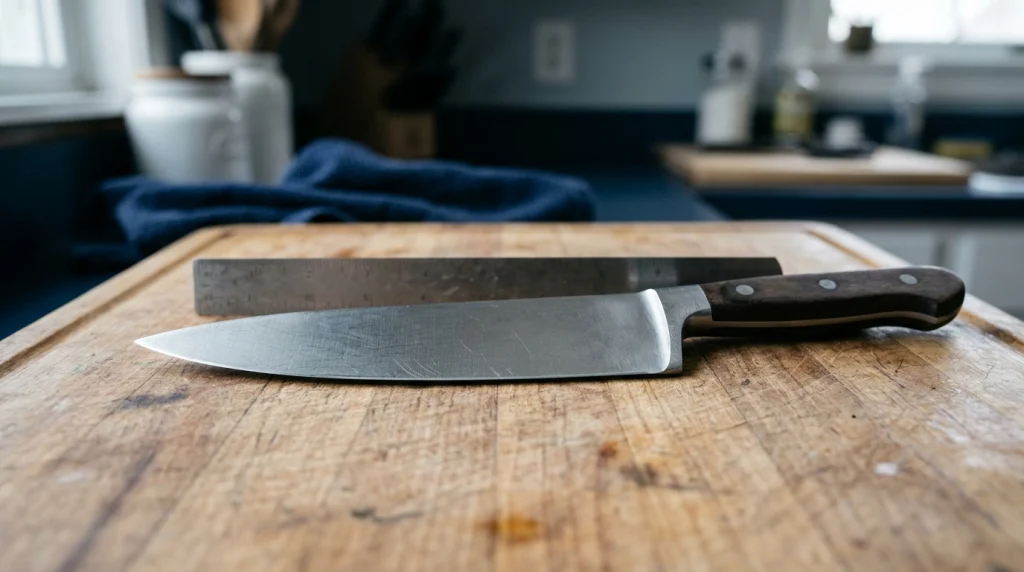
Measuring a chef knife means determining the length of its blade or its entire length, depending on the purpose of the measurement. Blade length is the measurement most commonly used to describe a chef knife’s size.
The distinction matters because the handle can add several inches to the knife’s overall length. A knife advertised as an 8-inch chef knife generally has an 8-inch blade, not an 8-inch handle-to-tip measurement.
Before measuring, identify these three parts:
- Tip: The pointed front end of the blade.
- Heel: The rear portion of the blade closest to the handle.
- Handle: The part you hold while cutting, usually made from wood, plastic, composite material, or another grip material.
Some knives also have a bolster, which is a thick section between the blade and handle. Its shape varies by design, so use the actual blade-to-handle boundary as your reference rather than automatically including the entire bolster.
How Do You Measure a Chef Knife Step by Step?
The easiest method uses a ruler with inch markings or a tape measure. Keep the knife stationary and measure the blade in a straight line from its tip to its heel.
Step 1: Place the knife on a flat surface
Put the knife on a stable cutting board or countertop with enough room to see the tip and handle clearly. Keep your fingers away from the cutting edge, and avoid holding the blade while moving the measuring tool.
A flat surface makes it easier to align the ruler accurately. If the knife has a curved blade, measure its length along the blade’s straight tip-to-heel axis rather than following the curve of the cutting edge.
Step 2: Identify the blade tip and heel
The tip is the frontmost end of the blade, while the heel is the back end nearest the handle. These two points define the blade length for a straightforward measurement.
On some knives, the heel may be partly covered by a bolster or may blend into the handle. Use the manufacturer’s stated blade boundary when available, especially when comparing knives with unusual designs.
Step 3: Measure from tip to heel
Place the zero mark of your ruler at the tip and align it with the blade’s lengthwise axis. Read the measurement at the heel without including the handle.
For example, if the heel reaches the 8-inch mark, the blade measures approximately 8 inches. If it reaches 7.5 inches, record that measurement rather than rounding it up to a full inch.
Step 4: Measure the handle separately
If you need to know how much space the handle occupies, measure from the point where the handle begins to its far end. Record this as the handle length, not the blade length.
For a complete size record, write down the blade length and overall length separately. This prevents confusion when comparing a knife with another model that has a longer or shorter handle.
Step 5: Record the measurement and units
Write the result in inches or centimeters, and note whether it describes the blade or the entire knife. If you are comparing several knives, use the same method for each one.
One practical check is to measure the blade twice, repositioning the ruler for the second reading. If the results differ, realign the ruler before recording the final measurement.
Should You Measure Along the Blade or the Cutting Edge?
For a typical Western chef knife, measure the blade in a straight line from the tip to the heel or the manufacturer’s specified blade endpoint. Don’t trace the curve of the cutting edge, because that produces a different measurement.
This distinction becomes more important when comparing Japanese knives, including gyuto-style chef knives. Some Japanese makers measure from the tip to the machi, the point where the blade transitions into the handle, rather than using the end of the cutting edge.
Three measurements you should know
- Blade length: The length of the blade, measured according to the manufacturer’s stated reference points.
- Cutting-edge length: The length of the sharpened edge that contacts food during cutting.
- Overall length: The complete distance from the blade tip to the end of the handle.
These measurements aren’t always identical or interchangeable. When precision matters, such as ordering a knife guard or comparing specifications, check the manufacturer’s measurement method rather than relying on the size printed in the product name.
The American Knife and Tool Institute publishes a knife blade measurement protocol that explains a straight-line measurement method for its intended purposes. Its protocol is particularly relevant when a specific legal definition applies, so don’t assume every kitchen knife manufacturer follows precisely the same convention.
What Tools Do You Need to Measure a Chef Knife?
You don’t need expensive equipment to measure a chef knife at home. A simple ruler usually provides enough accuracy for identifying its approximate blade size.
| Tool | Best use | Limitation |
|---|---|---|
| 12-inch ruler | Measuring common chef knife blades | May be too short for the overall length of a large knife |
| Tape measure | Measuring the blade and complete knife | Can shift or bend if not aligned carefully |
| Metric ruler | Checking millimeter or centimeter specifications | Requires conversion if you need inches |
| Digital caliper | Checking smaller dimensions, such as blade thickness | Usually unnecessary for measuring a full blade |
For most home cooks, I’d start with a rigid ruler marked in both inches and centimeters. It stays flat against the counter and makes the two endpoints easy to compare.
Keep the tool beside the knife rather than dragging it across the cutting edge. A stable setup helps prevent accidental cuts and makes the reading easier to see.
How Long Is a Chef Knife? Common Blade Sizes Explained
Chef knives come in several blade lengths, with 8-inch models being a common choice for everyday cooking. The right size depends on your cutting board, comfort, typical ingredients, and available workspace.
| Nominal blade size | Metric equivalent | Typical use |
|---|---|---|
| 6 inches | 15.24 cm | Small boards, compact kitchens, and lighter prep |
| 8 inches | 20.32 cm | General-purpose chopping, slicing, and mincing |
| 10 inches | 25.4 cm | Larger ingredients and high-volume preparation |
| 12 inches | 30.48 cm | Specialized or professional tasks requiring extra reach |
These are nominal size categories, not a guarantee that every blade measures exactly the listed number. A manufacturer may round a measurement, and different blade designs may use different reference points.
Which chef knife size should you choose?
A 6-inch knife can feel easier to control if you have limited counter space or prefer a compact blade. An 8-inch knife offers a useful balance between reach and maneuverability for many everyday tasks.
A 10-inch knife gives you more blade length for larger ingredients and bigger batches, but it also requires more room and comfortable handling. Longer isn’t automatically better.
To choose confidently, consider these practical factors:
- Cutting board: Make sure the blade fits comfortably within your working area.
- Typical ingredients: Consider whether you mostly cut small vegetables or frequently prepare large produce and substantial portions.
- Control: Choose a length you can move comfortably without crowding your hands or nearby objects.
- Storage: Check that your knife block, drawer insert, or protective cover accommodates the complete knife or blade.
Why Does My Chef Knife Measure Differently From Its Listed Size?
A chef knife may measure slightly differently from its advertised size because manufacturers round their dimensions or use different endpoints. The discrepancy doesn’t necessarily indicate a defect.
For example, a manufacturer might market a knife in the 8-inch category even if its published blade dimension is slightly shorter. Some Japanese knives also use metric size classes, such as 210 mm, which equals approximately 8.27 inches.
Several factors can explain a difference:
- Different endpoints: One specification may measure to the bolster, while another may use the point where the blade meets the handle.
- Rounded dimensions: A nominal 8-inch size doesn’t always mean an exact 8.00-inch measurement.
- Different measurement paths: A straight-line measurement and a measurement that follows the cutting edge won’t necessarily agree.
- Manufacturing variation: Small dimensional differences can occur between models or production batches.
If the difference seems substantial, consult the manufacturer’s technical specifications before deciding that your measurement is wrong. A documented blade dimension is generally more useful than the size category alone.
What Are the Most Common Chef Knife Measuring Mistakes?
Most measuring errors happen when someone uses the wrong endpoints or compares two different types of measurements. A consistent method solves most of these problems.
- Including the handle: This gives you overall length rather than blade length.
- Following the cutting edge: This can produce a different result from a straight-line blade measurement.
- Starting at the ruler’s edge instead of zero: The ruler’s physical end may not align with its zero mark.
- Measuring at an angle: A ruler that runs diagonally across the blade can distort the result.
- Ignoring the manufacturer’s convention: This can make two differently measured knives appear directly comparable when they aren’t.
My recommended approach is to record the blade measurement, overall length, and measurement method separately whenever you need an accurate comparison. That simple habit makes shopping, storage planning, and equipment identification much easier.
How Do You Convert Chef Knife Measurements From Inches to Centimeters?
Use the conversion factor 1 inch = 2.54 centimeters. Multiply inches by 2.54 to convert to centimeters, or divide centimeters by 2.54 to convert to inches.
| Inches | Centimeters | Millimeters |
|---|---|---|
| 6 | 15.24 | 152.4 |
| 8 | 20.32 | 203.2 |
| 10 | 25.4 | 254 |
| 12 | 30.48 | 304.8 |
For example, a blade measuring 20 centimeters is approximately 7.87 inches. That is close to the nominal 8-inch category, but it isn’t an exact 8-inch measurement.
When comparing a Western chef knife with a Japanese gyuto, check whether both dimensions refer to the same part of the blade. The conversion itself is straightforward; the measurement convention is what can cause confusion.
How Should You Measure a Chef Knife for Storage?
 Save
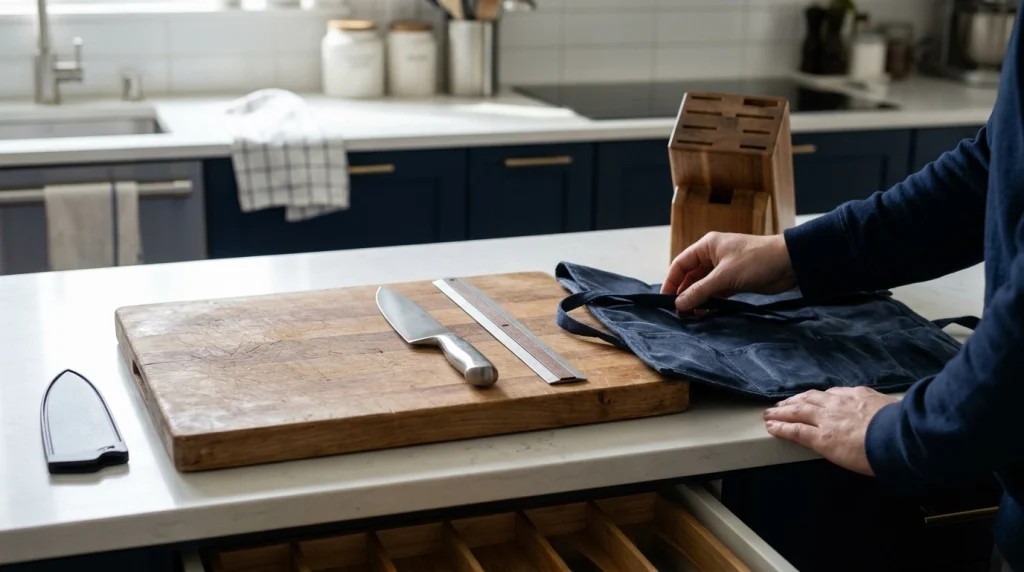
If you’re measuring a knife for a drawer insert, knife block, or protective sleeve, the relevant dimension depends on the accessory. A blade guard needs to accommodate the blade, while a drawer organizer may need to accommodate the complete knife.
Use this checklist before buying storage equipment:
- For a blade guard: Measure the blade length and consider its height and thickness.
- For a knife block: Check the slot’s usable depth and width, as well as the knife’s overall length.
- For a drawer insert: Measure the available drawer space and compare it with the knife’s full length.
- For a roll or case: Check the maker’s stated blade capacity and the dimensions of the knife compartments.
Don’t assume that a storage accessory labeled for an 8-inch knife will fit every 8-inch model. Blade height, handle shape, bolster design, and the accessory’s internal dimensions can all affect compatibility.
Which Measuring Tools Are Worth Buying?
If you measure kitchen tools only occasionally, a basic ruler is enough. If you frequently compare knife specifications or measure other kitchen equipment, a dual-unit ruler or a dependable tape measure can be more convenient.
Here are three practical options to consider, depending on what you need.
📏 BEST FOR EVERYDAY USE
12-Inch Stainless Steel Ruler
★★★★☆
A rigid ruler is easy to align along a knife blade and works well for common sizes. I’d prioritize clear markings and a visible zero point over extra features.
🧰 BEST FOR LARGER MEASUREMENTS
Retractable Tape Measure
★★★★☆
A tape measure is handy when checking overall knife length or storage dimensions. Choose one with easy-to-read markings and keep the tape straight during measurement.
🔧 BEST FOR DETAILED CHECKS
Digital Caliper
★★★☆☆
A caliper can measure blade thickness and other small dimensions, but it’s unnecessary for ordinary blade-length checks. Use it only when you need those extra measurements.
These are tool-category suggestions rather than independently tested product reviews. For measuring a chef knife’s blade length, a ruler is generally the simplest and most cost-effective choice.
Frequently Asked Questions
Do you measure a chef knife from the tip or the handle?
You generally measure a chef knife’s blade from the tip to the heel or the manufacturer’s specified blade endpoint. The handle isn’t included in the blade length. To determine the overall length, measure from the tip to the far end of the handle instead.
Is an 8-inch chef knife exactly 8 inches long?
Not necessarily. An 8-inch chef knife belongs to a nominal blade-size category, and its actual measurement may differ slightly because of rounding or the manufacturer’s measurement method. Check the published blade dimensions when you need an exact measurement.
Can I measure a chef knife with a tape measure?
Yes, you can use a tape measure to determine blade length or overall length. Keep it straight and aligned with the blade’s lengthwise axis rather than following the curve of the cutting edge. A rigid ruler is often easier to align for this task.
What is the difference between blade length and overall knife length?
Blade length describes the blade alone, measured using the manufacturer’s reference points. Overall length extends from the blade tip to the end of the handle. The overall measurement is longer because it includes both the blade and handle.
How do you measure a Japanese chef knife?
Check the manufacturer’s measurement convention first. Many Japanese chef knives, including gyuto models, are measured from the tip to the machi, where the blade meets the handle. Other makers may use different reference points, so confirm the specification before comparing sizes.
Final Takeaway: Measure the Blade, Not Just the Knife
To measure a chef knife accurately, lay it on a stable surface and measure in a straight line from the tip to the manufacturer’s specified blade endpoint. Record the overall length separately if you’re checking storage space or comparing complete knife dimensions.
A ruler is usually all you need, and repeating the measurement helps catch alignment errors. Whether you’re checking a 6-inch, 8-inch, or 10-inch chef knife, using the same method makes it easier to compare sizes and choose the right tool for your kitchen.
Before buying a replacement knife or storage accessory, compare the actual dimensions rather than relying on the advertised size alone. That small check can save you from choosing a knife or accessory that doesn’t fit your needs.
“`

