German vs French Chef Knife: Key Differences, Uses, and Which to Choose
Quick Answer
A German chef knife typically has a thicker, heavier blade with a more curved edge, making it a versatile choice for rocking cuts and everyday kitchen prep. A French chef knife traditionally has a more tapered profile and a straighter section of edge, making it well suited to push-cutting, slicing, and precise work. For a first all-purpose chef knife, I would compare the actual blade shape, weight, and handle comfort rather than choosing by country alone.
The main differences
- Blade shape: German profiles often have a pronounced belly, while traditional French profiles tend to be more tapered.
- Weight and feel: Many German knives feel substantial, while many French-style knives feel more agile.
- Cutting technique: A curved edge favors rocking; a flatter edge supports push-cutting and controlled slicing.
- Edge maintenance: Steel, heat treatment, edge angle, and sharpening matter more than nationality alone.
- Best choice: Choose the knife that feels balanced in your hand and suits the way you cut vegetables, herbs, meat, and fish.
One practical tip
- If possible, hold both styles before buying and compare how the heel, tip, and curved portion of the edge contact your cutting board.
Choosing between a German and French chef knife can feel confusing because both are designed to handle much of the same kitchen work. The difference becomes clearer when you look at the blade’s profile, how it moves across a cutting board, and how much weight you prefer in your hand.
In this guide, I’ll explain the traditional differences, compare their strengths and limitations, and show you what to look for when choosing a knife in 2026. You’ll also learn why the knife’s design matters more than the label on its packaging.
What Is the Difference Between a German and French Chef Knife?
A German chef knife is a general-purpose kitchen knife commonly associated with a curved cutting edge, a relatively substantial blade, and a design suited to rocking cuts. A French chef knife is a traditional chef’s knife profile often characterized by a more tapered blade and a longer, comparatively flatter cutting section.
Both styles can chop, slice, mince, and prepare everyday ingredients. Their main difference lies in how the blade’s geometry supports particular cutting motions.
- German-style profile: Often features a fuller belly that makes rocking motions comfortable.
- French-style profile: Often has a more gradual taper and a flatter usable section for push-cutting.
- Modern variations: Manufacturers frequently blend these characteristics, so not every knife fits a strict category.
One important distinction: French-style does not automatically mean a knife was made in France, and German-style does not guarantee German manufacture. These labels describe design traditions as well as common manufacturing associations.
German vs French Chef Knife: Comparison Table
The following table summarizes common tendencies rather than universal specifications. Individual models can differ substantially in blade thickness, weight, steel, handle shape, and cutting-edge geometry.
| Feature | German-style chef knife | French-style chef knife |
|---|---|---|
| Blade profile | Often a pronounced curve or belly | Often more tapered with a flatter edge section |
| Typical feel | Substantial and stable | Often more agile toward the tip |
| Rock chopping | Often a natural fit | Possible, depending on the curve |
| Push-cutting | Works well, but some profiles have less flat edge | Often well suited to the motion |
| Blade thickness | Many models have a sturdier spine | Many traditional profiles taper more noticeably |
| Maintenance | Depends on steel, edge, and heat treatment | Depends on steel, edge, and heat treatment |
| Best starting point | Cooks who prefer a curved edge and substantial feel | Cooks who prefer controlled push-cuts and a tapered profile |
Neither style wins every category. The right choice depends on your cutting technique, the ingredients you prepare most often, and whether the blade feels comfortable during repeated cuts.
How Does the Blade Shape Affect Cutting Performance?
 Save
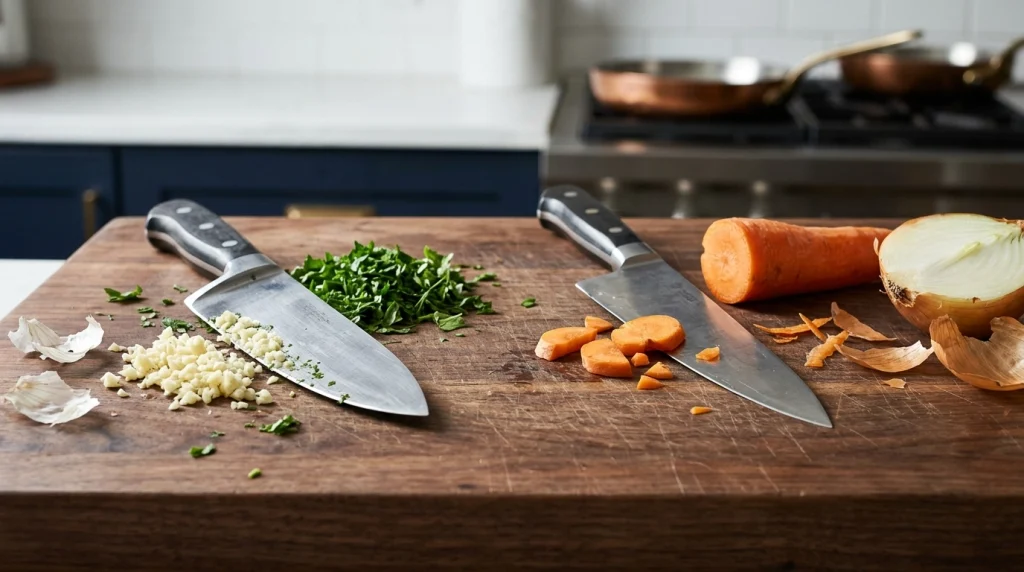
The biggest practical difference between these profiles is how much of the cutting edge touches the board during a stroke. A curved edge encourages a rocking motion, while a flatter section makes it easier to push the blade forward and down.
German chef knives: A curved edge for rocking cuts
Many German-style chef knives have a noticeable belly, meaning the cutting edge curves upward toward the tip. This shape suits cooks who keep the tip near the board while lifting and lowering the handle.
It’s useful for chopping herbs, mincing garlic, and processing onions. The curve also helps the blade move smoothly through repeated cuts without requiring you to lift the entire knife after every stroke.
French chef knives: A tapered profile for controlled cuts
Traditional French-style profiles often have a more gradual curve and a longer section of edge that sits relatively flat against the board. That geometry can make push-cutting and forward slicing feel natural.
This is useful when dicing carrots, slicing potatoes, or making even cuts through boneless meat. The pointed tip also helps with detailed work, although tip performance depends on the individual knife’s design.
- For rocking: Look for a pronounced belly and a comfortable pivot point.
- For push-cutting: Look for a longer, flatter edge section.
- For mixed techniques: Choose a moderate curve that doesn’t force you into one cutting motion.
Neither profile is inherently more accurate. Your technique, the knife’s sharpness, and the way the edge meets the board all affect the result.
Which Chef Knife Is Better for Vegetables, Meat, and Herbs?
Both styles handle common kitchen ingredients, but their geometry can make particular tasks feel more comfortable. The best match depends on how you prepare food rather than the ingredient alone.
| Kitchen task | German-style advantage | French-style advantage |
|---|---|---|
| Chopping herbs | A curved edge supports repeated rocking | Works well with a controlled rocking or push-cutting motion |
| Dicing onions | Comfortable for cooks who rock through the cut | A flatter edge can suit forward-and-down cuts |
| Slicing boneless meat | A substantial blade may feel reassuring | A tapered profile can offer useful tip control |
| Cutting firm vegetables | A sturdy blade may feel stable | A thinner grind may reduce resistance, depending on the model |
| Fine tip work | Suitable if the tip is slender and responsive | Often appealing to cooks who prefer a tapered tip |
For everyday home cooking, either style can prepare an entire meal. If you mostly chop vegetables with a rocking motion, start with a curved profile; if you prefer forward cuts, pay closer attention to the flatter section of the edge.
Are German Chef Knives Heavier Than French Chef Knives?
German-style chef knives are often associated with a heavier, more substantial feel, while French-style profiles can feel lighter or more agile. However, blade thickness, handle construction, bolster design, and overall dimensions matter more than the country label.
A bolster is the thicker junction between the blade and handle found on some knives. It can influence balance, protect the hand, and affect how easily you can sharpen the heel of the blade.
For a real-world reference, the WÜSTHOF Classic 8-inch chef’s knife is a German-made forged model with a full bolster and a published hardness rating of 58 HRC. Its construction illustrates why a specific model’s design tells you more than a broad national stereotype.
When comparing knives, pay attention to these details:
- Total weight: A heavier knife may feel stable, but it can cause fatigue during long preparation sessions.
- Balance point: Notice whether the knife feels blade-heavy, handle-heavy, or balanced between them.
- Handle shape: Check that the grip feels secure without forcing your fingers into an awkward position.
- Blade height: A taller blade can provide knuckle clearance and make transferring chopped ingredients easier.
My practical recommendation is to compare the balance and grip before comparing country of origin. A comfortable, well-maintained knife will generally serve you better than one chosen for its reputation alone.
Which Knife Steel Holds an Edge Longer?
Neither German nor French chef knives automatically hold an edge longer. Edge retention depends on the steel composition, heat treatment, edge geometry, cutting surface, and the ingredients you prepare.
Many traditional European knives use stainless steels designed to balance corrosion resistance, toughness, and ease of sharpening. Some premium models use harder steels or thinner edges, but those features don’t guarantee better performance for every cook.
What does the HRC rating mean?
HRC stands for Rockwell hardness on the C scale, a measurement of how resistant a material is to indentation. A higher number often indicates harder steel, but it doesn’t independently tell you how sharp a knife is or how well it will perform.
For example, WÜSTHOF lists its Classic chef’s knife at 58 HRC, while other manufacturers may specify different hardness levels for their own designs. Those figures are useful when comparing individual products, but they aren’t enough to declare one national style superior.
Look at the whole knife instead of chasing a particular hardness number. A slightly softer blade that sharpens easily and resists damage may suit a busy home kitchen better than a harder blade that demands more careful handling.
For general background on blade materials and manufacturing, consult the manufacturer’s specifications and care guidance before purchasing. A useful starting point is de BUYER’s FK2 French chef knife information, which describes a French-made design using German X50CrMoV15 stainless steel.
How Should You Sharpen and Maintain Each Style?
Both German and French chef knives need regular maintenance, and the same basic care rules apply to most quality kitchen knives. The blade’s edge angle and steel determine the best sharpening method, not simply its national style.
Follow these habits to protect the edge:
- Use a suitable board: Wood and quality plastic are common choices; avoid glass, stone, and metal surfaces for routine cutting.
- Hone when needed: A suitable honing tool can help realign an edge between sharpening sessions, depending on the blade steel and tool.
- Sharpen when dull: Use an appropriate whetstone or sharpening service to restore the cutting edge.
- Wash by hand: Unless the manufacturer explicitly says otherwise, hand-wash with mild soap and dry promptly.
- Store safely: Use a blade guard, knife block, or magnetic strip that protects the edge and keeps the blade secure.
A honing rod is not the same as a sharpening stone. Honing helps maintain an edge, while sharpening removes a small amount of material to create a new cutting edge.
Also, don’t assume that every knife should use the same sharpening angle. Follow the manufacturer’s recommended angle where available, especially if you own a knife with a thin or unusually hard blade.
How Do You Choose Between a German and French Chef Knife?
Start with your cutting technique and comfort level, then compare the specific models available within your budget. You don’t need to buy both styles to prepare food effectively.
Use this quick checklist before making a decision:
- Choose German-style if you prefer a curved edge, a substantial feel, and repeated rocking cuts.
- Choose French-style if you prefer a tapered profile and a cutting edge that supports controlled push-cuts.
- Choose by balance if weight and wrist comfort matter more than the style label.
- Choose by maintenance if you want steel and edge geometry that match the sharpening tools you already own.
- Choose by length if your board, kitchen space, or hand size makes a long blade awkward to manage.
An 8-inch chef knife is a useful starting size for many home cooks, but a shorter 6-inch or 7-inch knife can be easier to control in a compact kitchen. Blade length should match the work surface and your comfort rather than a fixed rule.
Before buying, inspect the blade from the side and imagine how its edge would meet your board. If you can test the grip in person, hold it in your normal cutting position and check that the handle doesn’t force your wrist into an uncomfortable angle.
Are French Chef Knives Made With German Steel?
Yes. A knife can follow a French design tradition and use steel produced or developed in Germany, because blade design, steel origin, and manufacturing location are separate things.
The de BUYER FK2 French chef knife is a useful example: its product information identifies German X50CrMoV15 stainless steel while describing the knife as made in France. This illustrates why the country associated with a knife’s style doesn’t necessarily identify its steel.
When researching a model, check three separate details:
- Design: Is the blade profile curved, tapered, or relatively flat?
- Steel: What material does the manufacturer specify, and how does it describe hardness and maintenance?
- Manufacture: Where is the knife made, and what construction method does the manufacturer use?
These details help you make a more informed comparison than relying on labels such as German quality or French precision. Both countries have established cutlery traditions, and individual knives vary widely within each tradition.
Common Mistakes When Comparing German and French Chef Knives
Shoppers sometimes focus on national origin and overlook the details that affect daily performance. Avoid these common mistakes when choosing your first or next chef knife.
- Assuming heavier means better: Extra weight may feel stable, but it can also increase fatigue.
- Assuming harder steel is always superior: Hardness doesn’t measure sharpness, corrosion resistance, or overall usability by itself.
- Buying based on style alone: Modern knives often combine traditional features, so inspect the actual edge profile.
- Ignoring the handle: Poor grip comfort can make even a high-quality blade unpleasant to use.
- Expecting a knife to stay sharp forever: Every working edge needs maintenance, regardless of price or origin.
The most useful comparison is a specific German model against a specific French-style model. Once you know their dimensions, weight, steel, edge profile, and care requirements, the decision becomes much clearer.
Chef Knife Recommendations: German and French-Style Options
 Save
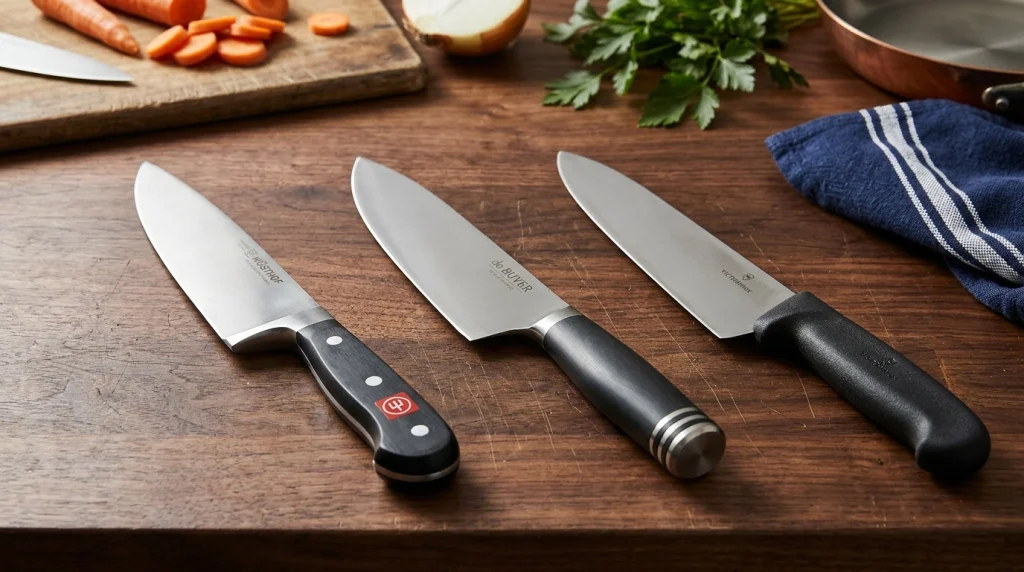
If you’re ready to choose a knife, these three models provide different starting points for comparing a traditional German design, a French chef knife, and a practical everyday alternative. These are product suggestions based on published design details, not claims of personal testing.
🏆 Traditional German Pick
WÜSTHOF Classic 8-Inch Chef’s Knife
★★★★☆
This forged German knife has an 8-inch blade, a full bolster, and a published hardness of 58 HRC. I’d shortlist it for cooks who want a traditional, substantial-feeling all-purpose knife and don’t mind investing in a premium model.
🇫🇷 French-Style Pick
de BUYER FK2 French Chef Knife
★★★★☆
This French-made design uses German X50CrMoV15 stainless steel and a carbon-fiber-composite handle with adjustable counterweights. I’d consider it if you want a French chef knife and value the option to fine-tune balance.
💰 Practical Everyday Alternative
Victorinox Fibrox Chef’s Knife
★★★★☆
The Swiss-made Fibrox range offers practical chef knives with non-slip handles and straightforward designs. I’d include it as a comparison point for buyers who prioritize everyday function and grip over a traditional German or French identity.
Prices, availability, and exact configurations can change, so compare the current specifications before ordering. Check the blade length, handle design, seller, and return policy rather than relying on a product name alone.
Frequently Asked Questions
Is a German or French chef knife better for beginners?
Both are suitable for beginners. A German-style knife can suit someone who likes rocking cuts and a substantial feel, while a French-style profile can appeal to cooks who prefer push-cutting. Choose a manageable blade length, a comfortable handle, and steel that’s easy to maintain.
Are French chef knives sharper than German chef knives?
No, not automatically. Sharpness depends on the edge’s condition, geometry, sharpening quality, and steel. A well-sharpened German knife can cut better than a dull French knife, and the reverse is equally true. Compare specific models rather than assuming one national style has a sharper edge.
Can I use a German chef knife for push-cutting?
Yes. A German chef knife can handle push-cutting, slicing, dicing, and other common kitchen tasks. A strongly curved edge may offer less board contact during a straight downward stroke, but many cooks use German-style knives with several techniques comfortably.
Does a French chef knife need special sharpening equipment?
Usually not. Most conventional French chef knives can be sharpened with a suitable whetstone or by a qualified sharpening service. Follow the manufacturer’s recommended edge angle and care instructions, especially when the knife uses an unusually thin grind or harder steel.
Should I buy an 8-inch German knife or a French chef knife?
Choose an 8-inch German knife if its curved profile and weight suit your cutting style. Choose a French chef knife if its taper and edge shape feel more natural for your preferred cuts. If possible, handle both before buying and compare their balance, grip, and board contact.
Final Takeaway: German vs French Chef Knife
The German vs French chef knife decision comes down to blade profile, cutting technique, balance, and maintenance. German-style knives often suit rocking cuts and cooks who prefer a substantial feel, while French-style knives can appeal to those who favor a tapered profile and controlled push-cutting.
For a first chef knife, prioritize comfort, a suitable length, dependable steel, and straightforward sharpening. A knife that matches your technique will be more useful than one selected simply because of its country of origin.
Compare the actual models, check their specifications, and choose the blade that feels natural in your hand. That’s the most reliable way to find a chef knife you’ll enjoy using every day.

