
Do Plastic Cutting Boards Dull Knives? Explained
Quick Answer
Yes, plastic cutting boards gradually dull knives through repeated contact with the cutting surface. However, softer polyethylene and polypropylene boards are generally much gentler on knife edges than glass, ceramic, or stone. Quality plastic and wooden cutting boards are both suitable for everyday kitchen use.
What You Should Know:
- Plastic hardness: Harder plastic surfaces can accelerate knife edge wear.
- Polyethylene boards: Quality polyethylene boards generally provide a forgiving cutting surface.
- Cutting pressure: Heavy chopping increases stress on the blade edge.
- Surface damage: Deep grooves can interfere with smooth cutting and make cleaning difficult.
- Wood alternatives: End-grain wooden boards are often excellent for protecting delicate knife edges.
- Knife maintenance: Regular sharpening helps restore cutting performance.
Practical Tip:
- Protect your edge: Choose a stable, slightly forgiving plastic board and avoid dragging your knife sideways across its surface.
Have you noticed your favorite kitchen knife becoming dull despite using a plastic cutting board? The problem may involve the board material, your cutting technique, or normal blade wear.
I recommend evaluating the knife and cutting surface together rather than blaming either one immediately. This guide explains how plastic boards affect knife sharpness, which materials work best, and how to extend the life of your kitchen knives.
How Do Plastic Cutting Boards Affect Knife Sharpness?
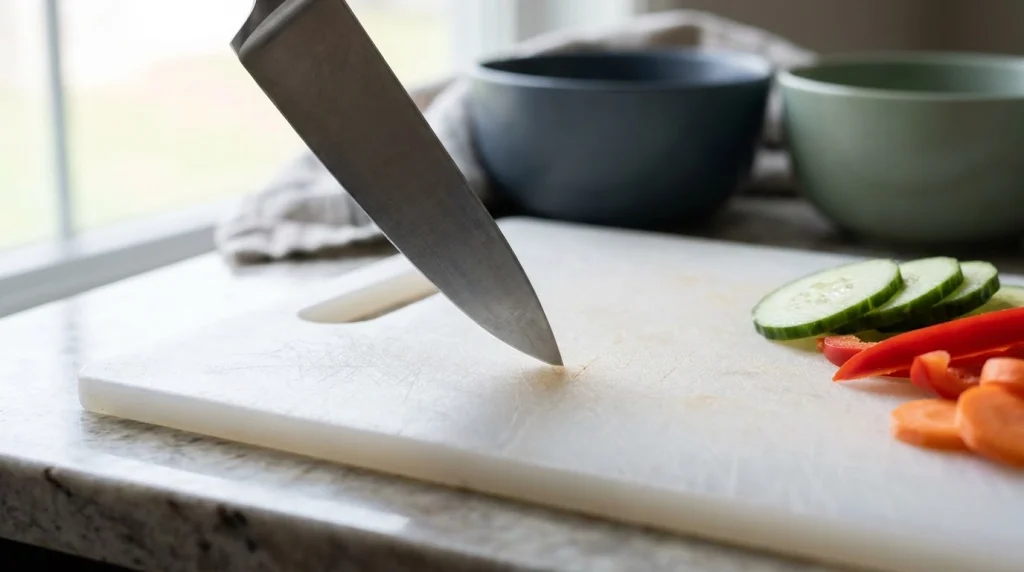
Plastic cutting boards affect knife sharpness by creating repeated contact between the blade edge and the board. Each contact places a small amount of mechanical stress on the cutting edge.
A cutting board is a protective food preparation surface that supports ingredients while providing a suitable landing area for a knife blade.
Although plastic is considerably softer than hardened knife steel, repeated cutting can still contribute to gradual edge deterioration.
What Happens to the Knife Edge?
- Edge rolling: A thin section of the cutting edge may bend out of alignment.
- Abrasive wear: Repeated friction gradually removes microscopic amounts of blade material.
- Microchipping: Small pieces of a brittle cutting edge may break away under excessive force.
- Edge rounding: The original sharp apex gradually becomes less defined.
- Reduced cutting efficiency: The knife requires more pressure to slice through ingredients.
Plastic boards are not inherently destructive to kitchen knives. Most quality plastic boards provide a reasonable balance between blade protection, affordability, and convenient cleaning.
Why Do Some Plastic Cutting Boards Dull Knives Faster?
Some plastic cutting boards dull knives faster because their surfaces are harder, less forgiving, or more abrasive. Cutting pressure and knife construction also influence how quickly the blade loses sharpness.
1. Plastic Material Hardness
Plastic cutting boards come in several material formulations. Their hardness, flexibility, and surface texture can differ considerably.
A forgiving plastic surface can accommodate some blade contact. A rigid surface may produce a harsher impact when the knife reaches the board.
2. Excessive Chopping Pressure
Forceful chopping drives the cutting edge against the board repeatedly. This increases mechanical stress, particularly on thin or brittle knife edges.
Letting a sharp knife perform the cutting reduces unnecessary impact. Controlled movements also improve accuracy during food preparation.
3. Scraping Food With the Cutting Edge
Dragging the sharp edge sideways across a plastic board creates lateral pressure. Kitchen knives generally handle downward cutting forces better than sideways loading.
Instead, use the blunt spine of the knife or a bench scraper to collect chopped ingredients.
4. Poor Cutting Board Stability
A lightweight or warped plastic board may shift during chopping. Sudden movement can introduce unwanted twisting forces at the blade edge.
I prefer a board that remains flat and secure on the countertop. Stability matters for both knife protection and personal safety.
5. Abrasive Contamination
Sand, dirt, and gritty particles from unwashed vegetables can increase abrasive blade wear. These particles may be more damaging than the plastic surface itself.
- Wash root vegetables before chopping.
- Remove visible dirt from fresh produce.
- Keep cutting surfaces free from gritty residue.
- Clean the board between preparation tasks.
Which Types of Plastic Cutting Boards Are Best for Knives?
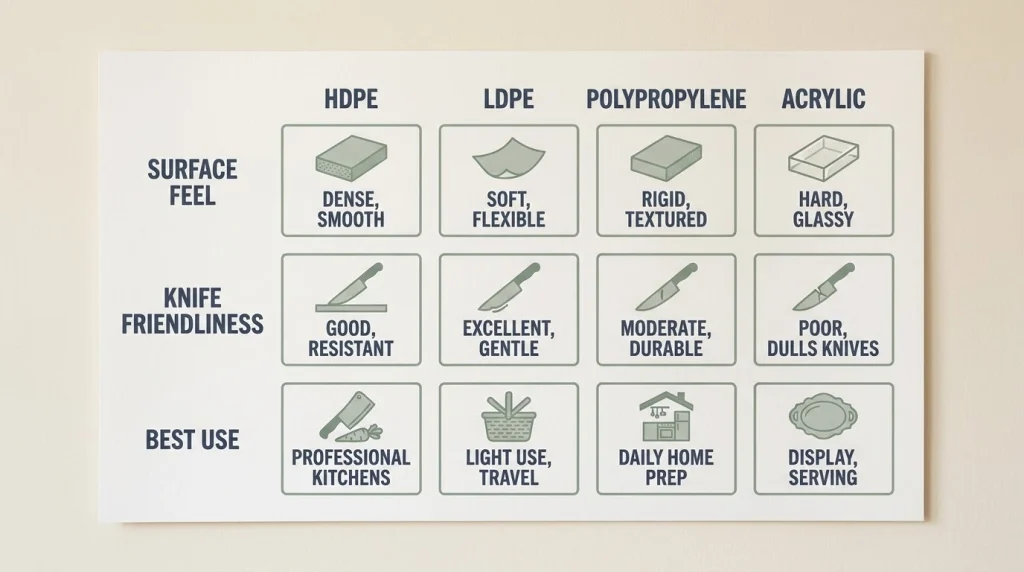
Food-grade polyethylene and polypropylene cutting boards are common choices for kitchen knives. Their actual knife friendliness depends on the material formulation, surface texture, and construction.
High-Density Polyethylene Cutting Boards
High-density polyethylene, commonly called HDPE, is widely used in residential and commercial cutting boards. It provides a durable surface with reasonable resistance to moisture.
- Generally suitable for everyday kitchen knives.
- Low moisture absorption.
- Available in multiple sizes and thicknesses.
- Easy to clean when the surface remains in good condition.
- Practical for raw meat and poultry preparation.
HDPE is a useful starting point when choosing a general-purpose plastic board.
Low-Density Polyethylene Cutting Boards
Low-density polyethylene, or LDPE, is generally more flexible than HDPE. Some flexible cutting mats use this type of plastic or similar formulations.
These products are convenient for transferring ingredients, although thin mats may offer less stability during demanding preparation tasks.
Polypropylene Cutting Boards
Polypropylene boards are popular because they can provide good durability and moisture resistance. Many manufacturers also produce dishwasher-compatible polypropylene boards.
Some formulations feel firmer than polyethylene, so evaluate the individual board instead of relying entirely on its material name.
Hard Acrylic Cutting Boards
Acrylic boards typically provide a more rigid cutting surface. Their hardness and limited flexibility make them less attractive for protecting delicate knife edges.
I would prioritize polyethylene or a suitable wooden board over rigid acrylic for frequent chopping.
Plastic Cutting Board Material Comparison
The following table compares common plastic cutting board materials using their general physical characteristics and practical kitchen applications.
| Material | Surface Feel | Knife Friendliness | Best Use |
|---|---|---|---|
| HDPE | Moderately firm | Good | Everyday preparation |
| LDPE | Flexible | Generally good | Light preparation |
| Polypropylene | Moderate to firm | Good to moderate | General chopping |
| Acrylic | Hard and rigid | Less favorable | Serving and light use |
Note: These are qualitative material comparisons, not measured knife retention test results. Individual products can perform differently.
Do Plastic Cutting Boards Dull Knives Faster Than Wood?
Some plastic cutting boards can dull knives faster than forgiving wooden boards, particularly end-grain designs. However, the difference depends on the specific plastic, wood species, knife steel, and cutting technique.
End-grain wooden boards expose the ends of wood fibers at the cutting surface. These fibers can accommodate blade contact more gently than many rigid surfaces.
Plastic boards remain practical when easy cleaning and frequent food preparation are priorities.
Plastic vs. Wood vs. Other Cutting Board Materials
| Board Material | Edge Protection | Maintenance | Everyday Cutting |
|---|---|---|---|
| End-grain wood | Excellent | Regular oiling | Excellent |
| Edge-grain wood | Good to excellent | Regular oiling | Excellent |
| Polyethylene plastic | Good | Low | Good |
| Bamboo | Moderate | Periodic oiling | Acceptable |
| Tempered glass | Poor | Low | Not recommended |
| Marble | Poor | Material dependent | Not recommended |
Knife manufacturer Wüsthof explains the importance of choosing an appropriate cutting surface to complement a quality kitchen knife.
If edge retention is your main concern, explore these cutting boards for keeping knives sharp before replacing your current board.
How Can You Tell If Your Plastic Cutting Board Is Dulling Your Knife?
You can identify declining knife sharpness by checking slicing performance, cutting resistance, and visible edge damage. However, these symptoms alone cannot prove that the cutting board caused the dullness.
Common Signs of a Dull Kitchen Knife
- The blade struggles to slice through tomato skin.
- Onions require noticeably more cutting pressure.
- The knife tears delicate herbs rather than slicing cleanly.
- Paper catches or tears during a controlled sharpness test.
- Small chips become visible along the cutting edge.
- The blade no longer produces smooth, consistent slices.
A Simple Tomato Test
Place a clean tomato on a stable cutting board. Attempt to slice through its skin using a controlled forward or backward cutting motion.
A sharp knife should penetrate the skin without excessive downward force. If the tomato compresses before the blade enters, the knife may need sharpening.
Compare Two Cutting Surfaces
- Sharpen your knife to establish a consistent starting edge.
- Check its initial slicing performance.
- Prepare a similar quantity of ingredients on your plastic board.
- Repeat the sharpness check.
- Restore the edge before repeating the process on another board.
- Compare the results while maintaining similar cutting pressure.
This informal comparison can provide a useful indication of performance. It does not replace controlled laboratory testing.
Are Plastic Cutting Boards Safe for Expensive Japanese Knives?
Quality plastic cutting boards can be suitable for Japanese kitchen knives, provided the surface is sufficiently forgiving. Hard plastic boards and forceful chopping are less suitable for thin, hard knife edges.
Many Japanese chef knives use relatively hard steel and thin cutting geometries. These characteristics can provide excellent slicing performance but may increase sensitivity to twisting and impact.
How to Protect Japanese Knife Edges
- Choose a forgiving polyethylene, rubber, or suitable wooden board.
- Avoid chopping frozen ingredients with delicate knives.
- Never twist the blade while it remains embedded in food.
- Use smooth slicing motions instead of forceful impacts.
- Keep the cutting surface clean and stable.
- Follow the knife manufacturer’s sharpening recommendations.
For thin Japanese knives, I would prioritize a forgiving cutting surface over the convenience of an inexpensive, rigid board.
How to Prevent Plastic Cutting Boards From Dulling Knives
You can reduce knife wear by selecting an appropriate plastic board, controlling cutting pressure, and avoiding unnecessary contact between the blade and the surface.
1. Choose a Quality Plastic Cutting Board
Look for a food-contact cutting board made from a suitable polyethylene or polypropylene formulation. Avoid products that feel excessively rigid or unstable.
Choose a board large enough to support the ingredients and the full cutting motion of your knife.
2. Use Proper Cutting Techniques
Controlled slicing motions reduce unnecessary impact compared with forceful chopping. Keep the blade aligned with the direction of the cut.
- Use a rocking motion when appropriate for the knife shape.
- Make smooth push cuts through vegetables.
- Avoid hammering the blade into the board.
- Do not pry or twist the knife sideways.
3. Use a Bench Scraper
A bench scraper allows you to collect diced vegetables and move ingredients without dragging your knife edge across the cutting board.
This small change removes an unnecessary source of lateral stress during everyday cooking.
4. Keep the Cutting Board Stable
Choose a board with non-slip edges or place a clean, damp towel underneath it. The board should remain stationary throughout food preparation.
Stability is particularly important when cutting large vegetables or working with a long chef knife.
5. Maintain Your Kitchen Knives
Regular maintenance helps restore cutting efficiency as the knife gradually wears. Use a sharpening method appropriate for the blade steel and geometry.
- Use a suitable honing tool when recommended by the manufacturer.
- Sharpen with an appropriate whetstone when the edge becomes dull.
- Wash knives by hand rather than placing them in a dishwasher.
- Store knives in a protective block, sheath, or suitable magnetic holder.
Do Scratched Plastic Cutting Boards Damage Knives?
Light scratches on a plastic cutting board do not necessarily damage knife edges. Deep grooves, raised ridges, and surface deformation can interfere with smooth cutting and make effective cleaning more difficult.
A knife may catch against irregular surface damage during preparation. This can introduce unwanted sideways movement, especially when chopping quickly.
When Should You Replace a Plastic Cutting Board?
- Deep cuts that remain difficult to clean.
- Cracks or splitting around the edges.
- Raised plastic ridges or loose fragments.
- Permanent warping that affects stability.
- Persistent contamination that proper cleaning cannot remove.
- Extensive deterioration across the cutting surface.
The USDA’s cutting board guidance recommends replacing boards when excessive wear creates grooves that are difficult to clean.
There is no universal replacement schedule. Inspect the board regularly and replace it according to its actual condition.
How to Clean Plastic Cutting Boards Without Damaging Them
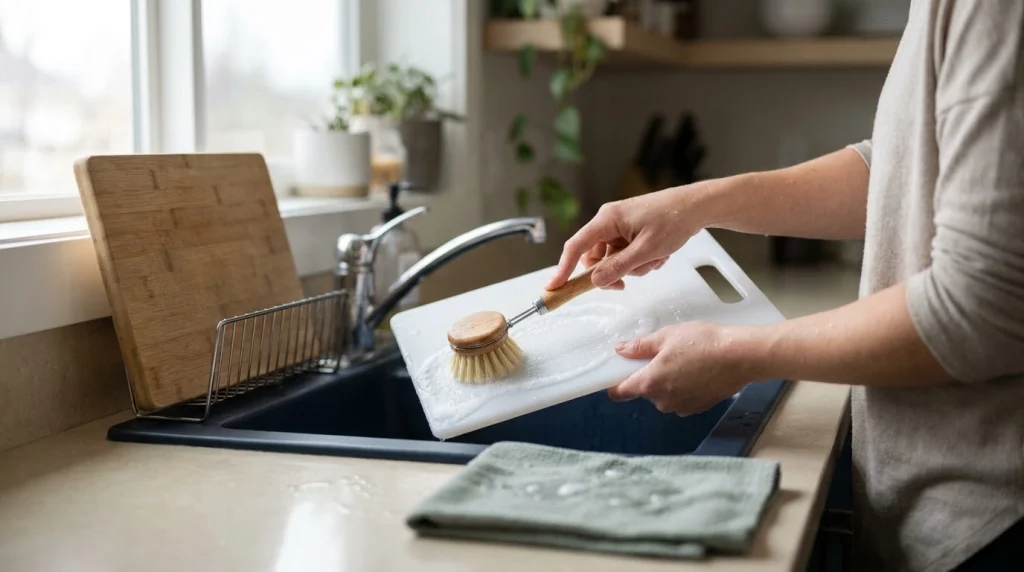
Proper cleaning removes food residue while helping maintain a usable cutting surface. Always follow the manufacturer’s instructions for temperature limits and dishwasher compatibility.
- Remove leftover ingredients and food particles.
- Wash the surface using hot, soapy water.
- Scrub visible residue with a suitable cleaning brush.
- Rinse thoroughly with clean water.
- Sanitize when appropriate, particularly after preparing raw meat.
- Allow the board to dry completely before storing it.
The University of Maine Cooperative Extension cutting board guide provides additional recommendations for safe cleaning, material selection, and food preparation.
Avoid using excessive heat on boards that are not dishwasher safe. Warping can make the surface unstable and shorten its useful life.
Do Plastic Cutting Boards Release Particles When Cutting?
Plastic cutting boards can release small plastic particles when knives repeatedly cut into their surfaces. The amount depends on factors such as board material, cutting force, and surface condition.
This issue differs from knife dullness, although both involve mechanical contact between the blade and cutting surface.
As of 2026, research continues to examine microplastic exposure and its potential health implications. The health effects of exposure specifically from cutting boards are not fully established.
Replacing severely worn boards and avoiding unnecessarily aggressive chopping are reasonable ways to limit visible surface deterioration.
Should You Switch From Plastic to Wood to Protect Your Knives?
Switching to a suitable wooden cutting board may benefit knife edge retention, particularly if your current plastic board is unusually hard. However, replacing a good plastic board is not automatically necessary.
I recommend choosing the material according to your preparation habits rather than expecting one board to excel at every kitchen task.
Choose Plastic If You Need:
- Convenient everyday cleaning.
- An affordable replacement option.
- A dedicated surface for raw meat.
- Lightweight storage and transportation.
- Dishwasher compatibility where specified.
Choose Wood If You Need:
- A forgiving surface for premium knives.
- A substantial, stable preparation area.
- A board that can potentially be refinished.
- A durable surface for frequent vegetable preparation.
- An alternative to plastic cutting surfaces.
A two-board arrangement offers a practical compromise. Use a dedicated plastic board for raw meat and a suitable wooden board for vegetables, bread, and other preparation tasks.
For a deeper comparison of knife retention, read this guide on which cutting board keeps knives sharp longer.
Recommended Cutting Boards for Protecting Knife Edges
If your current cutting board is heavily worn or excessively rigid, these three options are worth considering. Each addresses a different food preparation priority.
Affiliate disclosure: As an Amazon Associate, I earn from qualifying purchases. The ratings below are editorial estimates based on design and intended use, not verified customer ratings or hands-on test scores.
🏆 Best for Everyday Preparation
OXO Good Grips Utility Cutting Board
★★★★☆ 4.5/5 Editorial
This double-sided plastic cutting board features non-slip edges and a practical preparation surface. I would consider it for everyday chopping when stability and easy cleaning are priorities.
💰 Best Budget Option
Farberware Plastic Cutting Board
★★★★☆ 4.0/5 Editorial
Farberware offers lightweight polyethylene cutting boards suitable for routine kitchen preparation. I would consider one as an affordable dedicated board for raw meat or occasional chopping.
🌳 Best Wooden Alternative
John Boos Maple End-Grain Cutting Board
★★★★☆ 4.5/5 Editorial
Maple end-grain construction offers a substantial, forgiving surface for regular food preparation. I would choose this alternative when knife protection and long-term maintainability matter more than dishwasher convenience.
Frequently Asked Questions
Do Plastic Cutting Boards Ruin Knives?
Quality plastic cutting boards generally do not ruin kitchen knives during normal use. They contribute to gradual edge wear, as all cutting surfaces do. Choosing a forgiving polyethylene board and avoiding forceful chopping can help minimize unnecessary blade damage.
Is Plastic or Wood Better for Keeping Knives Sharp?
Suitable wooden cutting boards, especially end-grain designs, often provide excellent knife edge protection. Quality plastic boards also perform well for everyday preparation. The best choice depends on the board’s hardness, knife geometry, maintenance requirements, and the user’s cutting technique.
Do Plastic Cutting Boards Dull Stainless Steel Knives?
Plastic cutting boards gradually dull stainless steel knives through repeated cutting contact. The rate of wear depends on the steel’s properties, edge geometry, board material, and cutting pressure. Routine sharpening and proper cutting techniques can help maintain stainless steel knife performance.
Are Soft Plastic Cutting Boards Better for Knives?
A slightly forgiving plastic cutting surface can reduce impact stress compared with a harder, more rigid board. However, excessively flexible mats may lack stability. Choose a food-grade board that balances surface forgiveness, thickness, durability, and secure placement on the countertop.
How Often Should You Sharpen Knives Used on Plastic Cutting Boards?
Sharpen kitchen knives whenever their cutting performance noticeably declines rather than following a fixed schedule. Frequent cooking may require more regular maintenance. Knife steel, sharpening quality, preparation habits, and cutting board characteristics all influence how long the edge remains sharp.
Final Thoughts
Plastic cutting boards do gradually dull knives, but that does not make them unsuitable for everyday cooking. Quality polyethylene and polypropylene boards remain practical choices when their surfaces are stable, clean, and in good condition.
For maximum knife edge protection, consider a suitable end-grain wooden board or another forgiving cutting surface. Avoid glass, marble, and unnecessarily rigid materials for regular chopping.
The most important improvements involve your cutting habits. Reduce excessive pressure, stop scraping ingredients with the sharp edge, and maintain your knives whenever their performance declines.
My recommendation: Keep a quality plastic board for convenient food preparation and consider a forgiving wooden board for delicate knives and frequent vegetable chopping. Combining the right cutting surface with proper knife care can help maintain sharpness and improve your overall cooking experience.

