Chef Knife vs Utility Knife: Key Differences, Uses, and Which to Choose
Quick Answer
A chef knife is best for everyday chopping, dicing, mincing, and slicing larger ingredients, while a utility knife excels at smaller, more precise cutting jobs. Most home cooks should choose a chef knife first because it handles a wider range of meal-preparation tasks. A utility knife makes a useful second blade when you need more control in tight spaces or when a full-size blade feels cumbersome.
Which Knife Is Better for Your Kitchen?
- Best all-purpose choice: Choose a chef knife for onions, carrots, herbs, boneless meat, and everyday meal preparation.
- Best for smaller jobs: Choose a utility knife for apples, cucumbers, cheese, sandwiches, and small portions.
- Typical blade length: Chef knives commonly measure 8 inches, while utility knives often measure 5–6 inches, although sizes vary by model.
- Cutting control: A utility knife offers a compact feel, while a chef knife provides more blade height and room for larger cuts.
- Buying priority: If you can buy only one, start with a comfortable, sharp chef knife; add a utility knife when your cooking habits justify it.
Choosing between a chef knife and a utility knife can be confusing when both seem capable of cutting the same foods. The difference becomes clearer when you consider blade size, cutting technique, and how much food you prepare at once.
In this guide, I’ll explain what each knife does best, compare their practical differences, and help you decide whether you need one or both. I’ll also cover common mistakes, knife safety, and what to look for when buying either blade in 2026.
What Is the Difference Between a Chef Knife and a Utility Knife?
A chef knife is a general-purpose kitchen knife with a relatively broad blade and a curved cutting edge, designed for chopping, slicing, dicing, and mincing. A utility knife is a smaller, usually narrower kitchen knife designed for controlled cutting tasks that fall between a chef knife’s broad preparation work and a paring knife’s detailed work.
The main difference isn’t simply sharpness or quality. It’s how each blade’s size and shape suit different ingredients and cutting movements.
- Chef knife: Better for repetitive chopping, larger vegetables, substantial quantities of ingredients, and a rocking cutting motion.
- Utility knife: Better for smaller produce, trimming, cutting portions, and jobs where a long, broad blade feels awkward.
Both knives can have excellent cutting edges, and neither is automatically sharper than the other. The best choice depends on the task, blade condition, and how comfortably you can control the knife.
Chef Knife vs Utility Knife: Side-by-Side Comparison
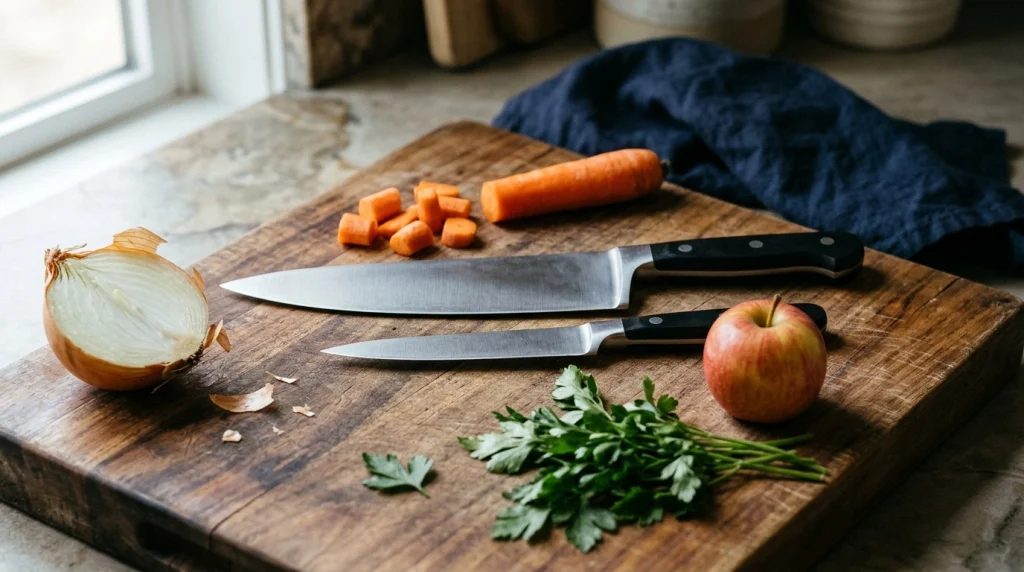 Save
The following table summarizes common differences between these two kitchen knives. Measurements are typical ranges rather than fixed industry standards, so individual models may differ.
| Feature | Chef Knife | Utility Knife |
|---|---|---|
| Typical blade length | 6–10 inches; 8 inches is common | 4–7 inches; 5–6 inches is common |
| Blade shape | Broad blade with a curved cutting edge | Narrower blade with a pointed tip |
| Best tasks | Chopping, dicing, mincing, general slicing | Small produce, trimming, portioning, light slicing |
| Large ingredients | Usually easier to manage | Can require extra cutting strokes |
| Small, precise cuts | Capable, but sometimes bulky | Often more convenient |
| Blade height | Generally taller | Generally narrower |
| Best first purchase | Usually yes | Best as a complement for most cooks |
One practical point matters more than the measurements: choose a knife that feels secure in your hand and suits the size of your cutting board. A shorter chef knife can be a better fit than a long blade if you have limited workspace or prefer compact movements.
What Is a Chef Knife Best Used For?
A chef knife is the main workhorse for everyday kitchen preparation. Its broad blade, substantial cutting edge, and balanced shape make it useful for many ingredients without switching knives repeatedly.
Here are the jobs it handles particularly well:
- Chopping vegetables: Cut onions, bell peppers, cabbage, and carrots into manageable pieces.
- Dicing ingredients: Create evenly sized cubes for soups, stir-fries, and sauces.
- Mincing herbs and garlic: Use controlled rocking or chopping motions to produce smaller pieces.
- Slicing boneless meat: Cut chicken breast, cooked meat, and other suitable boneless portions.
- Preparing larger produce: Work through potatoes, melons, and other ingredients that benefit from a longer blade.
Why does a chef knife have a broad blade?
The blade’s height provides knuckle clearance during chopping and gives you a broad surface for guiding or transferring chopped ingredients. Its curved edge also supports a rocking motion, although a straight up-and-down cut works well with many chef knives.
For more detail on the blade’s purpose and design, see this guide to what a chef knife is and how it works.
When should you avoid using a chef knife?
A chef knife is versatile, but it isn’t designed for every cutting job. Avoid using its edge to chop through hard bones, frozen food, or other materials that could damage the blade.
A serrated bread knife usually works better for crusty bread, while a paring knife offers better control for peeling small fruit. For boneless meat, a chef knife works well; removing bones calls for a suitable specialized knife and careful technique.
What Is a Utility Knife Best Used For?
A utility knife is useful when a chef knife feels too large for the amount of food you’re preparing. Its smaller blade offers a convenient balance of reach and control for everyday tasks that don’t need a broad chopping blade.
Common uses include:
- Slicing small fruit: Cut apples, pears, strawberries, and similar produce into portions.
- Trimming vegetables: Remove unwanted ends or tidy up smaller ingredients.
- Slicing cheese: Cut manageable pieces of many firm and semi-firm cheeses.
- Preparing sandwiches: Slice fillings and portion ingredients without reaching for a large blade.
- Cutting smaller portions: Slice boneless meat or cooked poultry when the blade length suits the task.
Utility knives come in different shapes, and some have serrated edges rather than smooth ones. Check the model before buying because a serrated utility knife behaves differently from a straight-edged version.
Is a utility knife better for small hands?
It can be more comfortable for some people, but blade length alone doesn’t determine control. Handle shape, weight, balance, grip comfort, and the size of the ingredient all affect how a knife feels during use.
If you find an 8-inch chef knife awkward, try holding a 6-inch chef knife and a utility knife before choosing. A shorter chef knife may provide the compact feel you want while retaining a broad blade for everyday chopping.
Chef Knife vs Utility Knife: Which Is Better for Different Foods?
The easiest way to choose is to match the blade to the ingredient and the cut. Both knives can perform overlapping jobs, but one often makes the work more comfortable.
| Food or task | Better starting choice | Reason |
|---|---|---|
| Dicing an onion | Chef knife | Broad blade and room for repeated cuts |
| Chopping a large cabbage | Chef knife | Longer edge and better clearance around larger pieces |
| Slicing a small apple | Either | Choose the blade you can control comfortably |
| Mincing a large bunch of herbs | Chef knife | A longer edge helps with repeated chopping |
| Trimming a small pepper | Utility knife | Compact size can make the work easier |
| Slicing a block of cheese | Either | Blade length and cheese texture determine comfort |
| Cutting crusty bread | Bread knife | A serrated edge handles the crust more effectively |
For a typical dinner, I would start with the chef knife for the main vegetable preparation and use a utility knife for smaller jobs that feel awkward with the larger blade. That’s a practical division of work, not a rule that prevents either knife from handling the same ingredient.
Which Knife Should You Buy First?
If you’re building a kitchen from scratch, a chef knife is usually the better first purchase. It covers more everyday preparation tasks, so you can cook a wide range of meals without needing several specialized blades.
A utility knife becomes worthwhile when you regularly prepare small ingredients or want a second knife for lighter cutting jobs.
- Choose a chef knife first if you cook daily, prepare family meals, or frequently chop vegetables.
- Choose a utility knife first if your kitchen work mainly involves small ingredients and you already own another suitable all-purpose knife.
- Buy both if you prepare a variety of meals and want a convenient alternative to switching between a chef knife and a small paring knife.
Is an 8-inch chef knife too big for beginners?
Not necessarily. An 8-inch blade is a common all-purpose size, but a 6-inch chef knife may feel easier to manage if you have smaller hands, limited counter space, or little knife experience.
Before purchasing, hold the knife if possible and check that the handle feels secure. You should be able to control the blade without excessive wrist movement or a strained grip.
What Should You Look for When Buying Either Knife?
Blade length matters, but it shouldn’t be your only buying criterion. Comfort, edge maintenance, construction, and intended use all influence how well a knife fits your kitchen.
1. Blade material
Stainless steel is a practical choice for most home cooks because it generally offers good corrosion resistance and straightforward maintenance. Carbon steel can develop a fine cutting edge, but it requires more attention to moisture and rust prevention.
Neither material guarantees better performance on its own. Steel quality, blade geometry, heat treatment, and maintenance all affect cutting ability.
2. Handle comfort and balance
A secure, comfortable handle helps you maintain control during repeated cuts. If the handle feels slippery, too large, or awkwardly shaped, a technically excellent blade may still be a poor fit.
Pay attention to the overall balance, too. Some cooks prefer a heavier knife, while others find a lighter blade easier to control over longer preparation sessions.
3. Edge maintenance
A sharp knife cuts more predictably than a dull one that requires extra pressure. Choose a blade you can maintain with an appropriate sharpening method or have professionally sharpened when needed.
For general knife selection and maintenance guidance, the University of Kentucky’s guide to selecting and caring for kitchen knives offers a useful starting point.
4. Construction and intended use
Forged and stamped knives can both serve home cooks well. A forged knife is shaped from heated steel, while a stamped knife is cut from sheet steel; neither construction method alone proves that a particular knife is better.
For more demanding daily work, prioritize a comfortable grip, a reliable edge, and a blade suited to your cutting style rather than paying extra for appearance alone.
Common Mistakes When Choosing Between These Knives
Many buying mistakes come from assuming that a smaller blade is always safer or that a larger blade is always more effective. In practice, the right knife depends on the food, the cut, and your ability to control the tool.
- Buying only by blade length: Compare handle comfort, blade height, weight, and balance as well.
- Expecting a utility knife to replace every other knife: It can handle many small jobs, but it isn’t ideal for every ingredient.
- Using a chef knife for hard bones: Bone contact can damage the cutting edge, so use a suitable tool for the job.
- Ignoring sharpness: A dull edge often needs more force, making control more difficult.
- Buying a large set unnecessarily: Start with the knives you will use regularly instead of paying for unused pieces.
How to Use and Maintain Both Knives Safely
 Save
Good knife technique matters regardless of blade size. A stable cutting surface, controlled movements, and a properly maintained edge help reduce the risk of slips.
- Secure the cutting board: Place a damp towel underneath a suitable board to help prevent movement.
- Use a controlled grip: Hold the handle firmly and keep your fingertips curled away from the cutting edge.
- Choose stable ingredients: Cut round vegetables into a stable shape before continuing with smaller cuts.
- Keep the edge maintained: Sharpen the knife when it stops cutting cleanly, following the manufacturer’s recommendations.
- Clean and store carefully: Wash according to the manufacturer’s instructions, dry the blade thoroughly, and store it where the edge cannot contact other utensils.
Never leave a knife hidden beneath soapy water in a sink. Someone reaching into the water could accidentally contact the blade.
For additional food-preparation guidance, see the University of California’s knife skills teaching guide, which covers common knife types and safe handling practices.
Chef Knife vs Utility Knife: Recommended Options
If you’re ready to choose a knife, I’d focus on dependable construction, a comfortable handle, and a blade length that suits your kitchen. The following are established models worth comparing; the ratings below are editorial assessments, not verified customer-review averages or results from personal hands-on testing.
🏆 BEST EVERYDAY CHEF KNIFE
Victorinox Fibrox Pro 8-Inch Chef’s Knife
★★★★½ Editorial assessment
Its 8-inch stainless-steel blade and textured Fibrox handle make it a practical candidate for everyday chopping, slicing, and dicing. It’s worth comparing if you want one main knife without moving into a premium price category.
💰 BEST BUDGET ALTERNATIVE
Mercer Culinary Millennia 8-Inch Chef’s Knife
★★★★½ Editorial assessment
This model combines an 8-inch high-carbon Japanese steel blade with an ergonomic handle featuring textured grip points. Compare it with the Victorinox if you want a straightforward chef knife for regular home cooking.
🎯 BEST COMPACT UTILITY KNIFE
Wüsthof Classic 6-Inch Utility Knife
★★★★ Editorial assessment
Its compact blade is suited to smaller slicing and trimming jobs where a full-size chef knife may feel bulky. Consider it as a complementary knife rather than a replacement for your main chopping blade.
Before ordering, confirm the exact model, blade length, handle style, current price, and seller. Product availability and prices can change, and a comfortable knife is more valuable than one chosen solely for its specifications.
Frequently Asked Questions
Is a chef knife better than a utility knife?
A chef knife is generally better for all-purpose food preparation because its broader blade handles chopping, dicing, and mincing efficiently. A utility knife is more convenient for many smaller cutting jobs. Neither is universally better; the right choice depends on your ingredients, technique, and comfort.
Can a utility knife replace a chef knife?
A utility knife can handle many basic kitchen tasks, including slicing fruit, trimming vegetables, and cutting smaller portions of meat. However, its narrower, shorter blade is less convenient for repeated chopping or preparing large ingredients. For most regular home cooking, a chef knife is the more versatile primary tool.
Can you cut meat with a utility knife?
Yes, a suitable utility knife can slice boneless meat, cooked poultry, and small portions when its blade is sharp and long enough. For large roasts, a dedicated slicing knife may work better. For removing bones, use an appropriate boning knife rather than forcing a utility knife into the task.
Is a 6-inch chef knife better than an 8-inch utility knife?
Blade length alone doesn’t determine which knife performs better. A 6-inch chef knife usually offers a broader blade suited to chopping, while an 8-inch utility-style knife may provide more reach for slicing. Compare the actual blade shape, balance, handle, and intended use before deciding.
Do I need both a chef knife and a utility knife?
No, you don’t need both to prepare everyday meals. A chef knife can handle most routine cutting tasks, while a utility knife adds convenience for smaller ingredients and precise slicing. Start with the knife you will use most often, then add a second blade if you find a genuine gap in your kitchen setup.
Final Verdict: Chef Knife or Utility Knife?
For most home cooks, the chef knife is the better first purchase because it handles a wider variety of everyday preparation tasks. An 8-inch model is a sensible starting point for many kitchens, while a 6-inch chef knife may suit cooks who prefer a smaller blade.
A utility knife earns its place as a compact companion for trimming, small produce, and lighter slicing jobs. If you already own a comfortable chef knife, adding a utility knife can make preparation more convenient without requiring a large knife set.
My recommendation is simple: prioritize comfort, a reliable cutting edge, and the work you do most often. Choose the knife that makes those tasks easier to control, and maintain it properly for years of useful service.

