Key Characteristics of a Chef Knife Explained
Quick Answer
The key characteristics of a chef knife are a broad multipurpose blade, a sharp plain edge, enough blade length and height for efficient chopping, a profile suited to your cutting motion, useful balance, a comfortable secure handle, and steel that balances sharpness, toughness, edge retention, and ease of maintenance. How these characteristics work together matters more than any single specification.
A chef knife is designed to cover a wide range of everyday preparation tasks rather than specialize in one cut. A good one can slice meat, chop vegetables, mince herbs, dice onions, and handle many other routine jobs without feeling awkward.
That versatility comes from several characteristics working together. Blade length gets much of the attention, but geometry, profile, thickness, balance, handle comfort, and edge condition can affect real cutting performance just as much.
What Makes a Knife a Chef Knife?
A chef knife normally has a relatively broad blade that tapers toward a pointed tip and provides enough edge length for both chopping and slicing. Unlike a paring knife, it gives your hand clearance above the cutting board and allows longer cutting strokes.
The blade also usually combines several functional zones. The tip handles controlled detail work, the center performs much of the general slicing, and the heel gives you a stronger section for firmer ingredients.
Chef knives are therefore defined less by one exact measurement than by their general-purpose design. An 8-inch blade is especially common, but shorter and longer versions can still perform the same basic role. Victorinox, for example, currently offers an 8-inch chef knife designed for chopping, slicing, mincing, and other general kitchen preparation.
1. Blade Profile Determines How the Knife Wants to Move
 Save
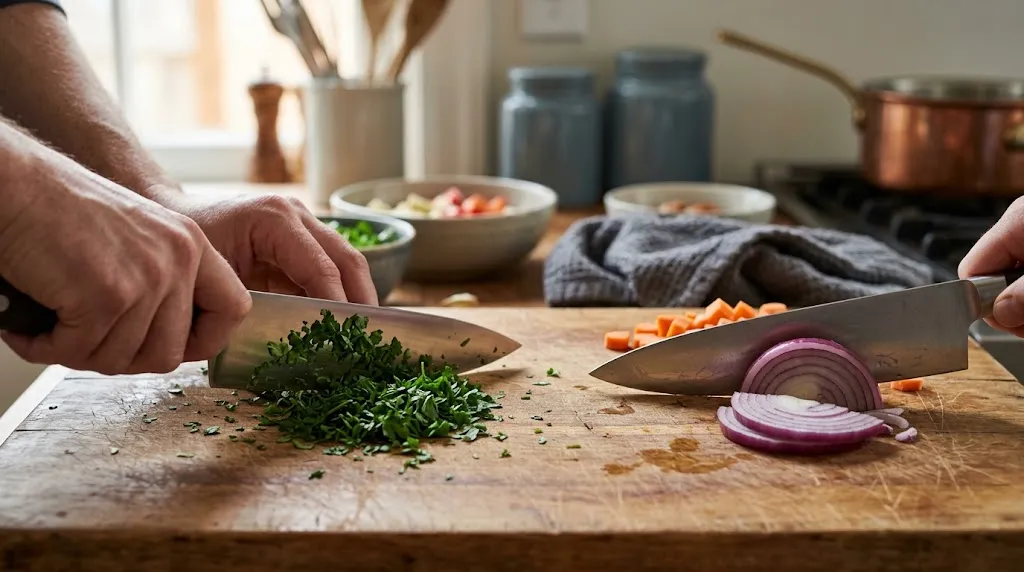
SaveThe shape of the cutting edge influences your cutting technique. Some chef knives have a pronounced curved belly, while others keep more of the edge relatively flat before rising toward the tip.
A more curved profile naturally supports a rocking motion because the blade can pivot while part of the edge remains near the board. A flatter profile gives more edge contact during push cuts and straight chopping.
This difference is easy to overlook because two knives can have the same length and steel yet feel completely different on a cutting board. ZWILLING, for example, describes different chef-knife profiles for rocking cuts as well as flatter versions intended for push-and-pull cutting.
Key Insight
Blade profile is not merely cosmetic. Match the curve of the edge to the way you actually cut: more curve for frequent rocking, more flat edge for push-cutting and chopping.
2. Blade Length Changes Reach, Control, and Maneuverability
Blade length affects how much food you can cut in one stroke and how easily the knife moves in a small workspace. Around 8 inches is a common middle ground because it offers useful reach without becoming difficult for many home cooks to control.
A shorter chef knife can feel more agile when trimming smaller ingredients or working on a compact board. A longer knife gives you more cutting edge for large vegetables, roasts, melons, and long slicing strokes, but it requires more board space and may feel cumbersome in smaller hands.
The useful question is therefore not “What is the correct chef-knife length?” but “What length lets me control the entire blade comfortably on my normal cutting board?”
3. Blade Height Provides Knuckle Clearance and Control
A chef knife is normally taller than a utility or paring knife. That height gives your guiding hand more clearance from the board and provides a broad blade face that can feel stable during chopping.
Blade height also affects how the knife feels in a pinch grip. A very shallow blade may leave larger hands crowded against the board, while a very tall blade can feel less nimble.
For most cooks, adequate clearance is more important than chasing the tallest possible blade. Your fingers should be able to guide food comfortably without repeatedly striking the board.
4. Edge Geometry Matters More Than Sharpness Alone
A freshly sharpened knife can still cut poorly if too much steel sits behind the edge. The blade has to move through food after the sharpened apex begins the cut, so the thickness and taper behind that edge influence resistance.
This is why two knives that both feel sharp on paper can behave differently in carrots, potatoes, squash, or other dense ingredients. A thin, well-tapered blade generally moves through food with less wedging, while a thicker blade may trade some cutting efficiency for greater robustness.
The best geometry depends on use. A delicate thin blade makes sense for precise vegetable prep, but a more substantial knife can be more forgiving when ingredients and technique are less controlled.
5. Steel Controls a Series of Tradeoffs
Knife steel affects how the blade takes and retains an edge, how resistant it is to corrosion, how easily it sharpens, and how tolerant it is of rough treatment.
Harder steel can support a fine edge and may retain cutting performance for longer, but greater hardness can also make an edge less tolerant of twisting or impact depending on the alloy, heat treatment, and blade geometry. More forgiving steel may need attention sooner but can be easier to maintain.
Corrosion resistance matters too. Stainless compositions are convenient for everyday home use, while some less corrosion-resistant steels require more careful drying and maintenance.
Do not judge a chef knife from a steel name alone. Heat treatment, blade geometry, edge quality, and manufacturing execution can matter as much as the alloy printed on the packaging.
6. Balance Should Support Control, Not Meet a Universal Rule
A useful chef knife should feel controllable in your hand. It does not have to balance at one mathematically perfect location.
Some cooks prefer a blade-forward feel that helps the knife move through food. Others prefer weight closer to the handle for a more neutral sensation. Forged knives with substantial bolsters can feel quite different from lightweight stamped designs, yet either construction can produce a practical chef knife.
WÜSTHOF describes the bolster as a feature that contributes to balance and control, while Victorinox also sells lightweight non-forged chef knives with ergonomic handles. This is a useful reminder that forged does not automatically mean better for every cook, and stamped does not automatically mean poor quality.
If you are deciding whether to buy knives individually or as a collection, the guide on whether knife sets are worth it explains why the chef knife is usually the piece worth evaluating most carefully.
7. The Handle Should Stay Comfortable and Secure
A handle that looks attractive but creates pressure points will become tiring during extended preparation. Shape, circumference, surface texture, weight, and the transition between blade and handle all affect comfort.
Your grip should feel secure even when your hands are slightly damp. The handle should not force your wrist into an uncomfortable angle or create sharp seams against your fingers.
Handle preferences are personal, which is one reason specifications cannot fully predict whether a knife will suit you. If possible, hold the knife in your normal grip rather than judging the handle only from photographs.
8. Bolster and Tang Design Affect Feel but Are Not Automatic Quality Scores
The tang is the portion of blade material that extends into the handle. A full tang extends through most or all of the handle and can add stability and weight, but a knife does not need a visibly exposed full tang to function well.
The bolster is the thicker transition area found on many forged Western-style knives. It can add weight near the hand and create a smooth transition into the blade.
A full bolster that extends all the way down to the heel can make sharpening the complete edge less convenient. A half bolster or bolster-free design leaves the heel more accessible.
These construction details should therefore be considered in terms of comfort, sharpening access, weight, and durability rather than treated as simple “premium versus cheap” labels.
9. A Good Chef Knife Must Be Maintainable
Even excellent blade geometry loses its advantage once the cutting edge becomes dull. Edge maintenance is therefore part of the knife’s practical performance.
Sharpening actually recreates the cutting edge by removing material. Honing or edge maintenance may improve the condition of an edge between sharpenings, but the appropriate method depends on the knife and the maintenance tool.
Our guide to cleaning, sharpening, and maintaining kitchen knives covers the maintenance process in greater detail.
Storage matters as well. Allowing an exposed edge to strike other metal tools can damage or dull it. For practical storage options, see how to store kitchen knives safely.
How to Judge the Characteristics Together
 Save
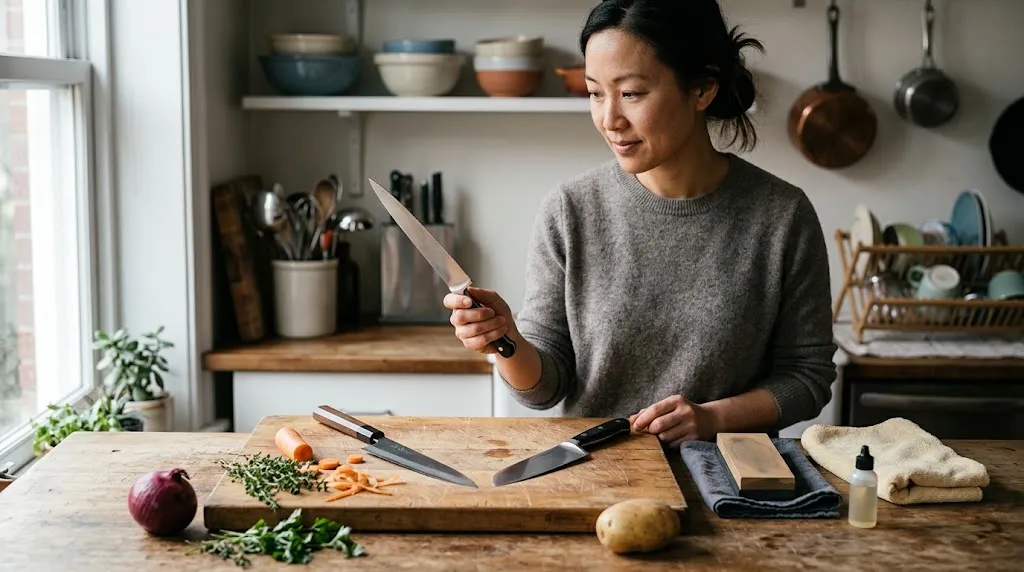
SaveDo not evaluate a chef knife from one specification. Use a short sequence instead:
- Check the length and height. Make sure the blade fits your hand, board, and usual ingredients.
- Look at the edge profile. Decide whether its curve suits rocking, push-cutting, or a mixture of techniques.
- Consider thickness and taper. A knife should move through your normal foods without unnecessary wedging.
- Assess the handle. Check grip security, pressure points, and wrist comfort.
- Notice the balance and total weight. Choose what feels controlled rather than chasing a prescribed balance point.
- Consider maintenance. Make sure the steel, edge, bolster, and construction fit the amount of sharpening and care you are willing to do.
Tip
When comparing chef knives, prioritize how blade profile, geometry, handle, and balance work together. A premium steel name cannot compensate for a knife that is uncomfortable or poorly matched to your cutting style.
For examples of how established manufacturers combine these features, WÜSTHOF’s knife-series comparison shows differences in construction, bolster style, weight, and hardness, while Victorinox’s 8-inch Swiss Classic chef knife illustrates a lightweight, non-forged approach to a general-purpose chef knife.
Related Product
8-Inch Chef Knives
An 8-inch chef knife is a useful reference point when comparing blade profile, handle style, weight, construction, and other characteristics discussed above.
As an Amazon Associate, we earn from qualifying purchases.
Frequently Asked Questions
Is an 8-inch blade required for a chef knife?
No. Eight inches is a common chef-knife size, but 6-, 7-, 9-, and 10-inch knives can perform the same general role. The best length depends on your hand, cutting board, workspace, and preferred level of control.
Does a chef knife need a full tang?
No. A full tang can influence durability, weight, and balance, but well-made knives also exist with other tang constructions. Judge the complete knife rather than treating a visible full tang as a mandatory quality test.
Is a heavier chef knife better?
Not necessarily. Extra weight can feel reassuring and help with some cuts, while a lighter knife can reduce fatigue and improve maneuverability. Choose a weight that remains controlled during the tasks you perform most often.
What is the difference between blade sharpness and blade geometry?
Sharpness mainly describes the condition of the cutting edge, while geometry describes the blade’s shape and thickness around and behind that edge. A sharp edge starts a cut, but overall geometry strongly affects how easily the rest of the blade continues through food.
Does harder knife steel always mean a better chef knife?
No. Hardness is one characteristic among many. Harder steel may support good edge retention, but toughness, corrosion resistance, sharpening difficulty, edge geometry, and heat treatment also influence performance.
Which chef-knife characteristic should a beginner prioritize first?
Start with comfort and control. Choose a manageable length, a secure handle, useful knuckle clearance, and a blade profile that suits your natural cutting motion. Steel specifications matter, but an uncomfortable knife is unlikely to become a useful everyday tool.
Conclusion
The most important characteristics of a chef knife are not isolated specifications. Blade length, height, profile, geometry, steel, weight, balance, handle design, and construction all influence how the knife behaves in your hand and on the cutting board. Start with the way you actually cook: the ingredients you cut, the motion you prefer, your board size, and the amount of maintenance you are comfortable doing. A chef knife that fits those conditions is more useful than one chosen simply because it has harder steel, a full tang, a higher price, or another impressive-sounding feature.