Chef Knife vs Santoku: Which Knife Should You Choose?
Quick Answer
A chef knife is the better all-purpose choice if you prefer rocking cuts, need a pointed tip, and regularly prepare larger ingredients. A santoku knife is an excellent alternative if you prefer a shorter blade, controlled chopping, and straight slicing motions. Both can handle everyday kitchen preparation, so your cutting style and comfort matter more than choosing one universally superior knife.
Which knife suits your cooking style?
- All-purpose versatility: Choose a chef knife for a broad range of everyday cutting tasks.
- Controlled chopping: Choose a santoku if you prefer a flatter cutting edge and a compact blade.
- Rocking cuts: A curved chef knife blade supports a rolling motion across the cutting board.
- Small workspaces: A shorter santoku can feel easier to manage on a compact board.
- One first knife: Start with the style that feels comfortable and matches the way you prepare food.
One important distinction
- Neither knife is automatically sharper, safer, or better quality. Steel, edge geometry, maintenance, and design vary between individual models.
Choosing between a chef knife and a santoku can feel confusing because both are designed to handle many of the same kitchen tasks. The difference becomes clearer when you look at their blade shapes, cutting motions, and everyday handling.
In this guide, I’ll explain what separates the two knives, where each one works best, and what to consider before choosing your first or next kitchen knife. The goal is to help you make a practical decision without buying equipment you don’t need.
What Is a Chef Knife?
A chef knife is a multipurpose kitchen knife with a broad blade, a pointed tip, and a curved cutting edge. It is designed for slicing, dicing, chopping, and mincing a wide range of ingredients.
Many home cooks choose an 8-inch chef knife as their primary kitchen blade. Longer and shorter versions are also available, so you can match the length to your hand, cutting board, and preferred working style.
What makes a chef knife useful?
- Curved cutting edge: Supports a rocking motion when chopping herbs, garlic, and other small ingredients.
- Pointed tip: Helps with detailed cuts, trimming, and working around small areas.
- Broad blade: Provides clearance for your knuckles and helps move chopped ingredients across a board.
- Versatile design: Handles most routine vegetable, fruit, boneless meat, and fish preparation.
The main advantage is flexibility. A well-chosen chef knife can perform many everyday cutting tasks without requiring a separate blade for each ingredient.
What Is a Santoku Knife?
A santoku knife is a Japanese-style multipurpose kitchen knife traditionally associated with three core tasks: slicing, dicing, and chopping. It typically has a shorter blade, a flatter cutting edge, and a tip that slopes down toward the cutting edge.
Many santoku knives measure around 5 to 7 inches, although sizes vary by manufacturer. Their compact shape can appeal to cooks who want precise control without handling a longer blade.
What makes a santoku different?
- Flatter edge: Encourages straight chopping and push-cutting rather than continuous rocking.
- Compact blade: Can feel manageable when preparing vegetables on a smaller cutting board.
- Distinctive tip: Usually has a less pronounced point than a traditional Western chef knife.
- Optional blade indentations: Some models have hollow-ground dimples intended to reduce food sticking during cutting.
Not every santoku has the same weight, edge geometry, or construction. Some are lightweight and thin, while others feel more substantial, so the knife’s individual design matters.
What Is the Difference Between a Chef Knife and a Santoku?
 Save
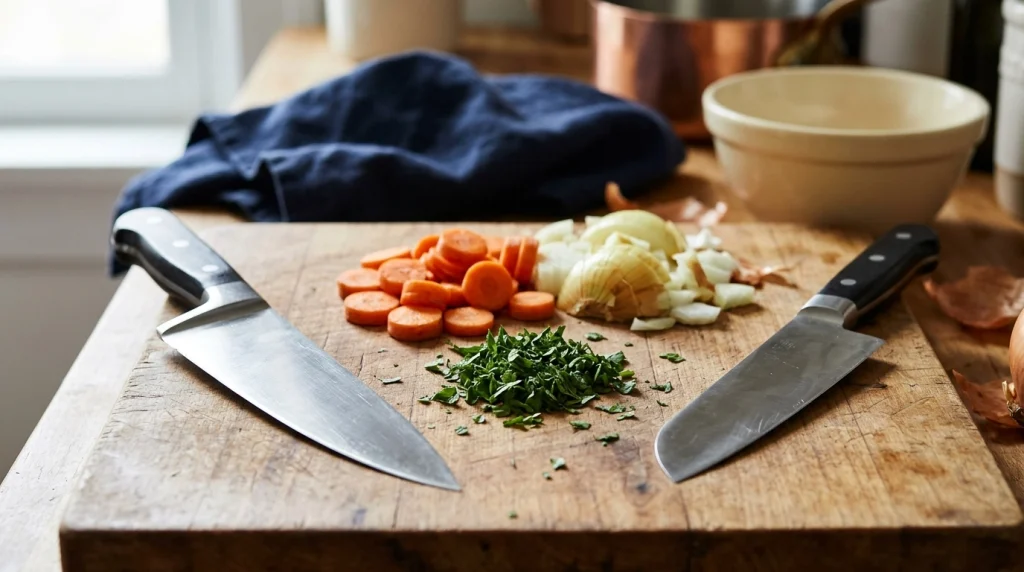
The biggest practical difference is the relationship between the blade shape and the cutting motion. A traditional chef knife favors rocking cuts, while a traditional santoku favors straight chopping and controlled push cuts.
Both knives can perform most everyday kitchen tasks. Your preferred technique, the ingredients you prepare, and the knife’s individual construction help determine which one suits you better.
| Feature | Chef Knife | Santoku Knife |
|---|---|---|
| Typical blade length | Around 8 inches for a common home-cooking size | Around 5–7 inches |
| Cutting edge | More pronounced curve | Generally flatter |
| Blade tip | Usually pointed | Usually rounded or sheep’s-foot shaped |
| Common cutting motion | Rocking and slicing | Straight chopping and push-cutting |
| Everyday strengths | Versatile preparation and pointed-tip work | Controlled chopping and compact handling |
| Best starting point | Cooks wanting one general-purpose knife | Cooks who prefer a shorter, flatter blade |
These are typical design characteristics, not universal specifications. A particular santoku may have a curved edge, and a Japanese-made chef knife may be thinner or lighter than a traditional Western model.
Which Knife Is Better for Cutting Vegetables?
Both knives work well for vegetables, but a santoku may suit cooks who regularly use straight chopping and push-cutting motions. A chef knife remains an excellent choice if you prefer rocking cuts or want more blade length.
Consider how you prepare a typical dinner. The right choice often becomes obvious when you think about the actual cutting movements you use most.
- Onions: Both knives can dice onions efficiently when properly sharpened.
- Carrots: Either can slice and chop carrots; use controlled cuts and avoid forcing the blade through hard ingredients.
- Leafy herbs: A chef knife’s curved edge suits rocking mincing, while a santoku works well with repeated straight cuts.
- Cabbage: Both can handle routine chopping when the blade is long and sturdy enough for the task.
- Tomatoes: A sharp edge helps prevent crushing. Technique and sharpness matter more than the knife’s name.
One feature sometimes associated with santoku knives is a hollow or fluted edge. These indentations can help reduce sticking with certain ingredients, but they don’t guarantee that food will release cleanly on every cut.
Is a Chef Knife or Santoku Better for Meat?
A chef knife is often the more flexible starting point for cooks who prepare a variety of meats, especially when they also need a pointed tip for trimming. A santoku can handle many boneless meat-slicing and portioning tasks just as well.
For raw chicken breast, boneless beef, or pork tenderloin, either style can work effectively. Choose a blade with suitable length, comfortable handling, and an edge that you can maintain.
Neither knife should replace a specialized butcher knife or boning knife when a task calls for a blade designed for heavy butchery, working around bones, or separating joints. Avoid twisting a thin kitchen blade through bones or using it to force apart frozen food.
Which Knife Is Easier for Beginners?
Neither knife is automatically easier for every beginner. A santoku’s shorter blade may feel less cumbersome, while a chef knife’s familiar curved edge may feel more natural if you want to learn rocking cuts.
Comfort is more useful than assumptions about a knife’s origin or price. If possible, hold both styles before choosing.
What should a beginner look for?
- Manageable length: Start with a blade you can control comfortably on your usual cutting board.
- Secure handle: Choose a grip that feels stable without forcing your fingers into an awkward position.
- Balanced handling: The knife should feel controllable rather than excessively heavy or unwieldy.
- Easy maintenance: A knife you can keep sharp and clean is more useful than one with impressive specifications you cannot maintain.
Practice a stable grip and controlled cutting technique with either style. Keep your fingertips curled away from the edge, use a stable cutting board, and never rush through unfamiliar knife movements.
Does a Santoku Stay Sharper Than a Chef Knife?
No, the knife style alone cannot tell you how long an edge will stay sharp. Edge retention depends on factors such as the steel, heat treatment, edge geometry, cutting surface, ingredients, and maintenance.
Some santoku knives use relatively hard steel and a fine edge, while some Western chef knives prioritize durability and straightforward maintenance. These are design choices, not guarantees attached to either category.
What affects sharpness and maintenance?
- Steel quality: Different steels balance edge retention, toughness, corrosion resistance, and ease of sharpening differently.
- Cutting board: Wood and suitable plastic boards are generally kinder to an edge than glass, stone, or ceramic surfaces.
- Sharpening: Every knife eventually needs sharpening. Follow the maker’s guidance for its edge angle and construction.
- Cleaning: Wash the knife after use and dry it promptly, particularly if the manufacturer recommends hand-washing.
- Storage: Protect the edge with a suitable knife guard, block, or magnetic rack that keeps the blade secure.
A sharp knife cuts more predictably than a dull one, but sharpness does not remove the need for careful handling. Avoid assuming that a santoku is inherently safer because its tip is less pointed.
Can You Use a Santoku Instead of a Chef Knife?
Yes. For many home cooks, a santoku can replace a chef knife for everyday chopping, slicing, dicing, and mincing.
The main limitation is not that a santoku cannot perform these tasks. Its shorter blade, tip shape, and flatter edge simply make some cutting techniques less convenient for cooks who prefer the geometry of a traditional chef knife.
If you already own a good santoku, you probably don’t need to buy a chef knife just to prepare ordinary meals. Consider a second knife only if you regularly encounter tasks that your current blade handles poorly.
How Should You Choose Between the Two Knives?
Start with your cooking habits instead of brand names or marketing claims. Your everyday ingredients and preferred cutting technique provide a practical basis for choosing.
- Think about your cutting motion. Choose a chef knife if you enjoy rocking cuts, or consider a santoku if you prefer straight chopping.
- Check your workspace. A shorter santoku can be convenient on a small board, while a longer chef knife offers more blade length for larger ingredients.
- Consider the tip. A pointed chef knife may be more convenient for detailed trimming and certain precision tasks.
- Hold the knife if possible. Check the handle, balance, clearance, and overall comfort before buying.
- Compare the actual construction. Look at steel, blade thickness, edge type, maintenance needs, and warranty rather than relying on the category alone.
As of 2026, both designs remain practical options for home kitchens. There is no need to own both unless the second knife adds a clear benefit to your cooking routine.
What About Price and Overall Value?
Neither knife style is automatically cheaper. Entry-level, midrange, and premium options exist in both categories, and the price often reflects materials, manufacturing, brand positioning, and finish.
A comfortable, well-maintained knife that suits your technique can offer better everyday value than an expensive model that feels awkward in your hand.
When comparing two knives at a similar price, check the following:
- Materials: Review the manufacturer’s stated steel and handle materials.
- Maintenance: Find out whether the knife needs special sharpening equipment or particular care.
- Ergonomics: Check the handle shape and how the blade balances in your hand.
- Support: Review the warranty and the manufacturer’s sharpening or repair guidance.
For a first kitchen knife, prioritize comfort, reliable construction, and maintenance over decorative finishes or a large knife collection.
Recommended Chef Knives and Santoku Knives
 Save
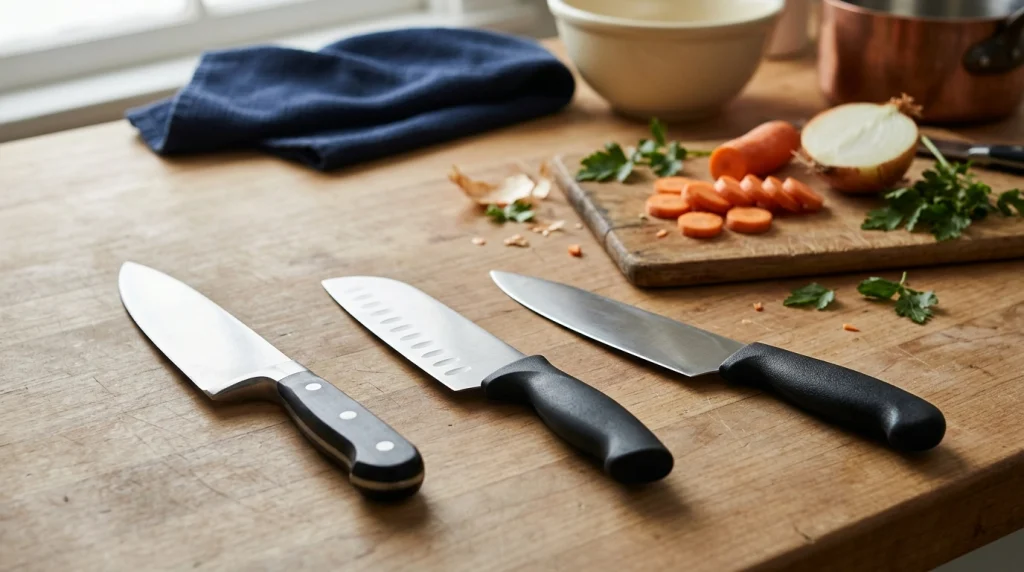
If you’re ready to compare individual models, these established options offer different starting points. The descriptions below are based on their product categories and general design characteristics, not a claim of hands-on testing or a verified live ranking.
🏆 GENERAL-PURPOSE PICK
Victorinox Fibrox Pro 8-Inch Chef’s Knife
An 8-inch chef knife with a practical, nonslip-style handle design. Consider it if you want a traditional multipurpose blade for routine chopping, slicing, and dicing.
🥬 COMPACT SANTOKU
Mercer Culinary Millennia 7-Inch Santoku
A 7-inch santoku-style knife for cooks who prefer a shorter blade and controlled chopping. Check the exact model’s edge design and handle details before ordering.
🔪 TRADITIONAL CHEF KNIFE
Wüsthof Classic 8-Inch Cook’s Knife
A traditional Western-style chef knife with a pointed tip and curved cutting profile. Consider this style if you value rocking cuts and want a broad-purpose kitchen blade.
Before purchasing, verify the exact model, current price, dimensions, and seller details on the retailer’s listing. These recommendations are starting points for comparison, not a guarantee that one knife will suit every cook.
Frequently Asked Questions
Is a chef knife better than a santoku?
Neither is universally better. A chef knife suits cooks who prefer a curved blade and rocking motion, while a santoku suits those who favor a flatter edge and controlled chopping. Both can handle many everyday kitchen tasks, so comfort, cutting technique, and blade quality should guide your decision.
Can a santoku knife cut meat and vegetables?
Yes. A santoku can slice boneless meat and prepare vegetables, fruit, and herbs. Its shorter blade and flatter edge may feel particularly convenient for controlled chopping. For bones, heavy butchery, or other specialized jobs, choose a knife designed specifically for that work instead.
Why does a santoku knife have a flatter blade?
The relatively flat cutting edge supports straight chopping and push-cutting motions. Unlike a traditional curved chef knife, a typical santoku does not rely as heavily on rocking across the cutting board. Individual designs vary, however, and some santoku knives have more curved edges.
Should I buy both a chef knife and a santoku?
You don’t need both to prepare everyday meals. Start with the style that feels most comfortable and covers your usual cutting tasks. A second knife makes sense when its blade shape or handling offers a useful advantage, rather than simply adding another tool to your drawer.
Are santoku knives always sharper than chef knives?
No. Sharpness and edge retention depend on the specific knife’s steel, sharpening, geometry, and use. Some santoku knives have fine edges, but many chef knives do too. Compare individual specifications and maintenance requirements instead of assuming that one knife category is always sharper.
Final Takeaway: Choose the Knife That Fits Your Technique
When comparing a chef knife vs santoku, focus on how the blade feels and how you prefer to cut. A chef knife is a versatile starting point for cooks who like rocking motions and a pointed tip, while a santoku offers a compact alternative for straight chopping and controlled slicing.
If you’re buying your first kitchen knife, choose one comfortable, well-made blade and learn to maintain it properly. You can always add the other style later if your cooking habits give you a clear reason to do so.

