Chef Knife Secondary Bevel: Definition, Purpose & Sharpening Guide
Quick Answer
A secondary bevel on a chef’s knife is a small, distinct angle ground at the very edge of the blade, separate from the primary grind. It is added to increase edge durability, improve strength against impact, and make routine maintenance and sharpening significantly easier without thinning the entire blade body.
What Is a Chef Knife Secondary Bevel?
When looking closely at the cutting edge of modern kitchen knives, you are often looking at two distinct geometric planes. The primary bevel forms the main taper of the blade from the spine down toward the edge, designed to reduce friction and help the knife glide smoothly through food.
The secondary bevel—often called the micro-bevel or edge bevel—is the very final apex where the two sides meet to form the cutting edge itself. While many traditional single-bevel Japanese blades or zero-grind knives feature a continuous flat taper, most Western and hybrid chef’s knives incorporate a secondary bevel to reinforce the steel right where it experiences the highest stress.
Understanding this distinction helps home cooks and sharpening enthusiasts choose the right maintenance routine. Grinding a secondary bevel means you do not have to remove steel from the entire primary face of the knife every time it needs a touch-up.
Primary Grinds vs. Secondary Bevels: The Key Differences
 Save
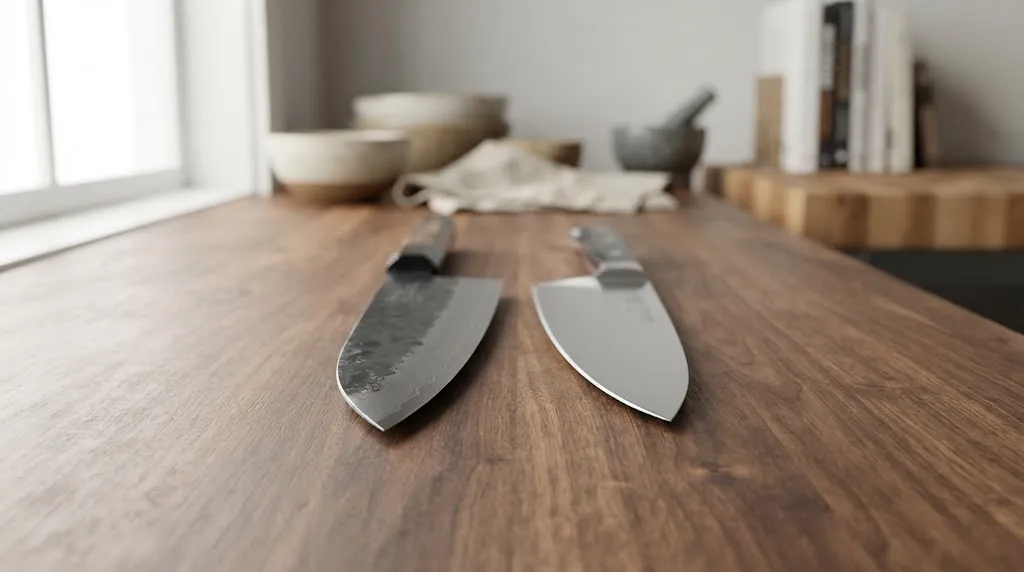
To understand why knife makers and sharpeners use a secondary bevel, it helps to look at how blade geometry influences performance. The primary grind determines how a knife wedges into ingredients, while the secondary bevel determines edge strength.
A knife with a completely flat or hollow primary grind that tapers straight to a zero-edge cuts exceptionally well through soft ingredients like tomatoes or fish. However, that razor-thin apex is extremely fragile. Twisting the blade or striking a hard bone can cause the thin edge to chip or roll.
| Feature | Primary Grind | Secondary Bevel |
|---|---|---|
| Location | Spine down to near the edge | The very edge apex |
| Primary Purpose | Reduce cutting resistance and friction | Provide structural strength and durability |
| Sharpening Frequency | Rarely (only when blade becomes too thick behind the edge) | Frequently (during regular stone sharpening) |
| Angle | Very shallow tapered angle | Steeper apex angle (e.g., 15° to 20°) |
The table above highlights how dividing the edge geometry into two distinct zones allows manufacturers to balance cutting efficiency with mechanical resilience.
Why Knife Makers Use a Secondary Bevel
Adding a secondary bevel is a deliberate engineering choice made to solve several practical problems associated with kitchen cutlery use.
Edge Durability and Chip Prevention
Kitchen environments are demanding. Knives frequently contact cutting boards made of wood, plastic, or composite materials, and they occasionally encounter hard items like squash rinds or small bones. A secondary bevel adds a tiny amount of thickness directly behind the apex, creating a stronger wedge that resists rolling and chipping.
Simplified Maintenance
If a chef’s knife relied entirely on a zero-grind primary taper, sharpening it would require grinding away massive amounts of steel from the flat sides of the blade every time it dulled. By utilizing a secondary bevel, a sharpener only needs to work on a tiny fraction of a millimeter at the very edge, saving time and extending the lifespan of the knife.
Consistent Geometry Over Time
As a knife is sharpened repeatedly over years of use, the blade naturally thickens behind the edge. Re-establishing or thinning the primary grind periodically, combined with a fresh secondary bevel, ensures the knife maintains optimal geometry throughout its working life.
How the Secondary Bevel Affects Cutting Performance
While a secondary bevel offers major durability advantages, it introduces a minor trade-off in absolute cutting performance. A thicker edge apex displaces more food as it travels downward, which can slightly increase resistance when cutting dense, hard ingredients like carrots or potatoes.
To mitigate this, high-end Japanese chef’s knives often feature very narrow secondary bevels or subtle micro-bevels, keeping the transition smooth. Western chef’s knives typically feature slightly more robust secondary bevels designed to withstand heavy rocking motions on cutting boards without failing.
Tip
If your chef’s knife feels like it is wedging or cracking dense vegetables rather than slicing cleanly, check whether the secondary bevel has grown too wide over years of careless sharpening. Thinning the shoulders behind the edge will restore effortless cutting performance.
How to Maintain and Sharpen a Secondary Bevel
 Save
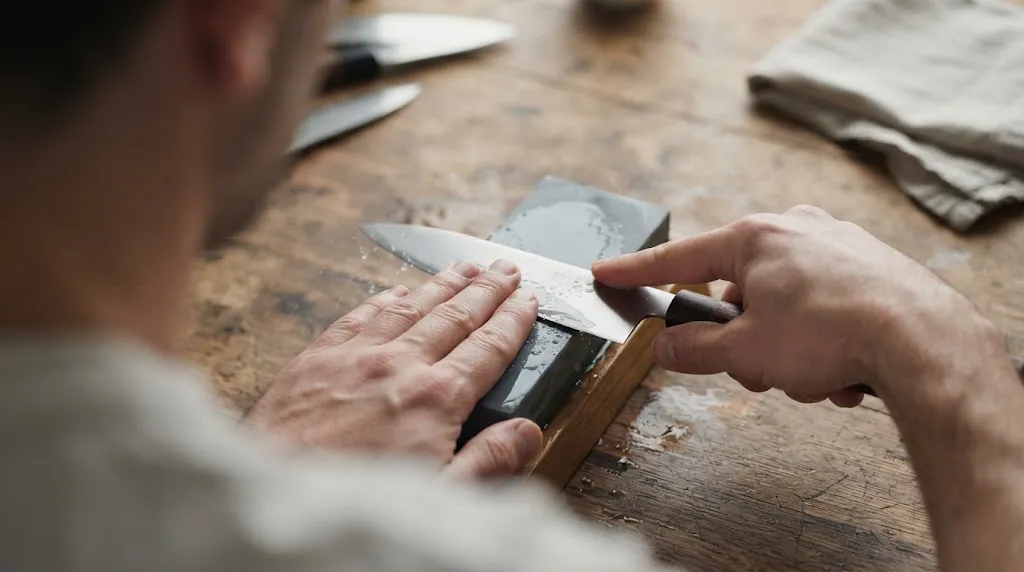
Maintaining a secondary bevel correctly requires attention to angle stability and stone selection. Because the secondary bevel is small, freehand sharpening on whetstones demands muscle memory and consistency.
Step-by-Step Sharpening Process
- Determine the Target Angle: Match the existing factory angle, typically 15 degrees for Japanese style blades or 20 degrees for Western style chef’s knives.
- Find the Bevel Flat: Rest the blade on the whetstone so that the flat of the secondary bevel rests flush against the abrasive surface.
- Form a Burr: Maintain a steady stroke from heel to tip until a fine metal burr forms along the opposite edge of the apex.
- Switch Sides: Flip the knife and repeat the process on the other side, ensuring equal strokes to keep the apex centered.
- Deburr and Polish: Finish on a fine grit stone or leather strop to remove the burr and polish the micro-bevel for a clean, sharp bite.
Warning
Raising the sharpening angle too high relative to the primary bevel creates a steep, blunt “beveled edge upon a bevel” known as a thick shoulder. This dramatically increases cutting resistance and ruins the knife’s slicing geometry.
Related Product
Combination Whetstone Sharpening Kit
A dual-grit water stone allows you to maintain precise angles on your chef knife secondary bevel and polish the edge for effortless daily food prep.
As an Amazon Associate, we earn from qualifying purchases.
Frequently Asked Questions
Do all chef’s knives have a secondary bevel?
No. While the vast majority of Western and mass-market stainless steel chef’s knives feature a secondary bevel for durability, many traditional single-bevel Japanese knives (like yanagiba or debu) and certain high-end custom double-bevel knives feature a continuous zero-grind taper straight to the apex without a distinct micro-bevel.
How can I tell if my knife has a secondary bevel?
You can identify a secondary bevel by looking closely at the very edge under bright lighting or using a magnifying loupe. If you see a subtle change in the light reflection or angle right at the final millimeter of the cutting edge, you are looking at the secondary bevel.
Should I remove the secondary bevel when sharpening?
In most cases, you should maintain the secondary bevel rather than grinding it away. Trying to convert a knife with a secondary bevel into a zero-grind blade requires removing an immense amount of steel from the primary flanks, which alters the blade balance and can ruin its structural integrity.
What is the ideal angle for a secondary bevel?
The ideal angle depends on the knife style and intended use. European and American chef’s knives typically feature a secondary bevel set between 18 and 20 degrees per side for durability, while Japanese chef’s knives often use a sharper 12 to 15 degree angle for finer slicing performance.
Does a micro-bevel mean the same thing as a secondary bevel?
In common knife terminology, a micro-bevel is simply an extremely narrow, slightly steeper secondary bevel applied at the very final stage of sharpening. It adds extra durability to an otherwise thin edge with minimal impact on cutting friction.
Why does my knife dull faster after sharpening?
If your knife dulls rapidly after sharpening, you may have left a microscopic wire edge or burr attached to the secondary bevel, or you may have used an improper angle that left the apex too thin and structurally weak. Ensure you fully deburr the edge on a fine stone or strop before use.
Conclusion
The secondary bevel is a vital structural element that balances sharpness with everyday durability in modern chef’s knives. By understanding how it protects the delicate edge and simplifies maintenance, you can sharpen your kitchen cutlery more effectively and keep your blades performing at their best. Maintaining the correct angle during regular stone touch-ups ensures your knife cuts cleanly and lasts for decades.

