Chef Knife Laminate Construction Explained: Core & Cladding
Quick Answer
Chef knife laminate construction involves fusing a hard, high-carbon steel core between softer, corrosion-resistant exterior cladding layers. This sandwich-like design creates a blade with an exceptionally sharp, durable cutting edge protected by a tough, flexible outer body that resists snapping and rust.
What Is Laminated Knife Construction?
 Save
Laminate construction in kitchen knives refers to a manufacturing technique where multiple layers of different steels are forge-welded or pressure-bonded together. Instead of making the entire blade from a single piece of steel, makers use a composite approach to combine conflicting physical properties into one cohesive tool.
At the center of a laminated chef knife lies the core, often referred to as the cutting core or San Mai (three-piece) center. This core is typically made from extremely hard, high-carbon steel capable of taking and holding a razor-sharp edge. Flanking this brittle core on both sides are outer layers of softer, more ductile stainless steel.
This structural division solves a fundamental engineering tradeoff in metallurgy: hardness usually equals brittleness, while toughness usually means softness. By laminating, the knife achieves both high edge retention and impact resistance simultaneously.
How Laminated Chef Knives Are Made
The manufacturing process requires precise temperature control, clean forge welding, and careful grinding to ensure the core steel is exposed precisely at the cutting edge while remaining safely encased along the spine and sides.
Makers begin by sandwiching the high-carbon core steel billet between two thicker slabs of outer cladding steel. Through high-heat forging or rolling mills, the layers are hammered or pressed together until the atomic structures bond permanently.
Once bonded, the billet is shaped, ground, and heat-treated. The final edge geometry is ground down so that only the exposed tip of the hard core forms the very apex of the cutting edge, while the softer cladding forms the visible upper flanks of the blade.
Core Steel vs. Cladding Steel: The Functional Balance
Understanding how laminate construction performs requires looking at how the two distinct steel types interact during daily kitchen tasks.
The core steel provides the cutting performance. Steels like VG-10, SG2 (R2), or white and blue high-carbon papers are chosen because they can be hardened to 60+ HRC on the Rockwell scale. This high hardness prevents the edge from rolling or dulling quickly during intensive prep work.
The cladding steel provides structural integrity and corrosion resistance. Because high-carbon steels are prone to rusting and chipping under lateral stress, the softer stainless exterior absorbs shock, protects the reactive core from acidic foods, and makes the overall blade less likely to snap if dropped or twisted improperly.
Advantages of Laminated Construction
Laminate blades offer several distinct benefits for home cooks and professional chefs who prioritize edge longevity and ease of maintenance.
- Superior Edge Retention: The hard core allows for steeper sharpening angles and long periods between sharpenings.
- Enhanced Durability: The softer outer layers absorb minor impacts that might otherwise fracture a mono-steel blade of equivalent hardness.
- Reduced Maintenance: Stainless cladding over a high-carbon core gives users the cutting performance of reactive steel with much lower risk of widespread rusting.
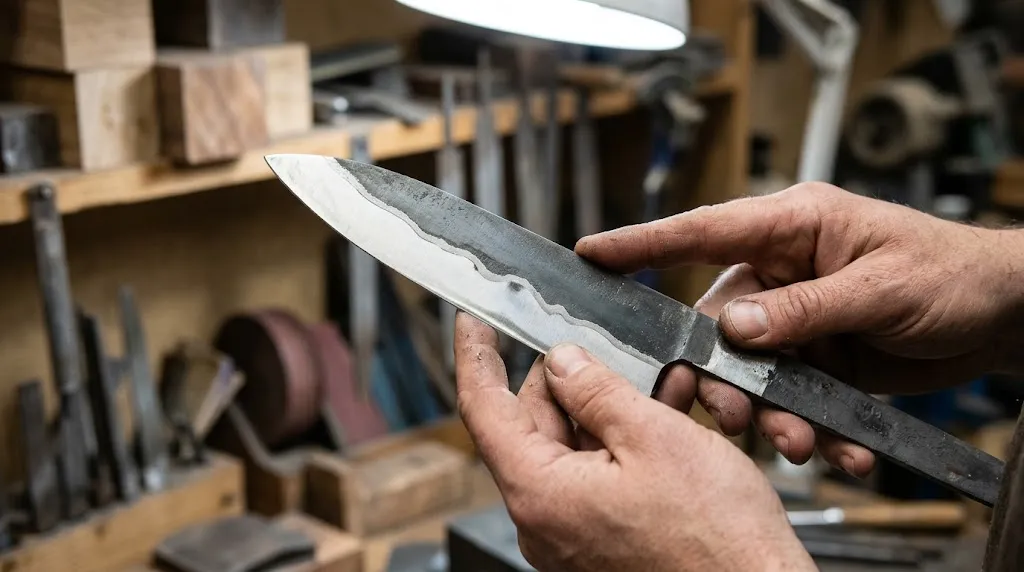
- Aesthetic Appeal: The weld line—often called the hamon or cladding line—creates a distinct visual pattern along the blade face.
Key Insight
Laminate construction does not mean the entire blade is made of one uniform material; it is an engineered composite designed to place maximum hardness precisely where the knife cuts and maximum toughness everywhere else.
Potential Drawbacks and Limitations
Despite their performance benefits, laminated chef knives come with specific trade-offs that buyers should consider before purchasing.
- Higher Cost: The complex multi-step manufacturing process makes laminated blades more expensive than standard stamped mono-steel knives.
- Sharpening Changes Over Years: As the blade is sharpened over decades, the edge recedes closer to the thicker spine, which can slightly alter cutting geometry if not thinned correctly.
- Cladding Scratching: Softer stainless cladding is more prone to surface scuffs and cosmetic scratches from abrasive sponges or heavy use.
How to Maintain and Sharpen Laminated Knives
 Save
Maintaining a laminated chef knife requires attention to both the hard edge and the softer body. When sharpening on whetstones, the user must grind away both the cladding and the core material proportionally to maintain the correct behind-the-edge thickness.
Avoid using pull-through sharpeners or electric grinders, as these aggressive tools can gouge the softer cladding unevenly and ruin the delicate geometry of the cutting edge. Hand washing and thorough drying after use will prevent any moisture from getting trapped along the weld boundary in reactive carbon-core variants.
Relevant Product
Japanese Whetstone Sharpening Set
A quality dual-grit water stone helps maintain the precise edge geometry required for high-performance laminated kitchen knives.
As an Amazon Associate, we earn from qualifying purchases.
Frequently Asked Questions
Is laminate steel better than single-steel construction?
Neither is universally better; they serve different design goals. Laminated steel allows manufacturers to pair extreme edge hardness with impact resistance, whereas single-steel blades offer uniform consistency and lower production costs.
Can a laminated chef knife snap in half?
While the softer outer cladding makes the blade more flexible and resistant to catastrophic snapping than a brittle mono-steel core, any kitchen knife can break if subjected to extreme lateral twisting, prying, or dropping onto hard floors.
What is the difference between San Mai and Damascus laminate?
San Mai refers specifically to a three-layer laminate construction where a core is flanked by two outer layers. Damascus laminate involves folding or layering the cladding steel multiple times to create intricate surface patterns while maintaining the same core-and-cladding functional principle.
Will the core steel rust on a laminated knife?
If the core is made from high-carbon steel (such as Shirogami or Aogami) and exposed at the very edge, that microscopic edge can develop patina or rust if left wet. However, the stainless cladding protects the rest of the blade body from corrosion.
How can you tell if a knife is truly laminated?
Look closely at the lower portion of the blade near the cutting edge. On a laminated knife, you will often see a distinct wavy or straight horizontal line where the different steel types meet, accompanied by a noticeable texture or color shift.
Do laminated knives require special sharpening techniques?
They require standard whetstone sharpening discipline, but care must be taken to thin the blade periodically over years of use so that the softer cladding does not make the edge too thick behind the apex.
Conclusion
Chef knife laminate construction represents a sophisticated metallurgical solution to the eternal balance between edge sharpness and structural toughness. By encasing a hard, high-carbon cutting core inside protective, resilient exterior layers, manufacturers deliver blades that hold a remarkable edge while resisting everyday stresses and corrosion. Understanding how these layers function helps home cooks and culinary professionals choose, maintain, and appreciate the engineering behind high-performance kitchen tools.

