Chef Knife Grind Angles: How to Choose and Maintain the Right Edge
Quick Answer
For most Western chef knives, a sharpening angle between 17 and 20 degrees per side provides a strong balance of cutting performance and durability. Lighter, harder Japanese-style chef knives often use a narrower 15-degree angle for finer slicing precision.
Understanding Chef Knife Grind Angles
Choosing the correct sharpening angle is the foundation of maintaining an effective kitchen blade. The grind angle determines how thin or thick the final V-shaped edge becomes, directly affecting how effortlessly the knife passes through food and how well the steel holds up under regular pressure.
Many home cooks struggle with sharpening because they chase exact numbers rather than focusing on stability. In practice, consistency across every stroke matters far more than hitting an isolated target degree.
Sharpening vs. Inclusive Angles Explained
 Save
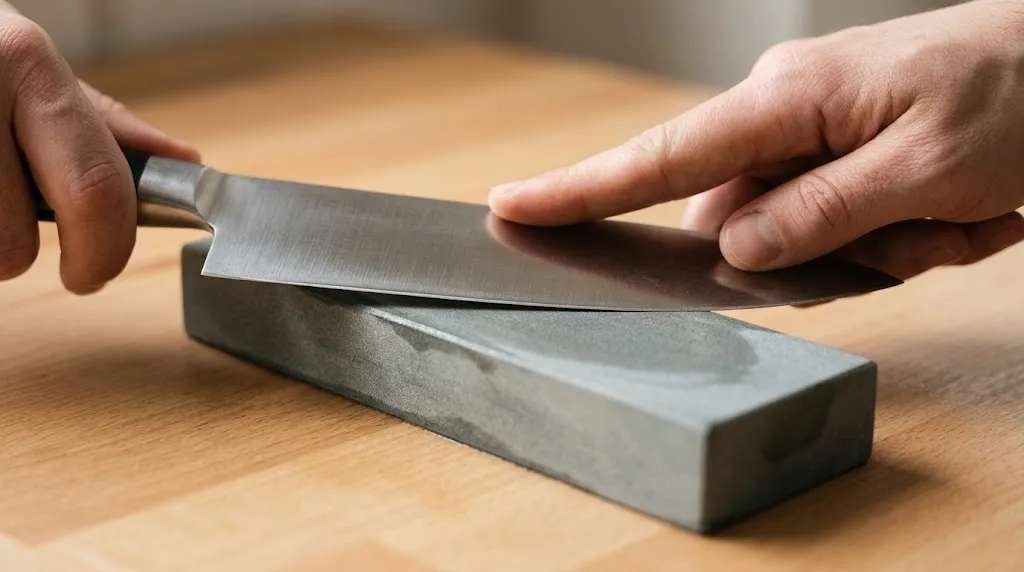
Before setting a blade on a stone or guided sharpener, it helps to understand how manufacturers and sharpeners measure angles. An angle can be quoted per side or inclusively.
- Per-side angle: The measurement between the flat face of the bevel and the centerline of the blade. This is the number you control when working on a whetstone.
- Inclusive angle: The total combined angle of both bevels added together. For example, a 20-degree angle per side equals a 40-degree inclusive angle.
When instructions or sharpening guides reference an angle, they typically mean per side unless specified otherwise.
Comparing 15-Degree and 20-Degree Grinds
| Angle Per Side | Typical Blade Type | Primary Benefit | Trade-off |
|---|---|---|---|
| 15 Degrees | Japanese-style or thin kitchen knives | Exceptional slicing performance for delicate ingredients | Higher risk of chipping or rolling on hard impacts |
| 17 to 20 Degrees | Traditional Western chef knives | Versatile durability for general chopping and board work | Requires slightly more effort on dense items |
A narrower angle creates a longer, thinner wedge that parts food with minimal resistance. However, that thin edge lacks heavy steel behind it, making it vulnerable if twisted against hard materials like bone or frozen food.
How to Find and Hold Your Angle on a Whetstone
Maintaining a steady angle by hand requires muscle memory rather than complex tools. A reliable visual process helps establish the correct starting position on a sharpening stone.
- Place the knife perpendicular to the stone so the spine points straight up at a 90-degree angle.
- Lower the spine halfway down toward the stone surface to reach approximately 45 degrees.
- Lower the spine halfway down again to hit roughly 22.5 degrees.
- Drop the spine just a fraction more to settle into your target zone between 15 and 20 degrees.
Tip
Use the permanent marker trick by coloring the edge bevel before starting. A few light passes across the stone will show where steel is being removed, letting you adjust your wrist angle instantly if the ink only rubs off at the very tip or spine.
Common Sharpening Mistakes to Avoid
 Save
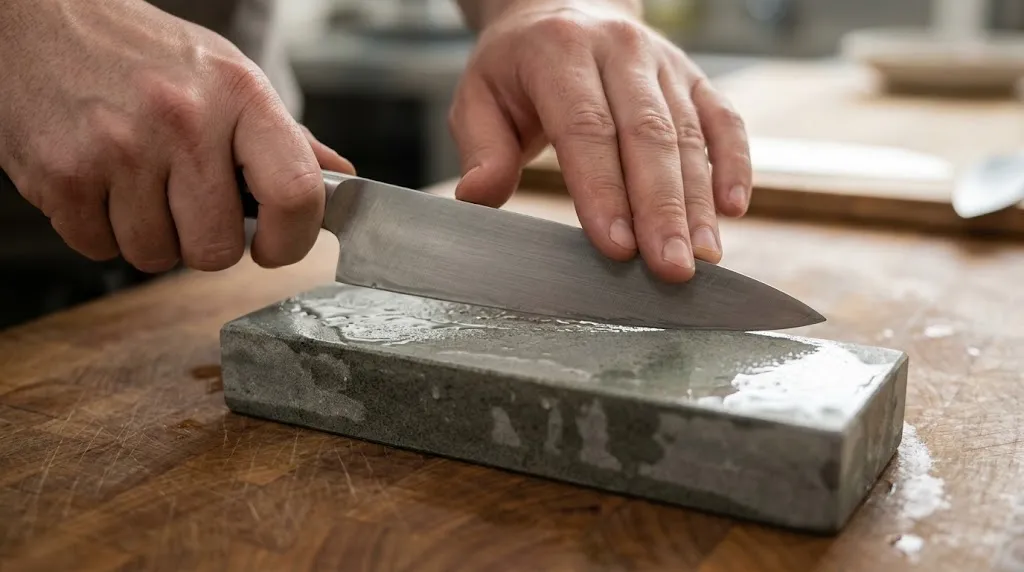
Even with the right angle in mind, certain habits can compromise the edge or damage the blade structure during maintenance.
- Wavering during strokes: Constantly shifting between 15 and 25 degrees rounds off the apex instead of forming a clean, flat bevel.
- Applying excessive downward pressure: Heavy force makes it difficult to keep the hands steady and removes excess metal unnecessarily. Let the abrasive grit do the cutting work.
- Stopping before a burr forms: Failing to grind until a rough wire edge develops across the entire length means the old dull apex has not been fully replaced.
Warning
Never test sharpness by running a bare finger directly along the edge. Always test against a lightweight material like a sheet of paper or a ripe tomato.
Frequently Asked Questions
Should I match my factory knife angle?
Matching the factory angle is generally the easiest and safest choice unless you find that the existing edge chips too easily or lacks the slicing performance you prefer for daily cooking tasks.
Does a chef knife need a different angle near the tip?
Most kitchen knives maintain a consistent angle along the belly, though the curve near the tip requires a slight lift of the handle to keep the spine-to-stone distance proportional as the blade tapers.
How does honing differ from changing the grind angle?
Honing uses a steel or ceramic rod to realign a microscopic bent apex back into place without removing metal, whereas grinding on a stone creates an entirely new bevel by shaving away steel.
Can I sharpen a 15-degree Japanese knife at 20 degrees?
Yes, though it will make the edge slightly more obtuse. Some cooks increase the angle slightly if their Japanese blade frequently chips on dense vegetables or hard board surfaces.
How often should a chef knife be reground on stones?
Regular honing maintains daily alignment, but a full sharpening on stones is typically only necessary every few months depending on frequency of use and cutting board materials.
Do guided sharpeners work better than freehand stones?
Guided systems lock in a physical angle mechanically, making them ideal for consistency, while whetstones offer greater flexibility once proper muscle memory is established.
Conclusion
Mastering the correct chef knife grind angle comes down to balancing cutting efficiency with edge resilience. Whether you prefer a fine 15-degree slice or a sturdy 20-degree utility edge, maintaining steady muscle memory and checking for a burr will deliver reliable results. Prioritizing consistency over absolute precision ensures your kitchen knives stay sharp, safe, and ready for everyday food preparation.

