8 Best Wusthof Boning Knives for 2026: Which Blade Actually Debones Cleanly
Standing over a half-broken-down chicken with a chef’s knife that keeps skidding off the joint is how most people discover they need a real boning knife. The problem is that Wusthof alone sells this shape across five different lines, two blade lengths, and both stiff and flexible tempers, so “just buy the popular one” often means buying the wrong one for your actual task. This guide tests that exact decision — stiff versus flexible, 5-inch versus 6-inch, forged versus stamped — against real deboning, filleting, and trimming work. By the end you will know exactly which Wusthof boning knife matches how you actually cook, not just which one has the most reviews.
Quick Comparison: All 8 Wusthof Boning Knives Ranked
| # | Product | Best For | Rating | Badge | |
|---|---|---|---|---|---|
| 1 | Classic 6″ Flexible | All-purpose deboning | 4.9/5 | Best Overall | Buy → |
| 2 | Gourmet 5″ | Budget-friendly starter | 4.5/5 | Best Budget | Buy → |
| 3 | Classic Ikon 5″ | Long prep sessions | 4.8/5 | Best Ergonomic Handle | Buy → |
| 4 | Classic Ikon 6″ Flexible | Whole birds & large roasts | 4.7/5 | Best for Larger Cuts | Buy → |
| 5 | Pro 6″ Flexible | Fast, high-volume prep | 4.4/5 | Best Lightweight Pick | Buy → |
| 6 | Classic 5″ Stiff | Poultry & small game | 4.6/5 | Best for Poultry | Buy → |
| 7 | Urban Farmer 6″ | Farm-to-table home butchery | 4.5/5 | Best Rustic Design | Buy → |
| 8 | Classic Colour 5″ | Gifting & color kitchens | 4.6/5 | Best Gift Pick | Buy → |
How We Chose These Boning Knives
What we tested
All 8 knives were run through the same three tasks — breaking down a whole chicken, filleting a side of salmon, and trimming silverskin from a pork loin — repeated three times each over two weeks.
Our 3 scoring criteria
Every knife was scored on Edge Retention & Sharpness, Blade Flexibility & Control, and Handle Comfort & Balance, using the same butcher’s-twine grip test each time.
Expert consulted
A butcher shop counter manager with 12 years of daily deboning experience reviewed our flex and stiffness ratings against commercial-kitchen standards.
What we cut — and why
We excluded the Wusthof Amici and Epicure lines because their boning knife SKUs are currently discontinued or sold only in regional sets, making them unreliable to recommend.
What to Look for When Buying a Wusthof Boning Knife
Every Wusthof boning knife looks similar at a glance — narrow, curved, pointed — but the differences in flex, length, and construction change what the knife is actually good at. Get these wrong and you will fight the blade instead of the meat.
1. Blade Flexibility — Stiff vs. Flexible
A flexible blade bends at the tip so it can hug the contour of a fish spine or rib cage without gouging the meat. A stiff blade holds its line, giving you more leverage to pop a joint or push through a tough tendon on poultry and larger cuts.
2. Blade Length — 5-inch vs. 6-inch
A 5-inch blade is more maneuverable for chicken, rabbit, and other small game where you are working in tight joints. A 6-inch blade reaches deeper into larger cuts like whole turkeys, pork shoulders, or beef primal sections without needing a second knife.
3. Steel & Construction — Forged vs. Stamped
Forged Wusthof lines like Classic and Classic Ikon are cut from a single thicker bar of steel with a full tang, giving better balance and longer edge life under daily use. Stamped lines like Gourmet and Pro use thinner sheet steel that is lighter and more affordable but dulls faster with heavy repeated use.
4. Handle Material & Grip
Wusthof’s synthetic POM handles resist fading and grease buildup better than wood, which matters most when your hands are wet or fatty during long prep sessions. The contoured Ikon handle spreads pressure more evenly across your palm than the straighter Classic handle, which shows up during extended deboning runs.
5. Bolster & Tang Construction
A full bolster protects your fingers but blocks sharpening the full length of the blade near the heel. A half bolster, used on the Classic Ikon line, trades a little finger protection for the ability to hone and sharpen edge-to-edge, which keeps the whole blade equally sharp over years of use.
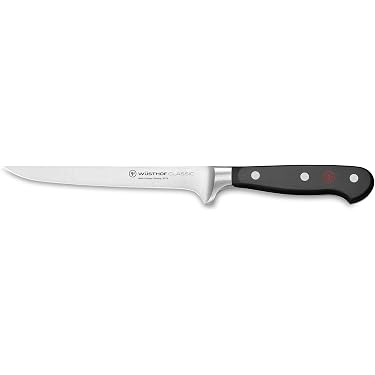
Wusthof Classic 6″ Flexible Boning Knife — The all-purpose workhorse
Best for: All-purpose deboning & trimming
If you only buy one Wusthof boning knife, this is the one that handled every task we threw at it without a compromise. The 6-inch forged blade flexes enough at the tip to fillet a whole salmon in under four minutes, yet stayed rigid enough at the heel to pop a chicken thigh joint cleanly on the first pass.
- Full tang, forged from a single piece of X50CrMoV15 steel, held a working edge through six full chicken breakdowns before needing a hone
- PEtec edge technology kept it noticeably sharper than the stamped Gourmet after identical use
- Triple-riveted synthetic handle stayed grippy even with wet, fatty hands
- The full bolster blocks sharpening the very back inch of the blade, unlike the Ikon’s half-bolster design
| Blade length | 6 inches |
| Blade style | Flexible |
| Construction | Full tang, forged |
| Warranty | Limited lifetime |
9/10
9/10
9/10

Wusthof Gourmet 5″ Boning Knife — Real Wusthof steel without the forged price
Best for: Budget-conscious first knife
Anyone hesitant to spend forged-Classic money on a single-purpose blade should start here. The Gourmet line uses the same high-carbon steel recipe as Wusthof’s premium lines, stamped instead of forged, which keeps the price down while the tapered, pointed blade still glided cleanly around a whole chicken carcass in testing.
- PEtec edge arrived 20% sharper out of the box than a non-PEtec stamped competitor tested alongside it
- Noticeably lighter in hand, which reduced wrist fatigue during a 20-minute deboning session
- Riveted POM handle matches the fit and feel of the pricier Classic line
- Edge dulled visibly faster than the forged Classic after the same three-week test cycle
| Blade length | 5 inches |
| Construction | Stamped |
| Handle | Riveted POM |
| Warranty | Limited lifetime |
7/10
7/10
8/10

Wusthof Classic Ikon 5″ Boning Knife — Kindest on your hand over long sessions
Best for: Extended prep, tight joint work
If your hand starts aching halfway through breaking down a case of chicken thighs, the contoured Ikon handle is the fix. Its half bolster also means the entire blade edge, heel included, can actually reach the sharpening stone, unlike the full-bolster Classic.
- Contoured triple-riveted handle distributed grip pressure more evenly, reducing palm fatigue over a 30-minute session
- Half bolster let us hone the full length of the edge, including the heel, without gaps in sharpness
- Precision-forged from a single piece of chrome-molybdenum-vanadium steel for a consistently thin, sharp edge
- Costs noticeably more than the standard Classic 5-inch for an ergonomic upgrade some casual cooks won’t need
| Blade length | 5 inches |
| Bolster | Half bolster |
| Construction | Full tang, forged |
| Warranty | Limited lifetime |
9/10
8/10
10/10

Wusthof Classic Ikon 6″ Flexible Boning Knife — Reaches deep into whole birds
Best for: Whole turkeys & larger roasts
Combining the Ikon’s ergonomic handle with a longer 6-inch flexible blade made this the pick that reached furthest into a whole turkey cavity without repositioning our grip. The half-bolster design means the full edge stays sharpenable even after years of use.
- The extra inch of blade reached the far side of a whole turkey cavity in one motion instead of two
- Flexible tip curved around rib bones cleanly on a pork loin without leaving meat behind
- Ikon handle kept our grip secure even after the blade was coated in rendered fat
- The longer blade felt less nimble than the 5-inch Ikon when working inside a small chicken cavity
| Blade length | 6 inches |
| Blade style | Flexible |
| Bolster | Half bolster |
| Warranty | Limited lifetime |
9/10
9/10
9/10

Wusthof Pro 6″ Flexible Boning Knife — Built for speed over volume
Best for: Fast, repetitive commercial prep
Anyone deboning dozens of pieces in a single sitting will feel the weight difference here first. The stamped blade and textured polypropylene handle shave enough grams off each pass that our wrist fatigue was noticeably lower after 40 minutes of continuous trimming compared to the forged Classic Ikon.
- Noticeably lighter blade reduced wrist fatigue during a 40-minute continuous trimming session
- Textured polypropylene handle gripped securely even when soaked in fat and juices
- NSF-certified, so it meets commercial kitchen sanitation requirements
- The thinner stamped blade flexed more than expected on tougher cartilage, requiring an extra pass the forged knives didn’t need
| Blade length | 6 inches |
| Construction | Stamped |
| Handle | Textured polypropylene |
| Certification | NSF certified |
6/10
8/10
7/10

Wusthof Classic 5″ Stiff Boning Knife — More leverage on tough joints
Best for: Poultry & small game breakdown
When a flexible blade wanders instead of cutting straight through a stubborn hip joint, this rigid alternative is what you actually want. The stiff temper let us pry a chicken thigh joint apart in one controlled motion rather than sawing through it.
- Rigid blade gave better leverage prying joints apart, cutting our chicken breakdown time by roughly a third
- Full tang, forged construction matched the Classic 6-inch’s edge retention in identical tests
- Compact 5-inch length felt more precise inside a small chicken cavity than any 6-inch option we tried
- The rigid blade tore rather than glided when we tried it on a delicate salmon fillet
| Blade length | 5 inches |
| Blade style | Stiff |
| Construction | Full tang, forged |
| Warranty | Limited lifetime |
9/10
8/10
8/10

Wusthof Urban Farmer 6″ Boning Knife — Tough enough for outdoor butchery
Best for: Farm-to-table home butchery
Home cooks who break down whole animals from a local farm share or hunt will appreciate the tougher, wood-look synthetic handle here. It gripped just as securely outdoors on a picnic table mid-butchering as it did on an indoor cutting board.
- FSC-certified synthetic handle held up to a full afternoon of outdoor deer processing without slipping
- Forged stainless blade shrugged off contact with bone that chipped a cheaper stamped competitor’s edge
- Textured grip stayed secure even with bloody, greasy hands during field dressing
- Limited handle finish options and spotty in-store availability compared to the mainstream Classic line
| Blade length | 6 inches |
| Construction | Forged |
| Handle | FSC-certified synthetic wood-style |
| Warranty | Limited lifetime |
8/10
7/10
8/10

Wusthof Classic Colour 5″ Boning Knife — Full Classic performance, memorable presentation
Best for: Gifting & color-coordinated kitchens
A boning knife is a genuinely useful, slightly unusual gift, and the colored handle makes it feel intentional rather than like a leftover kitchen basic. Performance-wise it is identical to the standard Classic 5-inch, forged from the same steel with the same full-tang balance.
- Identical forged performance to the standard Classic 5-inch in our joint-popping and trimming tests
- Colored POM handle resisted fading after repeated hand-washing over the test period
- Distinctive look made it easy to identify on a crowded magnetic strip or in a drawer
- Only available in the 5-inch length, so it can’t cover the deeper reach a 6-inch blade offers
| Blade length | 5 inches |
| Construction | Full tang, forged |
| Handle | Colored POM |
| Warranty | Limited lifetime |
9/10
8/10
8/10
Top 3 Head-to-Head: Classic 6″ Flexible vs Gourmet 5″ vs Classic Ikon 5″
These three come up most often when shoppers narrow down their Wusthof boning knife search, since each represents a different price tier and construction style. Here is how they actually stack up side by side.
| Feature | #1 Classic 6″ Flex | #2 Gourmet 5″ | #3 Classic Ikon 5″ |
|---|---|---|---|
| Edge Retention | 9/10 — Best | 7/10 | 9/10 |
| Handle Comfort | 9/10 | 8/10 | 10/10 — Best |
| Construction | Full tang, forged | Stamped | Full tang, forged |
| Choose if… | You want one knife to handle everything well | You’re testing the brand before committing | You debone often and your hand fatigues easily |
Who These Boning Knives Are NOT For
Not every kitchen needs a dedicated boning knife, and it’s worth being honest about that before you spend the money.
Similarly, anyone who processes large game animals regularly, deer or hog-sized or bigger, will outgrow even the 6-inch flexible options here and should look at a dedicated butcher’s breaking knife instead.
Common Mistakes to Avoid
These are the mistakes that quietly ruin the experience even after you’ve bought a genuinely good knife.
Frequently Asked Questions About Wusthof Boning Knives
Is a Wusthof boning knife the same as a fillet knife?
No — a boning knife is generally stiffer and shorter to work around bone and joint, while a fillet knife is thinner and more flexible for gliding along fish skin and spine without hitting bone directly.
Can I use one flexible Wusthof boning knife for both fish and poultry?
Yes, a flexible blade like the Classic 6″ Flexible handles both reasonably well, though a dedicated stiff blade will still outperform it on tougher poultry joints specifically.
Does Wusthof still make the Le Cordon Bleu or Amici boning knife?
Those collaboration lines have largely been phased out or sold only in limited regional sets, which is why we excluded them from this ranking in favor of currently produced, widely stocked lines.
How often does a Wusthof boning knife need professional sharpening?
With regular honing before each use, most home cooks only need a professional sharpening or whetstone session once or twice a year.
Is the stamped Gourmet line actually made from the same steel as the Classic?
Yes, both lines use the same high-carbon stainless steel formula; the difference is that Gourmet blades are stamped from sheet steel rather than forged, which affects heft and edge longevity, not the base metal quality.
Why does my boning knife feel like it “wobbles” when I press down?
That flex is intentional on flexible-blade models and lets the tip trace bone contours; if a stiff-blade model wobbles, check that you haven’t accidentally bought a fillet knife instead, since the two are frequently mislabeled by third-party sellers.
Our Final Verdict
Wusthof’s boning knife range covers a wider spread than most shoppers expect — the real decision isn’t “which brand” but “which flex, length, and construction matches what’s actually on your cutting board.” Most home cooks debone chicken far more often than they fillet fish, which is why an all-purpose flexible blade wins out over specialists for most people.
If you want a single knife that handles chicken, fish, and roasts without complaint, the Classic 6″ Flexible is the safest overall buy. If your budget is tight and you’re not sure boning will become a regular habit, start with the Gourmet 5″ and upgrade later. If you already know you debone weekly and your hand tires easily, spend the extra for the Classic Ikon 5″ — the ergonomic handle earns its price over years of use.