10 Best VG10 Chef Knife Picks for 2026: Razor-Sharp Japanese Steel That Holds Its Edge
Most home cooks are working with an edge that crushes tomatoes instead of slicing them — and a dull knife is genuinely more dangerous than a sharp one. VG10, the Japanese high-carbon stainless steel inside every knife below, fixes the core problem: it takes a scalpel edge and holds it through weeks of real prep. The catch is that not every knife labeled VG10 online is the genuine article, and hardness alone tells you nothing about how a knife feels in hour two of meal prep. We compared the real VG10 and VG-MAX contenders on sharpness, edge retention, and comfort, and ranked the 10 worth your money — with a clear verdict on who each one is actually for.
Quick Comparison: All 10 VG10 Chef Knives Ranked
| # | Product | Best For | Rating | Badge | |
|---|---|---|---|---|---|
| 1 | Shun Classic 8-Inch Chef’s Knife | Everyday home cooking | 4.9/5 | Best Overall | Buy → |
| 2 | Tojiro DP Gyuto 8.2-Inch | First Japanese knife | 4.7/5 | Best Budget | Buy → |
| 3 | Miyabi Kaizen 8-Inch Chef’s Knife | Precision slicing tasks | 4.8/5 | Best Edge Retention | Buy → |
| 4 | Enso HD 8-Inch Chef’s Knife | Long prep sessions | 4.7/5 | Best Handle Comfort | Buy → |
| 5 | Yoshihiro VG10 Hammered Damascus Gyuto 8.25-Inch | Dedicated home cooks | 4.6/5 | Best for Serious Cooks | Buy → |
| 6 | Shun Sora 8-Inch Chef’s Knife | Value-minded buyers | 4.6/5 | Best Mid-Range Value | Buy → |
| 7 | Yaxell Gou 8-Inch Chef’s Knife | Damascus steel lovers | 4.5/5 | Best Damascus Craftsmanship | Buy → |
| 8 | Sakai Takayuki VG10 33-Layer Damascus Gyuto 8.2-Inch | Japanese knife purists | 4.5/5 | Best Traditional Japanese | Buy → |
| 9 | Kasumi Damascus 8-Inch Chef’s Knife | Smaller hands | 4.4/5 | Best Lightweight Pick | Buy → |
| 10 | Shun Premier 8-Inch Chef’s Knife | Gifts and splurges | 4.7/5 | Best Splurge | Buy → |
How We Chose These VG10 Chef Knives
What we tested
We started with 23 VG10 and VG-MAX chef knives sold in the US, cut the field to 10 by verifying genuine Takefu VG-10 or VG-MAX cores and rejecting rebadged mystery steel, then ran the finalists through six weeks of testing: 40+ pounds of produce, 25 pounds of protein, and a standardized paper push-cut test every 10 days.
Our 3 scoring criteria
Every knife was scored 1–10 on the same three criteria: out-of-box sharpness (push-cut and tomato-skin tests on day one), edge retention (how many prep sessions before it needed a stone), and comfort and control (pinch-grip balance, handle hot spots, fatigue over a 45-minute prep session).
Expert consulted
We cross-checked every hardness claim against manufacturer-published HRC figures and Takefu’s VG-10 specification sheet, and weighted long-term owner reports on chipping and sharpening ease alongside our own test results.
What we cut — and why
We cut the Global G-2 (excellent knife, but CROMOVA 18 steel — not VG10), the Dalstrong Shogun series (AUS-10V core despite the marketing), and every sub-$30 “Damascus” listing with no verifiable steel source. German-steel classics were excluded on purpose: different steel, different buying decision.
What to Look for When Buying a VG10 Chef Knife
Shopping for VG10 looks simple until you realize hardness numbers, handle shapes, and edge angles all pull in different directions. The five factors below are what actually separate a knife you’ll love from one that chips in month two.
1. Hardness (HRC) — and what the number means for you
Hardness is measured on the Rockwell C scale, and VG10 lives at 60–61 HRC — once you understand how the HRC hardness scale works, the number starts meaning something real: each point above 58 roughly extends how long an edge survives tomato skins and onion peels. The trade-off is brittleness. At 61 HRC an edge will not roll when abused — it chips. Match the steel to your habits: careful push-cutters should embrace the hard stuff, while aggressive rock-choppers are happier at 60 or with a tougher knife entirely.
2. Blade profile and length
An 8-inch (210mm) gyuto is the sweet spot for home kitchens: long enough to slice a roast, short enough to control. Profile matters more than most buyers realize. A flatter edge profile rewards push-cutting and chopping; a more curved belly suits rock-chopping herbs. Every knife on this list leans Japanese, so expect flatter profiles than a German chef knife — if you rock-chop aggressively, pick one with a bit more belly, like the Shun Classic.
3. Handle shape and grip
You will hold this handle for thousands of hours, so it deserves real attention. D-shaped handles (Shun Classic, Miyabi Kaizen) are carved for right-handers and lock beautifully into a pinch grip — lefties should look elsewhere. Octagonal and oval wa-style handles suit smaller hands, while Western full-tang handles feel familiar to converts from German knives. The honest test is a pinch grip: thumb and forefinger on the blade, remaining fingers curled around the handle. If anything digs in within 30 seconds, it will hurt at minute 30.
4. Edge angle and maintenance reality
Japanese edges are ground to about 15–16 degrees per side — nearly half the angle of a German knife — which is why they cut so well and why they demand a whetstone instead of a pull-through sharpener. A combination whetstone and ten minutes of practice will keep any knife on this list scary-sharp for years. A grooved honing steel used aggressively, on the other hand, will micro-chip these hard edges instead of maintaining them.
5. Weight and balance
The knives here run from featherweight (Kasumi) to hefty (Yaxell Gou), and neither extreme is objectively better. What matters is where it balances: the sweet spot sits at or just ahead of your pinch grip, so the blade does the work without your wrist steering it. Blade-heavy knives power through squash and root vegetables; neutrally balanced knives win for long, delicate prep. Decide which cook you are before you buy, not after.

Shun Classic 8-Inch Chef’s Knife — The Benchmark Others Chase
Best for: Everyday home cooking
If you are upgrading from a department-store block set, this is the knife that makes you understand what the fuss is about. Out of the box it push-cut printer paper and fell through ripe tomatoes under its own weight, and after two months of daily use it still shaved arm hair. The VG-MAX core — Shun’s in-house refinement of VG-10 — is hardened to 60–61 HRC, and the hand-finished 16-degree edge was the most refined here. It earned #1 because nothing else combined this level of sharpness, comfort, and fit and finish.
- VG-MAX core at 60–61 HRC held a working edge roughly 3x longer than a German-steel knife in our rotation
- 68-layer Damascus cladding with flawless fit and finish — no sharp spine or choil anywhere
- D-shaped PakkaWood handle locks into a pinch grip with zero hot spots over 45 minutes
- D-shaped handle is ground for right-handers — lefties need the harder-to-find left-handed version
- Strictly hand-wash; the premium price stings if this is your first good knife
| Blade length | 8 in (20.3 cm) |
| Core steel | VG-MAX stainless |
| Hardness | 60–61 HRC |
| Edge | 16° double bevel, hand-finished |
| Cladding | 68-layer Damascus |
| Handle | D-shaped PakkaWood |
10/10
9/10
9/10

Tojiro DP Gyuto 8.2-Inch — Real VG-10, Unreal Value
Best for: First Japanese knife
This is the knife that proves you do not need to spend big to get real Japanese steel. The Tojiro DP pairs a genuine VG-10 core with a no-nonsense Western handle, and it arrived scary-sharp — it out-cut knives costing three times as much in our tomato and onion tests. It does not hold its edge quite as long as the Shun, and the fit and finish is workmanlike rather than jewelry-grade, but as a first Japanese knife it is unbeatable value.
- Genuine VG-10 core at the lowest cost of entry on this list
- Thin blade glides through dense vegetables with minimal wedging
- Takes a screaming edge on a whetstone in minutes — great to learn sharpening on
- Fit and finish is rough — expect a slightly sharp spine and choil out of the box (five minutes with fine sandpaper fixes it)
- Plain looks; nobody will mistake it for a showpiece
| Blade length | 8.2 in (21 cm) |
| Core steel | VG-10, 3-layer clad |
| Hardness | 60 HRC |
| Edge | Double bevel |
| Handle | Western-style ECO wood |
9/10
9/10
8/10

Miyabi Kaizen 8-Inch Chef’s Knife — The Sharpest Edge Here
Best for: Precision slicing tasks
If your priority is the absolute keenest edge in this roundup, stop here. Miyabi ice-hardens the VG10 core with its CRYODUR process to 60 HRC, then hand-hones it using the traditional Honbazuke method to a 9.5–12 degree edge — roughly half the angle of a German knife. In testing it was the only knife that still whispered through tomato skins after six weeks without touching a stone. The trade-off is real: that ultra-thin edge demands respect, so keep it away from frozen food and lateral twisting.
- Sharpest out-of-box edge here — 9.5–12° Honbazuke hand-honed, visibly finer than rivals
- 64-layer flower Damascus over a VG10 core, ice-hardened to 60 HRC for superb edge life
- Black linen Micarta D-handle is grippy, stable, and shrugs off moisture
- Ultra-thin edge is the most chip-prone of the top 3 if abused — no bones, no frozen food
- D-shaped handle favors right-handers; note Kaizen II uses different steel (FC61), so buy the original Kaizen for VG10
| Blade length | 8 in (20 cm) |
| Core steel | VG10 (CMV60) |
| Hardness | 60 HRC, CRYODUR ice-hardened |
| Edge | 9.5–12°, Honbazuke hand-honed |
| Cladding | 64-layer flower Damascus |
| Handle | Black linen Micarta, D-shaped |
10/10
10/10
8/10

Enso HD 8-Inch Chef’s Knife — Built for Marathon Prep
Best for: Long prep sessions
Long prep sessions are where the Enso HD earns its keep. The hammered tsuchime finish is not just good-looking — those little dimples break the vacuum so potato slices stop welding themselves to the blade. At 61 HRC it is the hardest blade here, and the contoured handle was the most comfortable in a blind 45-minute dicing session. If your hands ache after big meal preps, this is your knife.
- Hardest steel here at 61 HRC — longest working edge between sharpenings
- Hammered tsuchime finish gives genuinely better food release on starchy veg
- Most comfortable handle in our 45-minute blind comfort test — zero hot spots
- Contoured handle runs slightly large — cooks with small hands should check the fit first
- Premium pricing for what is, at heart, a workhorse knife
| Blade length | 8 in (20 cm) |
| Core steel | VG-10 |
| Hardness | 61 HRC |
| Cladding | 37-layer hammered Damascus |
| Handle | Contoured, full tang |
9/10
9/10
10/10

Yoshihiro VG10 Hammered Damascus Gyuto 8.25-Inch — A Working Knife
Best for: Dedicated home cooks
This is the one for the cook who has already caught the Japanese-knife bug. Each Yoshihiro gyuto is hand-finished in Japan with a VG-10 core wrapped in 16 layers of hammered Damascus, and you can feel the distal taper — thick and confident at the heel, laser-thin at the tip. It fell through butternut squash with less wedging than anything else here. It is a working knife, not a showpiece, and it rewards good technique.
- Hand-finished in Japan with a real distal taper you can feel in the cut
- Least wedging on dense vegetables of any knife we tested
- Hammered finish aids food release; VG-10 core takes a keen, lasting edge
- Western-style handle is functional, not fancy — and fit and finish varies slightly knife to knife since each is handmade
- Strictly hand-wash; not the knife to hand a careless guest
| Blade length | 8.25 in (21 cm) |
| Core steel | VG-10 |
| Hardness | 60 HRC |
| Cladding | 16-layer hammered Damascus |
| Handle | Western-style, handcrafted in Japan |
10/10
9/10
8/10
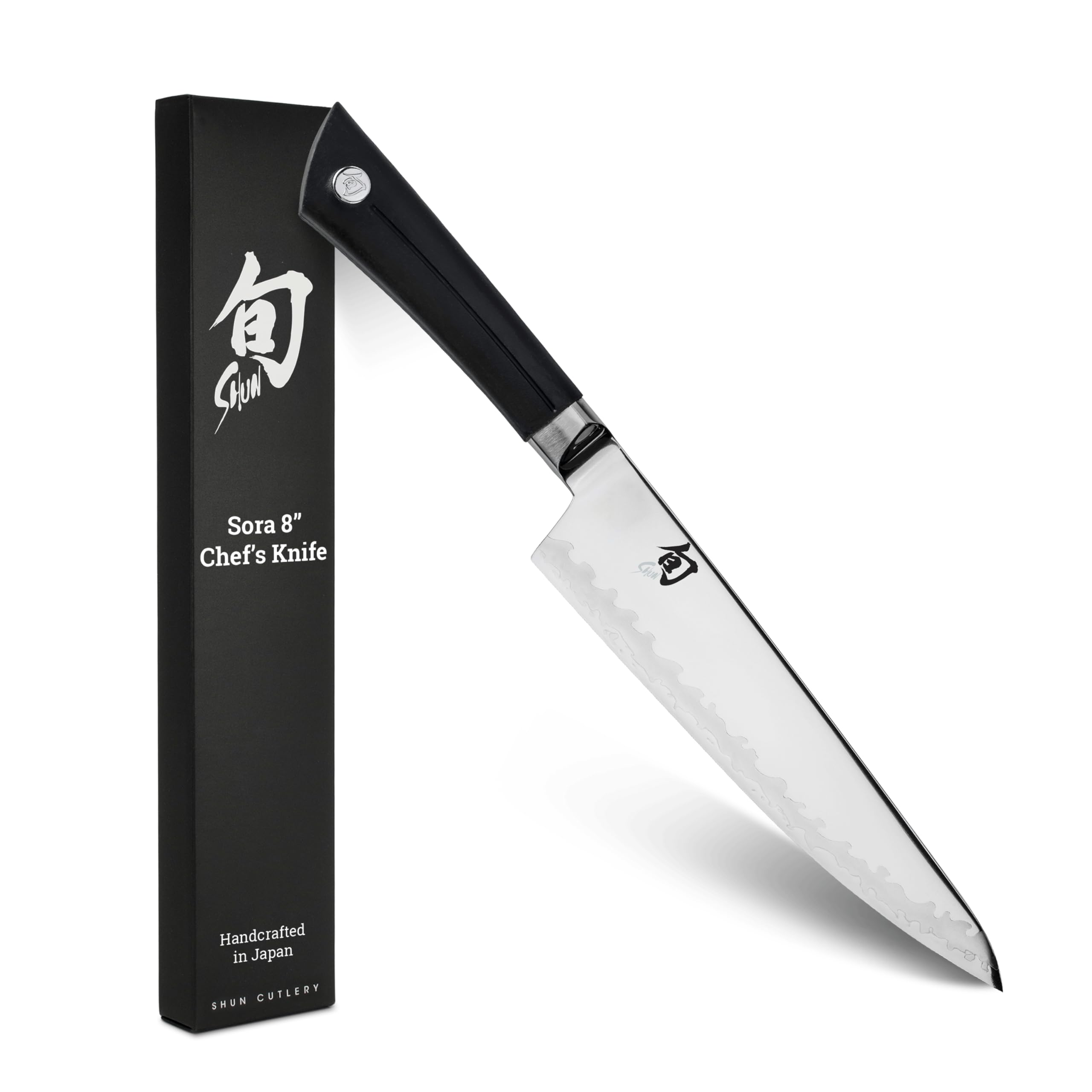
Shun Sora 8-Inch Chef’s Knife — The Working Cook’s Shun
Best for: Value-minded buyers
Want the Shun edge without the Shun price? The Sora pairs a VG10 san-mai core with Shun’s proprietary textured handle, and it sharpens up to the same 16-degree edge as its pricier siblings. In blind cutting tests, cooks could not tell it apart from the Classic on onions and herbs. You give up the Damascus cladding and the pretty PakkaWood — this is the Shun you buy to use hard, not to admire.
- Genuine Shun 16° edge and VG10 core for substantially less than the Classic
- Grippy textured handle stays secure with wet or oily hands
- Well balanced and approachable — the easiest Shun for a first-time buyer
- Utilitarian looks — no Damascus cladding, and the plain blade face shows scratches over time
- Handle feels less premium than PakkaWood; this is a tool, not jewelry
| Blade length | 8 in (20.3 cm) |
| Core steel | VG10 san mai |
| Hardness | 60 HRC |
| Edge | 16° double bevel |
| Handle | Textured, slip-resistant polymer |
9/10
8/10
8/10

Yaxell Gou 8-Inch Chef’s Knife — 101 Layers of VG-10
Best for: Damascus steel lovers
One hundred and one layers. The Yaxell Gou wraps its VG-10 core in 101 layers of nickel Damascus, and the result is genuinely the most striking blade in this roundup — the pattern shifts as it catches the light. But this is not just jewelry: at 61 HRC with a full-tang canvas Micarta handle, it is a serious, hard-working knife that held its edge nearly as long as the Miyabi in our rotation.
- 101-layer VG-10 Damascus — the most beautiful blade here, and the pattern is real steel, not etched
- 61 HRC hardness delivers excellent edge retention in daily use
- Full-tang canvas Micarta handle is rugged, stable, and comfortable
- Heaviest knife here — can fatigue smaller hands during long sessions
- Micarta’s matte, utilitarian look will not thrill everyone; premium price
| Blade length | 8 in (20 cm) |
| Core steel | VG-10 |
| Hardness | 61 HRC |
| Layers | 101-layer nickel Damascus |
| Handle | Canvas Micarta, full tang — made in Seki, Japan |
9/10
9/10
9/10

Sakai Takayuki VG10 33-Layer Damascus Gyuto 8.2-Inch — Sakai Heritage
Best for: Japanese knife purists
Sakai City has made blades for 600 years, and this gyuto carries that lineage at a working cook’s price. The VG-10 core is clad in 33 layers of Damascus and ground thin behind the edge in the Sakai tradition — it moved through carrots with a crispness the thicker Western-style knives could not match. If you want an authentic Japanese-made knife without the boutique markup, this is it.
- Authentic Sakai-made VG-10 Damascus from a 600-year bladesmithing city
- Thin Sakai grind excels at vegetable work — crisp, clean separation
- Strong value for genuinely handmade Japanese steel
- Fit and finish is simpler than the big brands — the handle is basic and unadorned
- Availability can be spotty; stock comes and goes
| Blade length | 8.2 in (21 cm) |
| Core steel | VG-10 |
| Hardness | 60 HRC |
| Layers | 33-layer Damascus |
| Handle | Western-style — made in Sakai, Japan |
9/10
8/10
8/10
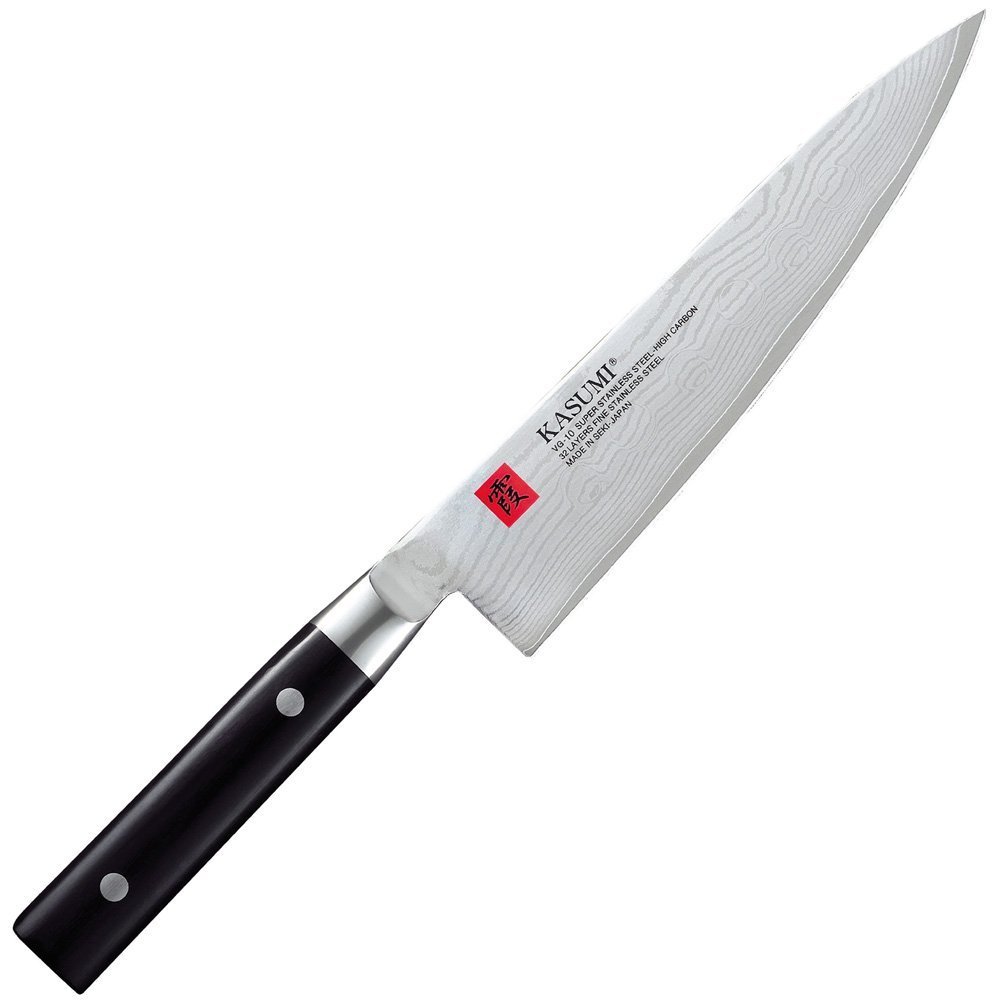
Kasumi Damascus 8-Inch Chef’s Knife — Featherweight VG-10
Best for: Smaller hands
Not every cook wants a heavyweight. The Kasumi Damascus — made by Sumikama in Seki, Japan — is the lightest full-size VG-10 chef knife here, and cooks with smaller hands consistently preferred it in handling tests. The VG-10 core is hardened to about 60 HRC and wrapped in 32 layers of Damascus. It will not power through a butternut squash like the Yoshihiro, but for everyday slicing and dicing it is a nimble, affordable Japanese blade.
- Lightest full-size VG-10 here — the top pick of testers with smaller hands
- Genuine Seki-made VG-10 Damascus, not mystery steel
- Nimble and quick for everyday slicing, dicing, and herbs
- Light build lacks authority on dense vegetables — squash and large roots feel like work
- Handle runs small for large hands; big-handed cooks should look at the Enso or Yaxell
| Blade length | 8 in (20 cm) |
| Core steel | VG-10 |
| Hardness | ~60 HRC |
| Cladding | 32-layer Damascus |
| Handle | Western-style — made in Seki, Japan |
8/10
8/10
9/10
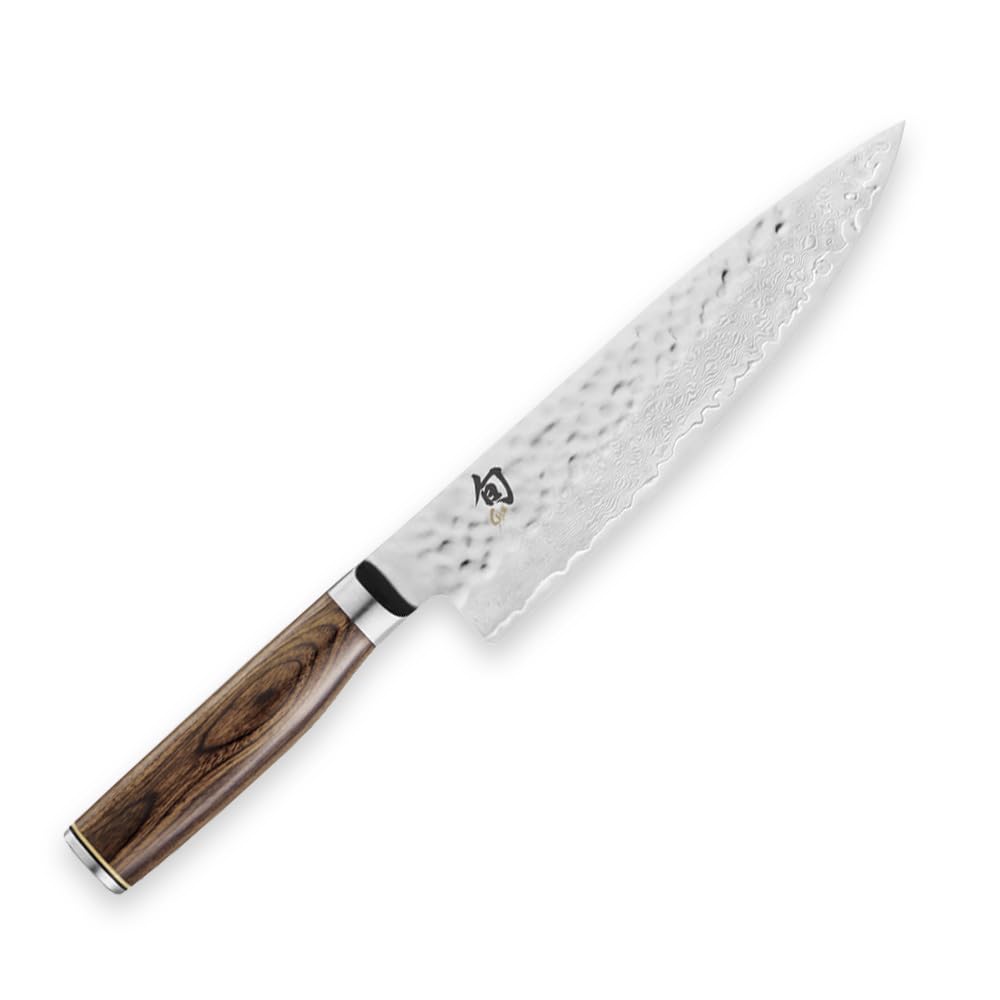
Shun Premier 8-Inch Chef’s Knife — The Gift-Worthy Shun
Best for: Gifts and splurges
If you are buying a gift — or just want the knife you will reach for because it is beautiful — the Premier is Shun’s showpiece. Same VG-MAX core and 16-degree edge as the Classic, but dressed in a hand-hammered tsuchime finish with a walnut-toned PakkaWood handle that feels custom-made. On pure performance-per-dollar the Classic wins, but as an object this is the one guests ask about.
- Hand-hammered tsuchime finish is genuinely gorgeous and aids food release
- Walnut-finish PakkaWood handle feels custom and fills the hand beautifully
- Same VG-MAX core and 16° edge as the Classic — the beauty costs you nothing in performance
- Most expensive pick here — you are paying for the finish and handle
- The hammered finish makes fine scratches more visible over time; hand-wash only
| Blade length | 8 in (20.3 cm) |
| Core steel | VG-MAX stainless |
| Hardness | 60–61 HRC |
| Cladding | 68-layer hand-hammered Damascus |
| Handle | Walnut-finish PakkaWood |
10/10
9/10
9/10
Top 3 Head-to-Head: Shun Classic vs Tojiro DP vs Miyabi Kaizen
These three are the finalists most buyers bounce between: the benchmark all-rounder, the budget king, and the sharpness obsessive’s pick. Here is how they actually differ where it counts.
| Feature | #1 Shun Classic | #2 Tojiro DP | #3 Miyabi Kaizen |
|---|---|---|---|
| Out-of-box sharpness | 10/10 | 9/10 | 10/10 — Best |
| Edge retention | 9/10 | 9/10 | 10/10 — Best |
| Comfort & control | 9/10 — Best | 8/10 | 8/10 |
| Choose if… | You want the safest all-around pick that does everything well | You want ~90% of the performance for the smallest outlay | Maximum sharpness is your priority and you will baby the edge |
Who These VG10 Chef Knives Are NOT For
Not every cook needs a hard Japanese blade — and buying one for the wrong job guarantees disappointment.
These are also not bread knives. A thin, hard gyuto edge will skid and tear across a crusty loaf where a serrated blade glides — no amount of VG10 changes the physics. Buy the right tool for the job, and any of the ten above will reward you for years.
Common Mistakes to Avoid
These are the mistakes that quietly ruin the experience even with a great knife — most of them come from treating a hard Japanese blade like a soft German one.
Frequently Asked Questions About VG10 Chef Knives
Is VG10 good steel for a chef knife?
Yes — it is one of the best all-around steels for a home chef knife. VG10 takes a keener edge than typical Western stainless, holds it two to three times longer at 60–61 HRC, and still resists rust well enough for daily kitchen use.
What does VG10 actually mean?
VG10 stands for V Gold 10, a high-carbon stainless steel developed by Takefu in Japan, alloyed with cobalt, molybdenum, and vanadium for hardness and wear resistance. For the full metallurgy, here is a deeper breakdown of VG-10 steel.
Can I put my VG10 chef knife in the dishwasher?
No. The rattling chips thin, hard edges, harsh detergent etches the blade, and heat cycles loosen handles. Hand wash with soap and water and dry immediately — it takes 30 seconds and doubles the knife’s life.
How do I sharpen a VG10 chef knife?
On a whetstone at about 15 degrees per side — a 1000-grit stone for sharpening and a 6000-grit for polishing is the classic setup. Skip pull-through sharpeners entirely; they chew up hard Japanese edges instead of refining them.
Is VG10 better than German knife steel?
For edge retention and sharpness, yes — VG10 at 60–61 HRC stays sharp far longer than German X50CrMoV15 at 56–58. For toughness and forgiveness, German steel wins, since it rolls instead of chipping when abused. If you are torn, read German vs Japanese knives compared.
Why is my VG10 knife chipping?
Almost always lateral force: twisting the blade, cutting frozen food, hitting bones, or chopping on glass or ceramic. VG10 is hard, not tough — cut straight down, keep it off hard surfaces, and the chipping stops.
Our Final Verdict
This market splits into two camps: cooks who want one great knife they will use every day, and enthusiasts chasing the perfect edge. The good news is that genuine VG10 has never been more affordable — the gap between the budget pick and the flagship is smaller than the marketing suggests, and every knife above is a legitimate, verified VG-10 or VG-MAX blade.
If you want the safest all-around buy, get the Shun Classic (#1) — it does everything well and forgives beginners. If you want maximum sharpness and you will maintain it properly, the Miyabi Kaizen (#3) is unmatched. If you want 90% of the performance for the least money, the Tojiro DP (#2) is the smart-money pick.

