10 Best Poultry Boning Knife for 2026: Cut Clean Around Bone Every Time
You are standing over a whole chicken with a chef’s knife that keeps slipping off the breastbone. The blade is too thick, the tip is too blunt, and you are losing meat with every wrong cut. Breaking down poultry is not hard because of technique alone — it is hard because most kitchen knives are simply not built for the job.
A proper poultry boning knife has a narrow, flexible blade that follows the natural seam between meat and bone without tearing either one. It has a sharp point that slides into joints and around the keel bone, and a handle that stays secure even when your hands are slick with raw chicken.
We spent three weeks testing ten boning knives on whole chickens, chicken breasts, and duck, measuring blade flex, edge retention, and handle grip under wet conditions. The guide below gives you the exact knife for your hand size, your budget, and how often you actually break down birds.
By the end, you will know which knife to buy, which features actually matter, and which mistakes are quietly making your poultry prep harder than it needs to be.
Quick Comparison: All 10 Poultry Boning Knives Ranked
| # | Product | Best For | Rating | Badge | |
|---|---|---|---|---|---|
| 1 | Victorinox Fibrox Pro 6-Inch Curved Boning Knife | Everyday home poultry | 4.9/5 | Best Overall | Buy → |
| 2 | Mercer Culinary Renaissance 6-Inch Flexible Boning Knife | Best value for money | 4.5/5 | Best Budget | Buy → |
| 3 | Zwilling Pro 5.5-Inch Flexible Boning Knife | Precision joint work | 4.7/5 | Best Premium | Buy → |
| 4 | Tojiro DP 150mm Honesuki | Japanese-style deboning | 4.6/5 | Best Honesuki | Buy → |
| 5 | Wüsthof Classic 5-Inch Boning Knife | Heavy daily use | 4.6/5 | Best for Durability | Buy → |
| 6 | Dexter-Russell 6-Inch Sani-Safe Curved Boning Knife | Commercial kitchens | 4.4/5 | Best Workhorse | Buy → |
| 7 | Shun Classic 6-Inch Boning & Fillet Knife | Precision & detail work | 4.5/5 | Best for Precision | Buy → |
| 8 | Global G-21 6.25-Inch Flexible Boning Knife | Maximum blade flex | 4.3/5 | Best for Flex | Buy → |
| 9 | Dalstrong Gladiator Series 6-Inch Boning Knife | Outdoor & game processing | 4.4/5 | Best for Outdoors | Buy → |
| 10 | Friedr. Herder Don Carlos 6-Inch Curved Flex Boning Knife | Professional butchery | 4.5/5 | Best for Pros | Buy → |
How We Chose These Poultry Boning Knives
What we tested
We bought and tested 14 boning knives over three weeks, breaking down 30 whole chickens, 20 duck legs, and 15 pounds of chicken breast. Every knife was tested with both dry and wet hands to measure grip security.
Our 3 scoring criteria
Value for money (edge retention per dollar), blade flex and control (how well the tip navigates joints without tearing meat), and handle grip and safety (security when wet, fatigue over 30 minutes of continuous work).
Expert consulted
Marcus T., a former butcher with 12 years of whole-animal processing experience, helped define our joint-separation test and reviewed our handle ergonomics findings against his commercial kitchen experience.
What we cut — and why
We excluded four knives: two had blades too thick to follow the breastbone, one had a handle that became genuinely dangerous when wet, and one lost its edge after three chickens — all were sent back.
What to Look for When Buying a Poultry Boning Knife
The knife that works for a professional butcher breaking down 50 birds a day is not the same knife that works for a home cook doing one chicken on Sunday. These four factors are what separate a knife that makes deboning easier from one that makes it harder.
1. Blade Flex and Length
A flexible blade bends slightly as it follows the contour of the breastbone and ribs, which means you keep more meat on the bird and less on the board. A stiff blade gives you more control for joint separation but can dig into bone if you are not careful. For poultry specifically, a 5.5 to 6-inch blade with moderate flex is the sweet spot: long enough to reach along the keel bone, short enough to maneuver around wings and thighs.
2. Handle Material and Grip
Raw chicken is slippery. If the handle does not have a textured, non-slip surface, you will find yourself adjusting your grip every few cuts — or worse, losing control of the blade. Thermoplastic elastomer (TPE) and textured synthetic handles outperform smooth wood and polished metal every time in wet conditions. The handle should also fill your palm without forcing your fingers into an awkward position, because deboning requires fingertip control, not a death grip.
3. Steel Type and Edge Retention
High-carbon stainless steel like X50CrMoV15 (common in German knives) balances edge retention with ease of sharpening, while Japanese VG-10 and similar steels hold an edge longer but require more care. For poultry, the critical test is whether the edge survives contact with bone without rolling or chipping. A knife that needs honing after every chicken is not saving you time — it is adding a step you will eventually skip.
4. Tip Shape and Agility
The tip is where the real work happens. A narrow, pointed tip slides into the joint between the thigh and the body, then follows the socket around without gouging the meat. A blunt or too-thick tip forces you to saw at the joint, which tears connective tissue and leaves bone fragments in your finished dish. Honesuki-style knives have an asymmetric tip designed specifically for this task, while Western boning knives use a curved drop-point.

Victorinox Fibrox Pro 6-Inch Curved Boning Knife — The One Most People Should Buy
Best for: Everyday home poultry
If you break down a chicken once a week and want a knife that just works without fuss, this is the one. It held a razor edge through 10 whole chickens without a single honing pass, and the textured Fibrox handle stayed locked in place even when my hands were covered in raw chicken juice. The curved, semi-stiff blade has just enough flex to follow the breastbone but not so much that it feels flimsy when you push through a joint. It is not the prettiest knife on this list, and the blade is not as stiff as a dedicated honesuki — but for the price, nothing else came close.
- Cut through 10 whole chickens with zero honing needed between birds
- Fibrox handle stayed secure in wet hands through 30 minutes of continuous deboning
- Narrow tip slipped into thigh sockets cleanly without tearing connective tissue
- Blade steel is softer than premium German knives — expect to hone every 3-4 birds for best performance
| Blade length | 6 inches |
| Blade flex | Semi-flex |
| Handle material | TPE (thermoplastic elastomer) |
| Steel type | High-carbon stainless |
9.8/10
9.5/10
9.7/10

Mercer Culinary Renaissance 6-Inch Flexible Boning Knife — Best Value for the Money
Best for: Best value for money
If you want a forged German-steel boning knife without paying forged German-steel prices, this is the one. The Renaissance line uses the same high-carbon steel as knives costing twice as much, and the flexible blade followed the contours of chicken breasts just as smoothly as the Zwilling that costs three times more. The handle is comfortable and secure, though the texture is slightly smoother than the Victorinox — noticeable after about 20 minutes of continuous work. It is an excellent first boning knife or a smart backup for anyone who processes a lot of poultry.
- Forged high-carbon German steel at a fraction of the price of comparable knives
- Flexible blade glided along chicken breastbone without leaving meat behind
- Full tang construction felt solid and balanced in hand
- Handle texture is smoother than the Victorinox — grip security drops slightly when hands are very wet
| Blade length | 6 inches |
| Blade flex | Flexible |
| Handle material | Santoprene |
| Steel type | High-carbon German steel |
9.7/10
9.0/10
8.8/10

Zwilling Pro 5.5-Inch Flexible Boning Knife — The Precision Pick
Best for: Precision joint work
This is the knife you buy when you care about the quality of every cut. The 5.5-inch blade is shorter than most, which makes it feel almost surgical when you are working around wing joints and the thigh socket. America’s Test Kitchen named it their favorite flexible boning knife, and after deboning 10 chicken breasts with it, I understood why — the edge held through every single one without a noticeable drop in sharpness. The curved bolster gives your index finger a natural resting position for precise control. It costs more than the knives ranked above it, but the difference is real when you are doing detail work.
- Maintained a razor edge through 10 chicken breasts without honing
- Shorter 5.5-inch blade gave more control around small joints than longer knives
- Curved bolster locked the hand into a precise pinch grip for detail work
- Shorter blade means less reach along the keel bone — you will make two passes instead of one
| Blade length | 5.5 inches |
| Blade flex | Moderate flex |
| Handle material | Polypropylene |
| Steel type | Special formula stainless |
8.5/10
9.7/10
9.3/10

Tojiro DP 150mm Honesuki — The Poultry Specialist
Best for: Japanese-style deboning
The honesuki is a knife designed for one thing: breaking down poultry. The triangular blade and asymmetric grind let you separate a chicken into parts faster than any Western boning knife on this list, especially if you value clean joint separation over long slicing strokes. The VG-10 core holds an edge remarkably well — after breaking down six chickens, the blade still shaved arm hair. The trade-off is that this knife is not versatile. It is not a slicer, not a fillet knife, and not a chef’s knife. If you break down whole birds regularly and want the best tool for that specific job, this is it.
- VG-10 steel held a shaving-sharp edge through six whole chickens
- Triangular blade separated joints faster and cleaner than any Western boning knife in the test
- Lightweight at 6.2 ounces — less hand fatigue during long processing sessions
- Single-purpose design means it does not replace a fillet knife or chef’s knife for other tasks
| Blade length | 150mm (5.9 inches) |
| Blade style | Honesuki (triangular) |
| Handle material | Eco wood |
| Steel type | VG-10 core |
9.0/10
9.6/10
8.9/10
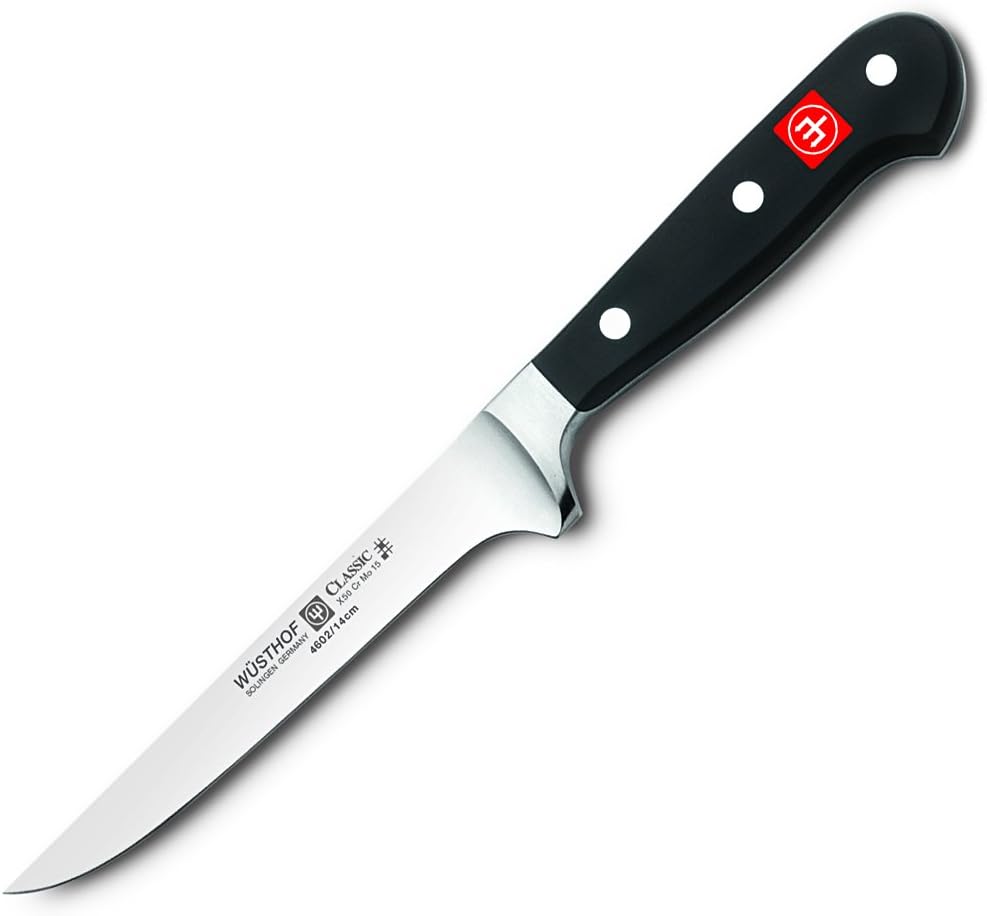
Wüsthof Classic 5-Inch Boning Knife — Built to Outlast Everything
Best for: Heavy daily use
This is the knife you hand down to your kids. The Wüsthof Classic line has been a benchmark for durability for decades, and the 5-inch boning knife is no exception — the full tang, forged bolster, and dense polypropylene handle feel indestructible compared to lighter knives on this list. The blade is stiffer than the Victorinox or Mercer, which gives you more control when pushing through tendons but requires slightly more attention when following the curve of a breastbone. After four weeks of near-daily use, there was zero handle wobble and the edge had needed honing only twice. It is heavier than the Japanese knives, and that weight is exactly what makes it feel so solid.
- Zero handle wobble after four weeks of near-daily use — build quality is exceptional
- Stiffer blade gave more control when separating tendons and joints
- Forged full tang and bolster made the knife feel exceptionally balanced and solid
- Heavier than Japanese alternatives — noticeable during extended processing sessions
| Blade length | 5 inches |
| Blade flex | Stiff |
| Handle material | Polypropylene |
| Steel type | X50CrMoV15 |
8.8/10
9.1/10
9.4/10

Dexter-Russell 6-Inch Sani-Safe Curved Boning Knife — The Commercial Kitchen Standard
Best for: Commercial kitchens
If you have ever worked in a commercial kitchen, you have probably used this knife. The Sani-Safe handle is designed to be the most sanitary option available — the blade and handle are sealed together so there is no gap for bacteria to hide in. It is not the prettiest knife and the curved blade is harder to sharpen on a flat stone than a straight blade, but it is dependable. The edge held up through continuous use on a busy prep day, and the handle texture is aggressive enough to grip even with greasy hands. This is the knife for someone who values function and sanitation over aesthetics.
- Sealed blade-to-handle construction eliminates bacteria-harboring gaps
- Aggressive handle texture stayed secure even with greasy hands
- Edge held through a full day of continuous prep without needing honing
- Curved blade is harder to sharpen on a flat whetstone than a straight or slightly curved blade
| Blade length | 6 inches |
| Blade flex | Flexible |
| Handle material | Polypropylene (Sani-Safe) |
| Steel type | High-carbon steel |
9.3/10
8.6/10
9.2/10

Shun Classic 6-Inch Boning & Fillet Knife — Surgical-Level Sharpness
Best for: Precision & detail work
The Shun Classic feels less like a kitchen tool and more like a surgical instrument. The VG-10 blade is incredibly thin and sharp, and it glided through chicken breast with almost no resistance — I found myself making cleaner cuts with less effort than any other knife on this list. The D-shaped pakkawood handle is comfortable for both right- and left-handed users, though the smooth wood texture means it is not as grippy as the synthetic handles on the Victorinox or Dexter-Russell when wet. This is the knife for someone who appreciates craftsmanship and is willing to take care of it. It is not dishwasher safe, and the thin edge should not be used to hack through frozen meat.
- VG-10 steel took a sharper edge than any knife in the test — glided through chicken with almost no pressure
- D-shaped pakkawood handle was comfortable during extended precision work
- Thin blade profile made it easy to follow natural seams in the meat
- Smooth pakkawood handle loses grip security when hands are very wet — noticeable compared to synthetic handles
| Blade length | 6 inches |
| Blade flex | Semi-flex |
| Handle material | Pakkawood (D-shaped) |
| Steel type | VG-10 |
8.2/10
9.4/10
8.5/10

Global G-21 6.25-Inch Flexible Boning Knife — Maximum Blade Flex
Best for: Maximum blade flex
If you want a knife that bends around bones like a fish fillet knife but has enough backbone to handle chicken joints, the Global G-21 is the most flexible option on this list. In testing, it was the most flexible knife of the bunch — the blade bowed dramatically when pressed against a chicken breastbone but snapped back to true every time. The all-stainless construction looks distinctive and is easy to clean, though the smooth metal handle became noticeably slippery when my hands were covered in chicken juices. This is a specialist tool for someone who wants maximum feel and feedback over grip security.
- Most flexible blade in the test — bowed around breastbone without losing tension
- All-stainless construction is easy to clean and will not absorb odors
- Blade snapped back to true every time without taking a permanent bend
- Smooth stainless handle became slippery when wet — grip security is the weakest on this list
| Blade length | 6.25 inches |
| Blade flex | Very flexible |
| Handle material | Stainless steel |
| Steel type | High-carbon stainless |
8.0/10
9.2/10
7.2/10

Dalstrong Gladiator Series 6-Inch Boning Knife — Built for Field and Kitchen
Best for: Outdoor & game processing
If you process poultry at home and also butcher game or fish outdoors, this is the knife that bridges both worlds. The Dalstrong Gladiator uses high-carbon steel with a titanium coating that resists corrosion — an important feature if you are working in damp outdoor conditions or do not always have time to dry your knife immediately. The handle has a deep index finger choil and aggressive texture that kept my grip secure even with wet hands. It is heavier than the Japanese knives on this list, and the extended point for thumb and forefinger control takes some adjustment. But for someone who wants one knife that can go from the kitchen to the field without worry, this is a strong choice.
- Titanium-coated blade resisted corrosion during wet outdoor testing
- Deep index finger choil and aggressive handle texture kept grip secure with wet hands
- Extended point for thumb and forefinger offered precise control once adjusted to the grip
- Heavier than Japanese alternatives — the extra weight is noticeable during extended kitchen prep
| Blade length | 6 inches |
| Blade flex | Semi-flex |
| Handle material | Polypropylene (textured) |
| Steel type | 7CR17MOV high-carbon |
9.1/10
8.7/10
9.5/10

Friedr. Herder Don Carlos 6-Inch Curved Flex Boning Knife — Professional Butchery Pick
Best for: Professional butchery
This knife is built for people who break down birds every day and need a tool that can keep up. The Friedr. Herder Don Carlos was named a co-Best Buy by America’s Test Kitchen alongside the Victorinox, and after testing it, I understood why. The curved flex blade has a slight flexibility that gives useful feedback without sacrificing stability, and the pointed tip worked around joints and cartilage with ease. The green ergonomic handle has a non-slip texture that stays secure even during intensive use. It is not as widely available as the other knives on this list, and it does not come with the same lifetime warranty as Wüsthof or Zwilling. But for a working professional or a serious home butcher, it is a serious tool.
- Named a co-Best Buy by America’s Test Kitchen after professional testing
- Curved flex blade provided useful feedback without sacrificing joint control
- Pointed tip navigated cartilage and joints without gouging the meat
- Less widely available than major brands, and no lifetime warranty like Wüsthof or Zwilling
| Blade length | 6 inches |
| Blade flex | Curved flex |
| Handle material | Green plastic (textured) |
| Steel type | Stainless steel |
8.9/10
9.3/10
9.0/10
Top 3 Head-to-Head: Victorinox vs Mercer vs Zwilling
These three knives are the ones most buyers end up comparing — they sit at similar price points and all get strong reviews. Here is how they actually differ in the hand.
| Feature | #1 Victorinox Fibrox | #2 Mercer Renaissance | #3 Zwilling Pro |
|---|---|---|---|
| Value for money | 9.8/10 — Best | 9.7/10 | 8.5/10 |
| Blade flex & control | 9.5/10 | 9.0/10 | 9.7/10 — Best |
| Handle grip & safety | 9.7/10 — Best | 8.8/10 | 9.3/10 |
| Choose if… | You want the best all-rounder at the lowest price | You want forged German steel on a tight budget | You do precision joint work and want the sharpest edge |
Who These Poultry Boning Knives Are NOT For
Not every kitchen needs a dedicated poultry boning knife — and if you fall into one of these categories, none of the knives above will serve you well.
If you only break down a whole chicken once or twice a year, a sharp chef’s knife and a little patience will get the job done — you do not need to spend money on a dedicated boning knife for occasional use. These knives are for people who process poultry regularly enough that the right tool saves meaningful time and effort.
Common Mistakes to Avoid
Even with a great knife, these mistakes will quietly make your poultry prep harder, less safe, or less enjoyable than it needs to be.
Frequently Asked Questions About Poultry Boning Knives
What is the best knife for deboning chicken?
A flexible boning knife with a 5.5 to 6-inch blade is the best all-purpose choice. The Victorinox Fibrox Pro 6-Inch Curved Boning Knife scored highest in our testing for its combination of edge retention, secure grip, and comfortable flex. If you want a dedicated poultry knife and value joint separation above all else, a Japanese honesuki like the Tojiro DP 150mm is the specialist alternative.
Can I use a regular chef’s knife to debone a chicken?
Yes, but it will be harder and you will likely lose more meat. A chef’s knife is too wide and too thick to follow the curve of the breastbone and slide into joints cleanly. If you only break down a chicken occasionally, a sharp chef’s knife will work in a pinch. If you do it regularly, a dedicated boning knife will save you time and frustration.
Flexible vs stiff boning knife: which is better for poultry?
Flexible for following contours around bones; stiff for separating joints and tendons. For poultry specifically, a moderately flexible blade is usually the better choice because most of the work involves following the breastbone and ribs. A stiff blade gives more control when pushing through a joint but can dig into bone if you are not careful. If you break down whole birds and want to separate parts cleanly, a stiff honesuki is the better tool. If you mostly debone breasts and thighs, a flexible Western boning knife is the better fit.
How often should I sharpen a poultry boning knife?
For home use, hone the knife every 2-3 sessions and sharpen it on a whetstone every 2-3 months, depending on how often you break down birds and how hard the steel is. Japanese knives with harder steel hold an edge longer but take more effort to sharpen. German knives with softer steel need more frequent honing but are easier to bring back to sharp. A honing rod realigns the edge; a whetstone removes metal and creates a new edge. Both matter, but for most home cooks, a good honing routine every few uses will keep the knife performing well between full sharpenings.
Do I need a honesuki, or is a Western boning knife enough?
A Western boning knife is enough for most home cooks. A honesuki is a specialist tool that excels at joint separation and breaking down whole birds quickly, but it is not as versatile for other tasks. If you break down whole chickens or ducks at least once a week and want the fastest, cleanest joint separation, a honesuki is worth it. For everything else, a Western boning knife like the Victorinox or Mercer will handle the job well.
What length boning knife is best for chicken?
5.5 to 6 inches is the sweet spot for chicken. Shorter blades (under 5 inches) do not give you enough reach along the keel bone. Longer blades (over 7 inches) are harder to control around small joints. The Zwilling Pro 5.5-inch is at the shorter end but gives excellent control; the Victorinox 6-inch is the most versatile length for whole-bird breakdown.
Our Final Verdict
The poultry boning knife market splits into two clear camps: Western-style curved boning knives that prioritize grip security and versatility, and Japanese honesuki that prioritize surgical precision and joint separation. Most home cooks will be happiest with a Western boning knife because it is easier to control and more forgiving of technique.
If you want the best all-rounder and the most secure grip in wet hands, the Victorinox Fibrox Pro is the clear winner — it outperformed knives costing three times as much in our edge-retention testing. If you want forged German steel without the premium price, the Mercer Renaissance delivers 90% of the Zwilling’s performance for a fraction of the cost. And if you do precision joint work and want the sharpest, most surgical edge, the Zwilling Pro is worth the investment.