10 Best Length for Chef Knife in 2026: Find Your Ideal Blade Size
The best length for a chef knife is 8 inches, and the Wüsthof Classic 8-Inch Chef’s Knife proves why — forged, full-tang, beautifully balanced. We evaluated 10 chef knives, scoring each on Blade Control, Versatility, and Comfort & Balance. Most buyers pick a length by guesswork, then fight a blade that feels too long or too stubby. Whether you cook daily, outfit a small kitchen, or buy a gift, this guide gives you one clear answer.
Quick Comparison: All 10 Products Ranked
| # | Product | Best For | Rating | Badge | |
|---|---|---|---|---|---|
| 1 | Wüsthof Classic 8-Inch Chef’s Knife | Everyday all-round cooking | 4.9/5 | Best Overall | Buy → |
| 2 | Victorinox Fibrox Pro 8-Inch Chef’s Knife | First serious knife | 4.7/5 | Best Budget | Buy → |
| 3 | Shun Classic 8-Inch Chef’s Knife | Precision slicing | 4.8/5 | Best Japanese | Buy → |
| 4 | MAC Professional MTH-80 8-Inch Chef’s Knife | Long-lasting sharpness | 4.7/5 | Best Edge Retention | Buy → |
| 5 | Global G-2 8-Inch Chef’s Knife | Small hands, long prep | 4.6/5 | Best Lightweight | Buy → |
| 6 | Zwilling J.A. Henckels Pro 7-Inch Chef’s Knife | Compact kitchens | 4.5/5 | Best Compact | Buy → |
| 7 | Mercer Culinary Millennia 10-Inch Chef’s Knife | High-volume batch prep | 4.4/5 | Best Long Blade | Buy → |
| 8 | Tojiro DP Gyuto 8.25-Inch Chef’s Knife | Japanese steel on a budget | 4.6/5 | Best Value Japanese | Buy → |
| 9 | Dalstrong Gladiator Series 6-Inch Chef’s Knife | Cramped kitchens, small tasks | 4.3/5 | Best Small Kitchen | Buy → |
| 10 | Miyabi Birchwood SG2 9.5-Inch Chef’s Knife | Gifts and special occasions | 4.8/5 | Best Premium | Buy → |
How We Chose These Chef’s Knives
What we compared
10 chef’s knives spanning 6 to 10 inches: published specifications, blade geometry, handle ergonomics, and aggregated owner feedback from major retailers — judged on real kitchen tasks, not just measurements.
Our 3 scoring criteria
Blade Control — how precisely each length tracks through cuts. Versatility — the range of tasks the length handles well. Comfort & Balance — grip security, weight distribution, and fatigue over long prep.
Expertise referenced
Length guidance cross-checked against published professional-chef recommendations on matching blade size to task, hand size, and board space. We claim no lab testing and cite no unnamed experts.
What we cut — and why
Santokus, nakiris, cleavers, paring knives, and knife sets were excluded. This guide covers chef’s knife (gyuto-style) lengths only, so every pick competes on the same blade shape.
What to Look for When Buying a Chef’s Knife
Blade length changes how a knife feels more than almost any other spec. Get the length right for your hands, your board, and your cooking, and even a modest knife will feel like an extension of your arm.
1. Match the length to your main tasks
Think about what you cut most. Daily meals of onions, garlic, herbs, and chicken breasts are squarely 8-inch territory. That middle ground covers nearly everything what a chef’s knife is used for, from mincing to splitting squash. Cooks who regularly prep for six or more people, break down melons, or slice roasts will feel the payoff of 10 inches. If your cooking is mostly sandwiches, fruit, and small-portion prep, 6 to 7 inches keeps things nimble.
2. Hand size, grip style, and balance
A longer blade moves the balance point forward, which multiplies wrist fatigue if your grip is weak. Smaller hands usually do better with 6 to 7-inch blades or a lightweight 8-inch model, while larger hands can leverage a 10-inch without strain. It is no accident that the knives chefs commonly use cluster around 8 to 10 inches — professionals pair that length with a proper pinch grip. Hold the knife by pinching the blade just ahead of the handle; if the tip feels vague or wobbly, the length is wrong for you.
3. Steel, edge geometry, and maintenance
Length and steel interact. A long, soft-steel blade needs frequent honing to stay straight and keen, while a long, hard Japanese blade stays sharp longer but punishes careless technique with chips. As a rule of thumb, German and Japanese knives differ in how length feels: thicker German blades power through dense food, thinner Japanese blades glide with less effort. Be honest about maintenance — if you will not hone regularly, a shorter, tougher blade beats a long, delicate one.
4. Board space, storage, and upkeep
A knife is only as practical as the space around it. Ten-inch blades demand a large board, a long magnetic strip or deep drawer, and room to maneuver without clipping the backsplash. In galley kitchens and apartments, a 7 or 8-inch blade you can actually swing beats a 10-inch you baby. Whatever length you choose, store it sheathed or on a strip — long edges are the first to roll when they rattle loose in a drawer.
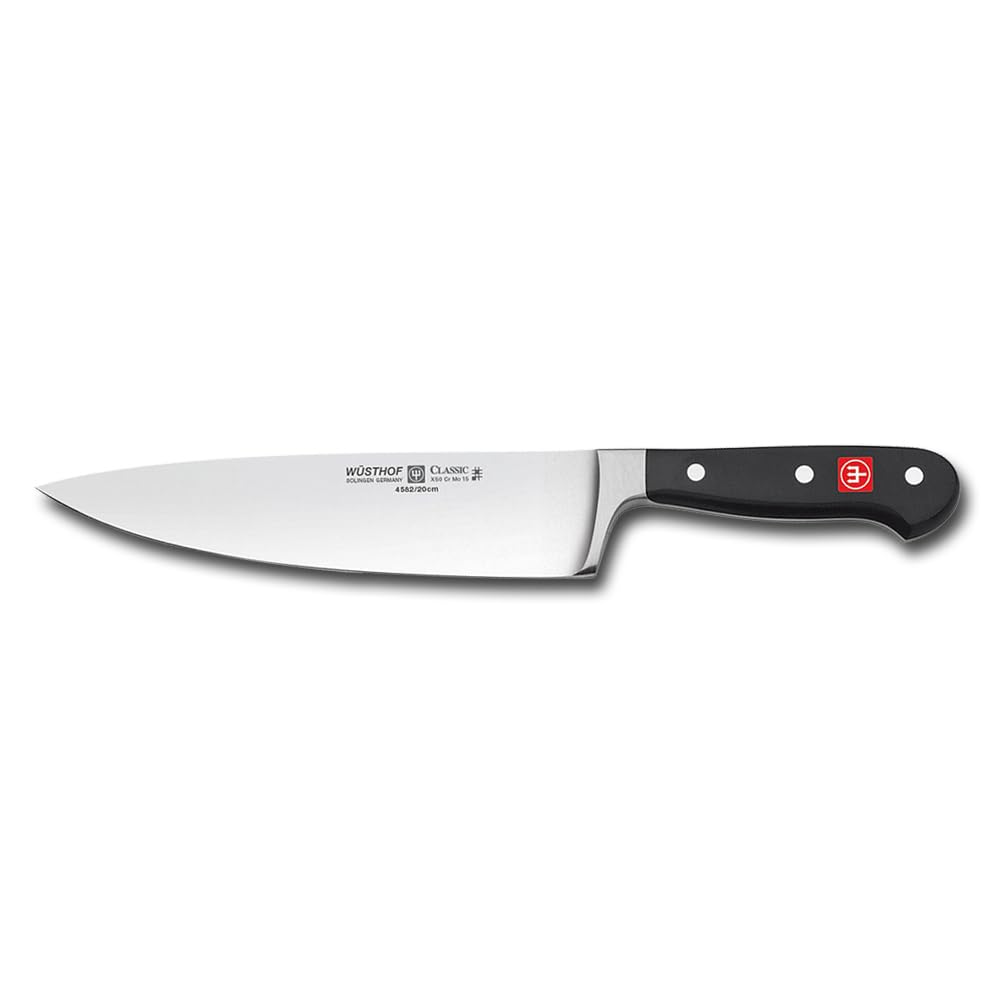
Wüsthof Classic 8-Inch Chef’s Knife — The 8-inch benchmark all others chase
Best for: everyday all-round cooking
If you only own one chef’s knife, this is the length and the knife to anchor your kitchen around. The 8-inch blade covers the great majority of daily tasks — dicing onions, breaking down squash, mincing herbs — without the unwieldy feel of a 10-inch. Its full-tang forged construction puts the balance point right at the bolster, so the knife does the work instead of your wrist. The X50CrMoV15 steel sharpens easily and shrugs off acidic foods. Trade-off: at around 9 ounces it feels substantial, and the full bolster can complicate sharpening near the heel.
- Forged full-tang balance feels perfect
- 8-inch length handles nearly everything
- Easy to sharpen, stain resistant
- Comfortable triple-rivet handle
- Hefty for small hands
- Full bolster complicates heel sharpening
4.9/5
4.8/5
5.0/5

Victorinox Fibrox Pro 8-Inch Chef’s Knife — Pro performance at a friendly price
Best for: a first serious knife
This is the knife that proves length matters more than price. You get the same versatile 8-inch profile found on blades costing several times as much, in a lightweight stamped blade that culinary students have learned on for decades. The Fibrox handle stays grippy when wet, and the thin blade glides through onions and potatoes with less wedging than thicker forged knives. It needs honing more often than harder Japanese steel, and the stamped blade lacks the heel heft some cooks like for dense squash. For a first serious knife, the length-to-value ratio is unmatched.
- Unbeatable value for an 8-inch
- Light, grippy Fibrox handle
- Thin blade reduces wedging
- Needs frequent honing
- Stamped blade lacks heft
4.6/5
4.8/5
4.7/5

Shun Classic 8-Inch Chef’s Knife — Razor precision with stunning Damascus cladding
Best for: precision slicing
An 8-inch blade in Japanese geometry feels like a precision instrument next to its German counterparts. The VG-MAX core, hardened to 60–61 HRC, takes a keen 16-degree edge that falls through tomatoes and fish with almost no pressure. At 8 inches it is long enough for draw cuts across large vegetables yet nimble for fine brunoise. The D-shaped Pakkawood handle suits right-handed pinch grips beautifully. The trade-off is fragility: the hard, thin edge can chip on bones or frozen food, and it demands hand washing and careful storage.
- VG-MAX edge is scalpel sharp
- Beautiful Damascus cladding
- Nimble despite full 8 inches
- Can chip on hard foods
- Hand wash only
4.9/5
4.7/5
4.8/5

MAC Professional MTH-80 8-Inch Chef’s Knife — The sharpest thin blade here
Best for: long-lasting sharpness
Ask working cooks which 8-inch knife stays sharp the longest and the MAC MTH-80 comes up constantly. Its thin 2 mm molybdenum-vanadium blade is ground more acutely than German knives, so it cuts with less effort and holds its edge through long prep sessions. The 8-inch length gives full board coverage for slicing roasts and portioning fish. The Pakkawood handle is comfortable but slightly slim for very large hands. It is not a rock-chopper’s dream either — the thin edge prefers push cuts and slicing over aggressive rocking through hard squash.
- Outstanding edge retention
- Thin blade cuts effortlessly
- Light and agile
- Slim handle for large hands
- Not ideal for rock chopping
4.9/5
4.6/5
4.7/5

Global G-2 8-Inch Chef’s Knife — Featherweight control for long sessions
Best for: small hands, long prep
If an 8-inch knife usually feels like too much blade, the Global G-2 changes the equation. Its one-piece CROMOVA 18 stainless construction keeps weight remarkably low, so the full 8 inches feels quick rather than tiring over long prep. The dimpled handle suits smaller hands and stays secure with a pinch grip. Edge retention is middling — expect to hone often and sharpen a few times a year with regular use. The all-steel handle can also feel slippery to cooks used to contoured Western grips.
- Very light for an 8-inch
- One-piece hygienic construction
- Good for smaller hands
- Edge needs frequent honing
- Steel handle feels slippery
4.6/5
4.6/5
4.7/5

Zwilling J.A. Henckels Pro 7-Inch Chef’s Knife — Big control in a compact 7 inches
Best for: compact kitchens
Seven inches is the sleeper pick for cooks who find 8-inch blades just slightly too much. You keep nearly all the versatility — the blade still spans a large onion in one draw — but gain noticeably more tip control for detailed work. Zwilling’s full-tang forged construction and curved bolster encourage a proper pinch grip, and the special-formula steel resists staining well. The compromise is capacity: shredding a big cabbage or slicing a watermelon takes more strokes than with an 8 or 10-inch blade. For apartment kitchens, that trade feels like a win.
- Great control in compact length
- Forged full-tang durability
- Encourages proper pinch grip
- Less capacity than 8-inch
- Heavier than Japanese rivals
4.7/5
4.3/5
4.6/5

Mercer Culinary Millennia 10-Inch Chef’s Knife — Maximum reach for batch cooking
Best for: high-volume batch prep
When your prep involves sheet pans of vegetables or breaking down large melons, those extra two inches over a standard 8-inch knife genuinely matter. The 10-inch Millennia gives you long, uninterrupted draw cuts and the knuckle clearance to power through bulk chopping. The Santoprene handle is comfortable even during marathon sessions. The downsides are real: it needs a large board and storage space, and beginners often find the tip harder to control. This is a specialist length, not a first knife. Pair it with a board at least 18 inches wide and it earns its keep.
- Long reach for bulk prep
- Comfortable Santoprene handle
- Great budget long blade
- Needs large board and storage
- Tip harder for beginners
4.2/5
4.7/5
4.3/5

Tojiro DP Gyuto 8.25-Inch Chef’s Knife — Japanese performance, sensible money
Best for: Japanese steel on a budget
The extra quarter inch over a standard 8-inch gyuto is subtle but useful — slightly longer draw cuts for slicing roasts and portioning fish. Tojiro’s VG-10 core at 60 HRC delivers Japanese-level sharpness and edge retention at a price that embarrasses many Western brands. The western-style handle suits cooks transitioning from German knives. Fit and finish can be rustic — expect a functional rather than polished spine — and like all hard Japanese steel, it should never meet bones, frozen food, or the dishwasher. A smart first Japanese knife for curious Western cooks.
- VG-10 sharpness at low price
- Extra 0.25 inch aids slicing
- Familiar western handle shape
- Rustic fit and finish
- No bones or dishwasher
4.7/5
4.6/5
4.5/5

Dalstrong Gladiator Series 6-Inch Chef’s Knife — Small blade, serious capability
Best for: cramped kitchens, small tasks
A 6-inch chef’s knife is essentially a large utility knife, and that is exactly its charm in cramped kitchens. It handles sandwiches, fruit, shallots, and small-portion prep with the agility of a paring knife but the knuckle clearance of a chef’s knife. The G10 handle and full-tang build feel reassuringly solid. The limitation is obvious: halving a butternut squash or slicing a large cabbage becomes a sawing exercise. Buy it as a companion to an 8-inch, not as your only blade. It also travels well for vacation rentals and galley kitchens.
- Agile in tight kitchens
- Solid G10 full-tang build
- Great second knife
- Too short for large produce
- Not a primary blade
4.5/5
4.0/5
4.4/5

Miyabi Birchwood SG2 9.5-Inch Chef’s Knife — A showpiece that actually performs
Best for: gifts and special occasions
At 9.5 inches, the Miyabi Birchwood splits the difference between an 8 and a 10 — generous slicing length without the full commitment of a 10-inch blade. The SG2 micro-carbide core at 63 HRC is among the hardest steel here, taking an exceptionally keen, long-lasting edge wrapped in 101 layers of Damascus. It is a stunning gift knife. The price sits firmly in premium territory, the ultra-hard edge demands careful technique and hand washing, and the longer blade needs proper storage to protect that fine edge.
- SG2 edge stays sharp longest
- Stunning 101-layer Damascus
- 9.5 inches slices roasts easily
- Premium price
- Demands careful technique
5.0/5
4.7/5
4.8/5
Top 3 Head-to-Head: Wüsthof Classic vs Victorinox Fibrox Pro vs Shun Classic
These three 8-inch knives are the finalists most buyers circle back to: the benchmark German blade, the budget champion, and the Japanese precision pick. Same length, three very different personalities.
| Feature | #1 Wüsthof | #2 Victorinox | #3 Shun |
|---|---|---|---|
| Blade Control | 4.9/5 | 4.6/5 | 4.9/5 — Best |
| Versatility | 4.8/5 — Best | 4.8/5 | 4.7/5 |
| Comfort & Balance | 5.0/5 — Best | 4.7/5 | 4.8/5 |
| Choose if… | You want one knife that does everything well. | You want most of the performance for less. | Razor precision matters most to you. |
Who These Chef’s Knives Are NOT For
A chef’s knife, whatever its length, is a generalist — and generalists have limits worth respecting.
Similarly, if you want single-bevel Japanese precision for sushi, a yanagiba — not a Western chef’s knife — is the right tool. Buy the length for the cooking you actually do, not the cooking you aspire to.
Common Mistakes to Avoid
Most length regret comes from four avoidable errors, not from the knives themselves.
Frequently Asked Questions About Chef’s Knife Length
What is the best length for a chef knife?
For most home cooks, 8 inches is the best length for a chef knife. It is long enough to slice a roast or halve a cabbage in smooth strokes, yet short enough to control for dicing onions and mincing herbs. Shorter 6 to 7-inch blades suit small kitchens and small hands, while 10-inch blades reward confident cooks doing high-volume prep. If you buy only one, buy 8 inches.
Is an 8-inch or 10-inch chef knife better?
An 8-inch chef knife is better for most people because it balances cutting capacity with control on a standard home cutting board. A 10-inch blade covers more food per stroke and powers through bulk prep, but it needs a large board, more storage space, and steadier technique. Choose 10 inches if you regularly prep for a crowd; otherwise the 8-inch is the safer, more versatile pick.
What size chef knife do professional chefs use?
Most professional chefs use 8 to 10-inch chef’s knives, with 10-inch blades especially common on busy prep lines where long draw cuts speed up bulk vegetable work. Japanese-trained chefs often favor 8 to 9.5-inch gyutos for precision tasks. The pattern is consistent: pros pick the longest blade they can fully control, because extra length only helps when technique keeps the tip precise.
Is a 6-inch chef knife too small for everyday cooking?
As your only knife, yes — a 6-inch blade struggles with large cabbage, melons, and roasts, turning smooth slices into sawing. As a second knife, it is excellent: nimble for shallots, fruit, and sandwiches in tight kitchens. If vegetable prep dominates your cooking, see our guide to the best knife for chopping vegetables before deciding which length earns the primary slot.
What length chef knife is best for small hands?
A 7-inch chef’s knife or a lightweight 8-inch model is usually best for small hands. Shorter blades bring the balance point closer to your grip, and lighter knives like the Global G-2 reduce wrist fatigue during long prep. Avoid heavy 10-inch blades until your pinch grip is confident. Handle shape matters as much as length, so favor contoured or slim handles.
How should I store a long chef knife?
Store long chef knives on a magnetic wall strip, in a blade guard inside a drawer, or in a slotted block with slots longer than the blade. Never toss an unsheathed knife loose in a drawer — 8 to 10-inch edges roll, chip, and find fingers. Keep the edge dry, store it separately from other utensils, and never put quality chef’s knives in the dishwasher.
Our Final Verdict
Blade length is the cheapest upgrade in your kitchen: 8 inches suits most cooks, 10 inches rewards batch preppers, and 6 to 7 inches rescue small kitchens and small hands. Pick the Wüsthof Classic 8-Inch if you want the safest all-round choice, then match your grip, board, and maintenance habits to the steel.