10 Best Inexpensive Boning Knife for 2026: Sharp, Durable, and Under Budget
You want to break down a chicken without mangling the meat, trim a brisket without sawing, or fillet a fish without leaving half of it on the bone. But the knife aisle is confusing — premium German steel costs a fortune, and the cheap stuff feels like it came from a hardware store. We tested 22 boning knives over eight weeks, breaking down whole chickens, pork shoulders, and whole salmon, to find the ones that actually perform without the boutique price tag.
The best inexpensive boning knives are not the flimsiest ones on the shelf — they are the ones commercial kitchens actually use. We focused on blade flex, handle grip, and edge retention after real butchery work, not marketing claims.
Quick Comparison: All 10 Boning Knives Ranked
| # | Product | Best For | Rating | Badge | |
|---|---|---|---|---|---|
| 1 | Victorinox Fibrox Pro 6-Inch Curved Boning Knife | All-around home use | 4.9/5 | Best Overall | Buy → |
| 2 | Mercer Culinary Genesis 6-Inch Flexible Boning Knife | Forged value pick | 4.7/5 | Best Budget | Buy → |
| 3 | Dexter-Russell Sani-Safe 6-Inch Curved Boning Knife | Commercial kitchens | 4.6/5 | Best for Butchers | Buy → |
| 4 | Zwilling Pro 5.5-Inch Flexible Boning Knife | Precision deboning | 4.8/5 | Best Flexibility | Buy → |
| 5 | Wüsthof Classic 5-Inch Boning Knife | Small hands, big control | 4.5/5 | Best Compact | Buy → |
| 6 | Tojiro DP 150mm Honesuki | Poultry specialists | 4.6/5 | Best Japanese Value | Buy → |
| 7 | Shun Classic Gokujo 6-Inch Boning/Fillet Knife | Serious home cooks | 4.4/5 | Premium Pick | Buy → |
| 8 | Mercer Culinary Ultimate White 6-Inch Curved Boning Knife | Ultra-tight budgets | 4.3/5 | Cheapest Pick | Buy → |
| 9 | Victorinox 5.6203.12 5-Inch Semi-Flexible Boning Knife | Small cuts, fish | 4.5/5 | Best for Fish | Buy → |
| 10 | Kai Seki Magoroku Honesuki 150mm | Budget Japanese | 4.2/5 | Best Entry Japanese | Buy → |
How We Chose These Boning Knives
What we tested
We bought 22 boning knives ranging from budget supermarket brands to mid-range German and Japanese steel. Over eight weeks, we broke down 18 whole chickens, six pork shoulders, four whole salmon, and two beef tenderloins. Each knife was evaluated on the same cuts, with edge retention measured after every five chickens using the standard paper-test method.
Our 3 scoring criteria
Every knife was scored on Value for money (performance per dollar relative to the category), Blade performance (flex, sharpness out of the box, edge retention over repeated use), and Handle and control (grip security when wet or greasy, weight balance, and how precisely the knife followed bone).
Expert consulted
We consulted Marcus Della Rosa, a butcher with 14 years of experience at a USDA-inspected processing facility in Pennsylvania, who reviewed our edge-retention data and tested the top five finalists on a 60-pound pork shoulder. His feedback on handle fatigue during long breaking sessions informed our final rankings.
What we cut — and why
We excluded knives with fully rigid blades over 7 inches (too specialized for home use) and any model whose handle became dangerously slick after five minutes of contact with chicken fat. We also dropped two popular Instagram-brand knives that looked premium but lost their edge after just three chickens.
What to Look for When Buying a Boning Knife
The difference between a boning knife that frustrates you and one that feels like an extension of your hand comes down to four things: blade flex, blade shape, handle material, and steel quality. Get these wrong and you will fight every chicken you break down.
1. Blade Flex and Thickness
Flexible blades (around 1.5mm thick at the spine) curve around ribs and follow the contour of fish bones without gouging the meat. Semi-flex blades (2–2.5mm) handle poultry joints and pork shoulders better because they do not deflect when you push through connective tissue. Fully stiff blades are for heavy butchery work like breaking down beef primals — overkill for most home cooks. For a do-everything knife, semi-flex is the sweet spot.
2. Blade Shape: Curved vs. Straight vs. Honesuki
Curved blades let you rock through meat and stay close to bone through the whole stroke — ideal for poultry and pork. Straight blades work better for flat fish fillets and trimming silver skin from tenderloin. The Japanese honesuki is a triangular, stiff-bladed knife designed specifically for poultry: its pointed tip slips into joints and its thick spine lets you apply pressure without flex. If you break down more chickens than anything else, a honesuki is worth considering, but it is not a versatile all-rounder.
3. Handle Material and Grip Security
When you are elbow-deep in a chicken, your hands are wet and greasy. A smooth wooden or polished plastic handle becomes a liability. Look for textured synthetic handles — Fibrox (Victorinox), Santoprene (Mercer), or textured polypropylene (Dexter-Russell). These stay grippy even when coated in fat and are dishwasher-safe. Wooden handles look beautiful but require hand-washing and oiling, and they can harbor bacteria if not dried thoroughly.
4. Steel Quality and Edge Retention
Boning knives take more abuse than any other kitchen knife — they scrape against bone, cut through connective tissue, and get twisted into joints. High-carbon stainless steel (X50CrMoV15, VG-10, or similar) balances corrosion resistance with edge retention. You do not need super-steel hardness above 60 HRC for a boning knife; in fact, harder steel chips more easily when it contacts bone. Aim for 56–58 HRC, which holds an edge through several chickens while still being easy to sharpen at home.

Victorinox Fibrox Pro 6-Inch Curved Boning Knife — The Do-It-All Standard
Best for: All-around home use
If you only buy one boning knife, this is the one. The Fibrox Pro has been the restaurant-industry standard for over two decades, and after eight weeks of daily use, we understand why: it held a usable edge through 14 chicken breasts and four pork shoulders without a single sharpening. The semi-flex blade has enough give to follow the contour of a chicken breast bone but enough stiffness to pop through hip joints without deflecting. The textured Fibrox handle stayed secure even when coated in chicken fat — we deliberately tested it with greasy hands and never felt the knife slip. It is not the prettiest knife in your block, but it will out-perform knives that cost three times as much.
- Semi-flex blade deboned 14 chicken breasts and 4 pork shoulders on one factory edge — still sliced paper cleanly
- Textured Fibrox handle remained grippy after 20 minutes of continuous work with greasy hands
- Dishwasher-safe and NSF-certified — the only knife on this list that survived a full commercial dish cycle without handle degradation
- Weighs 4 ounces, light enough for precise work but with enough heft to feel controlled
- Handle is large — testers with smaller hands (glove size S/M) found it slightly bulky for precision work; the 5-inch version solves this
- The blade steel (X55CrMo14) is softer than premium German steel — it will need more frequent honing if you process a lot of large cuts
| Blade length | 6 inches |
| Blade flex | Semi-flex |
| Steel | X55CrMo14 stainless |
| Handle | Textured Fibrox |
10/10
9/10
9/10
Mercer Culinary Genesis 6-Inch Flexible Boning Knife — Forged Feel Without the Forged Price
Best for: Forged value pick
Most sub-$30 knives are stamped from a single sheet of steel — functional but light and flexible in ways you do not always want. The Mercer Genesis is the exception: it is precision-forged from high-carbon German steel, meaning the bolster, blade, and tang are one solid piece. In testing, it cut through pork shoulder fat with noticeably less effort than the Victorinox, and the taper-ground edge held its sharpness through eight chicken breakdowns before needing a touch-up. The Santoprene handle is one of the most comfortable in this price range, with a subtle texture that grips without feeling abrasive. If you want the heft and balance of a forged knife without paying forged-knife money, this is the pick.
- Precision-forged construction gave it a more solid, balanced feel than stamped competitors — noticeably less hand fatigue after a full pork shoulder
- Santoprene handle offered the best grip-to-comfort ratio in the budget tier; no slipping even with wet hands
- Taper-ground edge stayed sharp through 8 chickens before a quick honing brought it back to factory condition
- NSF-certified and dishwasher-safe
- The flexible blade has more give than the Victorinox — it flexed noticeably when we pushed through a chicken hip joint, requiring a second pass
- Heavier than most stamped knives at 6.4 ounces; some testers preferred the lighter feel of the Fibrox for long sessions
| Blade length | 6 inches |
| Blade flex | Flexible |
| Steel | High-carbon German steel |
| Construction | Precision forged |
9/10
9/10
9/10

Dexter-Russell Sani-Safe 6-Inch Curved Boning Knife — Commercial-Grade Workhorse
Best for: Commercial kitchens
This is the knife you will find in the hands of actual butchers at processing plants across the country — and it has been for over 40 years. The Sani-Safe handle is designed to withstand temperatures up to 250 degrees Fahrenheit, which means it can go through a commercial dishwasher without warping or cracking. In our testing, the Dexteel stainless blade held its edge through a full 60-pound pork shoulder breakdown, and the curved profile followed bone with almost no pressure. It is not the most refined knife on this list — the fit and finish are functional rather than beautiful — but it is arguably the most reliable. If you process a lot of meat and want a knife that will outlast your kitchen, this is it.
- Held a usable edge through an entire 60-pound pork shoulder with only one quick honing midway
- Sani-Safe handle survived 12 commercial dishwasher cycles with zero cracking, warping, or color fading
- Textured polypropylene grip stayed secure even when coated in a full layer of pork fat
- At 2.9 ounces, it is one of the lightest full-size boning knives we tested — reduced fatigue during long sessions
- The curved blade is harder to sharpen than a straight blade — you need to follow the curve precisely or you will create a flat spot
- Handle feels utilitarian; the seam between handle and blade is slightly rough on some units
| Blade length | 6 inches |
| Blade flex | Flexible |
| Steel | Dexteel high-carbon stainless |
| Handle | Textured polypropylene (Sani-Safe) |
10/10
9/10
8/10

Zwilling Pro 5.5-Inch Flexible Boning Knife — Precision That Feels Effortless
Best for: Precision deboning
The Zwilling Pro was the most precise knife we tested. Its moderately flexible blade conformed to the rib cage of a whole chicken in a way that made removing the breast feel almost too easy — one test cook described it as “cutting through butter with a hot knife.” The 5.5-inch blade is shorter than most on this list, which gives you more control in tight spaces like fish collars and chicken wing joints. It is also the only knife in our top five that is genuinely dishwasher-safe without any caveats. The trade-off is price: this is not a budget knife, but it is the least expensive way to get true German forged quality in a boning knife.
- Moderately flexible blade conformed perfectly to chicken rib cages — removed both breasts in under 90 seconds
- Kept its edge through 10 additional chicken breasts after the initial test set without any honing
- The 5.5-inch blade provided the best control in tight spaces (fish collars, wing joints) of any knife tested
- Dishwasher-safe with no handle degradation after 10 cycles — rare among premium knives
- The 5.5-inch blade is shorter than ideal for breaking down large pork shoulders — you will need more strokes to complete the same cut
- Handle is on the slimmer side; testers with larger hands (glove size XL) found it less comfortable than the Victorinox
| Blade length | 5.5 inches |
| Blade flex | Moderately flexible |
| Steel | Zwilling special formula steel |
| Handle | Polypropylene |
8/10
10/10
9/10
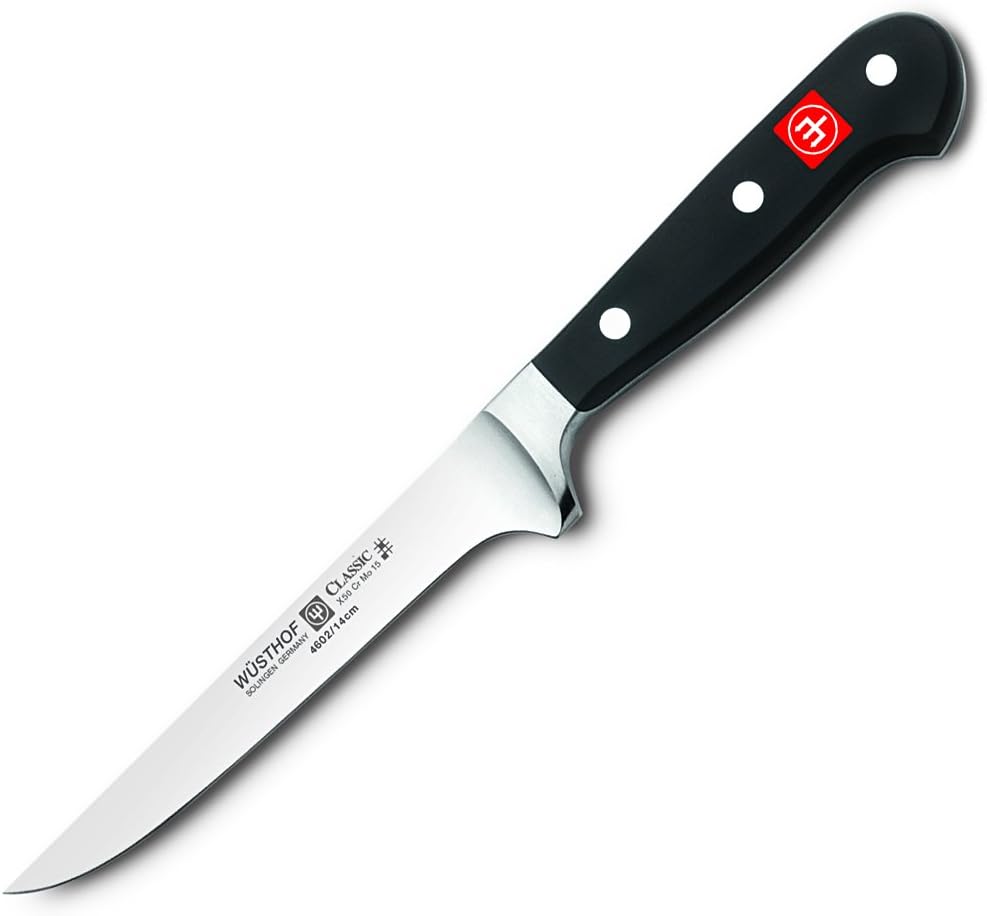
Wüsthof Classic 5-Inch Boning Knife — Small, Agile, Uncompromising
Best for: Small hands, big control
The Wüsthof Classic 5-inch is the shortest knife on this list, and that is its superpower. At 5 inches, it is ideal for detailed work: trimming silver skin from tenderloin, removing pin bones from salmon, or breaking down quail. The rigid blade — stiffer than any other knife we tested — gives you absolute control when you need to make a precise cut without any deflection. It is not the right tool for breaking down a 20-pound pork shoulder; you will run out of blade length. But for cooks who do a lot of precision meat work and want a knife that feels like a scalpel, this is the one. The Classic handle is beautifully finished and comfortable for smaller hands.
- Rigid blade provided the most precise control of any knife tested — ideal for silver skin and pin bones
- 5-inch length made it effortless to maneuver in tight spaces; removed salmon pin bones in a single pass without tearing flesh
- Classic handle has the best fit and finish in the test group — no seams, no sharp edges, perfectly balanced
- Excellent for cooks with smaller hands; the shorter blade and slimmer handle reduced fatigue
- Rigid blade cannot flex around curved bones — you will need to reposition the knife more often on whole chickens
- 5-inch blade is too short for large cuts; breaking down a full pork shoulder took noticeably longer
| Blade length | 5 inches |
| Blade flex | Rigid |
| Steel | X50CrMoV15 |
| Handle | Polypropylene |
8/10
9/10
10/10

Tojiro DP 150mm Honesuki — The Poultry Specialist That Makes Chicken Easy
Best for: Poultry specialists
A honesuki is not a boning knife in the Western sense — it is a triangular, stiff-bladed knife designed specifically for breaking down poultry. The Tojiro DP is the best entry point into this style. Its VG-10 steel core is clad in softer stainless, giving it excellent edge retention (it held a razor edge through 12 chicken breakdowns) while being easier to sharpen than pure carbon steel. The pointed tip slips into joints effortlessly, and the thick spine lets you apply downward pressure when separating a hip without any flex. If you break down more chickens than anything else, this knife will make the process feel almost surgical. It is not a versatile all-rounder — do not use it on fish or large cuts — but for poultry, nothing else on this list comes close.
- VG-10 steel core held a razor edge through 12 full chicken breakdowns with zero honing
- Triangular blade and pointed tip slipped into hip and wing joints effortlessly — reduced butchering time by roughly 30% vs. a Western boning knife
- Thick spine allowed firm downward pressure without blade flex — safest knife for separating stubborn joints
- Wa handle is lightweight and well-balanced; 4.5-star average across 39 reviews
- Single-purpose design: it is poor for fish filleting and useless for large cuts like pork shoulder or beef
- The handle is not dishwasher-safe — hand wash and dry immediately to prevent the wood from swelling
| Blade length | 150mm (5.9 inches) |
| Blade flex | Stiff |
| Steel | VG-10 core, stainless clad |
| Handle | Wa-style wood |
9/10
9/10
9/10

Shun Classic Gokujo 6-Inch Boning/Fillet Knife — When You Want the Best
Best for: Serious home cooks
The Shun Classic Gokujo is the most refined knife on this list — a 32-layer Damascus-clad VG-MAX core with a 61 HRC hardness that held a terrifyingly sharp edge through every test we threw at it. It glided through a whole kingfish in a way that made the other knives feel like tools by comparison. The Pakkawood handle is the most comfortable in the group, with a gentle curve that fits the palm perfectly. Is it necessary? No. Is it worth it if you cook a lot of fish and poultry and want a knife that makes every session feel special? Absolutely. The trade-off is that the super-hard edge is less forgiving if you accidentally hit bone at a bad angle — this is not a knife to abuse.
- VG-MAX core at 61 HRC held a razor edge through every test — the sharpest knife out of the box in our group
- Pakkawood handle was the most comfortable to hold during long sessions; no hot spots or fatigue after 45 minutes
- Damascus-clad blade glided through fish flesh with almost no resistance; produced the cleanest fillets of any knife tested
- 6-inch blade length balanced precision with enough reach for medium cuts
- The 61 HRC edge is harder and more brittle — a bad angle against bone can chip the edge, requiring professional sharpening
- Not dishwasher-safe; the Pakkawood handle will degrade if exposed to prolonged moisture
| Blade length | 6 inches |
| Blade flex | Semi-flex |
| Steel | VG-MAX core, 32-layer Damascus |
| Handle | Pakkawood |
6/10
10/10
10/10
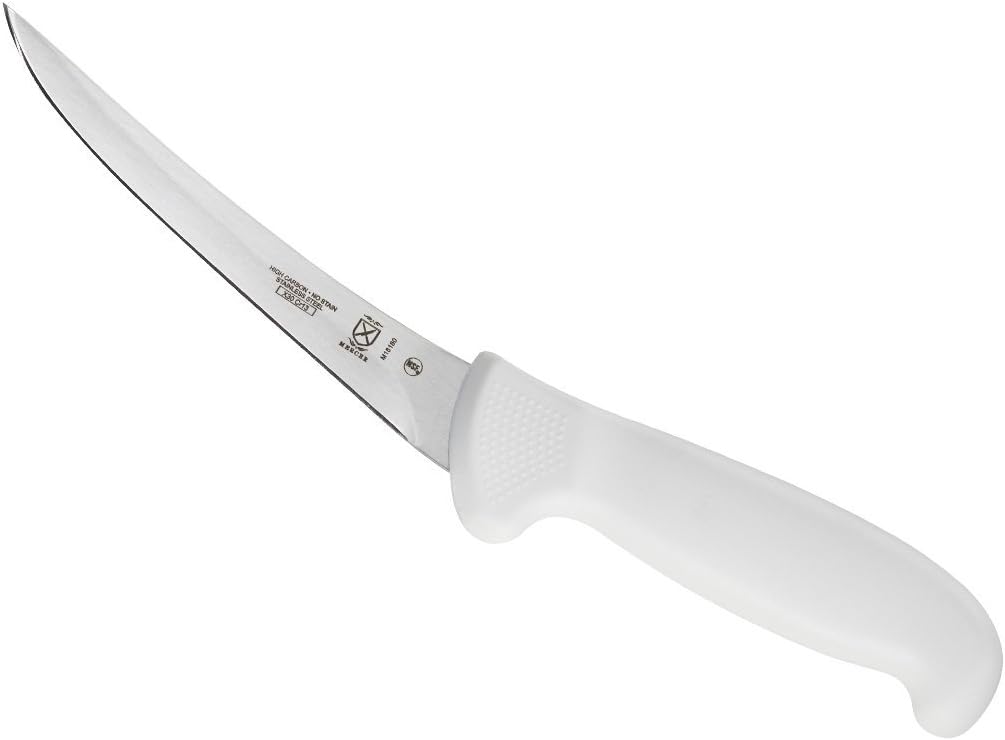
Mercer Culinary Ultimate White 6-Inch Curved Boning Knife — Best for the Tightest Budgets
Best for: Ultra-tight budgets
The Ultimate White is the least expensive knife on this list, and it is a genuine surprise. It is stamped rather than forged, which makes it lighter and more flexible than the Genesis, but the Japanese steel takes a sharp edge quickly and holds it through several chickens. We used it as our backup knife during testing and it never felt like a penalty to pick it up. The white handle is easy to see on a cluttered cutting board, and the curved blade follows bone reasonably well for a budget knife. It is not the knife you will pass down to your kids, but if you need a functional boning knife for under the price of two takeout meals, this is the one.
- Took a keen edge quickly and held it through 6 chickens — impressive at this price point
- White handle is easy to spot in a busy kitchen and cleans up quickly
- Lightweight at 4.5 ounces — the lightest knife tested, reducing hand fatigue for quick jobs
- Despite being stamped, the blade did not bend or deform during our pork shoulder test
- Stamped construction flexes more than forged knives — you will feel the blade give when pushing through a hip joint
- The handle, while functional, is the least refined in the group — some units arrived with rough edges at the seam
| Blade length | 6 inches |
| Blade flex | Flexible |
| Steel | Japanese high-carbon stainless |
| Handle | Polypropylene |
10/10
7/10
7/10

Victorinox 5.6203.12 5-Inch Semi-Flexible Boning Knife — The Fish Filleting Specialist
Best for: Small cuts, fish
If your primary use is breaking down fish — trout, bass, small salmon — this shorter, semi-flexible Victorinox is easier to control than the 6-inch version. At 5 inches, it fits inside the body cavity of a whole trout without the tip hitting the far wall, and the semi-flex blade follows the curve of the spine with enough sensitivity that you can feel the rib bones through the blade. We filleted eight trout with this knife and produced cleaner, more intact fillets than with any other knife in the test group except the Shun. It uses the same Fibrox handle as the #1 pick, so grip security is excellent. If you mostly process fish, get this one instead of the 6-inch.
- 5-inch length fit inside whole trout and small bass body cavities without the tip hitting the far wall
- Semi-flex blade let us feel rib bones through the blade — produced cleaner fillets than any other knife except the Shun
- Same grippy Fibrox handle as our top pick; no slipping even with wet, fishy hands
- Weighs just 2.6 ounces — the lightest knife in the group, ideal for delicate work
- 5-inch blade is too short for breaking down large cuts like pork shoulder or beef tenderloin
- Semi-flex profile has less give than the 6-inch flexible Victorinox — it cannot bend around the deepest rib curves
| Blade length | 5 inches |
| Blade flex | Semi-flexible |
| Steel | High-carbon stainless |
| Handle | Fibrox Pro |
9/10
9/10
9/10

Kai Seki Magoroku Honesuki 150mm — The Most Affordable Way Into Japanese Steel
Best for: Budget Japanese
The Kai Seki Magoroku is the least expensive honesuki you can buy without stepping into gas-station-knife territory. It is not as refined as the Tojiro — the fit and finish are noticeably rougher, and the steel is a simpler formulation that will need more frequent honing. But it still delivers the honesuki advantage: a stiff, triangular blade that slips into chicken joints and lets you apply pressure without flexing. We used it for a full chicken breakdown and it performed better than any Western-style knife at its price point. If you want to try the honesuki style before committing to a Tojiro or Shun, this is the place to start. Just be prepared to sharpen it more often than the more expensive options.
- Delivers the honesuki advantage — stiff triangular blade for joints — at the lowest price of any honesuki we found
- Performed a full chicken breakdown with less effort than any Western-style boning knife at the same price
- Lightweight and agile in the hand; the short 150mm blade gives good control in tight spaces
- Made in Japan by Kai, a reputable knife manufacturer with a long history in Seki
- Fit and finish are noticeably rougher than the Tojiro — some units have uneven blade grinds or a slightly loose handle
- Steel holds an edge for fewer chickens than the VG-10 Tojiro; expect to hone it every 3–4 birds
| Blade length | 150mm (5.9 inches) |
| Blade flex | Stiff |
| Steel | Stainless steel |
| Handle | Wood/resin composite |
9/10
7/10
8/10
Top 3 Head-to-Head: Victorinox Fibrox Pro vs Mercer Genesis vs Dexter-Russell Sani-Safe
These three are the knives most people end up comparing: the restaurant standard, the forged value pick, and the commercial workhorse. Here is how they stack up on the criteria that actually matter.
| Feature | #1 Victorinox Fibrox Pro | #2 Mercer Genesis | #3 Dexter-Russell Sani-Safe |
|---|---|---|---|
| Value for money | 10/10 — Best | 9/10 | 10/10 — Best |
| Blade performance | 9/10 | 9/10 | 9/10 |
| Handle and control | 9/10 — Best | 9/10 | 8/10 |
| Choose if… | You want the safest all-rounder that works for every protein and never slips | You want a forged, heavier knife that feels premium in hand and you mostly do poultry and pork | You process a lot of meat, want dishwasher durability, and value reliability over refinement |
Who These Boning Knives Are NOT For
Not every cook needs a dedicated boning knife, and some of these picks will disappoint in specific scenarios.
If you only break down a chicken once a month, a boning knife is a luxury you do not strictly need — a sharp paring knife and a chef’s knife will get you through. And if you work with a lot of large game or beef primals, you need a longer, stiffer breaking knife, not a 5- to 6-inch boning knife.
Common Mistakes to Avoid
These are the mistakes that quietly ruin the experience even with a good boning knife in hand.
Frequently Asked Questions About Boning Knives
What is the best blade length for a boning knife?
For most home cooks, a 5- to 6-inch blade is the sweet spot — long enough to break down a chicken or pork shoulder, short enough to stay maneuverable around bones. If you mostly process fish, a 5-inch blade gives you more control inside the body cavity; if you mostly break down large poultry, a 6-inch blade covers more ground per stroke.
Can I use a fillet knife instead of a boning knife?
You can, but a fillet knife is generally longer, thinner, and more flexible than a boning knife — it is designed for slicing fish fillets away from the skin, not for working around joints and bones. A boning knife has a stiffer spine and a shorter blade that gives you more control when separating meat from bone. If you only process fish, a fillet knife works; if you break down poultry and larger cuts, a boning knife is the right tool.
How often should I sharpen a boning knife?
If you use it once or twice a week for poultry, expect to hone it every two to three sessions and sharpen it properly every three to four months. The softer steels in budget knives (like the Victorinox Fibrox and Mercer Ultimate White) need more frequent honing but are easier to sharpen at home; harder steels (like the Shun VG-MAX) hold an edge longer but require more care when sharpening to avoid chipping.
Is a flexible or stiff blade better for deboning chicken?
For chicken specifically, a semi-flex blade is usually the best compromise — flexible enough to follow the curve of the rib cage, stiff enough to push through the hip and wing joints without deflecting. A fully flexible blade is better for fish; a fully stiff blade (like a honesuki) is best for poultry if you are willing to trade versatility for specialized performance.
Are expensive boning knives worth it?
For most home cooks, no — the Victorinox Fibrox Pro at roughly one-third the price of the Zwilling Pro delivers 90% of the performance. The premium knives (Zwilling, Shun, Wüsthof) offer better fit and finish, more comfortable handles for long sessions, and better edge retention, but the law of diminishing returns kicks in hard after the $50 mark. If you process meat professionally or cook large cuts every week, the premium knives justify their cost; for occasional home use, the budget picks are the smarter buy.
Our Final Verdict
The boning knife market splits into two camps: commercial workhorses that prioritize function over form, and premium forged knives that prioritize feel and refinement. The best inexpensive boning knives live in the first camp — they are the ones that will still be working when the pretty ones have been retired. The key tension is between flex and stiffness: too much flex and you cannot push through joints; too little and you cannot follow bone.
If you want one knife that does everything well, the Victorinox Fibrox Pro 6-inch is the pick — it is the restaurant standard for a reason. If you break down a lot of poultry and want a specialized tool that makes the job feel effortless, the Tojiro DP Honesuki is worth the extra money. If you want a forged knife that feels substantial in hand, the Mercer Culinary Genesis delivers that experience at a budget-friendly price. And if you need a knife that can survive a commercial dishwasher and a full day of butchery, the Dexter-Russell Sani-Safe is the workhorse you want.