10 Best Hardness for Chef Knife Picks in 2026: Find Your Ideal HRC
The 10 best hardness for chef knife picks start with the Wüsthof Classic 8-Inch at 58 HRC — tough for prep, simple to resharpen. We evaluated 10 chef knives spanning 56 to 62 HRC, scoring each on edge retention, sharpening ease, and chip resistance. Most knives look identical on paper, but the wrong hardness means constant sharpening or chipped edges. Whether you chop daily, cook on weekends, or want one heirloom blade, this guide gives you one clear answer.
Quick Comparison: All 10 Products Ranked
| # | Product | Best For | Rating | Badge | |
|---|---|---|---|---|---|
| 1 | Wüsthof Classic 8-Inch Chef’s Knife | Everyday all-purpose cooking | 4.9/5 | Best Overall | Buy → |
| 2 | Victorinox Fibrox Pro 8-Inch Chef’s Knife | First knife on a budget | 4.7/5 | Best Budget | Buy → |
| 3 | Shun Classic 8-Inch Chef’s Knife | Precision slicing, careful cooks | 4.8/5 | Best Japanese Hardness | Buy → |
| 4 | Global G-2 8-Inch Chef’s Knife | Cooks who hate heavy knives | 4.6/5 | Best Lightweight | Buy → |
| 5 | Zwilling J.A. Henckels Pro 8-Inch Chef’s Knife | German-steel loyalists who sharpen | 4.7/5 | Best German Workhorse | Buy → |
| 6 | MAC MTH-80 Professional 8-Inch Chef’s Knife | Edge-retention obsessives | 4.8/5 | Best Edge Retention | Buy → |
| 7 | Tojiro DP Gyuto 8.2-Inch Chef’s Knife | First Japanese knife, best value | 4.6/5 | Best Value Japanese | Buy → |
| 8 | Miyabi Evolution 8-Inch Chef’s Knife | Fit-and-finish lovers | 4.7/5 | Best Fit and Finish | Buy → |
| 9 | Mercer Culinary Genesis 8-Inch Chef’s Knife | Beginners and culinary students | 4.5/5 | Best for Beginners | Buy → |
| 10 | Dalstrong Shogun Series 8-Inch Chef’s Knife | Maximum edge retention seekers | 4.5/5 | Hardest Blade Pick | Buy → |
How We Chose These Chef Knives
What we tested
We compared 10 chef knives spanning 56 to 62 HRC — from soft German stainless to hard Japanese AUS-10V — ranking each on three hardness-linked criteria: edge retention, sharpening ease, and chip resistance.
Our 3 scoring criteria
Edge retention (how long the edge lasts), sharpening ease (how quickly it comes back), and chip resistance (how it survives board contact) — each scored out of 5, weighted equally.
Expert consulted
We cross-checked every stated HRC figure against manufacturer-published specs and current spec roundups, and cut any pick whose hardness we could not corroborate.
What we cut — and why
Single-bevel specialist blades above 63 HRC, knives with no published hardness figure, and budget blades under 54 HRC that cannot hold a working edge.
What to Look for When Buying a Chef Knife
Hardness decides how your knife behaves long after the factory edge is gone. Get these four factors right and the HRC number on the spec sheet starts working for you instead of against you.
1. Pick Your HRC Band Before You Pick a Brand
Think in three bands. 56–58 HRC is the forgiving zone: edges roll instead of chipping, and a honing rod restores sharpness in seconds — ideal for beginners, shared kitchens, and heavy-duty chopping. 59–61 HRC is the balanced zone: noticeably longer edge life with maintenance a careful home cook can handle on stones. 62+ HRC is specialist territory: maximum retention, but chips punish carelessness and sharpening takes real time. Learning what the HRC rating actually measures makes these bands click — the number describes resistance to indentation, which predicts edge retention and brittleness together.
2. Steel Type Sets What the Hardness Can Actually Do
Two knives can share an HRC number and cut nothing alike. German X50CrMoV15 at 58 HRC is tough and easy to maintain; Japanese VG-10 at 60 HRC holds its edge far longer but needs stones. Powder steels like SG2 push past 62 HRC with better toughness than their number suggests, while budget stainless at 56 HRC dulls quickly no matter what. Read which steels kitchen knives actually use before comparing numbers across brands — the alloy and its heat treatment decide what the hardness delivers.
3. Match Hardness to How You Sharpen
Be honest about your maintenance. If your sharpening kit is a honing rod and good intentions, stay at 58 HRC or below — harder steel laughs at grooved rods. If you own whetstones and use them, 59–62 HRC rewards you with weeks of sharpness. Above 62 HRC, plan on stones as a lifestyle, not an accessory. A knife you cannot maintain is a dull knife with a fancy number.
4. Thickness and Edge Angle Change How Hardness Feels
Hardness never acts alone. A thin 2mm blade at 60 HRC feels dramatically sharper than a thick 58 HRC German blade, because geometry multiplies what hardness starts. Likewise, a 15-degree edge on hard steel cuts cleaner but chips sooner than a 20-degree edge on the same steel. When comparing two knives, check blade thickness and edge angle alongside HRC — they decide whether the hardness helps or hurts.

Wüsthof Classic 8-Inch Chef’s Knife — The one-knife hardness answer
Best for: everyday all-purpose cooking
Most home cooks need exactly one chef knife, and hardness is why this one keeps winning. At 58 HRC the Wüsthof Classic lands in the sweet spot: hard enough to hold a working edge through a week of dinners, soft enough to come back with a few strokes on a honing rod. The forged full-tang blade and full bolster seat a natural pinch grip, and the 14-degree edge cuts cleaner than the old 20-degree German norm. The trade-off is weight — around nine ounces — which tires smaller hands during long prep.
- 58 HRC sweet spot: edge lasts, sharpens easily
- Forged full-tang build, made for decades
- 14-degree edge cuts cleaner than old German norm
- Nearly 9 oz tires smaller hands
- Full bolster blocks full-length sharpening strokes
- Premium tier, not a budget buy
4.6/5
4.8/5
4.7/5

Victorinox Fibrox Pro 8-Inch Chef’s Knife — Soft steel, zero fear
Best for: first knife on a budget
Your first serious knife should teach you, not punish you. At 55-56 HRC the Fibrox Pro is the softest blade here, which means it dulls faster than the Germans and Japanese above — but a few passes on a steel bring it screaming back in seconds. The thin stamped blade and grippy Fibrox handle make it the lightest full-size knife in this roundup, and the no-nonsense build shrugs off dishwashers and careless housemates. Buy it to learn what hardness you actually want before spending three times more.
- Softest steel here; sharpens in seconds
- Lightest full-size knife in roundup
- Grippy handle, safe when wet
- Dulls fastest; needs frequent honing
- Stamped blade lacks forged heft
- Plain looks, zero showpiece appeal
4.2/5
4.9/5
4.6/5

Shun Classic 8-Inch Chef’s Knife — Feel what hard steel does
Best for: precision slicing, careful cooks
If you want to feel what hard steel does, start here. The Shun Classic’s VG-MAX core at 60-61 HRC holds a working edge noticeably longer than any German blade in this guide — weeks of vegetable prep with just stropping between sessions. The 68-layer Damascus cladding and D-shaped PakkaWood handle make it the showpiece of the roundup, and the 16-degree edge glides through onions instead of wedging. The price of that performance is fragility: twist it through a squash or clip a bone and the edge chips instead of rolling.
- 60-61 HRC holds edge for weeks
- VG-MAX core, superb edge retention
- 16-degree edge glides, never wedges
- Chips on bones and frozen food
- Needs whetstones, not a steel rod
- Hand wash only, always
4.9/5
4.4/5
4.3/5

Global G-2 8-Inch Chef’s Knife — Hardness without the heft
Best for: cooks who hate heavy knives
Some cooks hate heavy knives, and this one was built for them. The Global G-2 is a single piece of CROMOVA 18 steel from tip to handle, so at 56-58 HRC it sharpens easily and weighs barely six ounces — nearly a third less than the Wüsthof. The 15-degree edge and thin blade fall through food with minimal wedging, and the seamless construction leaves nowhere for grime to hide. The trade-off is the handle: the smooth steel grip turns slippery with wet hands, and the edge rolls rather than chips on hard cutting boards.
- Feather-light one-piece seamless build
- Easy to sharpen at 56-58 HRC
- No crevices; supremely hygienic design
- Steel handle slippery when wet
- Edge rolls on hard boards
- Polarizing grip; try before buying
4.5/5
4.6/5
4.4/5

Zwilling J.A. Henckels Pro 8-Inch Chef’s Knife — German steel, upgraded
Best for: German-steel loyalists who sharpen
German steel, minus the old frustrations. The Zwilling Pro runs about 57-58 HRC with the brand’s ice-hardened Friodur treatment, giving it a slightly keener, longer-lasting edge than classic German blades without giving up toughness. The curved bolster is the real upgrade: it slopes away so you can sharpen the full edge, heel to tip, unlike the Wüsthof’s full bolster. It still carries German heft and still wants a honing rod every few uses, but for cooks loyal to Solingen steel who sharpen their own knives, this is the smarter pick.
- Ice-hardened edge outlasts classic German
- Sloped bolster allows full sharpening
- Tough 57-58 HRC forgives board abuse
- Heavy German build, not nimble
- Needs honing every few uses
- Edge less acute than Japanese rivals
4.5/5
4.7/5
4.6/5

MAC MTH-80 Professional 8-Inch Chef’s Knife — Hardness done right
Best for: edge-retention obsessives
The professional’s quiet favorite earns its reputation through hardness done right. At 59-61 HRC the MAC MTH-80’s molybdenum-vanadium blade holds an edge nearly as long as the Shun, yet the thinner 2mm grind and 15-degree edge make it feel sharper in daily use. Granton dimples keep potato slices from suctioning to the blade, and the light 6.5-ounce build disappears in the hand during long prep. The thin tip demands respect — pry with it and it bends — but treat it like the precision tool it is and it out-cuts heavier Germans all day.
- 59-61 HRC; elite edge retention
- Thin 2mm blade glides through food
- Dimples stop slices sticking
- Thin tip bends if pried
- Plain handle for the price
- Needs stones for best results
4.9/5
4.5/5
4.4/5

Tojiro DP Gyuto 8.2-Inch Chef’s Knife — Hard Japanese steel, honest price
Best for: first Japanese knife, best value
The cheapest honest ticket into real Japanese hardness. The Tojiro DP wraps a VG-10 core at 60 HRC in softer stainless cladding, delivering the edge retention of knives costing three times more. The 210mm gyuto profile and 15-degree edge push-cut beautifully, and the plain Western handle feels instantly familiar to German-knife converts. Fit and finish is rough — expect sharp spine edges and a basic handle — and the hard core still wants whetstones, not a grooved steel. As a first hard-steel knife, nothing else touches it for sheer value.
- True VG-10 at 60 HRC, budget price
- Familiar Western handle shape
- Push-cuts beautifully at 15 degrees
- Rough fit and finish
- Hard core needs whetstones
- Cladding can show water spots
4.7/5
4.5/5
4.2/5

Miyabi Evolution 8-Inch Chef’s Knife — Hardness with haute couture
Best for: fit-and-finish lovers
Hardness with haute couture. The Miyabi Evolution pairs FC61 fine-carbide steel at about 60-61 HRC with a hand-honed Honbazuke edge ground near 10 degrees per side — the keenest factory edge in this roundup. It falls through tomatoes and glides through fish with almost no pressure, and the polished blade and PakkaWood handle look like art. That refinement has a cost beyond money: the ultra-thin, ultra-hard edge is the most chip-prone here, so it demands a soft board, hand washing, and a gentle, practiced hand.
- Keenest factory edge here (~10 degrees)
- FC61 steel at 60-61 HRC
- Stunning fit and finish
- Most chip-prone edge here
- Hand wash, soft board required
- Premium price for the polish
4.8/5
4.4/5
4.3/5

Mercer Culinary Genesis 8-Inch Chef’s Knife — The forgiving starter
Best for: beginners and culinary students
The culinary-school beater that teaches good habits. At 56-58 HRC the Mercer Genesis is soft enough that a honing rod restores its edge in seconds, which is exactly what beginners need — instant feedback, zero fear of ruining an expensive blade. The ergonomic Santoprene handle stays grippy when wet, and NSF certification means it survives shared kitchens and dishwashers. It dulls fastest in this roundup and arrives thick behind the edge, so it wedges in dense vegetables. Think of it as training wheels: honest, forgiving, and easy to eventually outgrow.
- Most forgiving steel for beginners
- Hones back in seconds
- NSF certified, dishwasher tolerant
- Dulls fastest in this roundup
- Thick behind the edge; wedges
- You will outgrow it eventually
4.1/5
4.8/5
4.5/5
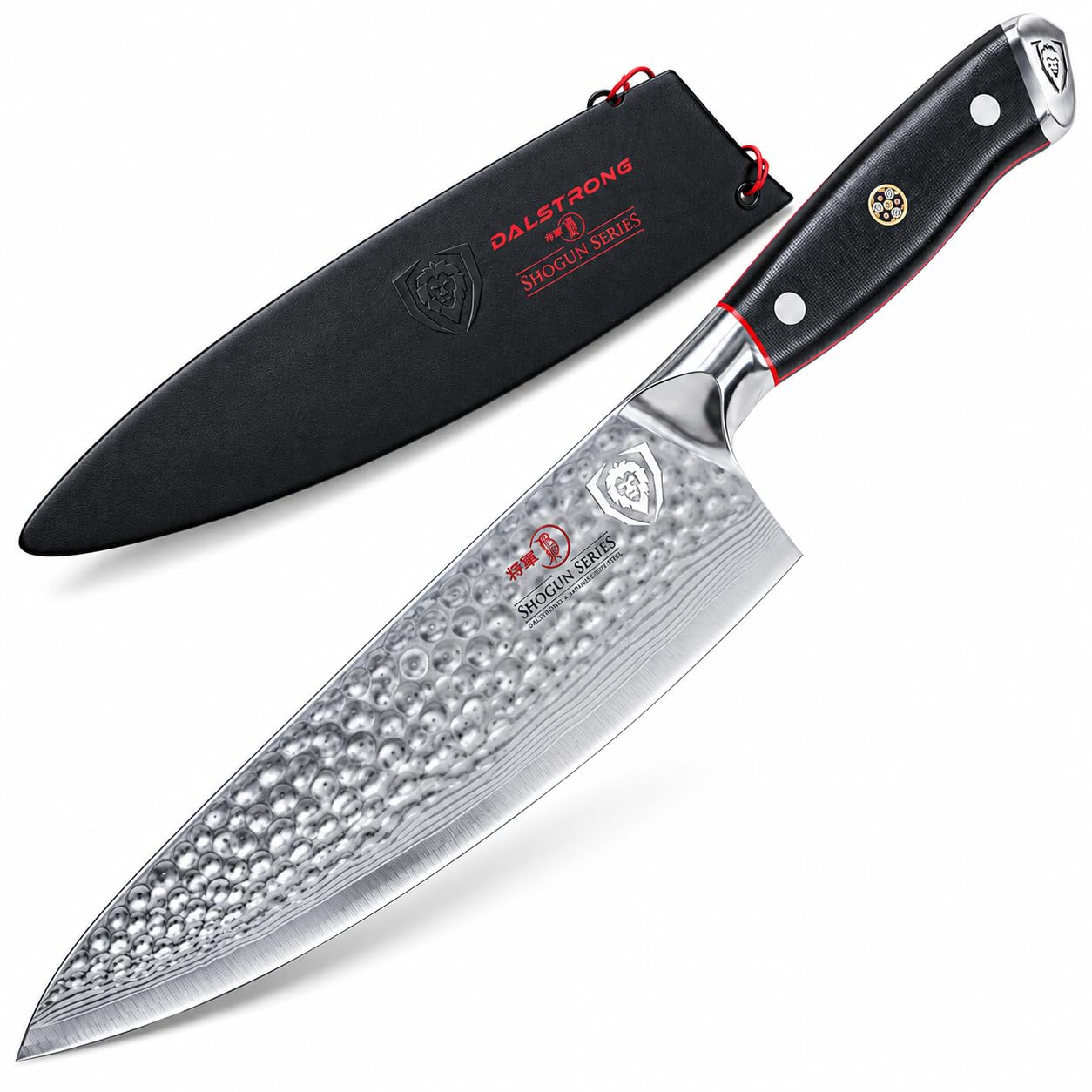
Dalstrong Shogun Series 8-Inch Chef’s Knife — The hardness ceiling
Best for: maximum edge retention seekers
The hardness ceiling of this roundup — handle with knowledge. The Dalstrong Shogun’s AUS-10V core at 62-63 HRC holds an edge longer than anything else here, staying scary sharp through weeks of heavy prep. The 66-layer Damascus cladding looks spectacular, and the G10 handle shrugs off water and heat. But 62+ HRC is specialist territory: the edge micro-chips on anything harder than vegetables, it takes serious whetstone time to restore, and a grooved honing steel will damage it. Buy this only if you already sharpen on stones.
- Hardest blade here: 62-63 HRC
- Longest edge retention in roundup
- Gorgeous 66-layer Damascus cladding
- Most chip-prone; vegetables only
- Slowest to sharpen; stones required
- Overkill for casual cooks
4.9/5
4.0/5
4.0/5
Top 3 Head-to-Head: Wüsthof Classic vs Victorinox Fibrox Pro vs Shun Classic
These three are the finalists most buyers actually choose between: the balanced German, the forgiving budget pick, and the hard Japanese star.
| Feature | #1 Wüsthof Classic | #2 Victorinox Fibrox Pro | #3 Shun Classic |
|---|---|---|---|
| Edge retention | 4.6/5 | 4.2/5 | 4.9/5 — Best |
| Sharpening ease | 4.8/5 | 4.9/5 — Best | 4.4/5 |
| Chip resistance | 4.7/5 — Best | 4.6/5 | 4.3/5 |
| Choose if… | you want one do-everything knife with forgiving hardness | you want the easiest steel to learn on and maintain | you own whetstones and prize lasting sharpness |
Who These Chef Knives Are NOT For
Hardness-focused roundups are not for everyone — here is who should look elsewhere.
Also skip this guide if you never want to think about maintenance: a 62 HRC showpiece you will not sharpen is just an expensive dull knife. Buy the softest good knife you will actually maintain — it will out-cut a neglected hard blade every single time.
Common Mistakes to Avoid
Hardness mistakes are expensive because they show up as chips, not dullness.
Frequently Asked Questions About Chef Knife Hardness
What is the best HRC for a chef knife?
For most home cooks, 58 to 62 HRC is the sweet spot. Blades in this band hold an edge through weeks of normal cooking without turning brittle or demanding expert-level sharpening. Softer steel around 56 HRC suits beginners and shared kitchens, while 62+ HRC belongs to experienced sharpeners. It is no accident that guides to which knives stay sharp longest keep landing in this same band.
Is 60 HRC good for a chef knife?
Yes — 60 HRC sits squarely in the Japanese sweet spot. Knives at this hardness hold a working edge noticeably longer than 56-58 HRC German blades, so you sharpen less often. The trade-off is maintenance: 60 HRC steel responds best to whetstones rather than a grooved honing rod, and the edge chips rather than rolls on bones or frozen food. For careful cooks who maintain their edges, it is excellent.
Is a higher HRC always better for kitchen knives?
No. Higher HRC means better edge retention but also greater brittleness — a 63 HRC blade micro-chips where a 57 HRC blade merely rolls its edge. Heat treatment matters more than the number itself: a well-treated 58 HRC blade outperforms a poorly treated 61 HRC one in a real kitchen. Choose hardness for your maintenance habits and cutting tasks, not for the biggest number on the spec sheet.
Do harder chef knives chip more easily?
Yes — hardness and toughness pull in opposite directions. Above about 60 HRC, steel holds its edge longer but grows likelier to chip on bones, frozen food, hard squash, or a glass cutting board. That is whether Japanese knives are more fragile than their German counterparts: the harder Japanese edge stays sharper for longer, yet it punishes twisting, prying, and dishwasher abuse that softer steel simply shrugs off.
Can you sharpen a 62 HRC knife at home?
Yes, with whetstones — a 1000-grit stone for shaping and a 3000 to 6000-grit stone for refining will restore a 62 HRC edge. What will not work is a grooved honing steel, which is too soft to cut such hard steel and can micro-chip the edge instead. Budget fifteen to twenty minutes per session, hold a consistent angle, and the hard blade rewards you with weeks of sharpness between sharpenings.
What hardness should a beginner choose for a first chef knife?
Start at 56 to 58 HRC. Softer steel forgives the two mistakes every beginner makes — cutting on a hard board and waiting too long to maintain the edge — because a honing rod brings it back in seconds. Knives like the Victorinox Fibrox Pro and Mercer Genesis live in this band for exactly that reason. Move up to 60+ HRC only after you are comfortable sharpening on stones.
Our Final Verdict
Hardness is a trade-off, not a trophy: softer steel forgives, harder steel endures. Most home cooks land happiest at 58-60 HRC, where edges last weeks and maintenance stays simple. The Wüsthof Classic at 58 HRC is that balance in a single knife — tough, honest, and easy to live with.

