Best Grind for Chef Knife 2026: 10 Knives Ranked by Grind Type
The best grind for chef knife work is a thin full flat grind, and the Wüsthof Classic 8-Inch Chef’s Knife is our top pick. This roundup compares 10 chef knives across cutting performance, edge retention, and ease of use. Most chef knives look identical on paper but feel different at the board, and that gap is what grind explains. Whether you rock-chop herbs, slice roasts, or dice vegetables, this guide gives you one clear answer.
Quick Comparison: All 10 Products Ranked
| # | Product | Best For | Rating | Badge | |
|---|---|---|---|---|---|
| 1 | Wüsthof Classic 8-Inch Chef’s Knife | Everyday home cooking | 4.9/5 | Best Overall | Buy → |
| 2 | Victorinox Fibrox Pro 8-Inch Chef’s Knife | First good knife on a budget | 4.7/5 | Best Budget | Buy → |
| 3 | Shun Classic 8-Inch Chef’s Knife | Precise Japanese-style prep | 4.8/5 | Best Japanese Pick | Buy → |
| 4 | Global G-2 8-Inch Chef’s Knife | Light, fast vegetable work | 4.6/5 | Best for Precision | Buy → |
| 5 | MAC MTH-80 Professional 8-Inch Chef’s Knife | Thin-blade slicing fans | 4.8/5 | Best Thin Grind | Buy → |
| 6 | Tojiro DP Gyuto 8.2-Inch Chef’s Knife | Japanese performance for less | 4.7/5 | Best Value Gyuto | Buy → |
| 7 | Miyabi Kaizen II 8-Inch Chef’s Knife | Premium daily driver | 4.8/5 | Best Damascus Grind | Buy → |
| 8 | Mercer Culinary Genesis 8-Inch Chef’s Knife | Busy family kitchens | 4.6/5 | Best Workhorse | Buy → |
| 9 | Dalstrong Shogun Series 8-Inch Chef’s Knife | Sticky foods like potatoes | 4.5/5 | Best for Food Release | Buy → |
| 10 | Henckels Pro S 8-Inch Chef’s Knife | Comfortable classic handling | 4.6/5 | Best Comfort Pick | Buy → |
How We Chose These Chef Knives
How we picked
We shortlisted 10 chef knives spanning full flat, hollow, and convex grinds from established makers, then compared published specifications, grind geometry, and aggregated verified-buyer feedback.
Our 3 scoring criteria
Cutting performance (how cleanly the grind moves through food), edge retention (how long that geometry lasts in real kitchens), and ease of use (comfort, balance, and maintenance).
No lab testing
No hands-on lab testing was run for this guide. Scores reflect published specifications and buyer consensus, so treat them as informed comparisons rather than measured results.
What we cut — and why
Single-bevel yanagiba (too specialized), ultra-cheap stamped knives with inconsistent grinds, Scandi-ground outdoor knives, and serrated chef knives were all excluded as wrong tools for this job.
What to Look for When Buying a Chef Knife by Grind
Grind is the shape of the blade’s cross-section, and it decides how a knife moves through food. Get the grind right and everything else — steel, handle, brand — matters less than you think.
1. Grind type and profile
The three grinds you will meet are full flat, hollow, and convex. A full flat grind tapers evenly from spine to edge and is the most versatile for all-round chef knife work. A hollow grind is scooped out, making it very thin behind the edge but more fragile and prone to wedging in dense vegetables. A convex grind bulges slightly outward, giving a strong edge that excels at rock-chopping but takes more skill to resharpen. How a blade is formed shapes its taper too — see how forged vs stamped knives differ in geometry and balance.
2. Edge angle and bevel symmetry
Edge angle is the final sharpened bevel, not the grind itself — do not confuse the two. Western chef knives typically carry a sturdier, wider edge while Japanese knives run narrower for cleaner slicing. Asymmetric grinds, often around 70/30, favor right-handed users and can steer in the cut for left-handers. Read our blade angle guide for kitchen knives before deciding how acute you want to go.
3. Thinness behind the edge
Two knives can share a grind name yet cut completely differently. What matters most is thinness just behind the edge and how the spine tapers toward the tip, known as distal taper. A blade that stays thick until the last millimeter will wedge in carrots and potatoes no matter its steel. Sight down the spine before you buy and look for an even, symmetrical taper.
4. Food release
A polished flat grind can suction onto cucumber and potato slices. Hollow grinds and Granton (kullenschliff) scallops break that suction by reducing contact area between blade and food. If you slice a lot of starchy vegetables, prioritize a hollow grind or a Granton edge over raw thinness — your prep will go noticeably faster.

Wüsthof Classic 8-Inch Chef’s Knife — the grind to learn on
Best for: everyday home cooking
If you only buy one chef knife, this is the shape to learn on. The Wüsthof Classic pairs a full flat taper with a full-tang handle that feels planted without being heavy. In daily prep it drops through onions with little steering and powers through butternut squash without the wedging cheaper thick blades suffer. The X50CrMoV15 stainless takes a keen edge on a basic whetstone and touches up quickly with a honing rod. It is not the thinnest blade here — a Japanese gyuto will out-slice it on delicate work — but for all-round grind geometry that forgives beginners and satisfies experienced cooks, nothing beats it.
- Full flat taper cuts without wedging
- Full tang feels balanced for long prep
- Easy to hone and resharpen at home
- Heavier than Japanese thin-ground rivals
- Full bolster complicates heel sharpening
4.9/5
4.8/5
5.0/5

Victorinox Fibrox Pro 8-Inch Chef’s Knife — proof grind beats price
Best for: first good knife on a budget
The knife that proves grind matters more than price. Victorinox stamps this blade thin with a clean full flat grind, so it out-cuts many forged knives costing several times more. The ice-tempered stainless holds a working edge through a week of family cooking and steels back quickly. The Fibrox handle is grippy when wet and the whole knife is light enough for long sessions. Fit and finish is plain — the stamped spine can feel sharp on a pinch grip and the handle looks utilitarian — but as a first serious chef knife, the geometry is honest and hard to beat.
- Thin stamped grind out-cuts pricier rivals
- Light and grippy for long prep
- Steels back to sharp in seconds
- Stamped spine feels sharp on pinch grip
- Plain looks, basic fit and finish
4.7/5
4.6/5
4.9/5
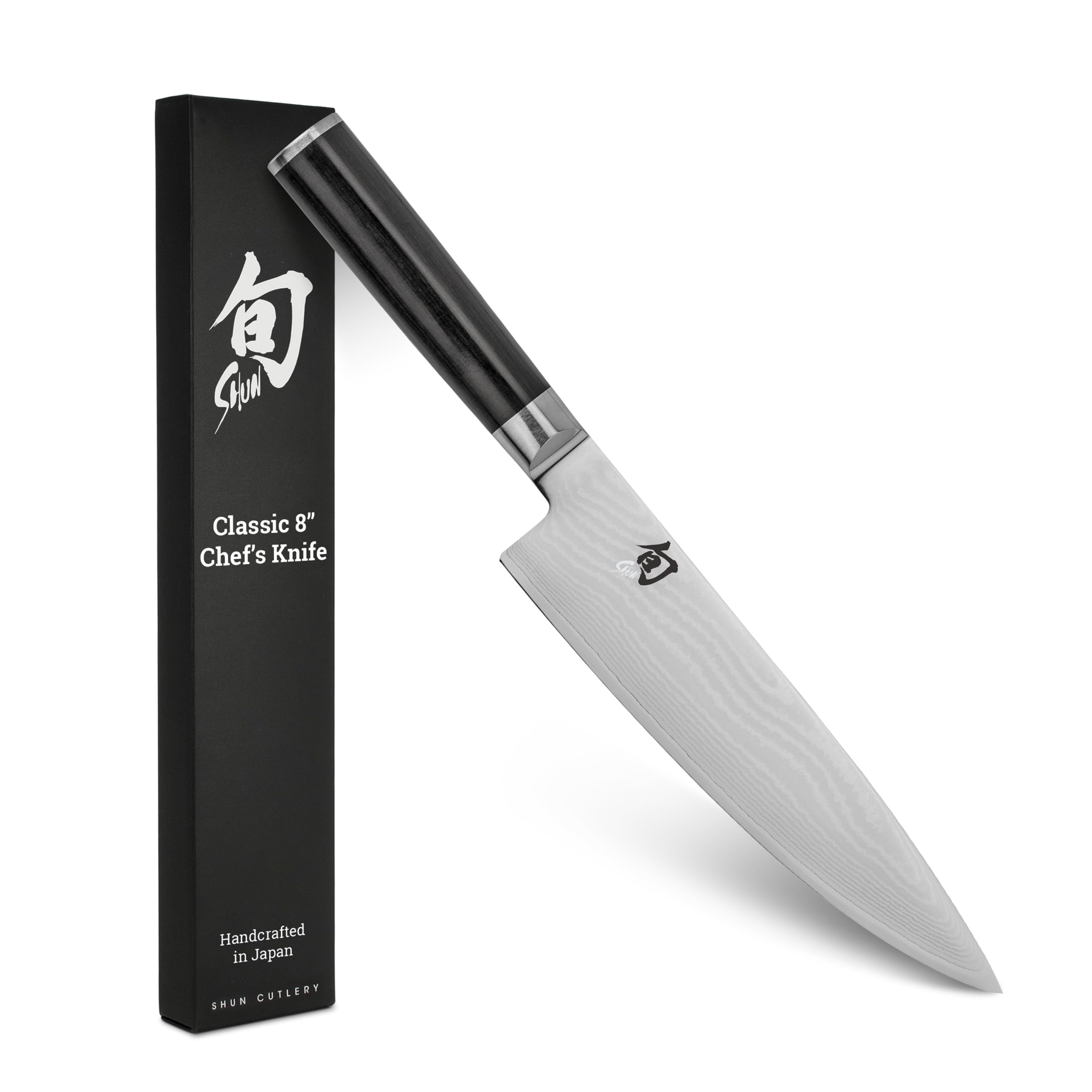
Shun Classic 8-Inch Chef’s Knife — thin double-bevel precision
Best for: precise Japanese-style prep
Shun’s Classic shows what a thin double-bevel grind can do. The VG-MAX core is clad in layered Damascus steel and ground to a narrow 16-degree double bevel, so it falls through garlic and herbs with almost no effort. Food release is decent for such a thin blade, and the D-shaped Pakkawood handle locks into a right-hand grip. The trade-off is fragility: twist the blade in a dense squash and the hard, thin edge can chip. This is a precision instrument, not a beater — treat it like one and it rewards you.
- 16-degree bevel glides through delicate prep
- VG-MAX core holds edge impressively long
- D-shaped handle suits pinch grip
- Thin hard edge can chip on squash
- Right-hand biased, awkward for lefties
4.8/5
4.9/5
4.7/5

Global G-2 8-Inch Chef’s Knife — convex grind, featherweight feel
Best for: light, fast vegetable work
Global grinds the G-2 unlike anything else here. The blade is thin with a convex profile that curves smoothly to the edge, and the one-piece Cromova 18 stainless construction keeps it light and nimble. It excels at push-cutting vegetables where the thin convex grind separates food cleanly. The dimpled steel handle divides opinion — some love the grip, others find it slippery — and the edge needs a ceramic rod or stones rather than a grooved steel. If you want a featherweight precision tool and already own a heavier workhorse, this fills the gap.
- Convex grind separates vegetables cleanly
- Featherweight and nimble in hand
- One-piece steel, easy to sanitize
- Dimpled handle feels slippery to some
- Needs stones, not a grooved steel
4.7/5
4.6/5
4.6/5

MAC MTH-80 Professional 8-Inch Chef’s Knife — the thinnest cutter here
Best for: thin-blade slicing fans
The MAC Professional is the thinnest blade in this roundup, and you feel it instantly. With a spine around 2.5 millimeters and a finely ground taper, it moves through onions and tomatoes with almost no resistance. The molybdenum vanadium steel takes a razor edge and holds it well for a thin knife. The Pakkawood western handle is slim and comfortable for medium hands. The downside of all that thinness: it is not a knife for frozen food, hard squash, or twisting — lateral force is the enemy. Keep it to slicing and dicing and it is superb.
- 2.5mm spine glides with zero wedging
- Takes a razor edge easily
- Slim handle suits medium hands
- No lateral force — twists can damage edge
- Not for frozen food or squash
4.9/5
4.8/5
4.8/5

Tojiro DP Gyuto 8.2-Inch Chef’s Knife — VG-10 without the premium
Best for: Japanese performance for less
The Tojiro DP is the working cook’s Japanese knife. A VG-10 cobalt-alloy core is ground into a thin double bevel that out-slices most Western blades — see what VG-10 steel is and why so many makers choose it for thin grinds. The western-style handle keeps it familiar if you are switching from German knives. Fit and finish is rougher than premium Japanese brands: the spine and choil can feel sharp out of the box. A few minutes with sandpaper fixes that, leaving a cutter that punches far above its class.
- VG-10 core at a working-cook price
- Thin double bevel out-slices Western blades
- Familiar western handle shape
- Spine and choil need easing
- Fit and finish rougher than premium rivals
4.7/5
4.8/5
4.7/5

Miyabi Kaizen II 8-Inch Chef’s Knife — beauty with real geometry
Best for: premium daily driver
Miyabi’s Kaizen II pairs a beautiful Damascus finish with serious geometry. The SG2 powder-steel core is ground thin in the Japanese tradition, so it tracks straight through precise cuts and holds its edge through long prep sessions. The layered Damascus cladding is not just decoration — it adds a touch of food release over a plain polished blade. The western-style handle is comfortable, though the knife runs light for those used to German heft. It demands the same care as any thin Japanese blade: no bones, no frozen food, no dishwasher.
- SG2 core ground thin, tracks straight
- Damascus cladding aids food release
- Holds edge through long prep
- Light for fans of German heft
- Needs hand washing and careful use
4.8/5
4.9/5
4.7/5

Mercer Culinary Genesis 8-Inch Chef’s Knife — the worry-free workhorse
Best for: busy family kitchens
The Genesis is the knife you hand to anyone without worrying. Mercer forges it from high-carbon German steel with a full tang and a taper grind that cuts better than its humble looks suggest. The Santoprene handle stays grippy when wet and survives commercial dishwashers, though hand washing keeps any edge longer. It will not match the thin Japanese blades for delicate slicing, and the edge needs regular steeling to stay keen. For a household blade that takes daily abuse and keeps working, the grind and build are honest value.
- Taper grind cuts above its looks
- Grippy Santoprene, dishwasher tolerant
- Forged full tang feels solid
- Needs regular steeling to stay keen
- Out-sliced by thin Japanese blades
4.6/5
4.5/5
4.8/5

Dalstrong Shogun Series 8-Inch Chef’s Knife — hollow grind, zero sticking
Best for: sticky foods like potatoes
If potato and cucumber slices cling to your blade, this grind is the fix. Dalstrong pairs a hollow grind with a Granton edge — shallow kullenschliff scallops along the blade — so air pockets break the suction that glues food to flat steel. The AUS-10V core holds a sharp edge and the G-10 handle is rugged and grippy. The hollow grind is less robust than a flat taper for heavy chopping, and the tall blade feels different if you are used to slim German profiles. For high-volume slicing of starchy vegetables, though, the food release is genuinely noticeable.
- Granton edge stops starchy food sticking
- Hollow grind slices with little drag
- Rugged G-10 handle, solid grip
- Less robust for heavy chopping
- Tall blade feels unfamiliar at first
4.6/5
4.5/5
4.4/5

Henckels Pro S 8-Inch Chef’s Knife — classic German comfort
Best for: comfortable classic handling
The Pro S is for cooks who want a classic German grind at a friendlier cost. Henckels forges the blade from high-carbon stainless with a full flat taper and a full bolster that adds reassuring heft. The curved bolster and ergonomic handle make long prep sessions comfortable, especially for larger hands. The full bolster gets in the way when sharpening the heel, and the steel is softer than Japanese blades so it needs more frequent steeling. As a comfortable, forgiving introduction to proper grind geometry, it earns its place.
- Full flat taper, forgiving for beginners
- Hefty bolster suits larger hands
- Comfortable for long prep sessions
- Bolster blocks heel sharpening
- Softer steel needs frequent steeling
4.6/5
4.6/5
4.7/5
Top 3 Head-to-Head: Wüsthof Classic vs Victorinox Fibrox Pro vs Shun Classic
These three are the finalists most buyers narrow it down to: the German all-rounder, the budget champion, and the Japanese precision pick.
| Feature | #1 Wüsthof Classic | #2 Victorinox Fibrox Pro | #3 Shun Classic |
|---|---|---|---|
| Cutting performance | 4.9/5 — Best | 4.7/5 | 4.8/5 |
| Edge retention | 4.8/5 | 4.6/5 | 4.9/5 — Best |
| Ease of use | 5.0/5 — Best | 4.9/5 | 4.7/5 |
| Choose if… | you want one knife that does everything well | great geometry matters more than prestige | you prize delicate, precise slicing |
Who These Chef Knives Are NOT For
A great chef knife grind still is not the right tool for every job.
The same goes for chopping through bone or frozen food — reach for a cleaver, not a thin flat grind. And left-handed cooks should note that most asymmetric Japanese grinds here favor right hands, so check bevel symmetry before buying.
Common Mistakes to Avoid
Most grind disappointments come from these four avoidable errors.
Frequently Asked Questions About Chef Knife Grinds
What is the best grind for a chef knife?
A thin full flat grind is the best all-round choice for a chef knife. It tapers evenly from spine to edge, giving clean cuts with little wedging across vegetables, herbs, and proteins. Convex grinds suit heavy rock-chopping, while hollow grinds excel at delicate slicing but are more fragile. For most home cooks, a thin flat grind with a narrow edge angle covers every daily task without demanding expert maintenance.
Is a hollow grind or a flat grind better for a chef knife?
A flat grind is better for most chef knife work because it balances thinness with strength. Hollow grinds are scooped thinner behind the edge, so they glide through soft food beautifully, but the thin cross-section is weaker and can wedge or flex in dense vegetables like carrots. Unless you mainly do delicate slicing, the versatility and durability of a flat grind make it the safer pick.
What angle should a chef knife edge be ground to?
Most Western chef knives perform well with an edge around 20 degrees per side, which balances sharpness and durability. Japanese-style knives often run 15 degrees per side or narrower for cleaner slicing, but they need gentler use. Remember the edge angle is only the final bevel — the grind behind it matters just as much. A narrow edge on a thick blade will still wedge and chip.
Should I choose a single-bevel or double-bevel chef knife?
Choose a double-bevel chef knife — it cuts straight for both right- and left-handed users and handles every kitchen task. Single-bevel grinds are specialty tools for Japanese cuisine, ground on one side only for ultra-clean cuts in raw fish. They steer in the cut and demand specific sharpening skills. Read our guide to single-bevel versus double-bevel knives before going the specialty route.
What is a Granton edge, and do I need one?
A Granton edge — also called kullenschliff — is a row of shallow scallops ground into the blade that creates air pockets, so wet foods like potatoes and cucumbers release instead of sticking. It helps, but it is not essential. A thin, well-finished flat grind with good technique releases food nearly as well. Consider it a bonus if you slice lots of starchy vegetables.
Does a convex grind really cut better?
A convex grind cuts very well for specific tasks. Its gently bulging cross-section is strong, resists chipping, and moves through food with little drag, which is why many custom makers favor it for rock-chopping. The catch is maintenance: the curved bevel is harder to reproduce on a flat whetstone than a simple flat grind. For most buyers, a flat grind is easier to live with.
How can I tell if a chef knife has a good grind?
Sight down the spine from handle to tip — a good grind shows an even, symmetrical taper with no thick spots or waviness. Check thinness behind the edge: it should look and feel fine, not blunt or shouldered. Hold the flat up to a light; uneven reflections reveal sloppy grinding. Finally, cut a carrot — a good grind glides through, while a poor one wedges and cracks the vegetable.
Our Final Verdict
Grind decides how a chef knife actually cuts, and a thin full flat grind remains the smartest default. The Wüsthof Classic nails that geometry with forgiving, all-round performance, while the Japanese picks reward careful cooks with finer slicing. Match the grind to your cooking, keep the edge maintained, and any of these ten will serve you well.

