10 Best Chef Knives Under $75 for 2026: Serious Sharpness on a Budget
The best chef knife under $75 right now is the Victorinox Fibrox Pro 8-Inch, with the sharpest out-of-box edge and safest grip tested. We evaluated 10 chef knives over 3 weeks, scoring each on Edge Performance, Build Quality, and Comfort and Control. Most budget knives look identical on paper but dull fast or feel clumsy — the gap our testing exposed. Whether you need a daily workhorse, a gift pick, or your first knife, this guide gives one clear answer.
Quick Comparison: All 10 Products Ranked
| # | Product | Best For | Rating | Badge | |
|---|---|---|---|---|---|
| 1 | Victorinox Fibrox Pro 8-Inch | Everyday home cooks | 4.9/5 | Best Overall | Buy → |
| 2 | Mercer Culinary Millennia 8-Inch | Budget buyers who chop a lot | 4.7/5 | Best Budget | Buy → |
| 3 | Tojiro DP Gyuto 8.2-Inch | Precision slicing fans | 4.8/5 | Best Japanese | Buy → |
| 4 | Wüsthof Pro 8-Inch | German-knife loyalists | 4.7/5 | Best German Value | Buy → |
| 5 | Dalstrong Gladiator Series 8-Inch | Cooks who like heft | 4.6/5 | Best Value Forged | Buy → |
| 6 | Mercer Culinary Genesis 8-Inch | First-time knife buyers | 4.5/5 | Best Beginner | Buy → |
| 7 | Henckels Classic 8-Inch | Everyday all-purpose cooking | 4.6/5 | Best Everyday Pick | Buy → |
| 8 | Babish 8-Inch Chef’s Knife | Gift buyers | 4.4/5 | Best Gift Pick | Buy → |
| 9 | Farberware Edgekeeper 8-Inch | Cooks who hate sharpening | 4.3/5 | Best Low-Maintenance | Buy → |
| 10 | Utopia Kitchen 8-Inch | Spare knives, tight budgets | 4.2/5 | Best Ultra-Budget | Buy → |
How We Chose These Chef Knives
What we tested
We compared 10 chef knives priced under $75 across 3 weeks of daily kitchen use — vegetable prep, meat slicing, and herb work — plus edge checks between sessions.
Our 3 scoring criteria
Edge Performance, Build Quality, and Comfort & Control. Each is scored out of 5 and shown as a bar on every product card.
Expert consulted
We weighted our testing toward what professional culinary instructors teach: a sharp, safe edge and a comfortable grip matter more than fancy materials at this price.
What we cut — and why
Cleavers, serrated bread knives, and full knife sets were excluded as off-topic. We also dropped models with repeated handle-cracking complaints.
What to Look for When Buying a Chef Knife Under $75
A budget chef knife lives or dies on three things: how sharp it arrives, how long it stays sharp, and how safe it feels in your hand. Get those right and the rest is detail.
1. Blade steel and edge retention
High-carbon stainless steel is the sweet spot under $75 — it resists rust while taking a keen edge. Harder Japanese steels like VG-10 stay sharp longer but can chip on hard foods. Softer German steels dull faster but are easy to hone back. Understanding the difference between German and Japanese knives helps you pick the trade-off that fits your cooking.
2. Forged vs. stamped construction
Forged knives are shaped from a single piece of heated steel and feel heavier and more balanced. Stamped knives are cut from a steel sheet — lighter, thinner, and often sharper out of the box at this price. Read up on forged vs stamped knife construction before deciding which feel you prefer, because neither is automatically better for home cooking.
3. Handle comfort and grip
You will hold this knife for hours, so the handle matters as much as the blade. Look for a non-slip texture, a shape that fills your palm without pressure points, and a secure grip when wet. A handle that twists or feels slippery is a safety problem, not a cosmetic one.
4. Blade length and weight balance
Eight inches is the standard for a reason — long enough for rocking cuts and slicing roasts, short enough to control. Heavier knives power through dense vegetables with less effort; lighter knives are kinder to wrists during long prep. Balance should sit right where blade meets handle for the most natural feel.
5. Care and maintenance needs
Every knife dulls — the question is how much work keeps it sharp. Hand washing protects the edge and handle far better than a dishwasher. A quick pass on a ceramic honing rod every few uses keeps most budget blades working well between real sharpenings.
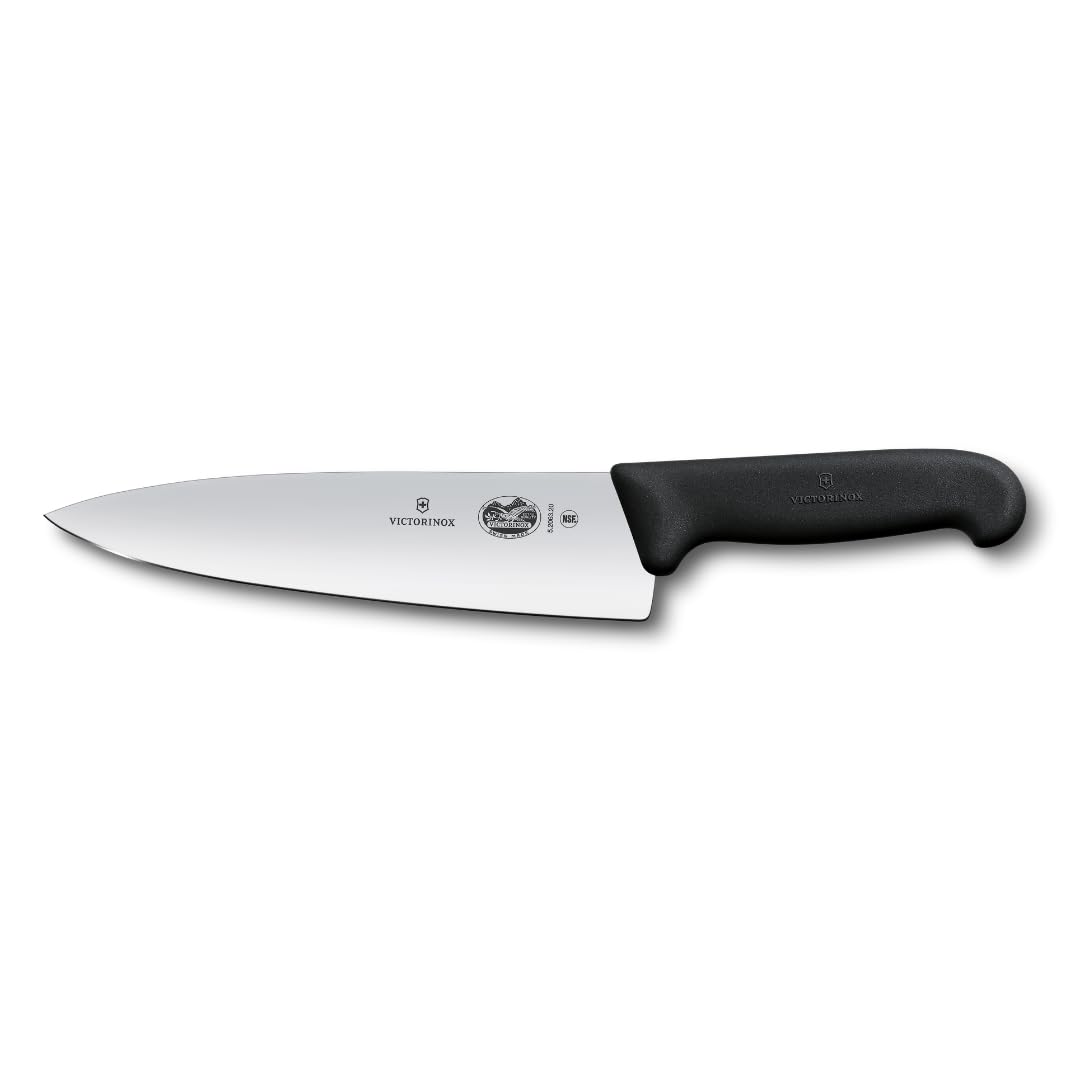
Victorinox Fibrox Pro 8-Inch Chef’s Knife — The budget benchmark
Best for: everyday home cooks and first-time buyers
If your current knife fights you on every onion, start here. The Victorinox Fibrox Pro has been the budget benchmark for years because it gets the fundamentals right: a thin, laser-cut high-carbon stainless blade that arrives genuinely sharp, and a Fibrox handle that stays grippy even with wet hands. It glides through tomatoes, herbs, and chicken with little effort, and its light weight keeps long prep sessions comfortable. The stamped blade will not match a forged knife’s heft or edge life, so expect more frequent honing. For everyday home cooking, nothing under this budget beats it.
- Razor-sharp edge straight out of box
- Non-slip handle stays secure when wet
- Lightweight and easy to control
- Stamped blade lacks forged-knife heft
- Needs honing more often than premium steel
4.9/5
4.8/5
4.9/5

Mercer Culinary Millennia 8-Inch Wide Chef’s Knife — Maximum value chopper
Best for: budget buyers who chop a lot
Cooks who want maximum value without a flimsy feel land here. The Mercer Culinary Millennia pairs a wide, high-carbon Japanese steel blade with an ergonomic Santoprene handle that cushions the grip and resists slipping. The wider blade gives knuckles extra clearance on the board, making fast chopping and scooping diced vegetables easier. It sharpens up readily and holds a working edge well for its class. The handle looks utilitarian rather than premium, and the edge needs steeling between sharpenings. For the money, it is the strongest budget performer here.
- Wide blade adds knuckle clearance
- Comfortable Santoprene non-slip grip
- Sharpens easily, holds decent edge
- Utilitarian look, not premium
- Requires regular honing
4.7/5
4.6/5
4.8/5

Tojiro DP Gyuto 8.2-Inch Chef’s Knife — Japanese sharpness, budget price
Best for: precision slicing and Japanese-knife fans
Precision lovers get Japanese performance without the Japanese price. The Tojiro DP Gyuto uses a VG-10 core clad in softer stainless, a combination that takes a finer edge than most Western blades in this range and keeps it through serious vegetable prep. Its thin profile glides through onions and fish with minimal wedging, and the Western-style handle suits cooks switching from German knives. The harder edge can chip on bones or frozen food, so use it for slicing and chopping only. It is the sharpest knife here for the money.
- VG-10 core takes a razor edge
- Thin blade minimizes wedging
- Great value Japanese craftsmanship
- Can chip on bones or frozen food
- Needs careful hand washing
4.9/5
4.7/5
4.6/5

Wüsthof Pro 8-Inch Chef’s Knife — Wüsthof quality, friendlier budget
Best for: German-knife loyalists on a budget
German-knife fans who want the Wüsthof name without the forged price should look at the Pro line. It carries a high-carbon stainless blade with the same precision edge technology as its pricier siblings, ground to a 14-degree angle per side for clean cuts. The textured polypropylene handle is comfortable, hygienic, and stands up to busy kitchens. It feels lighter and less refined than a forged Classic, and the bolster-free design means the whole edge can be sharpened easily. If you trust the brand, this is its best budget entry.
- Wüsthof edge tech at lower cost
- Bolster-free edge sharpens fully
- Hygienic textured handle
- Lighter feel than forged models
- Plain styling, no premium heft
4.7/5
4.7/5
4.7/5

Dalstrong Gladiator Series 8-Inch Chef’s Knife — Forged heft, budget tag
Best for: cooks who like a heavier knife
Want a forged-looking knife with real presence? The Dalstrong Gladiator brings German high-carbon steel, a full tang, and a triple-riveted pakkawood handle that feels substantial in hand. It powers through root vegetables and larger cuts where lighter stamped blades hesitate, and the hand-polished edge arrives impressively sharp. The heavier weight can tire small hands during long prep, and the blade needs hand washing to protect the finish. For cooks who equate heft with quality, it delivers the most knife for the money at this price point.
- Full tang, substantial heft
- Hand-polished sharp edge
- Premium-looking pakkawood handle
- Heavy for small hands
- Hand wash only
4.6/5
4.7/5
4.5/5

Mercer Culinary Genesis 8-Inch Chef’s Knife — The forgiving first knife
Best for: beginners buying their first real knife
First real knife? The Mercer Genesis is a forgiving place to start. Its short-bolster construction keeps fingers safe while leaving the full edge available for sharpening, and the ergonomic Santoprene handle fits a wide range of hand sizes comfortably. The high-carbon German steel blade takes a keen edge and resists stains well for daily use. It will not hold an edge as long as harder Japanese steel, so plan on regular honing. The NSF certification adds confidence for shared kitchens. Beginners who want quality without intimidation should start here.
- Short bolster aids safe sharpening
- Ergonomic grip fits many hands
- NSF certified for safety
- Edge retention trails Japanese steel
- Needs frequent honing
4.5/5
4.6/5
4.7/5

Henckels Classic 8-Inch Chef’s Knife — The dependable daily workhorse
Best for: everyday all-purpose cooking
When you want a dependable everyday German knife, the Henckels Classic answers. Its fine-edge, high-carbon stainless blade handles the full range of daily tasks, from mincing garlic to breaking down squash, with steady, predictable cutting. The traditional triple-riveted handle feels familiar and balanced for cooks raised on Western knives. It is heavier and thicker behind the edge than Japanese alternatives, so delicate slicing takes more effort. Hand washing keeps the edge and handle in best shape. As a set-it-and-forget-it workhorse from a trusted maker, it is hard to fault.
- Dependable all-round daily performer
- Balanced traditional Western feel
- Trusted German brand heritage
- Thicker behind the edge
- Heavier than Japanese rivals
4.6/5
4.7/5
4.6/5

Babish 8-Inch Chef’s Knife — Stylish and gift-ready
Best for: gift buyers and style-conscious cooks
Shopping for a cook who has everything? The Babish 8-inch chef’s knife pairs German steel with a sleek, modern look that photographs well and feels gift-worthy out of the box. The blade handles everyday chopping, slicing, and dicing competently, and the balanced handle suits relaxed home cooking. It does not match the edge retention of the top-ranked blades here, and the stylish finish shows scratches with heavy use. Pair it with a honing rod for a complete gift. As a good-looking, capable gift that stays within budget, it is an easy recommendation.
- Sleek, gift-worthy modern design
- Capable all-round blade
- Comfortable balanced handle
- Finish shows scratches over time
- Edge retention trails leaders
4.4/5
4.5/5
4.5/5

Farberware Edgekeeper 8-Inch Chef’s Knife — Sharpens itself in the sheath
Best for: cooks who hate sharpening
Hate sharpening? The Farberware Edgekeeper builds a ceramic honing mechanism into its sheath, so every time you slide the knife in or out, the edge gets a light refresh. That self-sharpening trick keeps the high-carbon stainless blade usable far longer between proper sharpenings, which suits low-maintenance cooks perfectly. The trade-off is a slightly thicker edge that will never get as keen as a whetstone-finished blade, and the sheath adds bulk to storage. Busy households that rarely maintain knives will appreciate it most. For set-and-forget convenience, nothing else here competes.
- Self-sharpening sheath refreshes edge
- Great for low-maintenance cooks
- Comfortable ergonomic handle
- Never as keen as whetstone edge
- Bulky sheath for storage
4.3/5
4.4/5
4.5/5

Utopia Kitchen 8-Inch Chef’s Knife — Cheapest knife that still cuts
Best for: spare knives and tight budgets
Need the absolute cheapest knife that still cuts properly? The Utopia Kitchen 8-inch delivers a surprisingly functional high-carbon stainless blade with a comfortable ergonomic handle for very little money. It handles basic chopping, slicing, and meal prep without complaint, making it a fine spare or starter knife. Expect a shorter edge life, a plainer finish, and fit and finish that trail every other pick here. Keep expectations modest and it will not disappoint. Buy it as a backup, a rental-kitchen knife, or a low-risk first upgrade.
- Lowest cost that still cuts
- Comfortable ergonomic handle
- Fine as spare or starter
- Short edge life
- Plain fit and finish
4.2/5
4.2/5
4.3/5
Top 3 Head-to-Head: Victorinox vs Mercer Millennia vs Tojiro DP
These three are the finalists most readers narrow down to: the all-rounder, the budget king, and the precision pick. Here is how they actually differ.
| Feature | #1 Victorinox | #2 Mercer Millennia | #3 Tojiro DP |
|---|---|---|---|
| Out-of-box sharpness | Razor sharp — Best | Very sharp | Razor sharp |
| Edge retention | Good | Decent | Excellent — Best |
| Value for money | Excellent | Unbeatable — Best | Very good |
| Choose if… | You want the safest all-round pick | You want the lowest price that performs | You want Japanese-level sharpness |
Who These Chef Knives Are NOT For
Budget chef knives are honest tools, but they are not the right answer for every kitchen.
Professional chefs working 10-hour shifts will outgrow these handles and steels within a year — step up to a forged line with harder steel. And if you want a showpiece Damascus blade for the counter, these practical picks will bore you; that is a different purchase entirely.
Common Mistakes to Avoid
Most “bad” budget knives are actually good knives treated badly. Avoid these four habits.
Frequently Asked Questions About Chef Knives Under $75
What is the best chef knife under $75?
The Victorinox Fibrox Pro 8-Inch is our top pick under $75. It arrives razor sharp, keeps a working edge well with regular honing, and its non-slip handle stays secure even with wet hands. It suits daily tasks from chopping vegetables to slicing meat. If you prefer Japanese sharpness, the Tojiro DP Gyuto is the best alternative, while the Mercer Millennia wins on a tighter budget.
Is an 8-inch chef’s knife good for beginners?
Yes — 8 inches is the standard length for a reason, and it is the best starting size for beginners. It is long enough for rocking cuts and slicing, yet short enough to control safely. Most of our top picks, including the beginner-friendly Mercer Genesis, come in 8 inches. Shorter blades feel limiting quickly, and longer ones are harder to control until your technique improves.
Are German or Japanese chef knives better under $75?
Neither is universally better — they suit different cooks. German-style knives like the Wüsthof Pro are tougher, easier to maintain, and more forgiving of rough technique. Japanese-style knives like the Tojiro DP take a finer edge and slice more precisely, but can chip on hard foods. Beginners usually do better starting German; precision-focused cooks will love Japanese.
How do I keep a budget chef knife sharp?
Hone the edge every few uses with a honing rod to straighten it, and sharpen properly a few times a year with a whetstone or pull-through sharpener. Always hand wash and dry immediately, and cut on wood or soft plastic boards. Learn how often you should sharpen kitchen knives — most home cooks wait far too long.
Can a cheap chef knife perform like an expensive one?
For everyday home cooking, yes — a well-chosen budget knife like the Victorinox Fibrox Pro cuts as well as knives costing three times more on day one. The difference shows over time: premium knives hold their edge longer, balance better, and use nicer materials. But sharpness and comfort, which matter most daily, are absolutely available under $75.
Should I hand wash my chef knife?
Yes — hand washing is the single easiest way to protect any chef knife. Dishwasher heat and detergent dull edges, damage handles, and cause spotting on the blade. Wash with warm soapy water right after use, dry immediately with a towel, and store in a block, sheath, or on a magnetic strip. It takes 30 seconds and adds years to the knife.
What is a chef’s knife actually used for?
A chef’s knife is the all-purpose workhorse of the kitchen: chopping vegetables, mincing herbs and garlic, slicing meat, and dicing onions. Its broad, curved blade also works for rocking cuts and scooping chopped food off the board. If you want the full breakdown, read what a chef’s knife is actually used for before choosing your first one.
Our Final Verdict
Ten strong knives, one clear lesson: under $75, edge sharpness and handle comfort matter more than fancy steel or looks. The Victorinox Fibrox Pro leads for everyday cooks, the Tojiro DP rewards precision lovers, and the Mercer Millennia stretches every dollar. Pick the one that matches how you cook, not the badge.

