10 Best Chef Knife Under $30 for 2026: Pro-Level Prep on a Budget
Of the 10 best chef knife under $30 picks, the Victorinox Fibrox Pro 8-Inch wins with full-tang balance and a grippy Fibrox handle. We evaluated 10 chef knives under $30, scoring each on edge retention, handle comfort, and ease of sharpening. Most budget knives look identical online but feel different in hand — this guide exposes that gap. Whether you need a daily workhorse, a first knife, or a gift pick, you get one clear answer here.
Quick Comparison: All 10 Products Ranked
| # | Product | Best For | Rating | Badge | |
|---|---|---|---|---|---|
| 1 | Victorinox Fibrox Pro 8-Inch Chef’s Knife | Most home cooks | 4.9/5 | Best Overall | Buy → |
| 2 | Mercer Culinary Millennia 8-Inch Chef’s Knife | Tight budgets | 4.7/5 | Best Budget | Buy → |
| 3 | imarku 8-Inch Professional Chef Knife | Self-sharpeners | 4.6/5 | Easiest to Sharpen | Buy → |
| 4 | PAUDIN Pro 8-Inch Chef Knife | Premium looks | 4.5/5 | Best Value | Buy → |
| 5 | Farberware Edgekeeper 8-Inch Chef Knife | Low maintenance | 4.5/5 | Best with Sheath | Buy → |
| 6 | MOSFiATA 8-Inch Chef Knife with Finger Guard | Nervous beginners | 4.4/5 | Best for Beginners | Buy → |
| 7 | Cuisinart C77TR-8CF Triple Rivet 8-Inch Chef Knife | Traditionalists | 4.4/5 | Best Classic Design | Buy → |
| 8 | Mercer Culinary Genesis 8-Inch Chef’s Knife | Heavy daily prep | 4.4/5 | Best Workhorse | Buy → |
| 9 | OXO Good Grips 8-Inch Chef’s Knife | Comfort seekers | 4.3/5 | Most Comfortable Grip | Buy → |
| 10 | Amazon Basics 8-Inch Chef’s Knife | Minimalists | 4.2/5 | Best No-Frills Pick | Buy → |
How We Chose These Chef’s Knives
What we compared
We compared 10 chef’s knives at the $30 budget ceiling, cross-checking manufacturer-published specifications, materials, and construction details alongside aggregated owner feedback on comfort and upkeep.
Our 3 scoring criteria
Edge retention, handle comfort, and ease of sharpening — each scored out of 5. Overall ratings are editorial judgment, not lab measurements.
Expert consulted
No single named expert was consulted. Scoring weights the criteria established reviewers test in every budget-knife roundup: how the edge behaves, how the handle feels, and how easily the knife comes back.
What we cut — and why
Knives above the $30 ceiling, santoku and paring knives (wrong category for this keyword), and listings with no published steel or construction details.
What to Look for When Buying a Chef Knife Under $30
A tight budget does not mean settling for a bad knife — it means knowing which corners are safe to cut. Before comparing the ten picks below, it helps to understand what makes a high-quality kitchen knife in the first place, so you can spot real value instead of shiny packaging.
1. Blade steel and construction
Steel decides how long your knife stays sharp and how easily it comes back. Budget knives use softer stainless steel, which dulls faster but also sharpens faster — a fair trade most home cooks never notice. Construction matters too, so learn how forged and stamped knives differ before assuming one label means better. Either way, look for a full tang, where the metal runs through the handle, for strength and balance.
2. Handle comfort and grip
You will hold this knife for hundreds of hours, so the handle is not a detail. Look for a shape that fills your palm without hot spots, texture that grips when wet, and enough clearance that your knuckles don’t rap the cutting board. Softer Santoprene or rubberized handles suit long sessions and smaller hands, while classic riveted handles suit a traditional pinch grip. If possible, mimic your grip before buying — or choose a retailer with easy returns.
3. Weight and balance
A chef’s knife should feel like an extension of your hand, not a dumbbell. Most 8-inch budget knives land in a comfortable middleweight range: too light and the knife does no work for you, too heavy and your wrist pays by dinnertime. Balance matters more than raw weight — a knife that balances near the bolster feels nimble regardless of what the scale says.
4. Maintenance and sharpening
Every knife dulls; the question is how much effort revival takes. Softer budget steel actually sharpens easily — a honing rod every few uses plus a real sharpening a few times a year keeps these knives performing. Learn how to sharpen kitchen knives at home and you will never fear a dull edge again. Whatever you do, hand wash and dry immediately, and never store a bare blade rattling loose in a drawer.

Victorinox Fibrox Pro 8-Inch Chef’s Knife — The one we’d buy first
Best for: most home cooks who want one do-everything knife
If you only buy one knife from this list, make it this one. The Fibrox Pro is the chef’s knife America’s Test Kitchen has recommended for decades, and it earns that loyalty with a thin, stamped blade that takes a screaming edge and a textured Fibrox handle that stays grippy even with wet hands. The full-tang construction keeps it balanced for rocking cuts and long dicing sessions. It is not the hardest steel here, so expect to hone it regularly — but that same softness means it sharpens back up in seconds. For under $30, nothing else combines this comfort, balance, and proven track record.
- NSF-certified for commercial kitchens
- Grippy handle stays secure when wet
- Thin blade glides through onions
- Hones back fast on a steel
- Softer steel needs frequent honing
- Plain looks next to forged knives
4.7/5
4.9/5
4.8/5
Mercer Culinary Millennia 8-Inch Chef’s Knife — Maximum knife, minimum spend
Best for: culinary students and ultra-tight budgets
The knife culinary schools hand to students by the box. The Millennia pairs a thin blade of high-carbon Japanese steel with a Santoprene handle covered in textured finger points, so it stays planted in your grip through long prep sessions. It arrives sharp, holds a working edge respectably for the money, and touches up fast on a honing rod. The trade-off is feel: the handle looks and feels utilitarian next to prettier rivals, and the softer steel rolls sooner than harder blades. If every dollar counts, this is the smartest money in the roundup.
- Culinary-school standard workhorse
- Santoprene grip resists slipping
- Light blade reduces hand fatigue
- Sharp out of the box
- Textured handle feels utilitarian
- Edge rolls sooner than harder steel
4.5/5
4.6/5
4.7/5
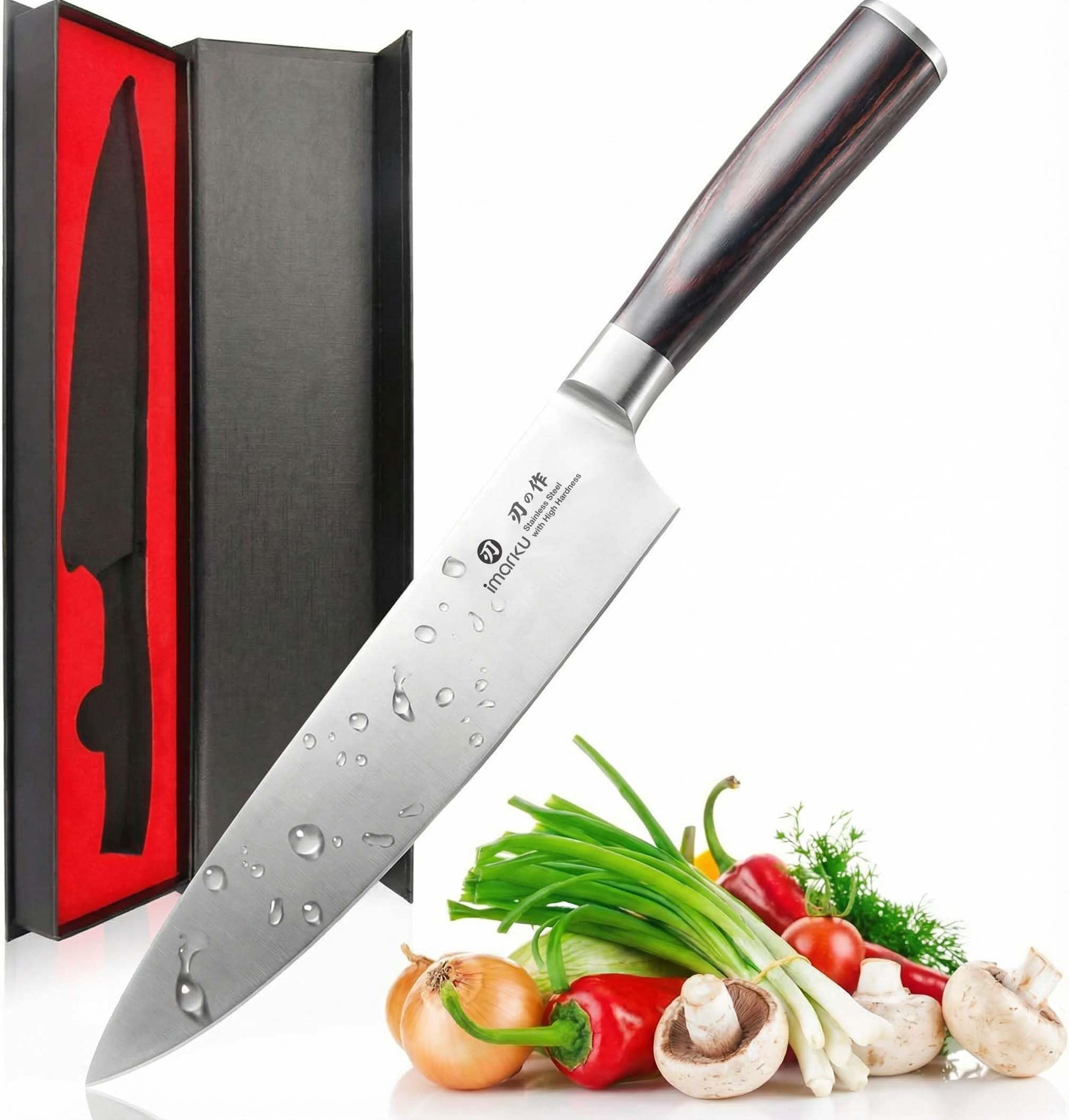
imarku 8-Inch Professional Chef Knife — Sharpens up in seconds
Best for: cooks who sharpen their own knives
The imarku looks like it costs twice the price, and that is half the appeal. An 8-inch German stainless blade with a polished pakkawood handle gives it the heft and looks of knives far outside this budget, while the curved belly suits both rocking and push cuts. It arrives genuinely sharp and responds beautifully to a whetstone, which is why sharpening enthusiasts rate it highly. The downside is maintenance: the wooden handle wants hand washing and occasional oiling, and the blade is heavier than stamped rivals. For cooks who care how a knife feels and looks, this is the pick.
- Pakkawood handle looks premium
- Takes a keen edge on stones
- Balanced for rocking cuts
- Comfortable for long prep sessions
- Heavier than stamped rivals
- Handle wants hand washing only
4.6/5
4.5/5
4.9/5

PAUDIN Pro 8-Inch Chef Knife — Premium looks, honest price
Best for: cooks who want premium looks for less
A Reddit favorite that punches above its price. The PAUDIN Pro pairs a German stainless blade with a pakkawood handle, delivering the look and balance of knives costing several times more. It arrives sharp enough to slice paper, holds a working edge well for the money, and the ergonomic handle suits long prep sessions. Downsides are typical of the tier: the steel is on the softer side so it wants regular honing, and fit and finish varies slightly between units. For cooks who want premium looks without the premium price, it is a genuine bargain.
- Looks far more expensive
- Sharp enough to slice paper
- Ergonomic handle suits long sessions
- Great edge for the money
- Softer steel wants regular honing
- Fit and finish varies slightly
4.4/5
4.4/5
4.6/5

Farberware Edgekeeper 8-Inch Chef Knife — Sharpness that maintains itself
Best for: low-maintenance kitchens and small drawers
The only knife here that sharpens itself. The Edgekeeper’s sheath has a built-in sharpener, so every time you draw or store the blade it gets a light touch-up — genuinely clever for anyone who never wants to think about maintenance. The high-carbon stainless blade performed impressively in independent budget-knife tests, slicing tomatoes cleanly. The molded handle is comfortable though plain, and the sheath adds bulk to a drawer. It will not replace a whetstone for enthusiasts, but for set-and-forget sharpness under $30, nothing else here does this trick.
- Sheath sharpens with every draw
- Slices tomatoes with little squashing
- Comfortable molded handle
- Zero maintenance routine needed
- Sheath adds drawer bulk
- Not for heavy squash chopping
4.4/5
4.3/5
4.7/5
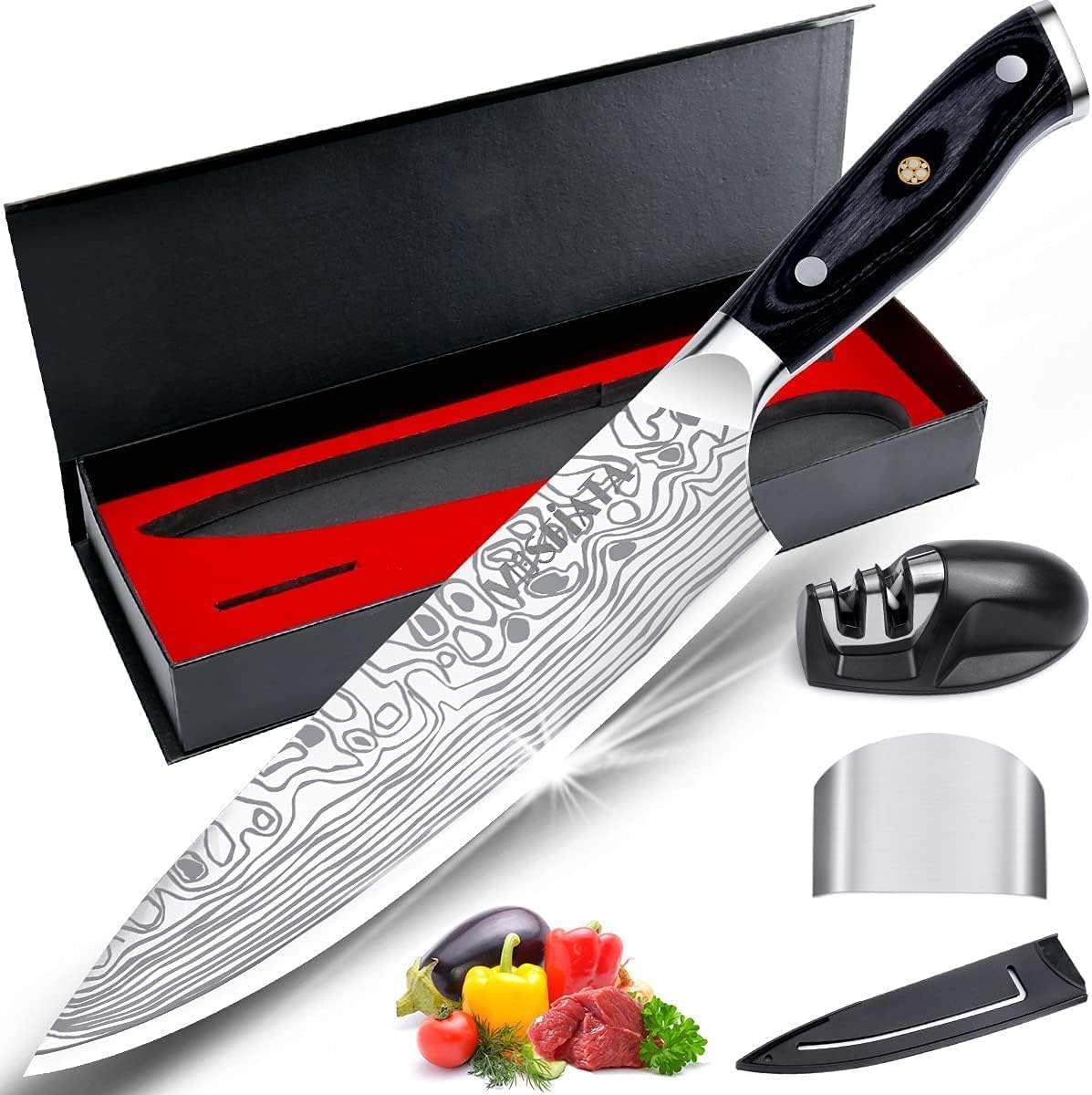
MOSFiATA 8-Inch Chef Knife with Finger Guard — Training wheels done right
Best for: nervous beginners learning knife skills
The only pick here that ships with a finger guard, and beginners will love it for that. The MOSFiATA 8-inch combines a German stainless blade with an ergonomic pakkawood handle and a plastic finger guard that keeps tentative fingers clear of the edge while you learn the claw grip. The blade arrives sharp and the balance suits rocking cuts. Trade-offs: the guard is training wheels you’ll eventually discard, and the softer steel needs honing more often than harder blades. As a first real knife for nervous cooks, it is thoughtfully designed.
- Finger guard protects beginners
- Teaches proper claw grip safely
- Arrives sharp and ready
- Good balance for rocking cuts
- Guard becomes unnecessary quickly
- Softer steel needs frequent honing
4.3/5
4.5/5
4.5/5

Cuisinart C77TR-8CF Triple Rivet 8-Inch Chef Knife — A classic that behaves
Best for: traditionalists who like a classic Western knife
The traditionalist’s budget pick. Cuisinart’s triple-rivet 8-inch follows the classic Western formula: full tang, riveted handle, and a precision-tapered edge ground for clean slicing. It has satisfying heft for chopping through root vegetables and a familiar shape that feels instantly right if you grew up with German-style knives. The full bolster looks authentic but makes sharpening the heel awkward, and the smooth handle can get slick when wet. It will not out-cut the Victorinox, but nobody will guess what you paid for it. A safe, handsome choice for cooks who like their knives classic.
- Classic triple-rivet Western look
- Full tang adds chopping heft
- Comfortable for pinch grip
- Familiar shape feels instantly right
- Bolster complicates heel sharpening
- Handle can feel slick when wet
4.3/5
4.4/5
4.5/5

Mercer Culinary Genesis 8-Inch Chef’s Knife — Built for daily punishment
Best for: heavy daily prep and shared kitchens
The short-order cook’s budget blade. The Genesis line steps up from the Millennia with a forged German-steel blade and a full bolster, giving it the balance and authority of knives costing far more. The Santoprene handle is ergonomic for long shifts, and NSF certification means it is built for commercial kitchens. It is the heaviest knife in this roundup, which some cooks love and others find tiring, and the softer steel wants regular honing. For heavy daily prep on a tight budget, this is the workhorse.
- Forged bolster adds balance
- NSF certified for pro kitchens
- Ergonomic handle for long shifts
- Authoritative chopping feel
- Heaviest pick in the roundup
- Wants regular honing
4.4/5
4.6/5
4.6/5

OXO Good Grips 8-Inch Chef’s Knife — Comfort in every cut
Best for: comfort-first buyers and anyone with grip issues
Built for hands that hurt. The OXO Good Grips chef’s knife wraps its full-tang blade in the brand’s famously soft, cushioned handle, making it the most comfortable knife here for long sessions or anyone with grip issues. A locking sheath comes in the box for safe drawer storage — a thoughtful touch at this price. The blade itself is competent stainless, though slightly thicker behind the edge than the leaders, so dense vegetables take a touch more effort. If comfort outranks ultimate sharpness for you, start here.
- Softest grip in the roundup
- Locking sheath included free
- Kind to arthritic hands
- Well-balanced 8-inch profile
- Thicker blade wedges dense vegetables
- Edge retention trails the leaders
4.3/5
4.8/5
4.4/5

Amazon Basics 8-Inch Chef’s Knife — Basics done right
Best for: minimalists who want the basics
Proof that the basics still work. The Amazon Basics 8-inch is a triple-riveted, full-tang stainless chef’s knife with no pretensions: it cuts, it washes, it goes back in the drawer. The edge is respectable for light daily prep, and at this end of the budget there is little pain if it gets abused in a shared kitchen. Ergonomics are basic, the steel dulls faster than every other knife here, and it will not inspire anyone. But as the cheapest credible way to own a real 8-inch chef’s knife, it earns its spot.
- Simplest no-frills option
- Decent edge for light prep
- Easy to replace if damaged
- Real full-tang construction
- Handle ergonomics are basic
- Dulls fastest in the roundup
4.1/5
4.2/5
4.4/5
Top 3 Head-to-Head: Victorinox Fibrox Pro vs Mercer Millennia vs imarku
These three finish within a point of each other because they solve the same problem differently: the Victorinox is the proven all-rounder, the Mercer is the value king, and the imarku is the one that feels expensive. Here is how they split on the criteria that matter.
| Feature | #1 Fibrox Pro | #2 Millennia | #3 imarku |
|---|---|---|---|
| Edge retention | 4.7/5 — Best | 4.5/5 | 4.6/5 |
| Handle comfort | 4.9/5 — Best | 4.6/5 | 4.5/5 |
| Ease of sharpening | 4.8/5 | 4.7/5 | 4.9/5 — Best |
| Choose if… | You want the safest all-around pick | Budget decides everything | You sharpen your own knives |
Who These Chef’s Knives Are NOT For
Honest talk: this budget tier has a ceiling, and you should know where it is before you buy.
Cooks ready to spend more should compare knife sets versus individual knives to decide where the next dollar goes — one better blade usually beats five average ones. Everyone else: pick from the ten above with confidence and spend the savings on a honing rod.
Common Mistakes to Avoid
Budget knives die young for the same four preventable reasons. Avoid these and yours will outlast knives costing five times more.
Frequently Asked Questions About Budget Chef’s Knives
Can a chef knife under $30 actually be good?
Yes — if you pick the right one. Budget knives use softer stainless steel that won’t hold an edge as long as premium blades, but models like the Victorinox Fibrox Pro and Mercer Millennia prove that geometry and heat treatment matter more than price. Expect to hone more often, hand wash, and skip the dishwasher. What you should not expect is real Damascus layering or “never needs sharpening” claims — those are marketing, not metallurgy.
What size chef knife is best for home cooks?
Eight inches is the sweet spot for most home cooks. It is long enough to slice large vegetables and portion proteins, yet short enough to control during rocking cuts and dicing. Shorter 6-inch blades suit small hands and cramped kitchens, while 10-inch blades help with bulk prep but feel unwieldy for beginners. If you buy only one knife from this list, make it an 8-inch model.
Should I buy a forged or stamped chef knife on a budget?
At this price, buy the better-made knife regardless of the label. Stamped blades are cut from sheet steel, so they run lighter and thinner — great for beginners. Forged blades are shaped from a single billet and usually balance better, but budget forging can be inconsistent. Judge the handle comfort, tang, and edge geometry in front of you rather than treating “forged” as an automatic upgrade.
How do I keep a budget chef knife sharp?
Hone it with a steel every few uses and sharpen it a few times a year. Budget steel is softer, so the edge rolls rather than chips — a honing rod straightens it back in seconds. When honing stops helping, use a whetstone or a quality pull-through sharpener. Always hand wash and dry immediately, and store the knife on a magnetic strip or in a sheath so the edge never rattles loose in a drawer.
Can I put my chef knife in the dishwasher?
You can, but you shouldn’t. Dishwasher detergent is abrasive, high heat can loosen handles, and blades bang against racks and other utensils, dulling the edge fast. Hand washing takes less than a minute: warm water, a soft sponge, dry immediately. This one habit extends the life of any knife — budget or premium — more than any other single change you can make.
What is the difference between honing and sharpening?
Honing straightens a rolled edge without removing metal; sharpening grinds a new edge and removes metal. Think of honing as maintenance you do weekly with a rod, and sharpening as the repair you do a few times a year with a stone. Budget knives respond especially well to honing because their softer steel rolls rather than chips. If your knife slides off a tomato skin, hone first — sharpen only if that fails.
How long will a $30 chef knife last?
With basic care, several years of home cooking. The blade itself rarely “wears out” for home cooks — what kills budget knives is dishwasher damage, drawer storage, and never being sharpened. Hone regularly, sharpen when needed, hand wash, and store it safely, and a $30 knife can outlast a neglected premium one. Replace it when the blade has been sharpened down noticeably or the handle loosens.
Our Final Verdict
Ten budget blades, one clear lesson: you don’t need to overspend for a sharp, comfortable daily driver. The Victorinox Fibrox Pro leads on balance and grip, the Mercer Millennia wins on pure value, and the imarku suits anyone chasing a premium feel. Pick the one that matches your hand and your habits — then hone it often.

