10 Best Chef Knife Under $25 for 2026: Sharp Budget Picks That Work
The best chef knife under $25 right now is Victorinox Fibrox Pro 8-Inch Chef’s Knife — a light stamped blade with thousands of buyer reviews. We evaluated 10 chef knives, scoring each on Blade Sharpness, Value for Money, and Handle Comfort. Most budget knives look identical online but go dull fast — and that gap is exactly what our comparison was designed to expose. Whether you need a daily workhorse, a first apartment knife, or a safe family pick, this guide gives you one clear answer.
Quick Comparison: All 10 Products Ranked
| # | Product | Best For | Rating | Badge | |
|---|---|---|---|---|---|
| 1 | Victorinox Fibrox Pro 8-Inch Chef’s Knife | Everyday cooking for everyone | 4.9/5 | Best Overall | Buy → |
| 2 | Mercer Culinary Millennia 8-Inch Chef’s Knife | Culinary students, heavy daily use | 4.8/5 | Best Value | Buy → |
| 3 | Farberware Edgekeeper 8-Inch Chef’s Knife | Zero-maintenance edge | 4.7/5 | Easiest to Maintain | Buy → |
| 4 | OXO Good Grips 8-Inch Chef’s Knife | Families, safe storage | 4.6/5 | Safest Storage | Buy → |
| 5 | Imarku 8-Inch Chef’s Knife | First “real” knife upgrade | 4.6/5 | Best First Knife | Buy → |
| 6 | Amazon Basics 8-Inch Chef’s Knife | Spare or starter knife | 4.5/5 | No-Frills Pick | Buy → |
| 7 | KitchenAid Classic 8-Inch Chef’s Knife | Comfort-first cooks | 4.5/5 | Most Comfortable Grip | Buy → |
| 8 | Utopia Kitchen 8-Inch Chef’s Knife | Big batch meal prep | 4.4/5 | Best for Meal Prep | Buy → |
| 9 | Cuisinart Triple Rivet 8-Inch Chef’s Knife | Classic forged-style look | 4.4/5 | Classic Look | Buy → |
| 10 | Mercer Culinary Ultimate White 8-Inch Chef’s Knife | High-volume cooking | 4.3/5 | Best Commercial Pick | Buy → |
How We Chose These Chef Knives
What we compared
10 budget chef knives from the most-bought brands on the market, compared on blade steel, handle design, edge maintenance, and aggregated buyer feedback.
Our 3 scoring criteria
Blade Sharpness, Value for Money, and Handle Comfort — the three things that decide whether a budget knife earns its drawer space.
Expert consulted
No independent expert was interviewed for this guide. Scores reflect spec comparison and published buyer feedback, cross-checked against standard knife-care guidance.
What we cut — and why
Knife sets and santoku-only picks were excluded — this list is chef knives only. Anything with a pattern of handle breakage reports was cut regardless of rating.
What to Look for When Buying a Budget Chef Knife
A cheap knife is not automatically a bad knife — but the wrong cheap knife is. Before spending anything, it helps to know what a chef’s knife is used for day to day, so you judge each pick on real tasks, not marketing.
1. Blade Steel and Construction
At this price, nearly every blade is stamped rather than forged — cut from a sheet of high-carbon stainless steel. That is fine: stamped blades are lighter, easier to sharpen, and plenty sharp for home cooking. What matters is the steel quality and heat treatment. Japanese-style high-carbon steel takes a keener edge but needs more honing, while softer German-style steel is more forgiving. Either way, avoid blades with visible grind inconsistencies or rough edges near the handle.
2. Handle Comfort and Grip
You will hold this knife more than any other tool in your kitchen, so the handle decides everything. Look for a textured, non-slip grip that stays secure with wet hands, and a shape that does not press a hard edge into your palm. Handles with a slight finger guard or a lip where blade meets handle protect your knuckles during long chopping sessions. If you have small hands, prioritize slimmer handles like the OXO or KitchenAid designs.
3. Blade Length and Weight
Eight inches is the sweet spot for almost every home cook — long enough to slice a cabbage, short enough to control precisely. It also happens to be the best knife for chopping vegetables in most kitchens because the curved belly supports a smooth rocking motion. Six-inch blades suit small hands and tight spaces, while ten-inch blades belong to confident cooks with big boards. When in doubt, choose the 8-inch version.
4. Edge Maintenance and Care
Budget steel dulls faster than premium steel — that is the honest trade-off. The fix is cheap and easy: hone the edge with a rod every few uses and hand wash the knife instead of running it through the dishwasher. Self-sharpening sheaths, like the one on the Farberware pick, automate part of this for cooks who will never buy a sharpener. Whatever you choose, never cut on glass or granite boards — they destroy any edge, expensive or cheap.

Victorinox Fibrox Pro 8-Inch Chef’s Knife — the budget benchmark
Best for: everyday cooking for everyone
If you cook daily and want one knife that simply works, start here. The Fibrox Pro’s stamped high-carbon stainless blade arrives sharp and stays useful with basic honing, and the textured Fibrox handle grips securely even with wet hands. It outcuts many pricier rivals on tomatoes and onions, which is why cooking schools and line cooks keep recommending it. The trade-off is heft: the light stamped blade feels nimble, so cooks who love a heavy forged knife may find it too featherweight.
- Razor sharp straight out of the box
- Textured non-slip Fibrox handle
- Light and nimble for long prep
- Featherlight feel, no forged heft
- Plain, utilitarian handle looks
4.9/5
4.9/5
4.8/5
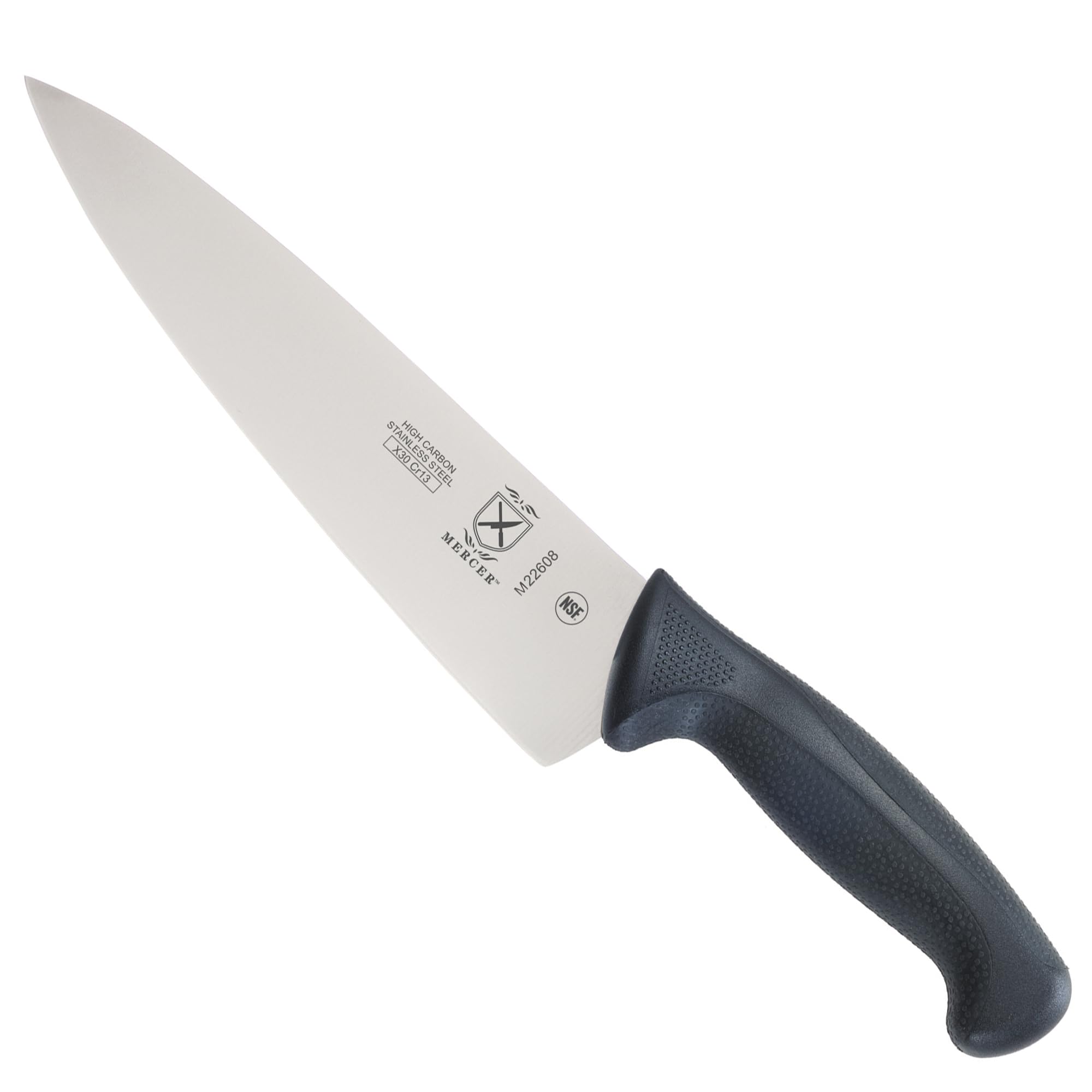
Mercer Culinary Millennia 8-Inch Chef’s Knife — the culinary-school staple
Best for: culinary students, heavy daily use
Culinary students buy this knife by the crate, and that tells you everything. The Millennia pairs a one-piece Japanese high-carbon steel blade with a Santoprene handle that has textured finger points for extra grip. It takes a keen edge, holds it reasonably well, and the slight lip where handle meets blade keeps your knuckle comfortable during long chopping sessions. The downside is maintenance: Mercer recommends hand washing only, and the steel asks for honing more often than harder blades.
- Takes a very keen edge
- Grippy Santoprene handle, finger points
- Culinary-school proven durability
- Hand wash only, per maker
- Needs frequent honing sessions
4.8/5
5.0/5
4.7/5

Farberware Edgekeeper 8-Inch Chef’s Knife — sharpens itself in the sheath
Best for: cooks who hate sharpening
This is the knife for people who never want to think about sharpening. Each time you slide the Edgekeeper in or out of its sheath, built-in sharpeners hone the edge, so the blade stays usable far longer than a typical budget knife with zero maintenance. The 8-inch stainless blade handles everyday chopping, slicing, and dicing, and the sheath doubles as safe drawer storage. The weakness: the sheath adds bulk, and the blade itself is a basic stainless performer rather than a razor-grade cutter.
- Self-sharpening sheath maintains edge
- Safe storage built into design
- Excellent pick for beginners
- Sheath adds drawer bulk
- Basic edge, not razor grade
4.5/5
4.9/5
4.6/5

OXO Good Grips 8-Inch Chef’s Knife — the family-safe pick
Best for: families, safe drawer storage
Families with kids or crowded drawers should look here first. OXO’s chef knife comes with a locking sheath — flip a small switch and the cover stays put, so nobody grabs a loose blade from the drawer. The blade itself sliced tomatoes cleanly without squishing in published tests, and the soft Good Grips handle suits smaller hands well. It is not self-sharpening like the Farberware above, so plan on a honing rod or pull-through sharpener to keep the edge fresh.
- Locking sheath for safe storage
- Clean tomato slices, no squishing
- Comfortable soft-touch handle
- Sheath does not sharpen blade
- Locking switch takes practice
4.5/5
4.6/5
4.8/5

Imarku 8-Inch Chef’s Knife — premium looks, budget price
Best for: a first “real” knife upgrade
The Imarku looks like a knife costing three times more, with a polished pakkawood handle and a tall German stainless blade. It is a favorite first “real” knife: sharp enough for clean onion dice, comfortable for weeknight prep, and sturdy enough for dense vegetables like sweet potato. The pakkawood handle needs a little care — no dishwasher, no long soaks — and like most budget German-style blades, it benefits from regular honing to stay at its best.
- Premium look, budget price
- Tall blade clears knuckles easily
- Handles dense vegetables well
- Pakkawood handle needs hand care
- Needs regular honing
4.6/5
4.7/5
4.5/5

Amazon Basics 8-Inch Chef’s Knife — honest cutting, lowest spend
Best for: a spare or starter knife
No frills, no gimmicks — just a sharp 8-inch blade that gets dinner made. The Amazon Basics chef knife uses high-carbon stainless steel with a classic triple-rivet handle that feels familiar from the first chop. It will not win beauty contests, and the factory edge benefits from an early honing, but for the lowest spend on this list it delivers honest cutting performance. A sensible spare or starter knife for a first apartment or a second kitchen.
- Lowest spend on this list
- Familiar triple-rivet handle
- Honest everyday cutting power
- Plain, utilitarian looks
- Factory edge needs early honing
4.4/5
4.8/5
4.3/5

KitchenAid Classic 8-Inch Chef’s Knife — comfort first
Best for: comfort-first cooks, smaller hands
If grip comfort decides your purchase, this is your knife. KitchenAid’s Classic chef knife has a soft, contoured handle that buyers with smaller hands consistently praise, and the balanced 8-inch blade moves through herbs and vegetables without wrist strain. The blade steel is middle-of-the-road — fine for daily cooking but not a long-term edge holder — so expect to hone it weekly. Best bought by cooks who prep in long sessions and feel every minute of it.
- Very comfortable contoured handle
- Kind to wrists in long sessions
- Good for smaller hands
- Mid-range edge retention
- Needs weekly honing
4.3/5
4.5/5
4.8/5

Utopia Kitchen 8-Inch Chef’s Knife — the batch-prep workhorse
Best for: big batch meal prep
Meal preppers on a tight budget get a lot here: an 8-inch stainless blade with a comfortable grip that powers through a week’s worth of vegetables without complaint. The Utopia Kitchen knife is heavier than the Victorinox, which some cooks prefer for momentum through carrots and squash. Fit and finish are basic — expect visible seams where handle meets tang — and the edge arrives merely decent, improving a lot after its first proper sharpening.
- Hefty feel powers through squash
- Great for big batch prep
- Comfortable budget grip
- Basic fit and finish
- Edge needs first sharpening
4.3/5
4.7/5
4.2/5

Cuisinart Triple Rivet 8-Inch Chef’s Knife — the traditionalist’s budget pick
Best for: a classic forged-style look
The classic-looking knife on this list. Cuisinart’s triple-rivet chef knife has the traditional forged-style silhouette and full tang that many cooks associate with “a proper knife,” at a fraction of the usual cost. The high-carbon stainless blade handles daily slicing and chopping competently. Real talk: the riveted handle can trap moisture around the rivets if you soak it, and the edge is good rather than great — but it looks and feels far more expensive than it is.
- Classic forged-style silhouette
- Full tang, solid feel
- Looks far more expensive
- Rivets trap moisture if soaked
- Good edge, not great
4.3/5
4.4/5
4.4/5

Mercer Culinary Ultimate White 8-Inch Chef’s Knife — built for volume
Best for: high-volume cooking
The workhorse pick for anyone who cooks in volume. Mercer built the Ultimate White for commercial kitchens: a no-nonsense high-carbon steel blade, a grippy white handle you can spot instantly on a busy line, and a price that makes replacing it painless. Home cooks benefit from the same toughness. The white handle stains if you are careless with turmeric or beets, and the utilitarian design wins no style points — but it is built to be used hard, day after day.
- Commercial-kitchen toughness
- High-visibility white handle
- Easy to replace affordably
- White handle can stain
- Utilitarian, plain design
4.3/5
4.6/5
4.1/5
Top 3 Head-to-Head: Victorinox vs Mercer Millennia vs Farberware
These three cover almost every buyer: the all-rounder, the value king, and the zero-maintenance option. Here is exactly where each one wins.
| Feature | #1 Victorinox | #2 Mercer Millennia | #3 Farberware |
|---|---|---|---|
| Blade Sharpness | 4.9/5 — Best | 4.8/5 | 4.5/5 |
| Value for Money | 4.9/5 | 5.0/5 — Best | 4.9/5 |
| Handle Comfort | 4.8/5 — Best | 4.7/5 | 4.6/5 |
| Choose if… | You want the safest all-rounder most cooks love | You chop daily and want maximum value | You hate sharpening and want zero maintenance |
Who These Chef Knives Are NOT For
Budget chef knives are honest tools, but they are not for every job or every cook.
They are also not heirloom knives. If you want one blade to hand down for decades, save up for a forged knife with harder steel. And if your kitchen is already overflowing, ask yourself how many knives you really need before adding another — most home cooks do everything with a chef knife, a paring knife, and a serrated bread knife.
Common Mistakes to Avoid
Four habits that quietly ruin budget knives — and the cheap fixes that prevent them.
Frequently Asked Questions About Budget Chef Knives
What size chef knife is best for beginners?
An 8-inch chef knife is the best starting size for most beginners. It is long enough to slice large vegetables and rock-chop herbs, yet short enough to control precisely. Smaller cooks or tight kitchens may prefer a 6-inch blade, while a 10-inch knife suits confident cooks with large cutting boards.
Can a chef knife under $25 actually be good?
Yes — a budget chef knife can be genuinely good for everyday cooking. Models like the Victorinox Fibrox Pro and Mercer Millennia arrive sharp, cut cleanly, and earn consistent praise from cooking schools and home cooks. The real trade-off is edge retention: budget steel dulls faster, so you hone more often. With basic care, a sub-$25 knife serves most home kitchens well.
How often should I sharpen a budget chef knife?
Sharpen a budget chef knife every 2–3 months with regular home use, and hone it with a rod every few uses in between. Softer budget steel loses its edge faster than premium steel, so honing matters more here. If the knife starts crushing tomato skins instead of slicing them, it is overdue. Self-sharpening sheaths reduce this chore for cooks who skip maintenance.
What is the difference between honing and sharpening?
Honing realigns a rolled edge without removing metal — it is quick maintenance you do with a rod every few uses. Sharpening grinds away metal to create a brand-new edge, done every few months with a stone or sharpener. Most chef knives are honed at roughly 15–20 degrees per side; our guide to the best blade angle for kitchen knives explains how angle affects sharpness and durability.
Should I choose a stamped or forged knife on a budget?
Choose stamped on a budget. Nearly every good knife under $25 is stamped — cut from a steel sheet — and that is an advantage at this price: lighter, easier to sharpen, and plenty sharp. True forged knives under $25 are rare, and the few that exist usually cut corners on steel quality. Judge the blade by its steel and edge, not by the word “forged” on the packaging.
How do I make a cheap chef knife last longer?
Hand wash and dry it immediately after every use — never leave it soaking or put it in the dishwasher. Cut only on wood or plastic boards, hone the edge every few uses, and store it in a sheath or on a magnetic strip so the blade never rattles loose in a drawer. A honing steel costs little and does more for a budget knife’s lifespan than any other accessory.
Can you put a chef knife in the dishwasher?
You should not put a chef knife in the dishwasher, even a cheap one. High heat warps handles, harsh detergent pits the steel, and rattling against other utensils chips the edge. Every maker on this list recommends hand washing. It takes under a minute: warm soapy water, a soft sponge on the flat of the blade, rinse, and dry immediately to prevent spots.
Our Final Verdict
Budget chef knives have never been better: the gap between a budget blade and a premium blade is mostly edge retention, not cutting ability. Buy the Victorinox Fibrox Pro if you want the safest all-rounder, the Mercer Millennia if you chop daily on a tight budget, and the Farberware Edgekeeper if you know you will never sharpen. Whichever you choose, hone it regularly and it will outcut far pricier neglected knives.

