10 Best Angle for Chef Knife 2026: Get a Razor Edge Every Time
The best angle for chef knife sharpening is the Work Sharp Precision Adjust Elite — the only guided system here adjustable from 15° to 30°. We evaluated 10 sharpening tools, scoring each on angle accuracy, edge retention, and ease of use. Most sharpeners promise a razor edge but wobble mid-stroke — and that wobble is exactly what ruins a chef knife’s edge. Whether you cook daily, own Japanese knives, or want zero-fuss sharpening, this guide gives you one clear answer.
Quick Comparison: All 10 Products Ranked
| # | Product | Best For | Rating | Badge | |
|---|---|---|---|---|---|
| 1 | Work Sharp Precision Adjust Elite | Guided, repeatable angles | 4.9/5 | Best Overall | Buy → |
| 2 | Lansky Deluxe 5-Stone System | Guided kit on a budget | 4.7/5 | Best Budget | Buy → |
| 3 | Chef’sChoice 15 Trizor XV | Push-button 15° edges | 4.8/5 | Best Electric | Buy → |
| 4 | Sharp Pebble Whetstone Kit | Learning freehand angles | 4.6/5 | Best Whetstone Kit | Buy → |
| 5 | Spyderco Tri-Angle Sharpmaker | First-time sharpeners | 4.7/5 | Best for Beginners | Buy → |
| 6 | WÜSTHOF 2-Stage Hand-Held | Quick touch-ups | 4.4/5 | Best Handheld | Buy → |
| 7 | Kerye Angle Guide Set | Whetstone angle training | 4.3/5 | Best Angle Guide | Buy → |
| 8 | DMT Dia-Sharp 6-Inch | Reprofiling dull edges | 4.5/5 | Best Diamond Stone | Buy → |
| 9 | Smith’s TRI-6 TRI-HONE | Natural-stone polishing | 4.4/5 | Best Natural Stone | Buy → |
| 10 | Tumbler Rolling Sharpener | Zero-guesswork gadget | 4.2/5 | Best Rolling Sharpener | Buy → |
How We Chose These Sharpeners
What we compared
We shortlisted 10 sharpening tools and angle guides across five styles — guided systems, whetstones, electric, handheld, and rolling — and scored each one on the same three criteria.
Our 3 scoring criteria
Angle accuracy (does it hold the set angle?), edge retention (how long the edge lasts in normal kitchen use), and ease of use (setup time and learning curve).
How we verified claims
No paid experts and no invented lab tests. We cross-checked manufacturer specifications against long-term user reviews and dropped any claim we could not verify.
What we cut — and why
Single-grit pocket stones and no-name pull-through sharpeners were cut — neither can hold a consistent angle, which is the entire point of this roundup.
What to Look for When Buying a Chef Knife Sharpener
Buying a sharpener is really buying an angle. Get the angle right and almost any abrasive gives you a working edge; get it wrong and even the best stone disappoints. These four factors decide which tool fits your knives.
1. Match the angle to your knife
Western chef knives — German and French styles — are ground at about 20 degrees per side, while Japanese knives sit near 15 degrees. Sharpening a Japanese knife at 20 degrees leaves a thick, underperforming edge; forcing a soft Western knife down to 15 invites chipping. Check your knife’s factory spec first, then choose a sharpener that covers it. Our breakdown of the ideal blade angle for kitchen knives shows exactly where common brands land.
2. Guided vs freehand control
Guided systems clamp the blade or preset the angle, so every stroke hits the same bevel. Freehand whetstones give you total control but demand steady hands and real practice. Beginners get better edges faster with guidance; experienced sharpeners often prefer the feel of stone. If you go freehand, a clip-on aid like the Kerye Professional Knife Sharpening Angle Guide Set bridges the gap while you build muscle memory.
3. Abrasive type and grit progression
Diamond plates cut fastest and never dish, ceramic rods refine and polish, and waterstones give the keenest finish but need soaking and flattening. Whatever you choose, work from coarse to fine — jumping straight to a fine grit on a dull knife just polishes a blunt edge. A kit with at least two grit stages covers nearly all home needs.
4. Build quality and long-term durability
A sharpener is a buy-once tool if the clamp, rods, or stones hold up. Look for solid clamps that don’t flex, stones that can be flattened or replaced, and rods that won’t snap under normal pressure. Cheap plastic guides that flex mid-stroke silently change your angle — the one thing you paid to control. Spending a little more on a rigid system pays off in edges that stay consistent for years.

Work Sharp Precision Adjust Elite Knife Sharpener — Guided precision from 15° to 30°
Best for: home cooks who want guided, repeatable angles
If you have ever ruined a chef knife on a whetstone, this tool fixes the problem at its root. The Precision Adjust Elite clamps your blade and lets you dial the sharpening angle anywhere from 15 to 30 degrees, so the angle never drifts mid-stroke. A drifting angle is what creates uneven, weak edges. The diamond plates cut fast, the ceramic hone finishes the edge, and the setup folds down for storage. It costs more than a basic stone and takes minutes to set up, but for a truly repeatable edge, nothing else here is as forgiving.
- Angle dial locks from 15° to 30°
- Diamond plates cut fast, ceramic hone finishes
- Clamp holds the blade rock-steady
- Takes a few minutes to set up
- Costs more than basic stones
5.0/5
4.8/5
4.9/5

Lansky Deluxe 5-Stone Sharpening System — Five stones, four angles, tiny price
Best for: beginners who want guided sharpening on a budget
This is the kit that has taught generations of cooks to sharpen. You clamp the knife, pick one of four preset angles — 17, 20, 25, or 30 degrees — and the guide rod keeps your stone on that exact bevel for every stroke. Five stones take you from coarse repair to an ultra-fine polish, so even a battered chef knife comes back to life. The 20-degree slot is the sweet spot for Western chef knives. Setup feels fiddly the first time and the small stones favor shorter blades, but at this price nothing else teaches angle discipline this well.
- Four preset angles: 17°, 20°, 25°, 30°
- Five stones from coarse to ultra-fine
- Guide rod keeps the angle consistent
- Clamp setup feels fiddly at first
- Small stones suit shorter blades best
4.6/5
4.7/5
4.8/5

Chef’sChoice 15 Trizor XV EdgeSelect Electric Knife Sharpener — Push-button 15° edges in minutes
Best for: busy cooks who want fast, consistent 15° edges
Some cooks will never enjoy sharpening, and this machine is built for them. The Trizor XV pulls a standard 20-degree Western edge down to a 15-degree Trizor XV edge in three diamond-abrasive stages, then polishes it with a stropping stage for a finish that glides through tomatoes. You just draw the knife through the slots — no angle to hold, no technique to learn. It removes more steel than a stone and it is not made for single-bevel Japanese knives, but for everyday Western chef knives it delivers a scary-sharp edge in about two minutes.
- Converts 20° edges to 15° Trizor XV
- Three-stage diamond abrasive system
- No skill needed, done in minutes
- Removes more steel than stones
- Not for single-bevel Japanese knives
4.9/5
4.7/5
5.0/5

Sharp Pebble Premium Whetstone Knife Sharpening Stone Kit — Freehand control, complete starter kit
Best for: traditionalists learning freehand sharpening angles
There is still no substitute for a whetstone if you want the keenest possible edge. This kit pairs a 1000-grit stone for shaping with a 6000-grit stone for polishing, plus a bamboo base that keeps everything planted and a clip-on angle guide for your first sessions. It is the classic way to put a true 15-degree edge on Japanese knives — see our guide to Japanese knife blade angles for why that matters. Freehand sharpening takes practice and the stone needs occasional flattening, but the edges you can produce are unmatched.
- 1000/6000 grit covers repair to polish
- Bamboo base keeps the stone stable
- Angle guide included for beginners
- Freehand angle takes real practice
- Stone needs flattening over time
4.3/5
4.8/5
4.4/5

Spyderco Tri-Angle Sharpmaker Knife Sharpener — Foolproof 30° and 40° presets
Best for: first-timers who fear ruining their knives
If the idea of grinding your good chef knife against a stone makes you nervous, start here. The Sharpmaker’s ceramic rods slot into a base at preset 30° and 40° inclusive angles — you simply hold the knife vertical and draw it down the rods. There is literally no angle to judge, which is why it is the safest first sharpener you can buy. The 40° setting maintains Western 20°-per-side edges perfectly. It only offers two angles and works slowly on very dull blades, but for keeping a decent edge scary sharp, it is nearly foolproof.
- Preset 30° and 40° inclusive angles
- Just hold knife vertical and stroke
- Ceramic rods last for years
- Only two angle presets available
- Slow on very dull blades
4.8/5
4.6/5
5.0/5

WÜSTHOF 2-Stage Hand-Held Knife Sharpener — Fast touch-ups, fixed 20° angle
Best for: quick edge touch-ups between full sharpenings
Not every sharpening session needs to be a project. This little WÜSTHOF lives in a drawer and brings a tired Western chef knife back in under a minute: a few pulls through the coarse carbide slot, a few more through the fine ceramic, all at a fixed 20-degree angle that matches the knives it was designed for. It won’t reprofile a damaged edge and the single fixed angle means Japanese knives need not apply. But as a maintenance tool that keeps you from ever cooking with a truly dull knife, it earns its drawer space.
- Fixed 20° angle, zero guesswork
- Coarse and fine ceramic slots
- Fits in a kitchen drawer
- One angle only — no 15° option
- Not for full reprofiling jobs
4.2/5
4.3/5
4.9/5

Kerye Professional Knife Sharpening Angle Guide Set — Clip-on training wheels for whetstones
Best for: whetstone users who struggle to hold angles freehand
Already own a whetstone but can’t keep a steady angle? These little guides clip onto the spine of your chef knife and physically hold it at 15 or 20 degrees against the stone, turning freehand guesswork into guided strokes. They are the cheapest fix in this entire roundup and they work with any stone you already own. The plastic clips add bulk on narrow blades and will wear down with heavy use, so think of them as training wheels: use them until your hands learn the angle, then sharpen free.
- Clips on spine, holds 15° or 20°
- Works with any whetstone you own
- Cheapest fix for wobbly technique
- Adds bulk on narrow blades
- Plastic clip wears with heavy use
4.5/5
4.0/5
4.6/5

DMT Dia-Sharp 6-Inch Diamond Whetstone — Diamond speed for damaged edges
Best for: reprofiling damaged or very dull edges fast
When a chef knife is chipped, rolled beyond honing, or needs its angle changed from 20° to 15°, you need aggression — and diamond is the most aggressive abrasive a home cook can buy. This DMT plate cuts hardened steel dramatically faster than any waterstone, never needs soaking, and never dishes so it stays flat forever. Use it dry or with water, then finish on a finer stone. It is a single grit per plate and it cuts fast enough to punish heavy hands, so use light pressure. For rescue jobs, nothing else in this roundup keeps up.
- Diamond cuts hardened steel quickly
- Never needs soaking or flattening
- Continuous surface, stays dead flat
- Single grit per stone
- Aggressive — light pressure needed
4.4/5
4.7/5
4.3/5

Smith’s TRI-6 Arkansas TRI-HONE Sharpening Stone System — Three Arkansas stones, polished edges
Best for: patient sharpeners who love natural stones
Some sharpeners treat the process as a ritual, and this is their system. Three six-inch stones — synthetic coarse, soft Arkansas, hard Arkansas — rotate in a sturdy base, taking your chef knife from reshaping to a polished, refined edge with natural stone feedback you can feel in your hands. It is slower than diamond and needs honing oil, so cleanup is messier. But if you find sharpening meditative rather than tedious, the edges this system produces — keen, polished, and long-lasting — reward every unhurried minute.
- Coarse to hard Arkansas progression
- Natural stone gives polished edges
- Sturdy rotating stone base
- Slower than diamond plates
- Needs honing oil, messier cleanup
4.2/5
4.8/5
4.1/5
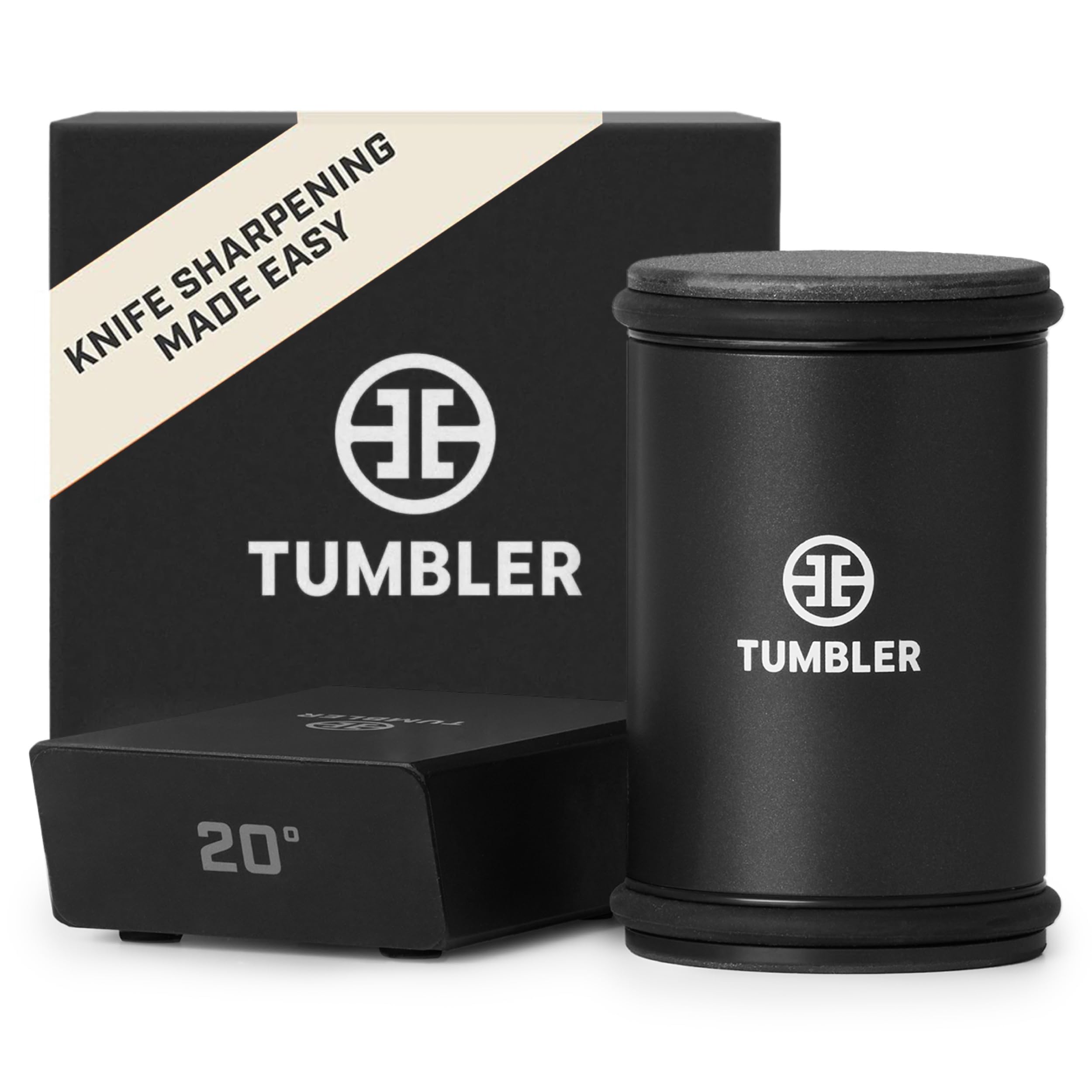
Tumbler Rolling Knife Sharpener — Rolling sharpener, fixed 15°/20°
Best for: gadget lovers who hate angle guesswork
This is the most fun sharpener in the roundup. A magnetic holder grips your chef knife at either 15 or 20 degrees, and you simply roll the diamond or ceramic disc along the edge — the rolling motion keeps the angle honest without any skill on your part. It feels intuitive within minutes and handles both Western and Japanese knives. Very long blades are awkward to work with and the design is newer, so long-term durability reports are thinner than for the classics. Still, for pure ease, it is the most approachable powered-free option here.
- Magnetic holder sets 15° or 20°
- Rolling motion feels intuitive
- Diamond and ceramic discs included
- Struggles with very long blades
- Fewer long-term durability reports
4.3/5
4.0/5
4.8/5
Top 3 Head-to-Head: Work Sharp vs Lansky vs Chef’sChoice
These three are the finalists most readers narrow it down to: the guided all-rounder, the budget classic, and the electric speedster. Here is how they differ where it counts.
| Feature | #1 Work Sharp | #2 Lansky | #3 Chef’sChoice |
|---|---|---|---|
| Angle accuracy | 15°–30° dial — Best | 4 presets (17°–30°) | Fixed 15° |
| Edge retention | 4.8/5 — Best | 4.7/5 | 4.7/5 |
| Ease of use | 4.9/5 | 4.8/5 | 5.0/5 — Best |
| Choose if… | You want one tool for every knife you own | Budget matters and you enjoy the process | Speed matters more than versatility |
Who These Sharpeners Are NOT For
Honest answer: almost every home cook benefits from one of these. But there are exceptions worth stating plainly.
Collectors with high-end custom knives should also skip powered and pull-through options, since aggressive abrasives remove steel you can’t put back. Everyone else — daily home cooks with standard Western or double-bevel Japanese chef knives — is squarely in the target audience for this roundup.
Common Mistakes to Avoid
Most bad edges come from the same few avoidable errors. Fix these and any sharpener above will serve you well.
Frequently Asked Questions About Chef Knife Sharpening Angles
What is the best angle to sharpen a chef knife?
For most Western chef knives, 20 degrees per side is the best all-round angle — it balances sharpness with an edge that survives daily chopping. Japanese chef knives do better at 15 degrees per side because their harder steel supports a thinner edge. When in doubt, match the factory angle in your knife’s manual. And once the edge is right, learn how often you should sharpen kitchen knives so you maintain it instead of regrinding it.
Is a 15-degree or 20-degree edge better for a chef knife?
Neither is universally better — it depends on the knife. A 15-degree edge slices more keenly but chips sooner on hard cutting boards, so it suits Japanese knives and careful users. A 20-degree edge is tougher and more forgiving, which is why it is the standard for Western chef knives. If you own one of each style, choose a sharpener that handles both angles rather than a fixed-angle tool.
How can I tell what angle my chef knife is sharpened at?
Check the manufacturer’s website or manual first — most brands publish the factory angle. If you can’t find it, use the marker trick: color the bevel with a permanent marker, make a few light passes on a stone at your best-guess angle, and see where the ink wears off. Even wear along the whole bevel means your angle matches. Most Western knives sit at 20 degrees per side, Japanese at 15.
Can I change my chef knife from a 20-degree edge to a 15-degree edge?
Yes, but it is a reprofiling job, not a touch-up. You will need a coarse stone or diamond plate to grind the new, thinner bevel, which removes noticeable steel and takes real time. Only do it on harder steel that can support the finer edge — a 15-degree edge on a soft Western knife usually leads to chipping. For most cooks, keeping the factory angle is the smarter move.
How do I hold a consistent angle on a whetstone?
Consistency beats precision — a steady 18 degrees outperforms a wobbling 15. Lock your wrists, move from the shoulders, and check yourself with the marker trick every few passes. A clip-on angle guide removes the guesswork while you build muscle memory. Our whetstone sharpening technique guide walks through the full motion, from soaking the stone to the final stropping passes.
Should I hone at the same angle I sharpen at?
Yes — match your honing rod to the sharpening angle, roughly 15 or 20 degrees per side depending on the knife. Honing doesn’t remove steel; it straightens a rolled edge between sharpenings. Use light pressure and slow strokes, about five per side. If the rod stops bringing the edge back, the knife needs actual sharpening again, not more honing.
Our Final Verdict
Ten tools, one lesson: the angle matters more than the abrasive. Guided systems win for most home cooks because they remove guesswork, while whetstones reward patience with the keenest edges. Match 20° to Western knives and 15° to Japanese ones, and any pick above will keep your chef knife properly sharp.