10 Best 8-Inch Boning Knives for 2026 — Flexible, Stiff, and Professional Picks
Choosing an 8-inch boning knife is less about finding one universally “best” blade than matching flexibility, steel, and grip to the cut in front of you. This evidence-based 2026 review compares ten models using manufacturer specifications and independent culinary guidance, not personal testing. You will find narrow flexible knives for fish and poultry, stiffer blades for meat, and professional handles built for wet, repetitive prep. If you want one controlled all-rounder, start with the MAC BNS-80, then use the comparison and buyer’s guide to check whether your work calls for more flex, leverage, or sanitation.
Quick Comparison: All 10 Ranked
| # | Product | Best for | Rating | Badge | |
|---|---|---|---|---|---|
| 1 | MAC Chef Series 8-inch Boning Knife, Straight (BNS-80) | Controlled straight-blade boning | 4.8/5 | Best for controlled, straight-blade boning | Buy → |
| 2 | Victorinox 8-inch Flexible Narrow Boning Knife with Fibrox Handle | Flexible poultry and fish work | 4.6/5 | Best for flexible bone-following | Buy → |
| 3 | Dexter-Russell Traditional 8-inch Wide Carbon Boning Knife | Heavy beef and pork deboning | 4.5/5 | Best for heavy-duty meat deboning | Buy → |
| 4 | Dexter-Russell BASICS 8-inch Narrow Fillet Knife (P94813 / 31609) | Smaller fish and poultry | 4.4/5 | Best for wet-prep versatility | Buy → |
| 5 | Victorinox 8-inch Semi-Flexible Blade Fillet Knife with Fibrox Handle | Fish and lamb filleting | 4.5/5 | Best for controlled semi-flex work | Buy → |
| 6 | Choice 8-inch Narrow Semi-Stiff Fillet Knife with White Handle | Budget commercial fish prep | 4.2/5 | Best value for commercial prep | Buy → |
| 7 | Smith’s EdgeSport 8-inch Boning-Fillet Knife | Field trimming and skinning | 4.0/5 | Best for field carry | Buy → |
| 8 | Bianco Brothers 8-inch Boning Knife | Everyday chicken trimming | 3.9/5 | Best for chicken and fish trimming | Buy → |
| 9 | F. Dick ErgoGrip 8-inch Bull Nose Butcher Knife | High-volume meat trimming | 4.7/5 | Best professional ergonomic handle | Buy → |
| 10 | F. Dick ErgoGrip 8-inch Breaking Knife with Black Handle | Breaking and trimming meat | 4.7/5 | Best for meat breakdown | Buy → |
How We Chose These 10 Boning Knives
What we evaluated
We evaluated exactly 10 listed models, checking blade length, profile, steel, handle, care, warranty, and intended use against manufacturer pages and retailer specifications. For context on length, see boning knife size guidance. No personal-use claim is implied.
Our 3 scoring criteria
Every model receives scores for Cutting performance and edge control; Blade flexibility and boning precision; and Handle safety, comfort, and sanitation.
Evidence standard
Concrete dimensions, steel names, hardness figures, care rules, and warranty terms are included only when the supplied research reported them. Where flex or edge life is undocumented, the verdict says so.
What we excluded
No extra products were added, and none were removed to force a category winner. The ranking reflects fit for specific meat, poultry, fish, field, and foodservice jobs.
What to Look for When Buying an 8-Inch Boning Knife
An 8-inch knife can be narrow and precise, broad and forceful, or flexible enough to trace a joint, so length alone does not decide the fit. These four factors help you avoid buying a blade that is technically capable but wrong for your cutting style, maintenance habits, or sanitation needs. Start with core boning knife techniques and review proper boning knife grip before choosing.
1. Blade profile and flexibility: narrow, stiff, semi-stiff, or flexible
Match the profile to the tissue, not the product title. Narrow blades enter close to bone; stiff blades resist twisting on beef and pork; semi-stiff designs split the difference; flexible blades follow fish and poultry contours. An 8-inch length gives reach, but it can feel oversized for tiny joints. Read the manufacturer’s flex description carefully because several listings provide no measured stiffness value.
2. Steel type, edge retention, and corrosion resistance
Steel names are useful only with care instructions and hardness context. Carbon steel can be easy to sharpen but needs immediate drying; stainless and coated 400-series blades better tolerate wet prep but may publish less edge data. A 56 HRC specification is more actionable than a vague “long-lasting” claim, while stamped knives are often easier to hone but may need more frequent touch-ups.
3. Handle grip, finger protection, and hygiene
A secure handle is a safety feature when fat, water, or gloves reduce friction. Look for a non-slip texture, a pronounced finger guard, a useful thumb rest, and a sealed or gap-free blade exit that does not trap residue. Wood can feel warm and controlled, but it needs gentler care than polypropylene, TPE, or molded plastic.
4. Care requirements, sheath/storage, and warranty
Care rules should fit your routine before you buy. Carbon blades and wood handles need prompt washing and drying; even dishwasher-listed stainless knives can keep their edge longer with hand washing and protected storage. A sheath helps field transport, while a warranty typically covers defects rather than normal wear, corrosion, or sharpening.
MAC Chef Series 8-inch Boning Knife, Straight (BNS-80) — The best controlled, straight-blade choice for deliberate deboning.
When you want a narrow blade that stays predictable around joints, a stiff profile is easier to steer than a yielding fillet knife. MAC publishes unusually concrete dimensions, including an 8.00-inch blade, 2.0 mm thickness, and 5.0 oz weight, while its retailers report 57–61 HRC hardness and a full taper. That combination puts it first for controlled straight cuts, especially for butchers, hunters, and cooks who use a reverse grip. Skip it if your work is mostly delicate fish filleting or contoured poultry because the stiff, thin blade is less forgiving there.
- 8.00-inch, 2.0 mm blade gives a precise cutting path.
- Oversized pakkawood handle supports standard or reverse butcher grip.
- 25-year US warranty and home-sharpening support add long-term serviceability.
- The stiff geometry and 2.0 mm construction are less adaptable on highly curved bones, and MAC says to avoid frozen foods, shellfish shells, and other hard items.
| Blade | 8.00 in |
| Steel | High-carbon chrome molybdenum vanadium |
| Handle | Oversized pakkawood grip |
| Care / coverage | MAC confirms a 25-year US warranty against material and workmanship defects, excluding corrosion, accidental damage, and ordinary cosmetic wear. |
9/10
8/10
8/10

Victorinox 8-inch Flexible Narrow Boning Knife with Fibrox Handle — The most capable flexible option for contour-following cuts.
If your main problem is getting a blade to follow joints without tearing meat, flexibility matters more than brute stiffness. Victorinox specifies a narrow, flexible, high-carbon stainless blade and a slip-resistant Fibrox/TPE handle, while independent culinary testing of the closely related Fibrox flexible boning knife found strong out-of-box sharpness and secure greasy-hand handling. Its 8-inch reach suits poultry, meat, and fish when you want a long tracking stroke. Choose another profile if you need very tight tip work or a rigid blade for heavy beef and pork.
- Flexible narrow blade follows bones and joints with less forcing.
- Fibrox/TPE handle remains secure in wet preparation.
- Swiss Made construction, dishwasher listing, and lifetime defect coverage simplify ownership.
- An 8-inch flexible blade can feel too yielding for tiny bones and delicate tip control, and the manufacturer does not publish a quantitative stiffness rating.
| Blade | 8 in (7.9 in listed) |
| Steel | High-carbon stainless steel |
| Handle | Black Fibrox/TPE, slip-resistant |
| Care / coverage | Victorinox lists Swiss Made construction, dishwasher safety, and a lifetime cutlery warranty for material or manufacturing defects. |
8.5/10
7.5/10
8.8/10

Dexter-Russell Traditional 8-inch Wide Carbon Boning Knife — The right pick when leverage outranks low-maintenance care.
Large cuts punish a narrow, delicate knife, so a wide profile can be the better tool when leverage and a confident entry matter most. Dexter Russell positions this 8-inch Traditional blade for robust meat deboning, and the specification includes a half tang, beech handle, brass compression rivets, and 12 3/4-inch overall length. Its high-carbon edge is individually ground and honed, which favors resharpening in a working kitchen. Do not buy it for low-maintenance storage or curved fish work: carbon steel and wood demand immediate care.
- Wide 8-inch blade supplies leverage on beef, pork, roasts, and hams.
- High-carbon edge is described as keen, long-lasting, and easy to sharpen.
- Beech handle and brass rivets provide a traditional, repairable-feeling build.
- The carbon blade must be washed and dried immediately, and the wood handle cannot tolerate dishwasher treatment or prolonged soaking.
| Blade | 8 in wide, slightly curved |
| Steel | High-carbon carbon steel |
| Handle | Beech wood with brass rivets |
| Care / coverage | Dexter describes a keen, long-lasting, easy-to-sharpen high-carbon edge and a lifetime defects guarantee. |
7.5/10
7.5/10
7/10

Dexter-Russell BASICS 8-inch Narrow Fillet Knife (P94813 / 31609) — A practical semi-stiff bridge between fillet and boning knives.
Smaller fish and mixed poultry prep need more backbone than a fully flexible fillet knife, but still benefit from a narrow edge. Dexter-Russell’s BASICS model is identified as an 8-inch narrow knife with a semi-stiff classification, high-carbon stainless/stain-free steel, and a sealed white polypropylene grip. The combination is practical for close cuts, skinning, and wet prep where sanitation matters. It is a weaker choice for highly contoured fish because semi-stiff steel cannot track curves as freely as a flexible blade.
- Narrow 8-inch profile supports clean, close-to-bone cuts.
- Semi-stiff construction balances piercing control with some contour tracking.
- Textured polypropylene, finger guard, and sealed junction suit wet food prep.
- The model is optimized for smaller-to-medium fish and is less capable than a fully flexible knife on tight curves; the retailer also lists hand-wash care.
| Blade | 8 in narrow, semi-stiff |
| Steel | High-carbon stainless/stain-free steel |
| Handle | White textured polypropylene |
| Care / coverage | The textured white polypropylene handle has a sealed grip-to-blade junction and a finger guard; hand washing is required. |
8/10
7/10
8/10

Victorinox 8-inch Semi-Flexible Blade Fillet Knife with Fibrox Handle — The best balanced semi-flex knife for controlled filleting.
A semi-flexible blade is useful when a fully flexible knife folds too readily but a rigid boner feels clumsy. Victorinox’s 5.3703.20B combines a 20 cm blade, stamped high-carbon stainless steel, a black Fibrox/TPE handle, and an 84 g listed weight. The retailer classification and user evidence describe flex around bone without a fragile feel, making it a controlled choice for fish, lamb, and veal. Its softer stamped steel is the trade-off: it is easy to hone, but heavy use can demand more frequent touch-ups.
- 20 cm blade gives a long, manageable filleting stroke.
- Semi-flex profile offers a useful balance of bend and control.
- NSF-listed handle design and 20-degree honing guidance make daily upkeep clear.
- Stamped steel is relatively softer and can need more frequent edge maintenance than a harder premium blade; hand washing remains the gentler choice despite the dishwasher listing.
| Blade | 20 cm / about 8 in |
| Steel | High-carbon stainless steel |
| Handle | Black Fibrox/TPE, NSF listed |
| Care / coverage | Victorinox recommends honing at 20 degrees and sharpening when honing no longer restores the edge; the product page lists dishwasher safety. |
8.5/10
6.5/10
8.5/10
Choice 8-inch Narrow Semi-Stiff Fillet Knife with White Handle — The sensible value choice for busy wet-prep stations.
Commercial kitchens often need a knife that can take wet, repetitive prep without turning every sharpening decision into a project. Choice’s 220KWFLTNRW8 uses an 8-inch narrow semi-stiff stamped blade in high-carbon 420 stainless steel, with a hand-honed edge and white polypropylene handle. The finger guard and non-slip profile make it a sensible value pick for fish, beef, and pork deboning. It gives up contour-following and documented long-term edge data, so professionals seeking measured hardness should move up the list.
- Narrow semi-stiff profile supports piercing and close deboning.
- 420 stainless construction resists routine wet-prep corrosion better than plain carbon steel.
- Lightweight polypropylene handle and finger guard suit repeated service use.
- The listing does not provide hardness, edge angle, warranty, or independent edge-retention testing, so longevity is less predictable than the specification-rich picks.
| Blade | 8 in narrow, semi-stiff |
| Steel | High-carbon 420 stainless steel |
| Handle | White polypropylene, finger guard |
| Care / coverage | The listing allows commercial-dishwasher cleaning but provides no hardness, sharpening angle, origin, or warranty claim. |
7.5/10
6.5/10
8/10
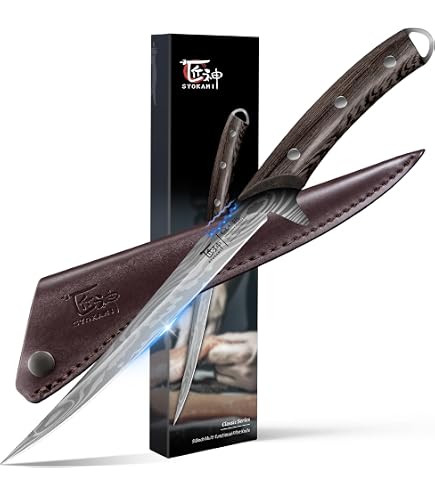
Smith’s EdgeSport 8-inch Boning-Fillet Knife — A practical sheath-equipped field knife, not a data-rich kitchen specialist.
Field users need a knife that can be carried safely between cuts, not just a blade that looks capable on a prep table. Smith’s EdgeSport pairs an 8-inch fixed curved profile with coated 400-series stainless steel, a soft-grip TPE handle, lanyard hole, and included breathable sheath. Those features support trimming, skinning, butterflying, and fish work when storage and transport are part of the job. Choose it only if you accept the information gap: Smith’s does not publish hardness, edge angle, or measured flexibility.
- Fixed curved 8-inch blade covers boning, trimming, skinning, and filleting tasks.
- TPE grip and lanyard hole are useful when hands or terrain are unstable.
- Breathable sheath improves transport and blade protection.
- The steel is identified only as a 400-series family, and flex behavior, sharpening guidance, country of origin, and detailed edge data are not published.
| Blade | 8 in fixed curved |
| Steel | Coated 400-series stainless steel |
| Handle | Soft-grip TPE with lanyard hole |
| Care / coverage | A breathable protective sheath is included; the consulted retailer lists a 1-year limited warranty. |
7/10
5.5/10
8/10

Bianco Brothers 8-inch Boning Knife — A basic generalist when simple trimming is the goal.
For routine chicken and fish trimming, the priority may be a straightforward 8-inch tool rather than a specialized profile. Bianco Brothers identifies BB1510-8 as an 8-inch stainless boning knife for chicken, fish, poultry, and red meat, with an ergonomic grip and hand-wash care. That makes it a reasonable basic option when the task list is broad and the buyer is comfortable maintaining a knife without published technical detail. It ranks below the more documented models because the missing steel and flexibility data affect both control and service-life decisions.
- 8-inch length covers common chicken and fish trimming tasks.
- Stainless construction is described as rust-resistant for ordinary kitchen use.
- Hand-wash guidance is simple and directly tied to preserving sharpness.
- The manufacturer does not state the steel grade, handle material, flex profile, warranty, origin, or cover, so buyers cannot verify several key fit and storage factors.
| Blade | 8 in |
| Steel | Stainless steel; grade not published |
| Handle | Ergonomic grip; material not published |
| Care / coverage | No blade-flex rating, steel grade, sharpening angle, warranty, origin, or protective cover is specified on the product page. |
7/10
5.5/10
7/10

F. Dick ErgoGrip 8-inch Bull Nose Butcher Knife — The ergonomic professional pick for repetitive meat trimming.
High-volume meat work exposes handle flaws quickly, so grip hygiene and fatigue control can matter as much as the edge. F. Dick documents a 21 cm blade, X55CrMo14 stainless steel, 50/50 bevel, and 56 HRC hardness, while its ErgoGrip design adds a thumb rest, finger guard, rounded spine, and gap-free exit. That evidence earns it the strongest ergonomics score in this group and makes it a compelling professional trimming knife. Skip it for delicate bone-following because the bull-nose butcher profile is robust and its exact flex rating is not published.
- 56 HRC and polished edge geometry provide a concrete performance baseline.
- Gap-free, grease-resistant handle design supports sanitation in repeated service.
- Thumb rest, finger guard, and rounded spine reduce hand-position compromises.
- The broad bull-nose profile is less precise on tight contours than a narrow boning blade, and no model-specific flexibility or warranty term was located.
| Blade | 21 cm / 8 in bull nose |
| Steel | X55CrMo14 stainless, 56 HRC |
| Handle | NSF plastic, thumb rest, guard |
| Care / coverage | The handle is described as non-slip, grease-resistant, heat- and shock-resistant, with NSF certification reported for the series. |
8/10
8/10
9/10
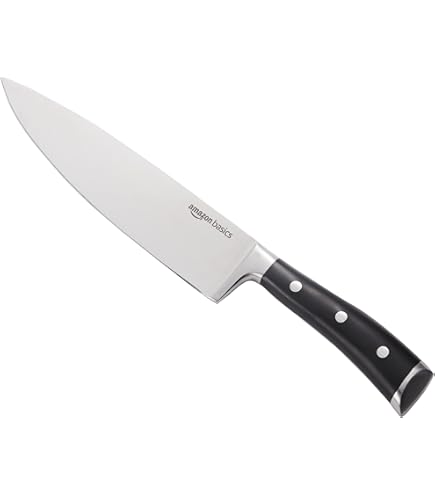
F. Dick ErgoGrip 8-inch Breaking Knife with Black Handle — The strongest breaking-knife choice for meat-processing routines.
Breaking down meat calls for a curved, pointed path and a handle that will not become slippery or contaminated during long shifts. The ErgoGrip 8242521-01 combines a stamped X55CrMo14 blade, the series’ documented 56 HRC hardness, and a molded black handle with thumb rest, guard, rounded spine, and no-gap exit. Its edge and handle package makes it one of the strongest professional options here for robust trimming. It is not the best choice for fish or tight bone contours because the model-specific flex rating is absent and the profile is built for breaking work.
- 56 HRC series specification supports a harder, stable edge than softer stamped options.
- ErgoGrip geometry addresses wet grip, finger protection, and cleanability.
- Manufacturer guidance recommends frequent light honing at a 15–20 degree angle.
- Retailer listings disagree on 8-inch versus 8 1/2-inch blade length, and no model-specific stiffness rating or warranty term was located.
| Blade | 8 in name; 8.5 in retailer spec |
| Steel | X55CrMo14 stainless, 56 HRC |
| Handle | Black molded ErgoGrip plastic |
| Care / coverage | The handle has a thumb rest, finger guard, rounded spine, no-gap exit, and NSF-linked hygiene characteristics. |
8/10
8.5/10
9/10
Top 3 Head-to-Head: MAC BNS-80 vs Victorinox Flexible vs Dexter Wide Carbon
These are the common final choices because they represent three distinct solutions: controlled stiffness, flexible bone-following, and wide-blade leverage. The winner changes with the cut, not with the length printed on the package.
| Feature | #1 MAC BNS-80 | #2 Victorinox flexible | #3 Dexter wide carbon |
|---|---|---|---|
| Cutting performance and edge control | 9/10 — Best | 8.5/10 | 7.5/10 |
| Blade flexibility and boning precision | 8/10 | 7.5/10 — Best for flex | 7.5/10 |
| Handle safety, comfort, and sanitation | 8/10 — Best for control | 8.8/10 | 7/10 |
| Choose if… | You want a narrow, stiff edge | You follow curved bones | You need leverage on large cuts |
Who These 10 Boning Knives Are NOT For
Not every kitchen needs an 8-inch boning knife, especially when the work is smaller, more delicate, or more specialized.
They are also poor substitutes for a dedicated chef’s knife, heavy cleaver, or fish-scaling tool. Do not use them on frozen food, shells, or hard surfaces; that can damage an edge and create a handling hazard. For the workflow itself, see debone meat step by step.
Common Mistakes to Avoid
These are the category-specific mistakes that quietly shorten edge life, reduce control, or make a safe knife harder to use.
Frequently Asked Questions About 8-Inch Boning Knives
What is the best flexibility for an 8-inch boning knife?
Choose stiff for dense beef and pork, semi-stiff for mixed trimming, and flexible for fish or poultry contours. There is no universal best flex; the right choice follows the protein and cut shape.
Is an 8-inch boning knife too long for home cooks?
No, but it gives more reach than a short boning knife and can feel less precise around tiny joints. It is a useful home size when you routinely debone poultry, fish, roasts, or larger cuts.
Are carbon-steel boning knives worth the maintenance?
They can be worth it when you value easy sharpening and a keen edge, but only if you will wash and dry the blade immediately. Carbon steel is a poor fit for anyone who leaves tools wet or relies on a dishwasher.
Can these knives go in the dishwasher?
Some Victorinox and Choice listings allow dishwasher cleaning, but hand washing and immediate drying are gentler on edges and handles. Wood-handled carbon knives should be hand-washed and never soaked.
How should an 8-inch boning knife be stored?
Use a sheath, blade guard, or dedicated rack that keeps the edge from contacting other tools. A protected storage method also reduces accidental cuts when reaching into a drawer or transport bag.
What should I do if the product listing does not state flexibility?
Treat flexibility as undocumented rather than guessing from the name. Use the stated blade profile, intended application, and retailer construction details, and choose a model with published flex language when that factor is decisive.
Our Final Verdict
The best 8-inch boning knife depends on the tension between control, bone-following flexibility, and maintenance. Narrow stiff blades favor precise straight cuts, flexible blades favor fish and poultry contours, and wide professional profiles favor leverage and repeated meat work.
If you want the safest all-round recommendation, pick #1 MAC because its dimensions, stiffness, grip, and warranty are unusually well documented. If your work is mostly fish or poultry, pick #2 Victorinox flexible; if you break down large beef or pork cuts, pick #3 Dexter and accept the carbon-steel care.