Which Cutting Boards Are Pure Titanium? A Complete 2026 Guide
Quick Answer
Which cutting boards are pure titanium? Forneau, Surface22, PureTi, and Taima sell cutting boards advertised as solid, commercially pure Grade 1 titanium. These are more credible candidates than generic boards labeled “titanium steel” or “titanium-coated.” However, a manufacturer’s claim isn’t independent proof. For reliable verification, look for a material test report identifying the titanium grade, composition, and manufacturing batch. The ASTM B265 titanium standard provides a useful reference for distinguishing commercially pure titanium from titanium alloys.
What to Look For
- Grade 1 titanium: A commercially pure grade commonly advertised for solid titanium cutting boards.
- Grade 2 titanium: Another commercially pure grade, generally stronger and harder than Grade 1.
- Solid construction: The cutting surface should be titanium throughout, not merely coated metal.
- Material documentation: Look for a chemical analysis, recognized grade, and traceable batch information.
- Realistic claims: Pure titanium resists corrosion, but it does not automatically sterilize food or protect knife edges.
Titanium cutting boards have become a noticeable trend in kitchen equipment, but their labels can be confusing. Some products contain solid titanium, while others use steel or a titanium-containing coating.
I’ll explain which brands advertise commercially pure titanium, how to check those claims, and whether a metal cutting surface makes sense for everyday cooking.
In This Guide
- What Is a Pure Titanium Cutting Board?
- Which Brands Sell Pure Titanium Cutting Boards?
- How Can You Identify a Real Titanium Cutting Board?
- How Does Pure Titanium Compare With Other Cutting Boards?
- Do Pure Titanium Cutting Boards Damage Knives?
- How Should You Choose and Maintain a Titanium Board?
- Frequently Asked Questions
What Is a Pure Titanium Cutting Board?
A pure titanium cutting board has a cutting surface made from commercially pure titanium rather than a titanium coating over another material. The term refers to a recognized metal grade, not a scientifically perfect 100% titanium composition.
Commercially pure titanium contains small amounts of elements such as oxygen, iron, nitrogen, and carbon. These controlled impurities influence its strength and other physical properties.
What Does Grade 1 Titanium Mean?
Grade 1 is an unalloyed titanium classification recognized under ASTM B265. It offers excellent corrosion resistance and is generally softer and more formable than other commercially pure titanium grades.
This combination makes Grade 1 attractive to manufacturers producing flat titanium sheets. Nevertheless, its softness relative to other metals doesn’t make it equivalent to a wooden cutting surface.
Is Grade 2 Titanium Also Pure?
Yes. Grade 2 is another unalloyed, commercially pure titanium grade with slightly different permitted impurity levels.
It generally offers greater mechanical strength than Grade 1. Both grades can be marketed as commercially pure titanium, provided their composition meets the relevant specification.
What About Grade 5 Titanium?
Grade 5 is a titanium alloy containing approximately 6% aluminum and 4% vanadium. It isn’t commercially pure titanium.
Although Grade 5 has valuable engineering applications, its additional hardness offers no clear advantage for protecting kitchen knife edges.
| Material | Classification | Pure Titanium? |
|---|---|---|
| Grade 1 titanium | Unalloyed titanium | Yes, commercially pure |
| Grade 2 titanium | Unalloyed titanium | Yes, commercially pure |
| Grade 5 titanium | Titanium alloy | No |
| Titanium-coated steel | Coated base metal | No |
Section takeaway: Grade 1 and Grade 2 can both qualify as commercially pure titanium. The key distinction is the actual metal composition, not a marketing label.
Which Brands Sell Pure Titanium Cutting Boards?
Several manufacturers advertise solid Grade 1 titanium cutting boards in 2026. Four identifiable options are Forneau, Surface22, PureTi, and Taima.
These examples are based on publicly available manufacturer specifications and documentation. I haven’t independently tested the boards or authenticated every laboratory report.
1. Forneau Pure Titanium Cutting Board
Forneau markets its cutting board as a solid Grade 1 titanium product. The company states that its material undergoes laboratory composition testing.
Its product description emphasizes an uncoated, nonporous surface. Forneau also provides a link to material documentation that buyers can review.
- Advertised material: Grade 1 titanium.
- Construction: Solid, uncoated titanium cutting surface.
- Documentation: Manufacturer-linked material certificate.
- Verification needed: Confirm that the certificate matches the board being purchased.
Forneau is worth examining when documented material composition matters more than finding the lowest-priced board.
Manufacturer website: Forneau titanium cutting board.
2. Surface22 Grade 1 Titanium Cutting Board
Surface22 advertises cutting boards made from commercially pure Grade 1 titanium. Its website provides material information, product dimensions, and details about traceability.
The company reports approximately 99.87% titanium in a displayed material analysis. Its current design also includes silicone grips, so not every component is titanium.
- Advertised material: Grade 1 commercially pure titanium.
- Cutting surface: Uncoated titanium.
- Added components: Silicone grips.
- Documentation: Material analysis and product traceability claims.
This is an example of a titanium cutting surface combined with non-titanium accessories. Such additions don’t automatically invalidate the metal’s purity.
Manufacturer website: Surface22 titanium cutting boards.
3. PureTi Titanium Cutting Board Set
PureTi advertises a three-piece cutting board set manufactured from Grade 1 titanium. Its website publishes chemical composition results and references independent laboratory testing.
The documentation includes a reported SGS chemical analysis and material traceability information. Those records offer more useful evidence than an unsupported product description.
- Advertised material: Commercially pure Grade 1 titanium.
- Reported thickness: 2 mm.
- Surface: No applied polymer coating, according to the supplier.
- Documentation: Published test results and report identifiers.
Buyers should verify report authenticity and confirm that the tested batch matches the product supplied.
Manufacturer documentation: PureTi laboratory results.
4. Taima Pure Titanium Cutting Board
Taima markets its board as Grade 1 titanium with a stated purity of 99.89%. Its website also advertises SGS testing and food-contact compliance.
These are manufacturer claims that should be checked against the complete underlying reports. Marketing statements alone cannot establish that every unit has the same composition.
- Advertised material: Grade 1 titanium.
- Claimed composition: 99.89% titanium.
- Construction: Advertised as solid titanium.
- Documentation to request: Complete material and food-contact test reports.
Taima is another candidate for comparison, but its claims about antibacterial performance deserve separate scrutiny.
Manufacturer website: Taima pure titanium cutting board.
Comparison of the Four Brands
| Brand | Advertised Grade | Material Evidence |
|---|---|---|
| Forneau | Grade 1 | Material certificate offered |
| Surface22 | Grade 1 | Material analysis and traceability claims |
| PureTi | Grade 1 | Published laboratory report details |
| Taima | Grade 1 | Purity and testing claims |
Section takeaway: All four brands advertise commercially pure Grade 1 titanium. Their documented claims make them candidates for further verification, not independently confirmed winners.
How Can You Identify a Real Titanium Cutting Board?
 Save
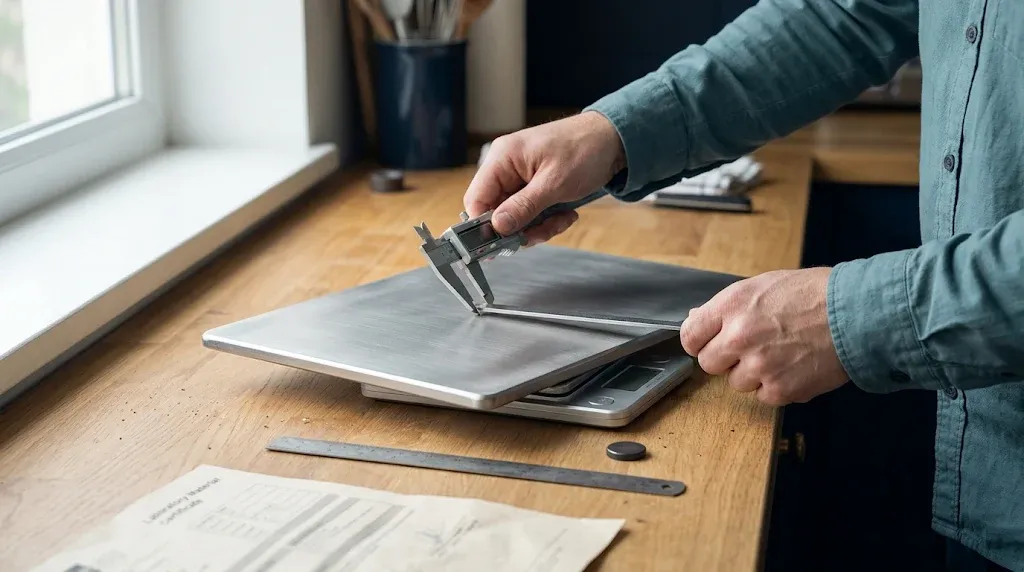
The most dependable way to identify a real titanium cutting board is to obtain a trustworthy material composition report. Weight, appearance, and magnetism can provide clues, but none independently proves purity.
Check the Material Grade
Look for a specific designation such as Grade 1, Grade 2, or UNS R50250. A seller should explain whether the entire cutting surface meets that classification.
Be cautious when the description only says “titanium technology” or “titanium steel.” Neither phrase establishes a commercially pure titanium composition.
Check the Weight Against the Dimensions
Titanium has a density of approximately 4.51 grams per cubic centimeter. Common 304 stainless steel has a density near 7.9 grams per cubic centimeter.
That difference provides a useful preliminary screening method when the board’s dimensions and thickness are known.
Consider a simple rectangular board measuring 30 × 20 cm with a 2 mm thickness.
- Volume: 30 × 20 × 0.2 = 120 cubic centimeters.
- Expected titanium weight: Approximately 541 grams.
- Expected stainless steel weight: Approximately 948 grams.
- Important limitation: Handles, rubber feet, unusual shapes, and inaccurate thickness measurements change the result.
A much heavier board may warrant closer investigation. However, a matching weight does not prove the material is titanium.
These estimates use basic material density values, not measurements of a specific retail product.
Does the Magnet Test Work?
Not reliably. Titanium is generally nonmagnetic, but some stainless steels also show little magnetic attraction.
Cold-working can also change the magnetic response of certain stainless steels. Consequently, a weak or absent magnetic response cannot authenticate a titanium board.
Request Proper Documentation
For a stronger assessment, ask the seller for:
- A material test report or mill certificate.
- The titanium grade and chemical composition.
- The manufacturing batch or heat number.
- Any relevant food-contact test documentation.
- Confirmation that the cutting surface has no coating or steel core.
The strongest paperwork connects the test results to the specific production batch. A generic certificate for unrelated titanium stock offers much less assurance.
Section takeaway: Use density and visual inspection as screening tools, then rely on traceable material analysis for meaningful confirmation.
How Does Pure Titanium Compare With Other Cutting Boards?
Pure titanium offers corrosion resistance, low moisture absorption, and straightforward surface cleaning. Yet these benefits must be balanced against knife wear, cutting feel, and price.
Wood and food-grade plastic remain practical choices for many kitchens. A premium material does not automatically create the best cutting surface.
| Material | Main Advantage | Main Drawback |
|---|---|---|
| Pure titanium | Corrosion-resistant, nonporous metal | Hard contact surface for knives |
| Hardwood | More forgiving cutting feel | Requires proper drying and maintenance |
| Food-grade plastic | Affordable and often dishwasher-safe | Can develop knife grooves |
| Bamboo | Lightweight, renewable material | Firm surface; moisture care needed |
| Glass | Easy-to-clean nonporous surface | Extremely unforgiving to knife edges |
Is Titanium More Hygienic Than Wood?
A smooth titanium surface doesn’t absorb water like an unfinished wooden surface. This can make routine washing convenient.
However, nonporous does not mean sterile. Raw poultry juices and other contaminants can remain on metal until removed through proper cleaning.
The USDA’s cross-contamination guidance recommends washing boards between food-preparation tasks and separating raw meat from fresh produce when possible.
Does Titanium Prevent Bacterial Growth?
Titanium’s corrosion resistance and nonporous surface are useful material properties. They don’t establish that an ordinary titanium board kills bacteria on contact.
Claims involving antimicrobial activity need product-specific testing under relevant conditions. I would not treat “self-sterilizing” advertising as a replacement for washing and sanitizing.
Is Pure Titanium Safer Than Plastic?
A solid uncoated titanium board has no plastic cutting layer to shed plastic fragments. That may appeal to shoppers who want a plastic-free cutting surface.
Still, overall food safety depends on the complete product, its manufacture, and how it is cleaned. Plastic cutting boards can also be used safely when properly maintained.
The FDA’s food-contact materials guidance explains how materials used in food preparation fall within its regulatory framework.
A seller’s statement that a board is “FDA compliant” should be supported by applicable documentation. It shouldn’t be interpreted automatically as FDA approval of that individual finished product.
Do Pure Titanium Cutting Boards Damage Knives?
 Save
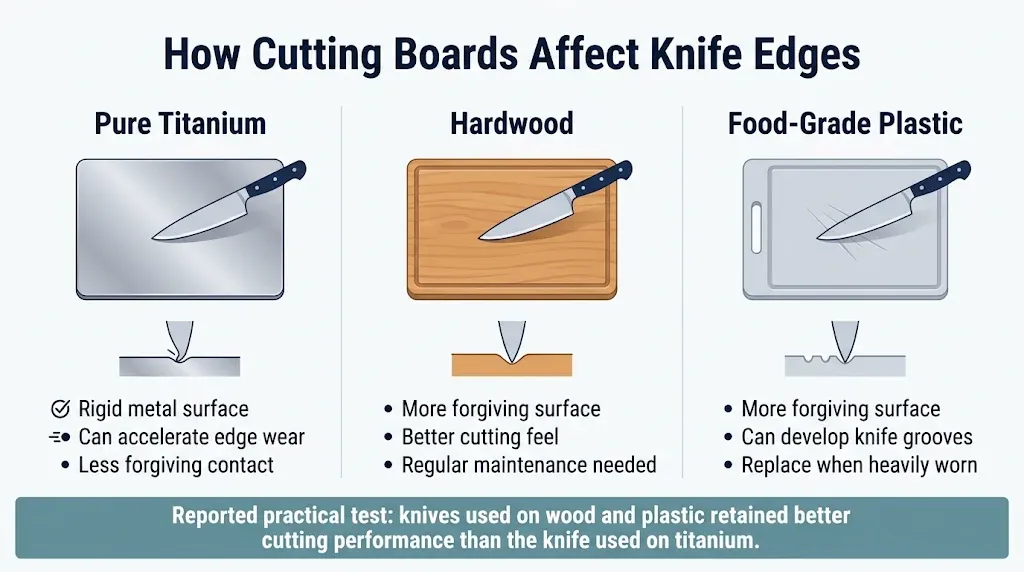
Yes, titanium cutting boards can accelerate knife-edge wear compared with suitable wooden or plastic boards. The main concern is repeated contact between the blade’s thin edge and a relatively unforgiving metal surface.
Grade 1 titanium may be softer than some hardened knife steels, but that doesn’t guarantee gentle cutting performance.
What Does Independent Testing Show?
In February 2026, Galaxus published a practical comparison using knives on titanium, wood, and plastic surfaces. Its tester reported substantially worse cutting performance after using the titanium board.
The knives used on wood and plastic performed better in that particular test. You can review the Galaxus titanium cutting board test for its methodology and limitations.
The results do not quantify the performance of every titanium grade or knife alloy. They do challenge broad claims that metal boards are automatically knife-friendly.
Why Does Cutting Surface Hardness Matter?
A knife edge is exceptionally thin. During chopping, the edge repeatedly strikes the cutting surface and experiences localized pressure.
A slightly yielding material can reduce some of that contact stress. Rigid surfaces provide less cushioning and may accelerate edge damage during repeated use.
Which Knives Should You Avoid Using?
I would be especially cautious with knives that have delicate, thin cutting edges or are expensive to sharpen or repair.
- Thin Japanese-style knives: Their fine edges may be vulnerable to rough board contact.
- High-end chef’s knives: A wood or suitable plastic board can better preserve the investment.
- Ceramic knives: Their brittle edges are poorly suited to hard-surface impacts.
- Everyday stainless knives: They can still experience accelerated dulling on metal.
For routine chopping, I favor a knife-friendly wooden or quality plastic board over a metal alternative. Titanium may still appeal for tasks that involve little or no blade contact.
Section takeaway: Pure titanium can be a durable material without being an ideal chopping surface. Protecting the knife edge is a separate consideration from material purity.
How Should You Choose and Maintain a Titanium Board?
 Save
Choose a titanium board based on documented material composition, usable dimensions, stability, and the cutting tasks you expect to perform. Do not choose solely because the packaging promises exceptional hygiene.
What Size and Thickness Should You Choose?
A small board can handle garnishes and light preparation, while larger models provide more room for ingredients. Check that the board fits your countertop and sink.
- Small: Around 10 × 7 inches for limited prep space.
- Medium: Around 12 × 9 inches for general kitchen tasks.
- Large: Around 16 × 11 inches for more preparation room.
- Thickness: Compare actual specifications because thin metal sheets may flex.
These are practical size categories, not industry-standard titanium board dimensions. A product’s thickness and support design affect rigidity.
Look for Stable Edges and Secure Placement
A thin, smooth metal board may slide on a wet countertop. Stability matters because unexpected board movement can cause a knife accident.
Choose rounded edges and reliable non-slip supports. A suitable food-safe mat can help if the manufacturer permits its use.
How Do You Clean a Pure Titanium Cutting Board?
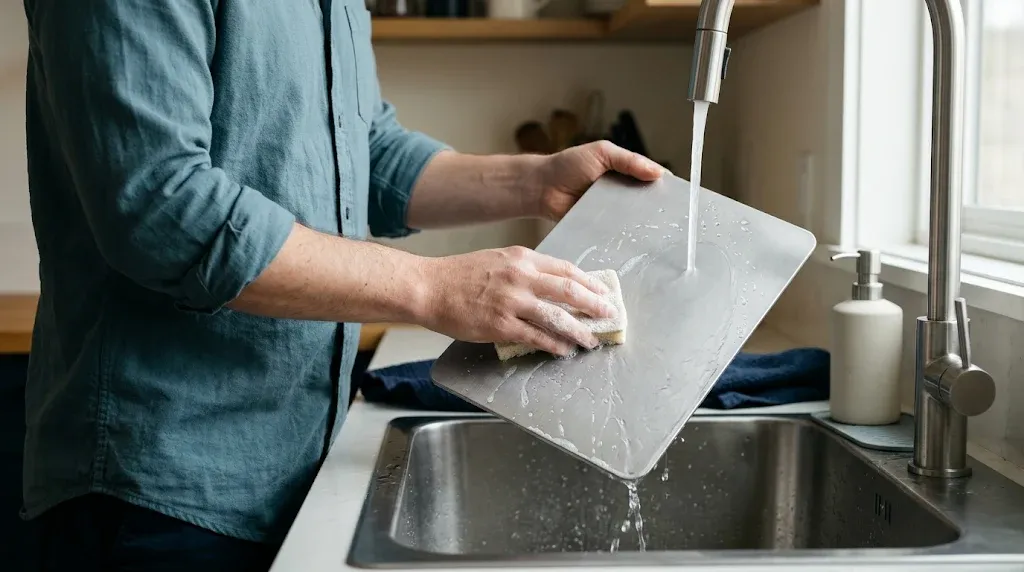
Wash the board after every food-preparation task. The following routine works as a sensible starting point unless the manufacturer specifies otherwise.
- Remove leftover food particles.
- Wash the surface with warm water and dish soap.
- Use a soft cloth or nonabrasive sponge.
- Rinse thoroughly with clean water.
- Dry with a clean towel or allow the board to air-dry.
- Sanitize when necessary using a method compatible with the complete product.
Do not assume every titanium board is dishwasher-safe. Silicone feet, adhesives, decorative components, or handles may have different care requirements.
Should You Worry About Surface Scratches?
Visible scratching can develop through repeated knife contact. A scratch does not automatically mean the titanium is peeling or that the product is counterfeit.
However, inspect any deeply damaged surface for rough edges or areas that become difficult to clean. Seek manufacturer guidance before attempting abrasive polishing.
What Should You Ask Before Buying?
Before purchasing, I would send the seller these five questions:
- Is the entire cutting surface solid Grade 1 or Grade 2 titanium?
- Can you provide a batch-specific material certificate?
- Does the product contain any coating, steel core, or applied film?
- What cleaning and dishwasher instructions apply?
- What warranty covers material misrepresentation or manufacturing defects?
Clear written answers can be more valuable than a long list of advertised benefits. If a seller cannot identify the actual metal grade, consider a more transparent supplier.
Section takeaway: Prioritize verifiable specifications, stable construction, and realistic care instructions. A high price alone does not prove titanium purity.
Frequently Asked Questions
Are all titanium cutting boards made from pure titanium?
No. Some products described as titanium contain coatings, alloys, or other base metals. Look for commercially pure Grade 1 or Grade 2 titanium documentation and confirmation that the cutting surface is solid metal rather than a thin coating.
Is 99.9% titanium considered pure titanium?
It can be, depending on the applicable material specification and tested composition. Commercially pure titanium allows controlled trace elements, so an exact 100% composition is not required. Verify the grade and laboratory report rather than judging purity from one percentage.
Is Grade 1 or Grade 2 titanium better for cutting boards?
Grade 1 is generally softer and more formable, while Grade 2 offers greater strength. Both are commercially pure titanium grades. Neither guarantees a knife-friendly surface, so cutting performance and design should be considered alongside purity.
Can a pure titanium cutting board go in the dishwasher?
The titanium metal itself resists water-related corrosion, but dishwasher compatibility depends on the complete board. Check the manufacturer’s care instructions, especially when silicone grips, bonded feet, or other components are attached.
Are pure titanium cutting boards antibacterial?
Do not assume a titanium board automatically kills bacteria. Its nonporous surface can be convenient to clean, but any antimicrobial claim requires appropriate product-specific evidence. Wash the board after food preparation and prevent cross-contamination as you would with other materials.
How can I tell titanium from stainless steel at home?
Compare the board’s measured dimensions and weight against expected material densities. Titanium is considerably lighter than stainless steel of the same volume. This is only a screening method; reliable identification requires suitable material analysis and traceable documentation.
Are pure titanium cutting boards worth buying?
They may be worthwhile for shoppers specifically seeking a durable, corrosion-resistant, plastic-free preparation surface. However, the hard cutting feel, possible knife wear, and higher cost make wood or quality plastic preferable for many routine chopping tasks.
Final Verdict: Which Pure Titanium Cutting Board Should You Choose?
Forneau, Surface22, PureTi, and Taima are identifiable brands advertising commercially pure Grade 1 titanium cutting boards. Compare their current models, request the supporting documentation, and verify the grade before purchasing.
For material transparency, start with the suppliers that publish chemical analysis reports and batch information. Those records provide a more useful basis for comparison than antibacterial slogans or unsupported purity claims.
My practical recommendation is to separate two questions: Is the board genuinely titanium, and is it the right surface for your knives? A product can satisfy the first requirement while still being a poor choice for heavy daily chopping.
Bottom line: Choose documented solid Grade 1 or Grade 2 titanium if material purity is your priority. Choose a well-made wooden or suitable plastic board if protecting knife edges matters more.

