
Is Fir Wood Good for Cutting Boards? Safety, Durability, and Better Alternatives
Quick Answer
No, fir wood is generally not a good choice for cutting boards. Most fir species are relatively soft, so repeated knife cuts can create grooves that become difficult to clean. Fir is not automatically poisonous, but a purpose-made hard maple board is a more dependable option. The 2026 FDA Food Code recognizes hard maple or equivalently hard, close-grained wood for cutting boards in regulated food establishments.
Why fir wood is not ideal
- Low hardness: Many fir species dent and scratch more easily than common cutting-board hardwoods.
- Deep knife marks: Frequent chopping can create grooves that trap food residue.
- Moisture concerns: Repeated washing and poor drying can encourage swelling, warping, or cracking.
- Variable wood quality: Knots, checks, unknown treatments, and unsuitable finishes add uncertainty.
- Better alternatives: Hard maple, walnut, and cherry are more practical choices for kitchen preparation.
My recommendation
- For everyday chopping: Choose a properly manufactured hard maple cutting board.
- For easy cleaning: Consider a quality, dishwasher-safe plastic cutting board.
Fir wood can look attractive, especially when you have leftover lumber from a woodworking project. But a board that looks beautiful is not necessarily suitable for preparing food.
I prefer to judge cutting-board materials by their durability, cleanability, and suitability for food contact. This guide explains where fir falls short, when it might still be useful, and which alternatives deserve your attention.
What Is Fir Wood?
Fir is a common name for several softwood trees, particularly true firs belonging to the genus Abies. Their wood is generally light-colored, relatively lightweight, and widely used for construction and woodworking.
Fir is a softwood because it comes from a coniferous tree. However, the term softwood describes botanical classification rather than guaranteeing a particular hardness.
Common woods sold under fir-related names include:
- White fir: A true fir with relatively soft, pale wood.
- Balsam fir: A lightweight true fir commonly associated with pulpwood and other general applications.
- Grand fir: Another true fir used in lumber and millwork.
- Douglas-fir: A different genus, Pseudotsuga, often sold commercially alongside other construction softwoods.
That last distinction matters. Douglas-fir is not a true fir, and its mechanical properties differ from those of many Abies species.
Is Douglas-fir the same as true fir?
No. Douglas-fir belongs to the genus Pseudotsuga, while true firs belong to Abies.
Coast Douglas-fir is generally harder than white fir. However, neither is my preferred choice for a cutting board exposed to daily chopping.
Why Is Fir Wood Not Recommended for Cutting Boards?
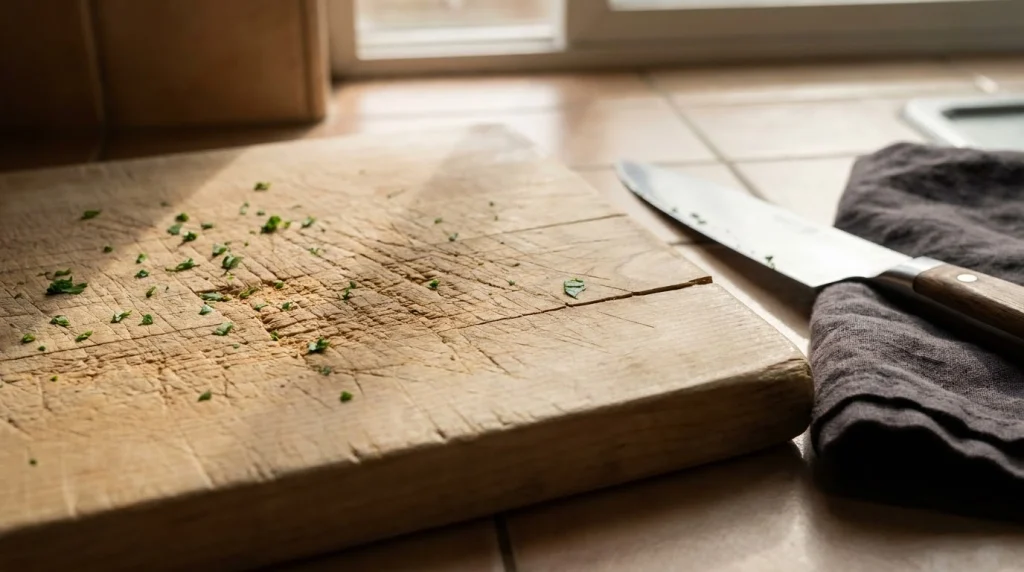
The main concern is durability rather than a blanket claim of toxicity. Fir typically lacks the balance of surface hardness, wear resistance, and proven cutting-board performance found in suitable hardwoods.
1. Fir wood is relatively soft
A cutting board must tolerate repeated contact with sharp blades. Fir’s comparatively soft surface can develop dents, scratches, and compressed fibers.
For perspective, white fir has an approximate Janka hardness of 480 pounds-force. Hard maple measures approximately 1,450 pounds-force.
The Janka test measures resistance to indentation, not actual knife-cutting performance. Still, it helps explain why a hard maple surface usually resists everyday wear better.
2. Repeated cutting creates surface grooves
A shallow scratch is not automatically dangerous. The problem begins when wear produces deep channels that resist effective washing.
Food particles and moisture can remain in damaged areas. This makes inspection and cleaning increasingly important.
For additional guidance, see my explanation of how wooden cutting boards affect knife sharpness.
3. Fir requires careful moisture management
Wood responds to changes in moisture content. Repeated wetting and drying can cause dimensional movement, especially in poorly seasoned or unevenly constructed boards.
Fir is no exception. A thin piece may cup, while existing defects can develop into more serious cracks.
4. Construction lumber may have an unknown history
Not every piece of fir sold at a lumberyard is appropriate for direct food contact. Some stock may have received treatments or encountered substances unsuitable for kitchen use.
Even untreated lumber needs inspection. Avoid unidentified wood, questionable finishes, contaminated reclaimed materials, and pieces with unstable knots.
Is Fir Wood Safe for Food Contact?
Fir wood is not automatically toxic simply because it is a softwood. However, that does not make every fir board appropriate for repeated food preparation.
Food-contact suitability depends on the wood species, its history, the finish, construction materials, and whether the surface remains easy to clean.
Does fir wood contain harmful resin?
Resin and extractive content vary between species. Douglas-fir and true fir should not be treated as having identical resin characteristics.
Some softwood boards may contain aromatic compounds or sticky pockets that make them undesirable for food preparation. But it would be inaccurate to claim that all fir wood contains poisonous resin.
I would avoid any board that releases sticky material, has an unusual chemical odor, or lacks a trustworthy material history.
What does the FDA say about wooden cutting boards?
The 2026 FDA Food Code permits hard maple or equivalently hard, close-grained wood for certain food-contact uses, including cutting boards. This offers a useful material benchmark for selecting a durable kitchen surface.
The Food Code is a model for regulated retail and food-service operations. It does not mean every softer wood is automatically poisonous in a home kitchen.
For practical advice on suitable wooden surfaces, see the North Carolina Cooperative Extension cutting-board guidance.
Fir vs. Maple vs. Walnut vs. Cherry: Which Wood Is Better?
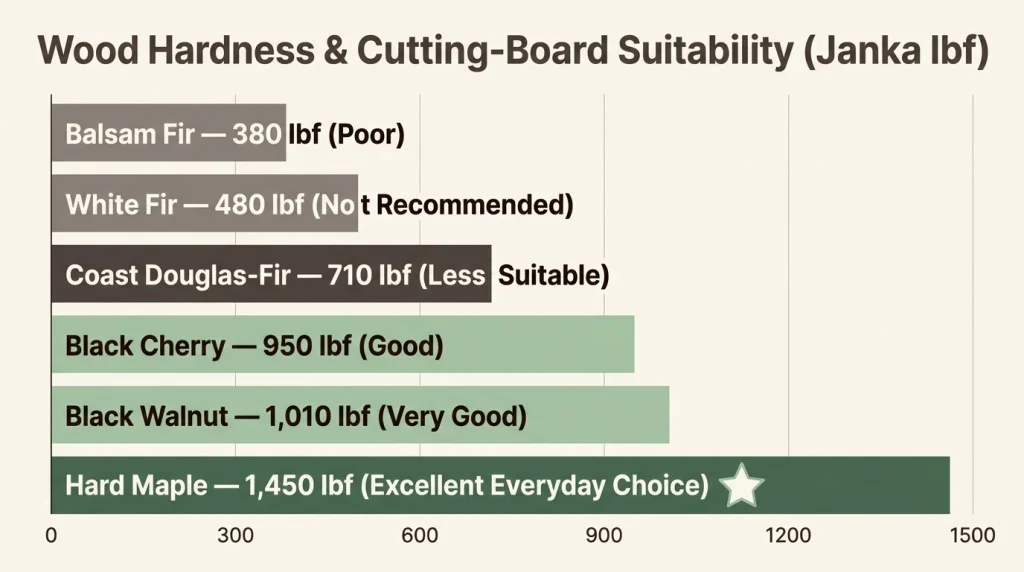
Hard maple offers the strongest general-purpose recommendation. Walnut and cherry are also established cutting-board materials, although they have different hardness and appearance characteristics.
The following figures are approximate Janka side-hardness values for the named species. They describe wood properties rather than laboratory tests of finished cutting boards.
| Wood species | Janka hardness | Cutting-board suitability |
|---|---|---|
| Balsam fir | 380 lbf | Poor for regular chopping |
| White fir | 480 lbf | Not recommended |
| Coast Douglas-fir | 710 lbf | Less suitable than traditional hardwoods |
| Black cherry | 950 lbf | Good with proper care |
| Black walnut | 1,010 lbf | Very good |
| Hard maple | 1,450 lbf | Excellent everyday choice |
Source note: Hardness figures represent the named species and typical published test values. Actual wood performance varies with moisture, grain orientation, and construction.
Hardness alone cannot determine food safety. A poorly built maple board may be less suitable than a properly manufactured alternative.
Why is maple better than fir?
Hard maple provides a more durable, close-grained surface for frequent chopping. It is also widely available in purpose-made cutting boards with established care instructions.
For most home kitchens, I would choose an appropriately sized maple board rather than experiment with fir lumber.
Is walnut a good alternative?
Yes. American black walnut is a popular cutting-board hardwood with an attractive dark color and reasonable cutting-surface durability.
Its appearance is especially appealing when a board serves both preparation and presentation purposes. However, darker surfaces may make some residue harder to notice.
What about cherry wood?
Black cherry is softer than hard maple but still offers useful properties for a carefully constructed cutting board. Its warm color and relatively fine texture make it attractive.
It can develop visible knife marks with use. Regular inspection and maintenance remain important.
Can You Make a Cutting Board From Fir Wood?
It is physically possible to make a board from clean, untreated fir. However, I would not recommend that project as your main everyday cutting surface.
Fir offers fewer advantages than suitable hardwoods once durability, sanitation, and ongoing maintenance are considered.
What should you check before using fir?
If you already own a homemade fir board, inspect it carefully before considering any food-contact use.
- Species identity: Confirm whether the material is true fir, Douglas-fir, or something else.
- Material history: Reject pressure-treated, painted, stained, or chemically contaminated lumber.
- Wood condition: Check for loose knots, splinters, cracks, and unstable joints.
- Surface quality: Look for grooves or defects that would interfere with thorough washing.
- Finish suitability: Verify that any coating is appropriate for the intended food-contact application.
- Intended workload: Avoid demanding chopping tasks that would quickly damage the soft surface.
These checks can identify obvious problems, but they do not certify a homemade fir board as food-safe.
For DIY projects, my preferred approach is to begin with known, untreated hardwood. You can explore broader material-selection principles in my guide to which types of wood can be used for cutting boards.
Can Fir Be Used as a Serving Board Instead?
A decorative serving board faces different demands from a chopping board. It does not need to withstand thousands of knife impacts.
Nevertheless, a serving surface still needs suitable food-contact materials when food touches it directly.
Safer decorative applications
Fir may be more practical for projects where food does not contact the wood itself.
- Table decoration: Use fir as a decorative centerpiece or display platform.
- Packaged-food displays: Keep food inside its original wrapping.
- Serving arrangements: Place food on suitable plates or removable food-safe inserts.
- Kitchen accessories: Consider non-food-contact projects such as decorative stands.
I would not assume that a decorative finish makes a fir plank safe for direct contact with cheese, bread, or fruit.
If the item will touch food, choose a surface explicitly intended for that purpose.
Does Fir Wood Damage Kitchen Knives?
Fir’s softness does not automatically make it harmful to knife edges. In fact, a softer surface may create less direct impact resistance than stone or glass.
However, knife friendliness is only one part of a cutting board’s performance. The board must also resist damage and remain practical to clean.
Why the softest wood is not always best
A cutting surface that develops deep grooves quickly can become frustrating to use. Damaged fibers may also produce an uneven chopping surface.
This is why I look for balance rather than maximum softness. Hard maple and walnut provide more dependable overall performance for regular food preparation.
Does grain direction make a difference?
Yes. Edge-grain boards expose long wood fibers, while end-grain boards expose the ends of those fibers.
End-grain construction can reduce some visible cutting damage, depending on the species and board quality. But changing the grain orientation does not automatically make unsuitable lumber an ideal cutting-board material.
For additional comparisons, see my guide to the best cutting boards for keeping knives sharp.
How Do You Clean and Maintain a Wooden Cutting Board?
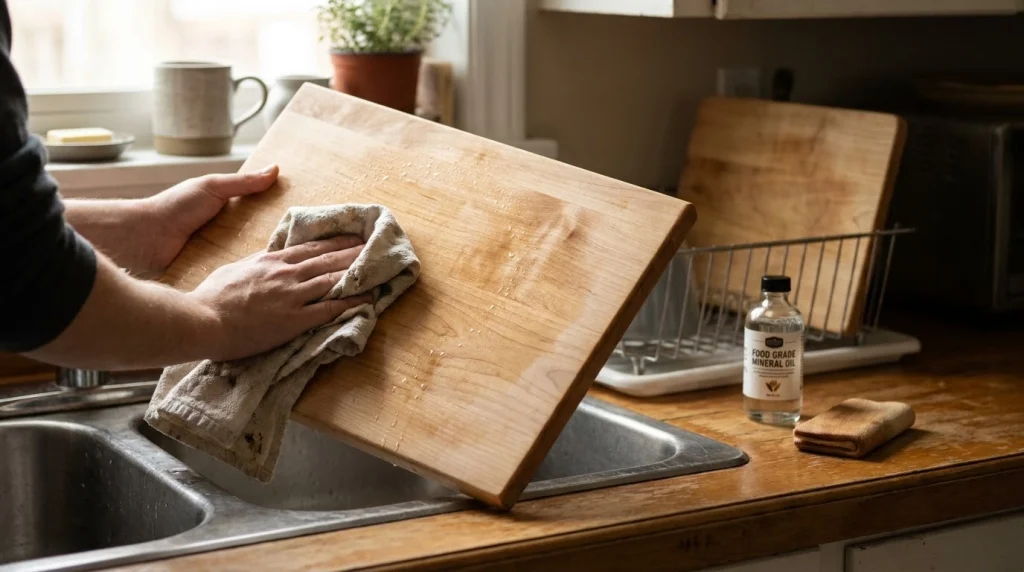
Proper cleaning is essential regardless of the wood species. Even an expensive hardwood board becomes unsuitable when food residue remains trapped in cracks or damaged joints.
The University of Maine Cooperative Extension cutting-board guide provides useful guidance on washing, sanitizing, drying, and conditioning wooden boards.
Daily cleaning steps
- Remove food scraps: Clear loose particles immediately after preparing food.
- Wash thoroughly: Scrub both sides with warm water and dishwashing soap.
- Rinse: Remove remaining soap and food particles with clean water.
- Sanitize when needed: Use a sanitizer appropriate for food-contact surfaces and follow its directions.
- Dry completely: Wipe away surface water and allow airflow around the board.
- Store correctly: Avoid stacking damp wooden boards or trapping moisture underneath them.
Do not leave a wooden board soaking in a sink. Prolonged water exposure can encourage warping, swelling, and joint separation.
Should you oil the board?
For suitable unfinished or oil-finished hardwood boards, food-grade mineral oil can help with routine conditioning. Always follow the manufacturer’s instructions.
Mineral oil is not a sanitizer. It cannot make contaminated wood safe or repair significant cracks and deep grooves.
When should you replace a cutting board?
Replace a board when deep grooves, cracks, separated joints, or severe warping prevent effective cleaning. Cosmetic scratches alone do not always require replacement.
Watch for these warning signs:
- Deep cuts that retain food particles.
- Cracks that cannot be cleaned thoroughly.
- Splintering or loose wood fibers.
- Persistent unpleasant odors after proper cleaning.
- Warping that makes the board unstable.
Are Wooden Cutting Boards Safe for Raw Meat?
Properly maintained wooden cutting boards can be used in home kitchens when cleaned and sanitized appropriately. However, cross-contamination remains an important concern.
I prefer keeping one board for ready-to-eat foods and another for raw meat, poultry, or seafood. This reduces the chance of transferring harmful microorganisms between ingredients.
For a clear explanation, consult the FoodSafety.gov four steps to food safety.
Practical board separation
- Produce board: Reserve it for fruit, vegetables, bread, and other ready-to-eat foods.
- Raw-protein board: Use a separate, easy-to-clean board for raw poultry, meat, and seafood.
- After-use cleaning: Wash and sanitize appropriate surfaces before switching tasks.
- Replacement: Discard boards that become too deeply scored to clean effectively.
A dishwasher-safe plastic board can make raw-protein cleanup more convenient. That is one reason I like a two-board kitchen setup.
What Are the Best Alternatives to Fir Wood Cutting Boards?
For everyday kitchen use, I would focus on proven hardwoods and purpose-made nonporous cutting surfaces. Each category offers different advantages.
Hard maple for daily chopping
Hard maple is my first choice for someone replacing a fir board. It offers a close-grained surface with strong durability and established kitchen use.
Walnut for appearance and preparation
Walnut balances practical cutting performance with a darker appearance. It suits cooks who value both function and presentation.
Cherry for lighter preparation
Cherry is useful for chopping vegetables, slicing fruit, and many regular food-preparation tasks. Expect some visible wear over time.
Bamboo for a lightweight alternative
Bamboo boards are widely available, although bamboo is botanically a grass. Their performance depends on construction, adhesives, care, and surface hardness.
Some bamboo surfaces can be harder on delicate knife edges than traditional hardwood boards. Explore the differences in my bamboo versus wood cutting board comparison.
Plastic for convenient cleaning
A quality nonporous plastic board is useful when simple washing and sanitizing are priorities. Many models are dishwasher-safe, although manufacturer instructions should always be checked.
Replace plastic boards when heavy scoring makes them difficult to clean.
Recommended Cutting Boards to Consider
If you are replacing fir with a more practical material, these two established products are worth comparing. The suitability ratings below are editorial assessments based on their published features, not hands-on test scores or customer review averages.
🏆 Best Wooden Alternative
John Boos Maple Chop-N-Slice Cutting Board
★★★★★ Editorial suitability: 5/5
This series uses northern hard rock maple with edge-grain construction and a reversible cutting surface. Selected sizes include 18 × 12 inches, with a 1¼-inch thickness.
I would put this near the top of the comparison list for anyone who wants a traditional wooden cutting board instead of fir. It requires hand washing and regular care.
🧼 Best for Easy Cleaning
OXO Good Grips Carving & Cutting Board
★★★★☆ Editorial suitability: 4/5
This polypropylene board measures approximately 21.1 × 14.5 inches. It features non-slip feet, a double-sided design, and a grooved surface for collecting juices.
I would consider it for cooks who prioritize dishwasher-safe cleanup over the appearance of natural wood. Its large surface is also convenient for carving and food preparation.
Frequently Asked Questions
Is fir wood food-safe for cutting boards?
Fir wood is not automatically poisonous, but it is generally a poor choice for a frequently used cutting board. Its relatively soft surface can develop damage that becomes difficult to clean. Unknown treatments, contaminated lumber, and unsuitable finishes create additional concerns. Choose a purpose-made cutting board instead.
Can I use Douglas-fir for a cutting board?
Douglas-fir is harder than many true fir species, but it remains less desirable than established cutting-board hardwoods. It can develop knife marks and needs careful material selection and maintenance. For regular food preparation, I recommend hard maple or another properly manufactured cutting-board material.
Is fir wood better than pine for cutting boards?
Neither fir nor pine is my preferred material for everyday chopping. Both groups contain species with different hardness values, so a simple universal ranking would be misleading. A clean, close-grained hardwood board generally provides a more dependable combination of durability and practical cleaning.
Can I use fir wood for a charcuterie board?
Fir can be used decoratively for a charcuterie display when the food sits on separate, suitable food-contact surfaces. Direct food contact requires more careful evaluation of the species, condition, and finish. For an actual food-contact serving board, I would choose a reputable product specifically manufactured for that purpose.
What is the best wood to use instead of fir?
Hard maple is one of the best all-around alternatives because of its relatively high hardness, fine grain, and long history of cutting-board use. American black walnut and black cherry are also useful options. Choose a reputable manufacturer and maintain the finished board according to its instructions.
Final Verdict: Should You Use Fir Wood for a Cutting Board?
Fir wood is generally not a good material for an everyday cutting board. Its lower hardness and tendency to develop surface damage outweigh its attractive appearance and woodworking convenience.
For a new board in 2026, my first wooden choice would be well-constructed hard maple. Walnut and cherry are also worth considering, while a quality plastic board offers convenient cleaning.
The simplest decision is to choose a material already proven for kitchen preparation. A good cutting board should support safe cleaning, comfortable chopping, and years of practical service.
My final recommendation: Save fir for suitable woodworking or decorative projects, and choose a purpose-made cutting board for preparing food.

