Important Features of a Chef Knife That Matter Most
Quick Answer
The most important features of a chef knife are its blade geometry, edge, steel, blade profile and length, balance, weight, handle comfort, and overall construction. A good knife should cut cleanly without excessive force, feel secure in your normal grip, provide enough knuckle clearance, and be practical for you to sharpen and maintain. Features such as a full tang or forged construction can be useful, but they should not outweigh cutting performance and comfort.
A chef knife may look simple, but several design choices determine how it behaves on a cutting board. Some affect how easily the blade passes through food. Others affect comfort, durability, control, or how difficult the knife will be to maintain.
The useful way to judge one is not to search for a single specification that means “high quality.” Look at how the features work together and whether they match the way you cook.
1. Blade Geometry Determines How Easily the Knife Cuts
 Save
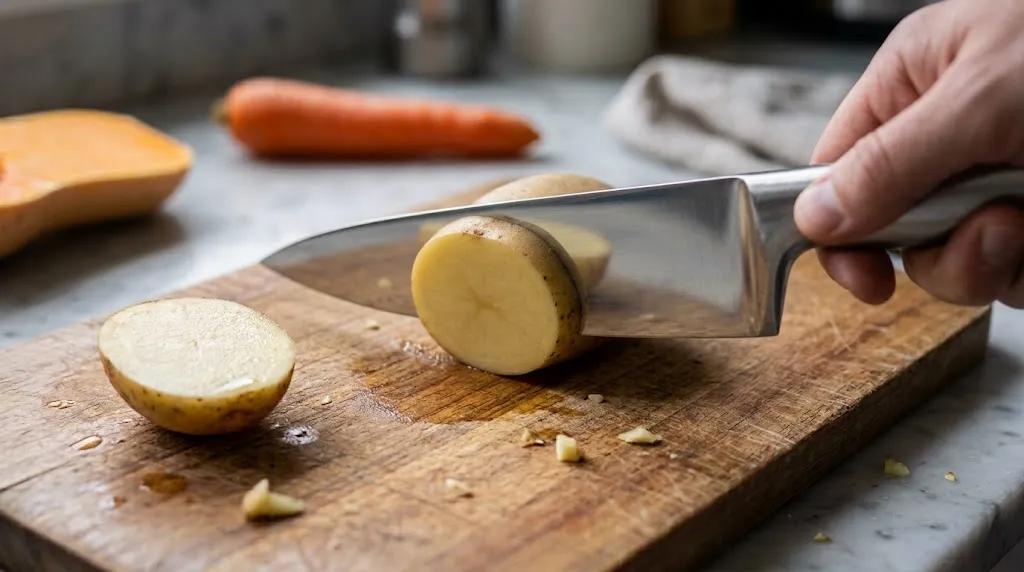
SaveBlade geometry is one of the most important performance features because sharpness alone does not determine how easily a knife passes through food. The thickness of the blade and how rapidly it becomes thinner toward the cutting edge influence resistance during a cut.
A very thick blade can have a sharp edge yet still wedge apart a dense potato, carrot, or squash. A thinner blade behind the edge generally moves through food with less resistance, although making a blade extremely thin can reduce its tolerance for rough treatment.
Also look at the blade from the spine toward the tip. A gradual reduction in thickness is known as distal taper. This can leave more material near the heel for stability while making the forward part of the knife lighter and more precise.
Key Insight
Do not judge cutting performance only by how sharp the factory edge feels. Edge sharpness and the thickness of the blade behind that edge work together.
2. The Edge Must Balance Sharpness With Durability
The cutting edge is where the two sides of the blade meet. A finer, more acute edge can reduce cutting resistance, but edge design always involves a tradeoff: making an edge thinner can also make it less tolerant of twisting, impacts, bones, frozen food, or other abusive cutting tasks.
This is why there is no universally perfect edge angle for every chef knife and every cook. The steel, heat treatment, blade geometry, intended use, and sharpening method all matter.
More important than chasing a particular angle is choosing an edge you can maintain. A knife that performs beautifully when new but becomes difficult for you to sharpen is less useful than one you can keep working well.
If you want to understand what happens after the factory edge begins to dull, CookingFlavour’s guide to cleaning, sharpening, and maintaining kitchen knives covers the maintenance side in more detail. Fixed-angle sharpening systems also deserve consideration because they may not match every blade; see the guide explaining the limitations of pull-through knife sharpeners.
3. Steel Controls a Set of Tradeoffs, Not Just Sharpness
Knife steel affects edge retention, toughness, corrosion resistance, and sharpening behavior. The mistake is assuming that one impressive steel name or a higher hardness automatically makes a better chef knife.
Harder blade steels can support fine edges and may retain useful sharpness well, but greater hardness can sometimes come with lower tolerance for impacts or poor technique. Softer, tougher steels may need more frequent edge maintenance but can be forgiving in a busy kitchen.
Corrosion resistance also matters. Stainless and highly corrosion-resistant steels reduce maintenance demands, while some carbon steels require quicker cleaning and drying to prevent discoloration or rust.
A useful starting point from Utah State University Extension’s chef-knife guidance is to consider blade material together with length, construction, and balance rather than judging a knife by steel alone.
4. Blade Profile Should Match Your Cutting Motion
The profile is the shape of the cutting edge from heel to tip. It strongly influences which cutting motions feel natural.
- More curved belly: supports a rocking motion in which the tip stays close to the board while the heel rises and falls.
- Flatter edge: gives more board contact during push cutting and straight chopping.
- Fine pointed tip: helps with detailed work, scoring, trimming, and starting precise cuts.
- Tall heel: provides useful knuckle clearance and a broad blade face while chopping.
Neither a curved nor a relatively flat profile is automatically superior. A cook who rocks through herbs may prefer more curvature, while someone who regularly push-cuts vegetables may prefer a flatter section of edge.
For a practical example of how blade control and edge position work during food preparation, see the guide on how to dice an onion properly.
5. Blade Length Should Give You Reach Without Sacrificing Control
A chef knife needs enough length to handle large ingredients while remaining manageable for everyday prep. An 8-inch blade is a common general-purpose starting point, and Utah State University Extension also identifies it as a practical size for many users.
That does not make eight inches mandatory. A shorter blade may feel easier to control in a small kitchen or for someone who prefers compact tools. A longer knife provides more slicing length and working capacity but needs more board space and may feel cumbersome to some cooks.
Instead of choosing length purely from a recommendation, consider your hand size, cutting board, common ingredients, and confidence controlling the tip.
6. Balance and Weight Affect Control More Than a Number on a Scale
A chef knife should feel predictable in your hand. Balance describes where the knife’s center of mass sits relative to your grip. A knife can be blade-heavy, handle-heavy, or relatively neutral.
Many cooks like a balance point close to the blade-handle junction or around the area used for a pinch grip. That placement can make the knife feel controlled without requiring excessive wrist effort. However, balance preference is personal. Some cooks deliberately prefer a little forward weight because it gives chopping strokes momentum.
Overall weight is also a preference rather than a universal quality score. A heavy knife can feel solid and powerful. A lighter knife may feel faster and less tiring during long vegetable preparation.
When possible, hold the knife in the grip you actually use rather than simply picking it up by the end of the handle.
7. Handle Comfort and Grip Matter Every Time You Use the Knife
A technically excellent blade attached to an uncomfortable handle is still the wrong knife for your hand.
Look for a handle that allows a secure grip without requiring excessive squeezing. Check for uncomfortable corners, raised rivets, gaps, slippery surfaces, or a shape that forces your wrist into an awkward position.
If you use a pinch grip, also examine the transition from the handle to the blade. The spine and choil—the area near the rear of the cutting edge—should not have sharp unfinished corners that press painfully into your fingers.
Handle material matters mainly through grip, durability, cleaning, and maintenance. Wood can feel warm and comfortable but typically needs more care. Synthetic handles can provide excellent grip and low maintenance. Metal handles are durable but their shape and surface finish determine whether they remain comfortable and secure.
8. Tang, Bolster, and Forged Construction Are Useful—but Not Automatic Quality Tests
The tang is the portion of blade steel extending into the handle. A full tang runs through most or all of the handle and can provide strong construction and influence weight distribution. It is a useful feature, particularly in traditional Western knife designs.
However, full tang should not be treated as a universal pass-or-fail quality test. A well-engineered knife with a different handle construction can still be durable and well balanced.
The bolster is the transition between blade and handle on some designs. It can add weight and provide a comfortable transition for the hand. A large full bolster that reaches the cutting edge, however, can make sharpening the heel more difficult as the blade wears over time.
Similarly, forged versus stamped construction does not tell you everything about performance. Modern manufacturing can produce effective chef knives using either approach. Geometry, heat treatment, fit, finishing, and ergonomics provide more useful information than the manufacturing label alone.
This distinction is useful if you are comparing individual knives with boxed collections. CookingFlavour’s guide to whether kitchen knife sets are worth buying explains why having more knives does not necessarily mean having better cutting tools.
How to Evaluate a Chef Knife in a Few Minutes
 Save
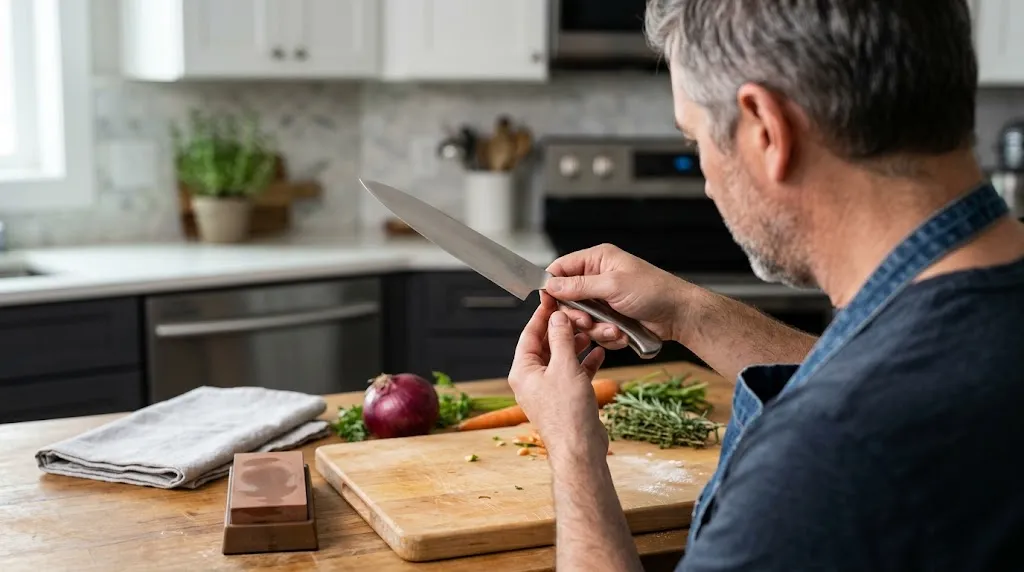
SaveInstead of trying to memorize dozens of specifications, use this sequence:
- Check the blade geometry. Look for sensible thickness and a gradual transition toward the cutting edge and tip.
- Examine the edge and profile. Decide whether its curve suits your normal chopping, rocking, or push-cutting motion.
- Choose manageable length. Make sure the blade fits your hand, board, and kitchen space.
- Hold it normally. Check balance, handle size, grip security, pinch-grip comfort, and knuckle clearance.
- Consider maintenance. Ask whether the steel and edge are realistic for the way you sharpen, wash, dry, and store knives.
- Inspect construction. Look for smooth transitions, secure handle assembly, even finishing, and no uncomfortable edges or gaps.
The best chef knife is not necessarily the one with the hardest steel, fanciest finish, heaviest construction, or longest feature list. It is the knife whose cutting geometry, ergonomics, durability, and maintenance requirements make sense together.
Related Product
8-Inch Chef Knives
If you are comparing chef knives after reviewing these features, an 8-inch model is a practical category to start with because it balances useful cutting length with everyday maneuverability for many home kitchens.
As an Amazon Associate, we earn from qualifying purchases.
Frequently Asked Questions
Is a full tang necessary for a good chef knife?
No. A full tang can provide strong construction and influence balance, but it is not the only way to build a durable chef knife. Judge the complete knife, including geometry, handle attachment, balance, workmanship, and intended use.
Is a forged chef knife better than a stamped chef knife?
Not automatically. Forged and stamped knives can both perform well. Forging may influence weight and construction, but blade geometry, steel treatment, edge quality, ergonomics, and manufacturing quality have a more direct effect on how useful the finished knife is.
How heavy should a chef knife be?
There is no ideal weight for everyone. Choose a weight you can control comfortably. A heavier knife can provide momentum, while a lighter knife may feel faster and reduce fatigue during repetitive prep.
What chef knife blade length is best for most home cooks?
An 8-inch chef knife is a useful starting point for many home cooks because it provides substantial cutting length without becoming excessively difficult to maneuver. Smaller or larger blades may be better depending on your hand size, board space, ingredients, and preference.
Is harder knife steel always better?
No. Hardness is only one part of blade performance. Harder steel may support strong edge retention, while tougher or somewhat softer steel can be more forgiving. Corrosion resistance, geometry, heat treatment, sharpening difficulty, and intended use also matter.
How can I tell whether a chef knife fits my hand?
Hold it in your normal cutting grip and check whether your fingers wrap naturally around the handle, your pinch grip feels comfortable, your knuckles clear the board, and the knife does not strongly pull forward or backward. Comfort and control matter more than matching a particular handle style.
Conclusion
The important features of a chef knife work as a system. Start with blade geometry and an edge suited to your cutting tasks, then consider steel, blade profile, length, balance, weight, and handle comfort. Construction details such as the tang, bolster, and forged or stamped manufacturing method are useful secondary clues rather than guarantees of quality. A good chef knife should cut efficiently, feel controlled in your hand, provide comfortable board clearance, and be realistic for you to maintain. If those qualities are right, decorative finishes and impressive-sounding specifications become much less important.