Chef Knife Rivets Loose: Causes, Safe Fixes, and When to Replace the Handle
Quick Answer
Loose chef knife rivets can result from handle wear, damaged handle scales, corrosion, or a failing attachment between the handle and blade tang. Stop using the knife if the handle moves, a rivet protrudes, or the blade shifts when you hold the handle. Check the manufacturer’s warranty before attempting repairs, because a loose rivet may require professional handle repair or replacement.
What to do first
- Stop cutting: Put the knife aside if its handle or blade connection feels unstable.
- Inspect the rivets: Look for protruding pins, cracks, gaps, rust, or movement around the handle.
- Check the handle: Determine whether the rivet itself is loose or the surrounding material has cracked.
- Contact the maker: Ask about warranty coverage and the correct repair procedure.
- Choose a safe repair: Have damaged rivets or handle scales repaired by a qualified knife repair professional.
Important safety tip
- Do not hammer a rivet, drill the handle, or apply ordinary glue while the knife remains assembled.
- Never test a loose handle by chopping food or applying extra force to the blade.
A chef knife with loose rivets can feel uncomfortable, unstable, and difficult to control. Even a small amount of handle movement deserves attention because the handle helps you guide the blade safely.
In this guide, I’ll explain how to recognize loose rivets, what causes them, which repairs make sense, and when replacing the handle or knife is the better option.
What Are Loose Rivets on a Chef Knife?
Chef knife rivets are metal pins that secure the handle scales to the knife’s tang, which is the part of the blade steel extending into the handle. Loose rivets occur when a pin no longer holds the handle components firmly together or the surrounding handle material deteriorates.
On a typical Western-style chef knife, you can see the rivets as small metal circles on the sides of the handle. They should sit securely against the handle surface without obvious movement or sharp protruding edges.
Rivets are not the only parts responsible for handle stability. The tang, handle scales, adhesive where used, and overall construction also affect how securely the handle stays attached.
For a clearer understanding of these components, see this guide to chef knife parts and construction.
How Can You Tell If Chef Knife Rivets Are Loose?
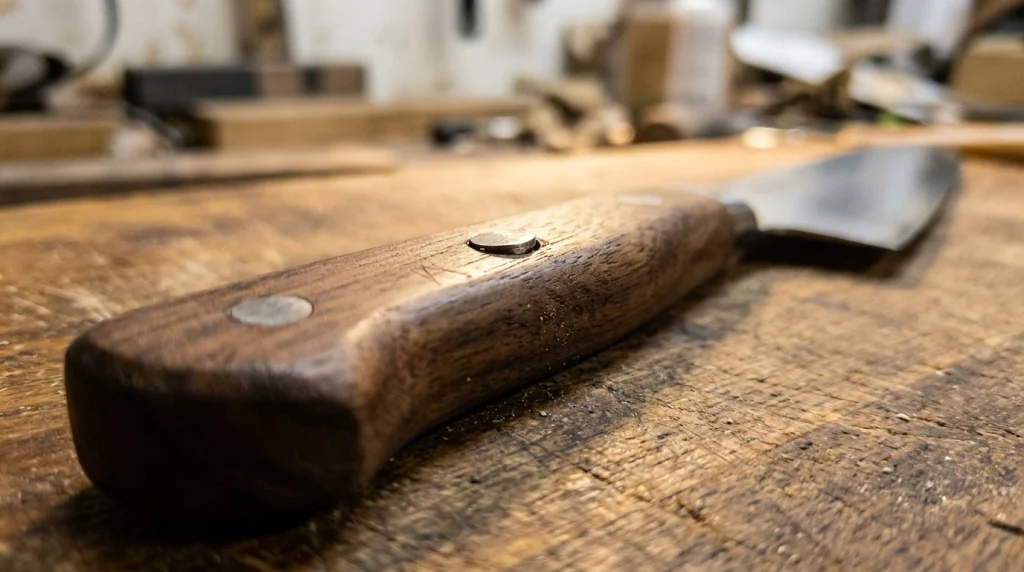 Save
You can often identify a rivet or handle problem through a careful visual inspection. You do not need to cut anything or apply pressure to the blade to look for warning signs.
- Raised rivet heads: One or more metal pins sit noticeably above the surrounding handle surface.
- Visible gaps: Small spaces appear between a rivet and the handle material.
- Cracked handle scales: Wood, composite, or plastic around a rivet shows splitting or chipping.
- Handle separation: A handle scale begins separating from the tang or the opposite scale.
- Rust around the hardware: Corrosion appears around the rivets or in nearby gaps.
- Loose handle components: Parts of the handle visibly shift during ordinary, gentle handling.
Safety warning
If the handle moves, the blade shifts, or a crack extends through the handle, stop using the knife. Do not attempt to confirm the problem by chopping, twisting the blade, or gripping the damaged area tightly.
Why Do Chef Knife Rivets Become Loose?
Loose rivets can develop for several reasons, and the correct repair depends on the underlying cause. Tightening or replacing a pin will not solve every handle problem.
1. Repeated Use and Mechanical Wear
Regular cutting, handling, and cleaning place repeated stress on the handle assembly. Over time, wear can affect the rivets, handle material, or the fit between the handle scales and tang.
Wear alone does not mean every older knife needs replacement. However, a handle that has started moving should be inspected before the knife returns to service.
2. Moisture and Temperature Changes
Wooden handles can absorb moisture and change dimensions as they become wet and dry. Repeated exposure to moisture may contribute to cracks, gaps, or changes in the fit around rivets.
Dishwasher heat, prolonged soaking, and improper drying can also damage some handle materials. Follow the knife manufacturer’s cleaning instructions rather than assuming every chef knife is dishwasher-safe.
3. Cracked or Deteriorating Handle Scales
The handle scales are the pieces of material attached to either side of the tang. If a scale cracks around a rivet, the pin may appear loose even when the metal itself has not failed.
Replacing or repairing the damaged scale may be necessary. Simply tightening the existing rivet will not restore strength to cracked material.
4. Corrosion or Damaged Rivets
Corrosion can develop when moisture and food residue remain around metal hardware. Damaged, worn, or improperly fitted rivets can also lose their ability to hold the handle components securely.
Surface discoloration does not automatically mean a rivet is loose. If the metal is deeply corroded, visibly deformed, or surrounded by damaged handle material, seek a professional inspection.
5. Manufacturing or Assembly Problems
A rivet that loosens early in the knife’s life may indicate a manufacturing or assembly problem. Incorrect fitting, defective materials, or an unsuitable handle attachment can affect long-term stability.
If the knife is relatively new, contact the manufacturer before attempting a repair. Altering the handle may affect warranty eligibility.
How Do You Fix Loose Chef Knife Rivets Safely?
The safest way to address loose chef knife rivets is to identify the damage, stop using the knife, and choose a repair that matches its construction. For a riveted handle that has started moving, professional service is generally safer than an improvised home fix.
Step 1: Stop Using the Knife
Set the knife aside on a stable surface away from the edge of the counter. Keep the blade pointed away from you, and avoid unnecessary handling while the handle is damaged.
Do not continue preparing food while waiting for a repair. A failing handle can compromise control and increase the risk of a cut.
Step 2: Inspect the Handle Without Applying Force
Look at each rivet and the surrounding handle material under good lighting. Check for cracks, gaps, corrosion, protruding metal, and visible separation.
- Determine whether the damage affects one rivet or several.
- Look for cracks extending from the rivet into the handle scale.
- Check whether the handle appears separated from the tang.
- Take clear photographs to share with the manufacturer or repair technician.
A visual inspection can help describe the problem, but it cannot always establish whether the tang or hidden fastening components are damaged.
Step 3: Check the Manufacturer’s Warranty
Contact the knife manufacturer or authorized service provider before disassembling the handle. Explain when the problem appeared and whether the knife has experienced impact, corrosion, or unusual stress.
Warranty terms differ by manufacturer and product. Some cover qualifying manufacturing defects, while accidental damage, wear, or unauthorized modifications may fall outside the coverage.
Step 4: Arrange the Correct Repair
A repair professional can determine whether the knife needs a replacement rivet, new handle scales, a complete rehandle, or replacement of the knife itself.
Riveted Western-style handles may require specialized tools and fitting. Removing a rivet can damage the handle or tang if the work is performed incorrectly.
Repair principle
Fix the cause, not just the visible symptom. A replacement rivet cannot reliably repair a cracked handle scale or a damaged tang, and glue cannot restore a structurally weakened assembly.
Can You Tighten a Loose Chef Knife Rivet at Home?
Sometimes a loose-looking rivet can be repaired, but the correct procedure depends on the knife’s construction. Traditional rivets, peened pins, and specialized handle fasteners do not all respond to the same repair method.
For an assembled chef knife with a moving rivet, I recommend professional assessment instead of hammering the metal at home. An incorrect strike can deform the rivet, crack the handle, damage the blade assembly, or leave sharp edges.
There are also important differences between a loose rivet and a loose screw. A screw may have a threaded connection designed for adjustment, while a conventional rivet is mechanically secured and usually requires a different repair process.
| Problem | Recommended response | DIY suitability |
|---|---|---|
| Minor surface discoloration | Clean according to manufacturer instructions. | Usually suitable if no structural damage exists. |
| Protruding or moving rivet | Stop using the knife and arrange an inspection. | Not recommended for an inexperienced owner. |
| Cracked handle scale | Repair or replace the damaged handle component. | Depends on construction and repair skills. |
| Damaged tang or multiple loose components | Seek professional repair or replace the knife. | Professional service recommended. |
| Loose handle screw on a designed screw-fastened model | Follow the manufacturer’s adjustment instructions. | Potentially suitable if the design permits it. |
The key distinction is whether the handle remains structurally sound. Cosmetic discoloration can often be addressed with ordinary care, but a moving fastener or cracked handle requires a more cautious response.
Why Should You Avoid Glue on Loose Knife Rivets?
Ordinary household glue is not a dependable fix for a loose chef knife rivet. It may cover the visible gap without restoring the mechanical connection that holds the handle together.
Heat, water, cleaning chemicals, and repeated handling can also affect an adhesive bond. Some adhesives may be unsuitable for food-contact environments or for the specific materials used in a knife handle.
Glue may have a legitimate role in certain handle constructions when a qualified repairer selects an appropriate product and process. However, it should not be treated as a universal substitute for a damaged rivet or cracked handle.
- Do not fill the gap blindly: The underlying damage may extend beyond what you can see.
- Do not seal in contamination: Food residue or moisture trapped beneath a handle can create additional problems.
- Do not rely on a temporary bond: The handle must remain secure under normal kitchen use.
Should You Repair or Replace a Chef Knife With Loose Rivets?
 Save
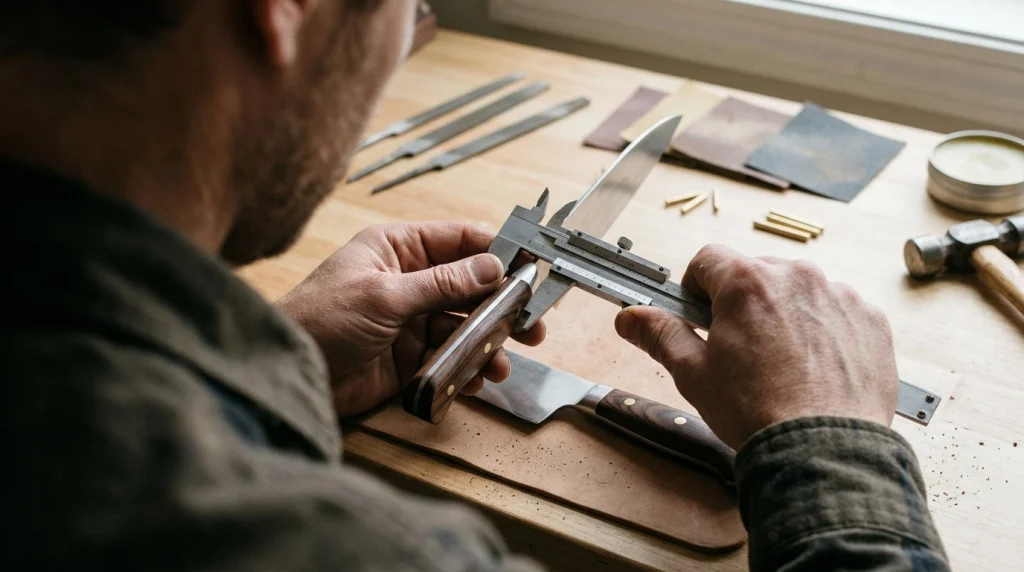
Repair makes sense when the blade remains in good condition and a qualified professional can restore the handle securely at a reasonable cost. Replacement may be more practical when the tang is damaged, the handle is extensively cracked, or several components have failed.
Compare the knife’s overall condition, warranty coverage, repair cost, and replacement options before making the decision.
| Factor | Repair | Replace |
|---|---|---|
| Blade condition | Blade is sound and worth keeping. | Blade or tang has serious structural damage. |
| Handle damage | Limited damage can be corrected. | Extensive damage makes repair impractical. |
| Warranty | Eligible defects may qualify for service. | Replacement may be preferable if service is unavailable. |
| Long-term value | Useful when repair preserves a good knife. | Useful when repair costs approach replacement cost. |
There is no single repair price that applies to every chef knife. The final cost depends on the handle material, fastening method, extent of the damage, and the availability of replacement parts.
Before spending money, ask for an estimate and confirm whether the repair includes replacement hardware, damaged handle scales, and inspection of the tang.
What Tools and Supplies Are Useful for Knife Handle Maintenance?
Routine maintenance does not require a specialized repair kit. A few basic supplies can help you clean and inspect an intact handle, while structural repairs should use the appropriate equipment and methods for the specific knife.
- Soft cleaning cloth: Helps remove moisture and food residue from the handle and rivet surfaces.
- Soft-bristled brush: Helps clean accessible gaps without aggressively scraping the handle.
- Good lighting: Makes cracks, gaps, and protruding hardware easier to identify.
- Manufacturer-approved cleaner: Helps maintain the handle without damaging its material or finish.
- Professional repair service: Appropriate for replacing rivets, fitting new handle scales, and correcting structural damage.
A general-purpose screwdriver is not a rivet repair tool, and a hammer is not a universal solution for loose handle hardware. Use tools only when the manufacturer or a qualified repair professional confirms they are suitable for your knife.
Recommended Products for Knife Handle Care and Repair
If your knife has loose rivets, prioritize a safe inspection and appropriate repair rather than buying supplies that might conceal the problem. The following options may help with routine maintenance or locating a suitable repair solution.
Best for routine cleaning
Microfiber Cleaning Cloth
Maintenance accessory
A soft microfiber cloth can help remove moisture and surface residue from an intact knife handle. Choose a clean cloth that will not scratch polished metal or delicate handle finishes.
Best for careful inspection
LED Inspection Flashlight
Inspection accessory
A small flashlight can illuminate the edges of rivets and the surrounding handle material. Inspect the knife while it rests securely on a stable surface, without testing or stressing a loose component.
Best for structural problems
Professional Knife Handle Repair
Repair service
A qualified knife repairer can inspect the rivets, handle scales, and tang before recommending a repair. Ask about the repair method, parts, warranty implications, and total cost before authorizing work.
These are general purchasing suggestions, not products tested for repairing your specific knife. A cleaning cloth or flashlight can support routine care, but neither can correct a loose rivet or restore a damaged handle.
How Can You Prevent Chef Knife Rivets From Becoming Loose?
Good maintenance helps reduce avoidable handle damage, especially when your chef knife has wooden or composite scales. It cannot prevent every manufacturing defect or mechanical failure, but it can help preserve the handle’s condition.
- Hand-wash when appropriate: Follow the manufacturer’s cleaning instructions instead of exposing the knife to unapproved dishwasher cycles.
- Dry the handle promptly: Remove moisture after cleaning, paying attention to the area around rivets.
- Avoid prolonged soaking: Do not leave the knife submerged in a sink or water-filled container.
- Use the knife correctly: Avoid prying, twisting, or striking hard materials with a chef knife.
- Store it securely: Prevent repeated impacts against other utensils or hard surfaces.
- Inspect periodically: Look for cracks, corrosion, gaps, or changes in handle stability.
For more general maintenance advice, follow the manufacturer’s instructions for cleaning, drying, and storing your particular knife model. Different handle materials may require different care.
Frequently Asked Questions
Can I keep using a chef knife with one loose rivet?
No, you should stop using a chef knife if a rivet is moving or the handle feels unstable. Even one loose fastener can indicate a problem with the handle assembly. Have the knife inspected and repaired before returning it to normal kitchen use.
Can I hammer a loose chef knife rivet back into place?
Hammering a rivet without understanding the handle construction can crack the scales, deform the fastener, or cause further damage. Conventional rivets may require specialized tools and fitting. Have a qualified repair professional assess the knife instead of attempting an improvised repair.
Will super glue fix loose knife rivets?
Super glue is not a dependable structural repair for a loose rivet. It may conceal a gap without restoring the mechanical connection between the handle components. A suitable repair depends on whether the rivet, handle scales, tang, or another part has failed.
Why do wooden knife handles become loose around rivets?
Wood can absorb moisture and change dimensions as it becomes wet and dries. Repeated exposure to water, temperature changes, and poor drying practices may contribute to gaps or cracks around rivets. However, manufacturing defects and mechanical wear can also cause handle problems.
Is it better to replace the handle or buy a new chef knife?
Repair is often worth considering when the blade and tang remain sound and the handle can be restored securely. Replacement may make more sense when structural damage is extensive or repair costs are disproportionate to the knife’s value. Compare a professional estimate with the cost of a suitable replacement.
Do loose rivets mean a chef knife is poor quality?
Not necessarily. A loose rivet can result from wear, moisture exposure, accidental damage, or a manufacturing defect. The cause matters more than the symptom alone. A knife with a new or recurring handle problem should be assessed under the manufacturer’s warranty terms before you decide whether to repair or replace it.
Final Takeaway: Don’t Ignore Loose Chef Knife Rivets
Loose chef knife rivets are more than a cosmetic concern when they affect handle stability. Stop using the knife, inspect it visually without applying force, and determine whether the problem involves the rivet, handle scales, or tang.
Check the warranty before attempting repairs, and use a qualified knife repair professional when the handle or fastening system is damaged. With appropriate maintenance and timely repairs, you can avoid turning a small handle problem into a more serious safety issue.

