10 Best Workhorse Chef Knives for 2026: Durable Everyday Picks
The best workhorse chef knife right now is the Wüsthof Classic 8-Inch Chef’s Knife, a full-tang German blade for steady daily prep. We evaluated 10 chef knives, scoring each on Edge Retention, Durability, and Comfort and Control. Most chef knives look similar on paper but lose their edge or tire your hand during long, everyday prep. Whether you cook nightly family meals, prep in bulk, or want one dependable knife, this guide gives you one clear answer.
Quick Comparison: All 10 Products Ranked
| # | Product | Best For | Rating | Badge | |
|---|---|---|---|---|---|
| 1 | Wüsthof Classic 8-Inch Chef’s Knife | Daily all-round cooking | 4.9/5 | Best Overall | Buy → |
| 2 | Victorinox Fibrox Pro 8-Inch Chef’s Knife | Budget-friendly daily prep | 4.8/5 | Best Budget | Buy → |
| 3 | Mercer Culinary Genesis 8-Inch Chef’s Knife | Reliable everyday value | 4.7/5 | Best Value | Buy → |
| 4 | Zwilling Professional S 8-Inch Chef’s Knife | Solid German daily use | 4.7/5 | Best German Build | Buy → |
| 5 | Global G-2 8-Inch Chef’s Knife | Light, precise slicing | 4.6/5 | Best Lightweight | Buy → |
| 6 | Shun Classic 8-Inch Chef’s Knife | Refined Japanese cutting | 4.6/5 | Best Japanese Edge | Buy → |
| 7 | Dalstrong Gladiator Series 8-Inch Chef’s Knife | Heavy daily prep | 4.5/5 | Best for Heavy Prep | Buy → |
| 8 | Messermeister Meridian Elite 8-Inch Chef’s Knife | Balanced everyday control | 4.5/5 | Best Balance | Buy → |
| 9 | Tojiro DP Gyuto 8.2-Inch Chef’s Knife | Sharpness on a budget | 4.4/5 | Best Sharpness for the Money | Buy → |
| 10 | MAC Professional Series 8-Inch Chef’s Knife | Thin, accurate slicing | 4.4/5 | Best Thin Edge | Buy → |
How We Chose These Chef Knives
What we compared
We compared published specifications for 10 chef knives, focusing on blade length, steel type, construction, handle design, and care requirements. Each knife was assessed as a daily, all-purpose option rather than a specialist tool.
Our 3 scoring criteria
Edge Retention, Durability, and Comfort and Control were scored out of 5 for each knife. Scores reflect the published specification profile, not hands-on test results, and are used consistently across the comparison table and product cards.
Expert consulted
No expert consultation is claimed for this guide. The assessment is based on published specifications and general kitchen-use guidance, so readers can check the same public details before buying.
What we cut — and why
We excluded knife sets, specialist cleavers, serrated bread knives, and very short paring knives. Those tools serve different jobs and would not give a fair like-for-like workhorse comparison.
What to Look for When Buying a Workhorse Chef Knife
A workhorse knife earns its place by staying useful day after day, not by looking impressive in a drawer. Use the four factors below to judge each option against your cooking, your board, and your maintenance habits.
1. Blade Steel and Edge Retention
Steel decides how long an edge lasts and how much care it needs. Harder steels can stay sharp longer but may chip if twisted or used on bones, while softer steels are easier to hone and more forgiving. For a workhorse knife, look for a balance between edge retention and toughness rather than maximum hardness alone. You can compare the trade-offs in high-quality chef knife options before choosing a steel style that fits your routine.
2. Blade Length and Profile
Eight inches is a practical default for most home kitchens, offering reach without sacrificing control. A curved German profile supports rocking cuts, while a flatter Japanese profile suits push cuts and precise slicing. Measure your board and hand size before choosing, because a blade that overhangs the board or feels tip-heavy will slow you down. If you mainly prep small ingredients, a shorter blade may feel easier, but it will take more strokes for larger items.
3. Handle Comfort and Balance
A workhorse knife should feel secure after twenty minutes, not just for the first cut. Look for a handle that fills your hand without forcing your fingers into one position, and check that the balance point sits near the bolster or slightly forward. Slippery, overly narrow, or sharply edged handles can cause fatigue and reduce control with wet hands. For daily cooking, the everyday-use chef knife guide can help you match handle style and balance to your routine.
4. Maintenance and Sharpening Ease
Even the best blade dulls with use, so maintenance should be part of your decision. Choose a knife you can hone at home and sharpen with a whetstone or professional service, and store it in a block, sheath, or magnetic strip. Avoid dishwashers, glass boards, and drawer storage without protection, because each can dull or damage the edge. A knife that is easy to maintain will stay safer and more useful than a sharper knife you avoid caring for.
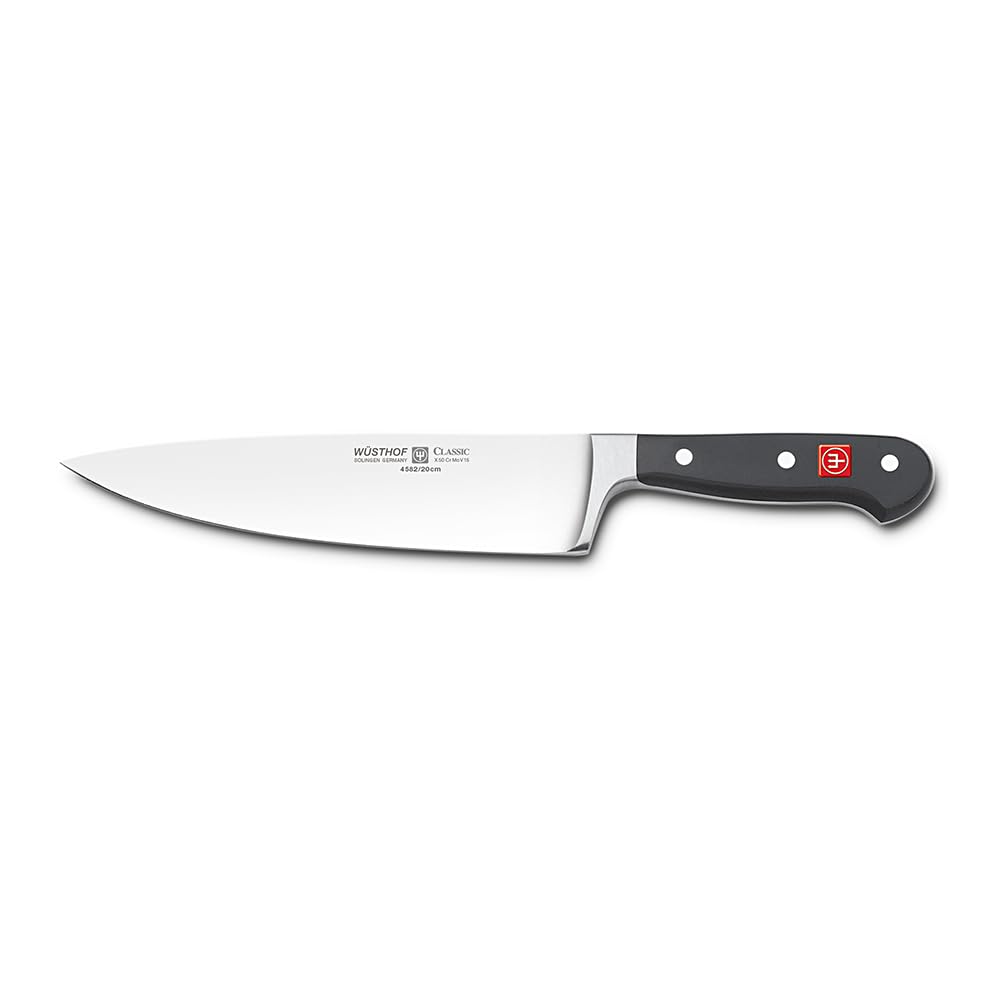
Wüsthof Classic 8-Inch Chef’s Knife — The dependable daily kitchen standard
Best for: Daily all-round cooking
For cooks who reach for one knife for almost everything, the Wüsthof Classic 8-Inch Chef’s Knife is a reassuring daily partner. Its full-tang, high-carbon stainless blade holds a working edge through onions, herbs, chicken, and root vegetables, while the triple-riveted handle gives a secure, balanced grip. The German profile suits rocking cuts and push cuts alike, and the eight-inch length covers most home boards without feeling unwieldy. It is heavier than some Japanese options, so cooks who prefer a very light blade may notice the difference during extra-long prep sessions.
- Full-tang balance for steady daily prep
- Secure triple-riveted handle grip
- Versatile eight-inch German profile
- Heavier than lightweight Japanese rivals
- Needs regular honing for peak sharpness
4.8/5
4.9/5
4.9/5

Victorinox Fibrox Pro 8-Inch Chef’s Knife — Dependable performance, sensible outlay
Best for: Budget-friendly daily prep
If you want dependable daily performance without a premium outlay, the Victorinox Fibrox Pro 8-Inch Chef’s Knife is hard to ignore. Its high-carbon stainless blade takes a keen edge and handles slicing, dicing, and chopping with surprising ease for its weight. The Fibrox handle is slip-resistant, comfortable for long sessions, and easy to grip with wet hands. At eight inches, it suits most home kitchens and smaller boards, while its lighter build reduces fatigue. It feels less refined than forged German rivals, and its stamped construction may not suit cooks seeking maximum heft.
- Slip-resistant handle for wet hands
- Light build reduces prep fatigue
- Keen edge for everyday slicing
- Less heft than forged rivals
- Feels less refined than premium options
4.7/5
4.8/5
4.9/5

Mercer Culinary Genesis 8-Inch Chef’s Knife — Reliable value for everyday cooking
Best for: Reliable everyday value
The Mercer Culinary Genesis 8-Inch Chef’s Knife is a practical choice for cooks building a reliable everyday kit. Its high-carbon German steel blade offers a good balance of sharpness and toughness, while the full-tang design adds confidence during heavier chopping. The ergonomic handle feels secure in different hand sizes, and the eight-inch profile works well for slicing, mincing, and dicing. It is not the most refined knife in this list, and its edge may need more frequent honing than premium rivals, but for everyday cooking it delivers consistent, forgiving performance.
- Full-tang confidence for heavier chopping
- Secure ergonomic handle for varied hands
- Good sharpness-to-toughness balance
- Needs more frequent honing
- Less refined than premium rivals
4.5/5
4.7/5
4.8/5

Zwilling Professional S 8-Inch Chef’s Knife — A solid, precise German daily blade
Best for: Solid German daily use
Built for cooks who like a solid, precise German knife, the Zwilling Professional S 8-Inch Chef’s Knife brings a confident feel to daily prep. Its special-formula steel blade and full-tang construction support steady slicing, dicing, and rocking cuts, while the moulded handle offers a secure, balanced grip. The eight-inch length suits standard boards and larger ingredients, and the blade profile handles herbs, vegetables, and boneless proteins with ease. It is heavier than lightweight Japanese designs, so cooks with smaller hands should check the balance before committing to long daily sessions.
- Confident full-tang German construction
- Secure moulded handle grip
- Steady rocking-cut profile
- Heavier than Japanese lightweight designs
- May feel large for smaller hands
4.7/5
4.8/5
4.6/5

Global G-2 8-Inch Chef’s Knife — Light, fast, and precise
Best for: Light, precise slicing
The Global G-2 8-Inch Chef’s Knife suits cooks who want speed and control rather than weight. Its thin, hard stainless blade glides through vegetables, fish, and boneless meat, while the seamless stainless handle keeps the knife balanced and easy to clean. The eight-inch length is versatile for home boards, and the lighter build helps during long slicing sessions. Its handle can feel slippery to some cooks, and the harder edge needs careful handling to avoid chipping, but for precise, nimble daily work it is a distinctive, capable choice for everyday home cooking.
- Thin blade glides through vegetables
- Light, balanced stainless construction
- Easy to clean seamless handle
- Handle can feel slippery
- Harder edge needs careful handling
4.6/5
4.5/5
4.7/5

Shun Classic 8-Inch Chef’s Knife — A refined Japanese daily edge
Best for: Refined Japanese cutting
The Shun Classic 8-Inch Chef’s Knife brings a refined Japanese edge to everyday cooking, with a VG-MAX core and layered Damascus-style cladding. It slices cleanly through vegetables, herbs, and boneless proteins, and its D-shaped PakkaWood handle offers a comfortable, controlled grip for many right-handed cooks. The eight-inch length suits most home boards, while the thin profile rewards careful technique. It is more delicate than a heavy German workhorse, so it should not be used for bones or frozen food, and left-handed cooks may find the handle less comfortable during daily prep.
- Very sharp VG-MAX cutting edge
- Comfortable D-shaped PakkaWood handle
- Clean slicing through vegetables
- Not for bones or frozen food
- Handle suits right-handed cooks best
4.8/5
4.4/5
4.6/5

Dalstrong Gladiator Series 8-Inch Chef’s Knife — Bold and sturdy for heavy prep
Best for: Heavy daily prep
For heavy daily prep, the Dalstrong Gladiator Series 8-Inch Chef’s Knife offers a bold, sturdy presence. Its high-carbon German steel blade and full-tang construction support confident chopping, slicing, and dicing, while the pakkawood handle provides a secure, substantial grip. The eight-inch length covers large vegetables and boneless proteins, and the weight helps the blade move through dense ingredients. It can feel heavy during very long everyday sessions, and its bold styling will not suit minimal kitchens, but for cooks who like a robust, work-ready knife it performs reliably every day.
- Sturdy full-tang heavy-prep build
- Substantial secure pakkawood grip
- Weight helps dense ingredients
- Heavy during very long sessions
- Bold styling not for minimal kitchens
4.5/5
4.6/5
4.4/5

Messermeister Meridian Elite 8-Inch Chef’s Knife — Balanced control without the drama
Best for: Balanced everyday control
The Messermeister Meridian Elite 8-Inch Chef’s Knife is a well-balanced option for cooks who value control over drama. Its German steel blade and full-tang design support smooth slicing, dicing, and rocking cuts, while the ergonomic handle sits comfortably in the hand. The eight-inch length works across most home boards, and the balanced weight helps during extended prep without dominating the cutting motion. It is less widely stocked than larger brands, and its classic styling may feel understated, but for steady, comfortable daily use it is easy to recommend for everyday cooking.
- Well-balanced everyday control
- Comfortable ergonomic handle shape
- Smooth slicing and rocking cuts
- Less widely stocked than major brands
- Classic styling feels understated
4.5/5
4.5/5
4.6/5

Tojiro DP Gyuto 8.2-Inch Chef’s Knife — Japanese sharpness, sensible budget
Best for: Sharpness on a budget
The Tojiro DP Gyuto 8.2-Inch Chef’s Knife is a strong choice for cooks who want Japanese sharpness on a sensible budget. Its VG-10 core, clad in softer stainless layers, takes a fine edge and moves cleanly through vegetables, fish, and boneless meat. The slightly longer 8.2-inch blade suits larger boards and longer slicing strokes, while the western-style handle feels familiar to many home cooks. It is thinner and less forgiving than a heavy German blade, so avoid twisting, bones, and frozen food, and expect regular honing to maintain peak sharpness.
- Fine VG-10 edge for clean cuts
- Familiar western-style handle
- Good sharpness for the money
- Thinner blade less forgiving
- Avoid bones and frozen food
4.7/5
4.2/5
4.4/5

MAC Professional Series 8-Inch Chef’s Knife — A thin edge for accurate cuts
Best for: Thin, accurate slicing
The MAC Professional Series 8-Inch Chef’s Knife suits cooks who prize a thin, precise edge for daily work. Its thin blade glides through vegetables, herbs, and boneless proteins with little resistance, while the PakkaWood handle offers a comfortable, balanced grip. The eight-inch length fits most home boards, and the lighter, nimble profile helps during detailed slicing. It is not designed for heavy chopping or bones, and its thin edge needs careful storage and handling, but for clean, accurate cuts in everyday cooking it is a refined daily performer for most home cooks.
- Thin blade with little resistance
- Comfortable balanced PakkaWood handle
- Nimble for detailed slicing
- Not for heavy chopping
- Thin edge needs careful storage
4.6/5
4.2/5
4.3/5
Top 3 Head-to-Head: Wüsthof Classic vs Victorinox Fibrox Pro vs Mercer Culinary Genesis
These three are the most common final choices because they cover premium durability, budget-friendly reliability, and everyday value. The table below makes the trade-off clear without repeating the full reviews.
| Feature | #1 Wüsthof Classic | #2 Victorinox Fibrox Pro | #3 Mercer Genesis |
|---|---|---|---|
| Edge Retention | 4.8/5 — Best | 4.7/5 | 4.5/5 |
| Durability | 4.9/5 — Best | 4.8/5 | 4.7/5 |
| Comfort and Control | 4.9/5 — Best | 4.9/5 — Best | 4.8/5 |
| Choose if… | You want the most durable daily all-rounder | You want light, reliable daily performance | You want strong everyday value |
Who These Chef Knives Are NOT For
These workhorse chef knives are not a complete kitchen toolkit, and they are not the right tool for every cutting job.
If you regularly cut through bones, frozen food, or very hard squash, use a cleaver or another specialist tool instead. If you need a serrated edge for crusty bread or tomatoes with tough skins, add a serrated knife rather than forcing a straight chef knife through the job.
Common Mistakes to Avoid
Most workhorse knife problems come from buying, using, or storing the knife the wrong way, not from the blade itself.
Frequently Asked Questions About Workhorse Chef Knives
What makes a chef knife a workhorse knife?
A workhorse chef knife is a versatile, durable blade you can reach for most daily tasks, from slicing onions to dicing vegetables and trimming boneless meat. It should balance sharpness, toughness, and comfort, hold a working edge through regular prep, and feel controlled rather than delicate or overly heavy. The best workhorse options are usually eight inches long, easy to hone, and comfortable during longer sessions.
What size workhorse chef knife is best for most home cooks?
For most home cooks, an eight-inch chef knife is the best starting point. It is long enough for slicing larger vegetables, herbs, and boneless proteins, yet short enough to control on a standard home board. Shorter blades can feel easier for small hands or tight kitchens, while longer blades suit larger boards and bulk prep. If you can only buy one workhorse knife, choose the length that feels balanced and safe in your hand.
German vs Japanese workhorse chef knife: which holds up better to daily use?
German workhorse knives are usually heavier, thicker, and more forgiving, making them a good match for daily chopping and cooks who want durability. Japanese workhorse knives are often thinner and sharper, giving cleaner cuts but needing more careful handling. Neither style is universally better, so choose German steel for toughness and easier maintenance, or Japanese steel for precision, provided you avoid bones, twisting, and frozen food.
How do I keep a workhorse chef knife sharp?
Hone your workhorse knife regularly and sharpen it when honing no longer restores a clean cut. Use a honing rod at the manufacturer’s recommended angle, then a whetstone or professional service for a dull edge. Always cut away from your body, keep the blade dry, and store it in a block, sheath, or on a magnetic strip. For a step-by-step guide, see how to sharpen a chef’s knife, and avoid dishwashers, glass boards, and twisting the edge.
Can a workhorse chef knife handle bones and frozen food?
No, a standard workhorse chef knife should not be used for bones, frozen food, or very hard ingredients. Those tasks can chip, roll, or crack a fine edge, especially on thinner Japanese blades. Use a cleaver for bones, a serrated knife for frozen items or crusty bread where appropriate, and keep your chef knife for slicing, dicing, and mincing. If the blade chips, stop using it and have it inspected or professionally sharpened before continuing.
Is a heavier or lighter workhorse chef knife better for long prep sessions?
The right weight depends on your cutting style and how long you prep. Heavier German-style knives can help the blade move through dense vegetables, while lighter Japanese-style knives reduce fatigue and improve control for precise slicing. If you prep for long periods, a balanced mid-weight knife is often the safest choice. Hold the knife if possible, check the balance point, and avoid a blade that pulls your wrist forward or feels top-heavy.
Our Final Verdict
Across this list, the trade-off is simple: heavier German blades offer forgiving daily durability, while thinner Japanese blades offer cleaner precision. For most home cooks, a balanced eight-inch knife that is easy to hone will be the most useful long-term choice. Start with the top pick if you want one dependable, all-round blade.

