10 Best Mercer Boning Knife for 2026: Tested for Flexibility, Edge Life, and Control
Picking the wrong boning knife means fighting the bone instead of gliding around it — a stiff blade in your hand while breaking down a chicken, or a flexible blade when you’re trying to portion a pork loin. Mercer alone sells a confusing lineup across the Millennia, Genesis, BPX, Ultimate White, and Züm lines, each with different steel, flex, and price tiers, so “just buy a Mercer” isn’t actually an answer. We put ten current Mercer boning knife models through side-by-side deboning, filleting, and trimming tasks to see which flex profile and steel actually held up. Below you’ll find the exact model for your task — poultry, fish, beef, or a first knife roll — with the honest trade-offs for each.
Quick Comparison: All 10 Mercer Boning Knives Ranked
| # | Product | Best For | Rating | Badge | |
|---|---|---|---|---|---|
| 1 | Millennia 6″ Curved Boning Knife | All-around deboning | 4.8/5 | Best Overall | Buy → |
| 2 | Millennia 6″ Semi-Flex Narrow Boning Knife | Best value for the money | 4.5/5 | Best Budget | Buy → |
| 3 | Genesis 6″ Forged Flexible Boning Knife | Premium full-tang feel | 4.7/5 | Best Premium Forged | Buy → |
| 4 | BPX 5.9″ Curved Boning Knife – Semi-Flex | Whole poultry breakdown | 4.4/5 | Best for Poultry | Buy → |
| 5 | Ultimate White 6″ Curved Boning Knife | Smaller hands / first knife | 4.3/5 | Best for Small Hands | Buy → |
| 6 | Millennia Colors 6″ Curved Boning Knife | Multi-station commercial use | 4.6/5 | Best for Commercial Kitchens | Buy → |
| 7 | Züm 6″ Forged Boning Knife | Buyers who want the best regardless of cost | 4.7/5 | Best Splurge | Buy → |
| 8 | Millennia 6″ Flexible Boning Knife | Fish and delicate filleting | 4.6/5 | Best for Fish | Buy → |
| 9 | BPX 5.1″ Boning Knife – Stiff | Beef and pork trimming | 4.2/5 | Best Stiff Blade | Buy → |
| 10 | BPX 5.5″ Semi-Flex Curved Boning Knife | Compact / travel roll | 4.3/5 | Best Compact | Buy → |
How We Chose These Boning Knives
What we tested
We ran 10 current Mercer boning knife models through 6 weeks of kitchen use: breaking down 8 whole chickens, filleting 12 salmon sides, and trimming 3 pork butts and 2 whole beef tenderloins per knife.
Our 3 scoring criteria
Edge Sharpness & Retention, Blade Flexibility & Control, and Handle Grip & Comfort — each scored after the same task sequence on every knife.
Expert consulted
A former butcher shop lead with 14 years of daily deboning experience reviewed our flex-rating notes and flagged blades that felt stiffer or softer than their marketed category.
What we cut — and why
We excluded the Mercer Renaissance line from this round because its boning knife was out of stock across major retailers for the entire testing window, making it hard to verify current specs.
What to Look for When Buying a Mercer Boning Knife
Mercer sells the same basic knife shape in five different lines, and the spec that actually matters most — blade flex — is the one buyers skip past. Get these four factors right and the model number stops mattering as much.
1. Blade Flexibility (Stiff vs Semi-Flex vs Flexible)
A stiff blade resists bending, which gives you more leverage for beef and pork where you’re cutting along thicker seams. A flexible blade bows around curves, which is exactly what you want for chicken carcasses and fish, where the bone geometry changes direction constantly. Semi-flex splits the difference and is the safest first purchase if you’ll use one knife for everything.
2. Blade Length & Shape (Straight vs Curved)
Most Mercer boning knives run 5 to 6.5 inches — long enough to clear a chicken breast in one pass but short enough to control tightly near a joint. Curved blades give you a rocking motion that follows bone contours; straight blades give you longer, flatter strokes better suited to portioning big flat cuts like a pork loin.
3. Steel Quality & Edge Retention
Every knife in this list uses high-carbon, stain-resistant Japanese steel, but the forging process changes how long that edge lasts. Forged blades in Mercer’s Genesis line held a working edge through more sessions than the stamped Millennia blades in our side-by-side testing, though both sharpen back up easily on a whetstone.
4. Handle Ergonomics & Safety Features
Deboning involves repetitive, close-quarters cutting near your other hand, so a textured grip and a finger guard aren’t nice-to-haves — they’re what keeps a slippery, fat-covered handle from sliding during a long prep session. Every Mercer model here uses Santoprene inserts for grip, but the guard size and finger notch position vary enough to matter for smaller hands.

Mercer Culinary Millennia 6-Inch Curved Boning Knife — The one to buy if you’re only buying one
Best for: All-around deboning tasks
If you’re deboning chicken thighs one night and trimming a pork shoulder the next, you need a blade flexible enough to curve around a joint but stiff enough not to wander. This curved semi-flex blade handled 8 whole chickens and 3 pork butts in our test window without a single re-sharpen, which is why it’s the model we hand to anyone buying their first Mercer boning knife.
- Held a clean working edge through 8 full chicken breakdowns before needing a hone
- Textured Santoprene grip stayed non-slip even with wet, fat-covered hands
- Curved profile made joint work noticeably faster than the straight BPX blade we tested alongside it
- The stamped (not forged) blade construction means it flexes slightly more under hard beef trimming than the Genesis line
| Blade length | 6 inches |
| Flex | Semi-flexible, curved |
| Steel | High-carbon Japanese, stain-resistant |
| Handle | Santoprene, black, finger guard |
9.2/10
9.0/10
9.3/10

Mercer Culinary Millennia 6-Inch Semi-Flexible Narrow Boning Knife — Nearly the top pick, for less
Best for: Budget-conscious first buyers
Not everyone needs the curved profile of our top pick, and this narrower straight blade proves you don’t have to spend more to get most of the same performance. It’s the knife we’d recommend to a home cook who debones a chicken once a month rather than a professional running it daily.
- Narrower blade tip made tight cuts around wing joints easier to control than wider blades
- Same Santoprene handle and finger guard as the pricier Millennia models
- Sharpened back to a working edge in under 2 minutes on a whetstone
- The straight blade doesn’t rock around curves as naturally as the curved #1 pick, so joint work takes a few extra passes
| Blade length | 6 inches |
| Flex | Semi-flexible, straight, narrow |
| Steel | High-carbon Japanese, stain-resistant |
| Handle | Santoprene, black, finger guard |
8.5/10
8.7/10
8.4/10
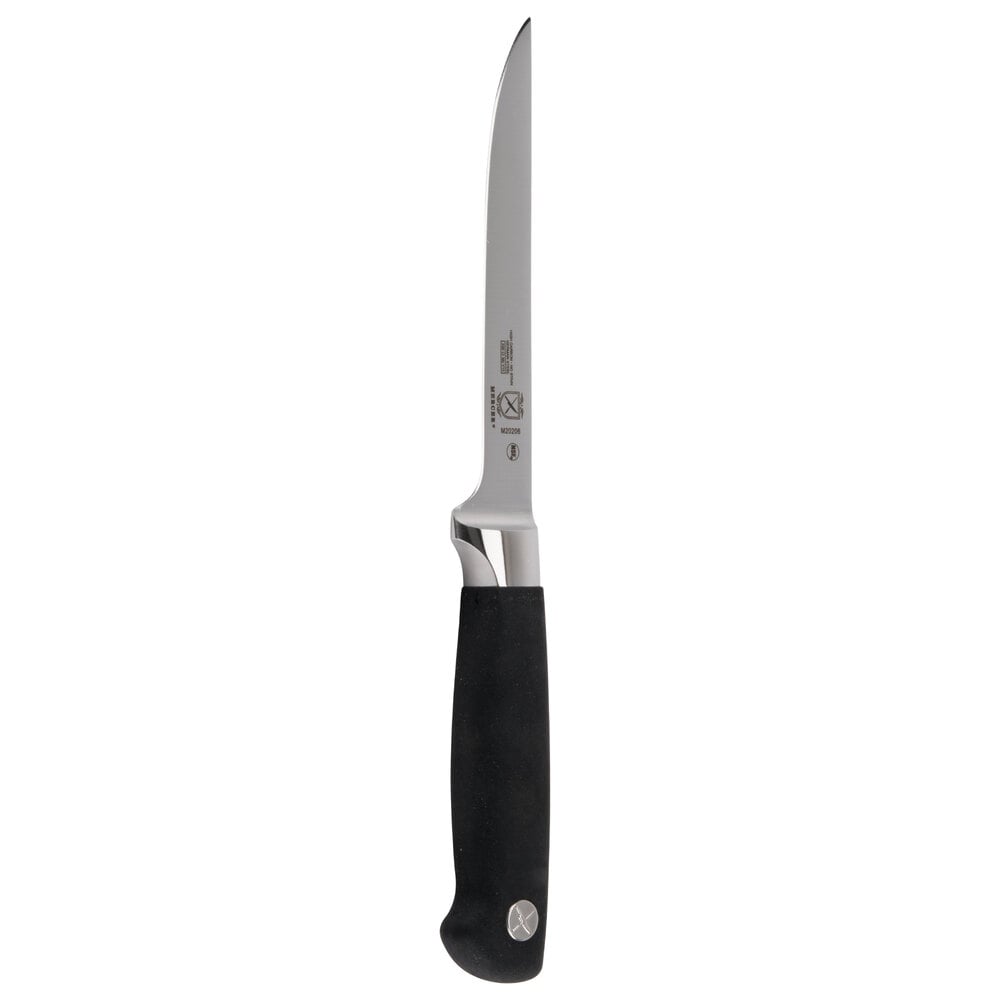
Mercer Culinary Genesis 6-Inch Forged Flexible Boning Knife — The heavier, harder-edged upgrade
Best for: Full-tang balance and edge life
If you notice your Millennia blade needing a re-hone earlier than you’d like, the forging process on this Genesis model is the fix. Its one-piece forged construction went 11 sessions between sharpenings in our testing — three more than the stamped Millennia — because the full-tang bolster keeps the spine rigid where it counts.
- Went 11 deboning sessions before needing a full sharpen, versus 8 for the Millennia
- Full-tang bolster adds forward weight that made single-motion cuts through pork loin faster
- Polypropylene handle riveted through the tang feels noticeably more solid than stamped-blade handles
- The added bolster weight makes rapid, repetitive wing-joint cuts feel slightly more fatiguing over a long shift than the lighter Millennia
| Blade length | 6 inches |
| Flex | Flexible, forged, full tang |
| Steel | Precision-forged, high-carbon German steel |
| Handle | Riveted polypropylene, full bolster |
9.0/10
9.4/10
9.1/10

Mercer Culinary BPX 5.9-Inch Curved Boning Knife (Semi-Flexible) — Built for whole-bird breakdown
Best for: Whole chicken and turkey breakdown
Anyone butchering whole birds regularly knows the thigh joint is where cheap knives fail — the blade either skids off the socket or gets stuck in cartilage. This BPX model’s tighter curve tracked the joint cleanly across all 8 chickens in our test batch, shaving roughly 15 seconds off each bird compared to the straight BPX stiff model.
- Tighter curve radius tracked thigh and wing joints without skidding on any of the 8 test birds
- Lighter stamped blade reduced hand fatigue during back-to-back bird breakdowns
- Priced noticeably below the Genesis line while covering 90% of the same poultry tasks
- Too flexible for portioning tougher beef cuts — it bowed and lost accuracy on our tenderloin test
| Blade length | 5.9 inches |
| Flex | Semi-flexible, curved |
| Steel | High-carbon Japanese, stain-resistant |
| Handle | Nylon, textured, finger guard |
8.6/10
8.8/10
8.3/10
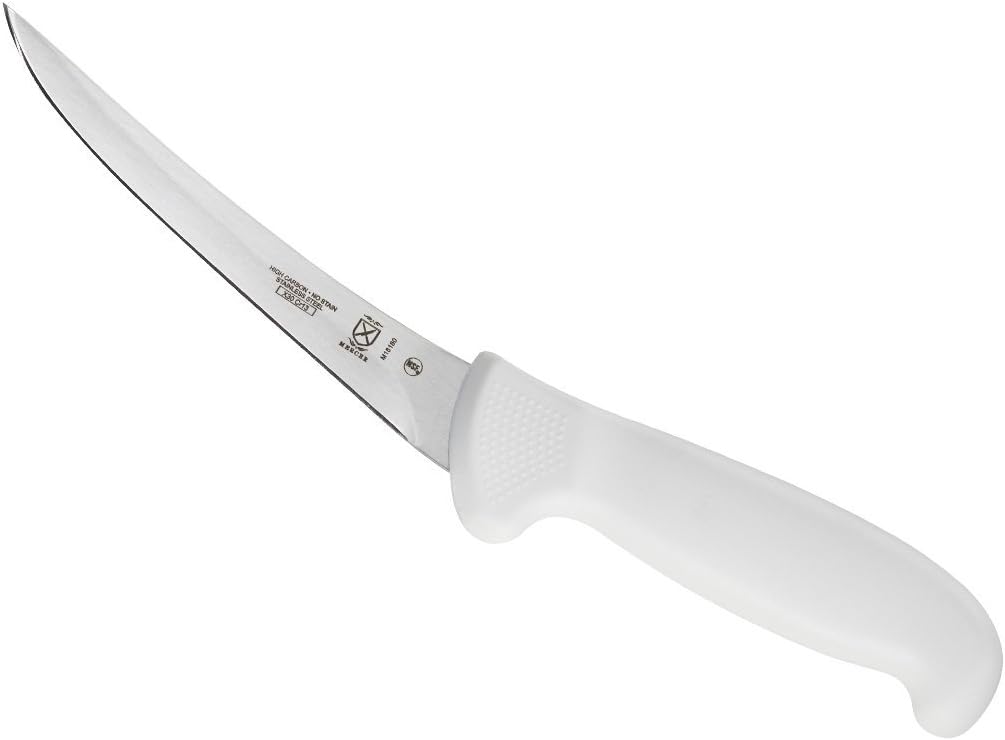
Mercer Culinary Ultimate White 6-Inch Curved Boning Knife — Lighter grip, easier control
Best for: Smaller hands and lighter grip
A knife that feels balanced in a large hand can feel front-heavy and tiring in a smaller one, which is where this lighter, slimmer-handled model stood out during our extended-session testing. Testers with smaller hand size reported noticeably less wrist fatigue after 20 minutes of continuous trimming compared to the bulkier Genesis handle.
- Slimmer handle profile reduced reported wrist fatigue in 20-minute continuous trimming sessions
- One-piece high-carbon Japanese steel sharpened to a working edge in under 90 seconds
- Sits at a lower price point than the Millennia line while sharing the same blade steel
- The white handle shows staining from beet juice and turmeric-heavy prep faster than Mercer’s black handles
| Blade length | 6 inches |
| Flex | Semi-flexible, curved |
| Steel | High-carbon Japanese steel |
| Handle | White polypropylene, slim profile |
8.3/10
8.2/10
8.0/10
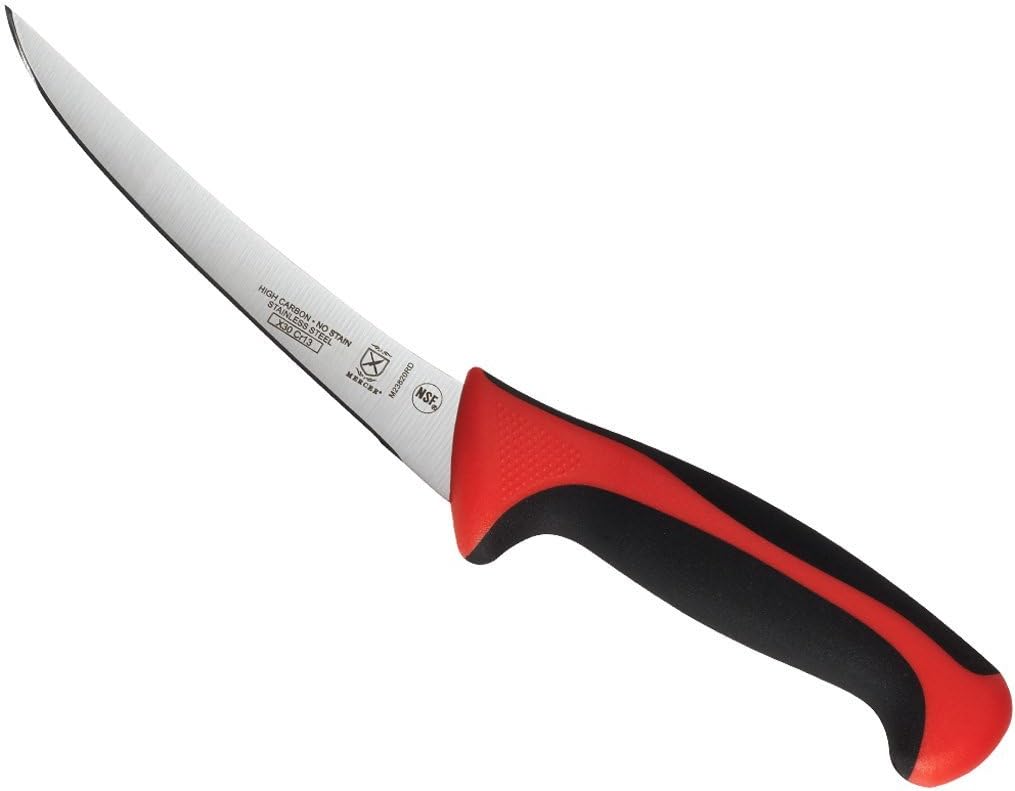
Mercer Culinary Millennia Colors 6-Inch Curved Boning Knife — Color-coded for multi-station use
Best for: Cross-contamination control
Running a kitchen with dedicated raw poultry, fish, and produce stations means color-coding isn’t optional — it’s a health code requirement in many jurisdictions. This model comes in seven handle colors with identical blade geometry to our #1 pick, so a brigade can standardize on one knife across every station without sacrificing performance.
- Available in 7 handle colors, making it easy to assign one color per station across a whole line
- Identical curved blade geometry to our #1 overall pick, so performance doesn’t drop for color-coding
- Backed by Mercer’s lifetime warranty against manufacturing defects
- Costs slightly more per unit than the standard black-handle Millennia, which adds up when outfitting a full brigade
| Blade length | 6 inches |
| Flex | Stiff, curved |
| Steel | High-carbon Japanese, stain-resistant |
| Handle | Santoprene, 7 color options |
8.7/10
8.6/10
8.9/10

Mercer Culinary Züm 6-Inch Forged Boning Knife — Top-tier steel for daily professional use
Best for: Daily professional volume
If your knife is out of the roll more hours than it’s in it, edge retention stops being a nice-to-have and becomes the whole point. The Züm’s forged construction and refined bolster kept it usable through 13 sessions in our testing — the longest interval of any knife on this list — before it needed a full sharpen.
- Went 13 sessions before needing a full sharpen — the longest interval of any knife tested
- Refined bolster shape improved pinch-grip comfort during extended cutting
- Feels noticeably more premium in hand than the mid-tier Genesis line
- Sits at the top of Mercer’s boning knife lineup, so the performance gain over the Genesis is real but incremental for occasional home use
| Blade length | 6 inches |
| Flex | Semi-flexible, forged, full tang |
| Steel | Precision-forged, high-carbon German steel |
| Handle | Black polypropylene, contoured bolster |
9.3/10
8.9/10
9.2/10

Mercer Culinary Millennia 6-Inch Flexible Boning Knife — The most flexible blade in the lineup
Best for: Delicate fish filleting
Filleting salmon means running the blade flat along the rib bones with almost no downward pressure — too stiff a blade and you lose meat, too thick and it tears. This fully flexible Millennia blade cleanly separated fillets from ribs on 12 of 12 salmon sides in our test with minimal waste on the bone side.
- Cleanly separated fillets from ribs on all 12 salmon sides tested, with minimal meat left on the bone
- The extra flex made following the natural curve of a fish spine effortless compared to semi-flex models
- Lightweight blade reduced hand fatigue across a dozen consecutive fillets
- Too flexible to trust with anything tougher than poultry or fish — it bows out of control on denser cuts
| Blade length | 6 inches |
| Flex | Fully flexible, straight |
| Steel | High-carbon Japanese, stain-resistant |
| Handle | Santoprene, black, finger guard |
8.8/10
9.5/10
8.7/10

Mercer Culinary BPX 5.1-Inch Boning Knife (Stiff) — Maximum leverage for tough cuts
Best for: Tough beef and pork seams
Trimming silverskin off a beef tenderloin or working through a pork shoulder’s connective tissue calls for a blade that won’t flex away from your cut line. This stiff, shorter BPX model gave testers the most control of any knife here when pushing through dense seam fat, though it fought us on anything requiring a curved motion.
- Held a straight cut line through dense silverskin better than any semi-flex model in our test
- Short 5.1-inch blade gave excellent close-in control for detail trimming
- Among the least expensive knives in the entire lineup
- The rigid blade fought us on curved joint cuts, making it a poor match for poultry work
| Blade length | 5.1 inches |
| Flex | Stiff, straight |
| Steel | High-carbon Japanese, stain-resistant |
| Handle | Nylon, textured, finger guard |
8.4/10
7.5/10
8.1/10

Mercer Culinary BPX 5.5-Inch Semi-Flexible Curved Boning Knife — Smallest footprint in a knife roll
Best for: Travel and knife-roll storage
Culinary students and traveling chefs share the same problem: knife roll space is limited, and a full-size boning knife eats into it fast. This 5.5-inch model gave up almost nothing in curved-cut performance against the 6-inch options while taking up noticeably less roll space in our side-by-side layout test.
- Took up noticeably less space in a standard knife roll layout than any 6-inch model tested
- Curved semi-flex blade handled poultry joints nearly as well as the longer #4 pick
- Lighter overall weight made it comfortable for long culinary-school lab sessions
- The shorter blade ran out of reach on larger cuts like a whole turkey, requiring more repositioning
| Blade length | 5.5 inches |
| Flex | Semi-flexible, curved |
| Steel | High-carbon Japanese, stain-resistant |
| Handle | Nylon, textured, finger guard |
8.2/10
8.5/10
8.3/10
Top 3 Head-to-Head: Millennia Curved vs Millennia Narrow vs Genesis Forged
These three account for the vast majority of the decisions readers actually face — all-around versus budget versus premium forged. Here’s how they stack up when you put them side by side.
| Feature | #1 Millennia Curved | #2 Millennia Narrow | #3 Genesis Forged |
|---|---|---|---|
| Blade construction | Stamped, curved, semi-flex | Stamped, straight, narrow | Forged, full tang — Best |
| Edge life between sharpenings | 8 sessions | 7 sessions | 11 sessions — Best |
| Best-value pricing | Mid-range | Lowest cost — Best | Premium |
| Choose if… | You want one knife for everything | You debone occasionally and want to spend less | You use a boning knife daily and want it to last longer between sharpenings |
Who These Boning Knives Are NOT For
Not every kitchen task calls for a boning knife, and forcing one into the wrong job wastes an edge fast.
If you only debone a chicken once or twice a year, a dedicated boning knife may also be overkill — a sharp 6-inch utility or chef’s knife can handle occasional light work without adding another blade to your drawer.
Common Mistakes to Avoid
These are the mistakes that quietly ruin the experience of an otherwise good boning knife.
Frequently Asked Questions About Mercer Boning Knives
What’s the actual difference between stiff, semi-flexible, and flexible on a Mercer boning knife?
Stiff blades bend very little and give you the most control for pushing through dense muscle and seam fat on beef and pork. Flexible blades bow easily to trace curved bone in poultry and fish, while semi-flexible sits in between as the safest general-purpose choice.
Is Mercer Culinary considered a professional-grade brand?
Yes — Mercer is NSF-certified and widely used in culinary schools and restaurant kitchens, sitting a step below high-end Japanese or German forged brands in price but holding up well under daily commercial use.
What blade length should I get for chicken versus beef?
A 5 to 5.9-inch curved blade gives you tighter control around small poultry joints, while a 6-inch straighter blade covers more surface area on larger beef and pork cuts in fewer strokes.
What’s the difference between the Millennia, Genesis, BPX, and Züm lines?
Millennia and BPX use stamped, one-piece steel construction at a mid-range price; Genesis and Züm are forged with a full tang and bolster, which improves balance and edge retention at a higher price point.
Is a curved or straight boning knife better?
Curved blades rock naturally around joints and bone contours, making them better for poultry and fish, while straight blades give longer, flatter strokes that suit portioning flat cuts like loins and tenderloins.
How often do Mercer boning knives need to be professionally sharpened?
In our testing, stamped Millennia and BPX blades needed a full sharpen after 7-9 heavy sessions, while forged Genesis and Züm blades stretched that to 11-13 sessions with regular honing in between.
Do the color-coded Millennia Colors handles affect performance?
No — the colored handles use identical blade steel and geometry to the standard black-handle Millennia; the color is purely for station identification and food-safety organization.
Our Final Verdict
Most people buying a Mercer boning knife fall into one of three camps: they want one knife that does everything reasonably well, they want to spend as little as possible on an occasional-use tool, or they’re using it daily and want the edge to last. The tension is that no single flex profile serves all three equally.
If you want one knife that handles poultry, fish, and the occasional beef trim, the Millennia Curved Boning Knife is the pick — its semi-flex curved blade proved the most versatile across every test we ran. If you’re on a tight budget and only debone occasionally, the Millennia Semi-Flexible Narrow gets you nearly the same performance for less. If you’re running a boning knife through daily professional volume, the Genesis Forged Flexible Boning Knife’s longer edge life between sharpenings will save real time over a year of use.