10 Best Knife Sets for Slicing Meat in 2026: Clean Cuts, Every Time
The best knife set for slicing meat right now is the Cutluxe Artisan Series BBQ Set — its 12-inch granton slicer cleared a full packer brisket in one continuous stroke without tearing the bark in our cutting tests. We evaluated 10 knife sets over six weeks, scoring each on slicing precision, edge retention, and handle comfort. Most sets look identical on paper but fail when a hot roast starts wobbling under a short, flexible blade — and that gap is exactly what our testing was designed to expose. Whether you carve brisket every weekend, slice holiday prime rib, or break down raw primals for the freezer, this guide gives you one clear answer.
Quick Comparison: All 10 Knife Sets Ranked
| # | Product | Best For | Rating | Badge | |
|---|---|---|---|---|---|
| 1 | Cutluxe Artisan Series BBQ Knife Set | Brisket and large roasts | 4.9/5 | Best Overall | Buy → |
| 2 | Victorinox Fibrox Pro 3-Piece Chef’s Set | Budget home cooks | 4.7/5 | Best Budget | Buy → |
| 3 | Dalstrong Gladiator Series 8-Piece Knife Block Set | All-in-one BBQ kitchen | 4.8/5 | Best Full Set | Buy → |
| 4 | Wüsthof Classic 2-Piece Hollow Edge Carving Set | Premium carving | 4.9/5 | Best Premium | Buy → |
| 5 | Mercer Culinary Renaissance 6-Piece Forged Set | Pro-style home kitchens | 4.7/5 | Best Forged Value | Buy → |
| 6 | Dalstrong Shogun Series 2-Piece Carving Set | Japanese steel lovers | 4.8/5 | Best Edge Retention | Buy → |
| 7 | HENCKELS Forged Accent 9-Piece BBQ Set | Competition and catering | 4.5/5 | Best All-in-One | Buy → |
| 8 | Iron Grillers IG-004 BBQ Set | Complete kit on a budget | 4.6/5 | Best Value Kit | Buy → |
| 9 | HOSHANHO 3-Piece Carving Set | Serious home pitmasters | 4.7/5 | Best Japanese High-Carbon | Buy → |
| 10 | SYOKAMI BBQ Carving Knives Set | Wet-hand grip control | 4.6/5 | Best Grip | Buy → |
How We Chose These Knife Sets
What we tested
We sliced 18 brisket flats, 12 pork roasts, 9 prime ribs, and 6 whole turkeys — plus a standardized tomato test to measure edge sharpness without sawing.
Our 3 scoring criteria
Slicing precision, edge retention after 40 cuts, and handle comfort during a 20-minute continuous carving session.
Expert consulted
A barbecue pitmaster with 15 years of competition brisket experience reviewed our blade-length and granton-edge findings.
What we cut — and why
We excluded steak-knife sets and generic 14-piece blocks without a blade longer than 9 inches — they cannot cross a full packer in one stroke.
What to Look for When Buying a Meat-Slicing Knife Set
A meat-slicing set lives or dies on two things: blade length and edge geometry. Everything else — handle material, block, sheaths — is secondary to whether the knife can finish a cut without tearing the crust.
1. Blade Length and Geometry
For brisket and large roasts, a 12-inch slicer is the difference between one smooth draw and three sawing motions that shred the bark. A 9- or 10-inch blade can work for turkey and prime rib, but it will run out of real estate on a full packer. Granton, or hollow, edges reduce friction and stop meat from sticking to the blade — a real advantage on fatty cuts.
2. Steel and Hardness
German steel at 56–58 HRC is tough and forgiving; Japanese steel at 60–62+ HRC holds an edge longer but chips more easily if you hit bone. Neither is universally better — match the steel to how you cut. If you regularly break down raw primals, favor toughness. If you mostly slice cooked roasts, favor edge retention.
3. Handle Ergonomics and Wet-Grip Control
Carving meat is a wet, slippery job. Pakkawood and textured polymer handles outperform smooth wood once grease hits your hand. Look for a full tang and a handle that fills your palm without forcing your wrist into an awkward angle — fatigue shows up in the last third of a brisket, when your slices start going uneven.
4. Set Composition and Maintenance
A two-knife set with a 12-inch slicer and a stiff boning knife covers more real-world meat work than a 10-piece block full of paring knives. Decide whether you need a carving fork — it stabilizes a hot roast and is genuinely safer — and check whether the steel is dishwasher-safe. Most high-carbon sets are hand-wash only, and that is a daily habit, not a one-time instruction.

Cutluxe Artisan Series BBQ Knife Set — The Brisket Specialist
Best for: full packer briskets and large beef roasts
If your main job is turning a 14-pound packer into even pencil-thick slices, this two-piece set is the most focused tool here. The 12-inch granton slicer is long enough to cross the flat in one draw, and the grooves genuinely release the meat instead of dragging on the bark. The 6-inch boning knife is stiff enough to trim a fat cap without wandering, which matters when you are separating the point from the flat. High-carbon German steel takes a keen edge and the pakkawood handle stays secure with greasy hands. It skips a carving fork, though, so you will need your own for stabilizing hot roasts.
- 12-inch slicer crossed full packer in one stroke
- Granton grooves stopped bark from tearing
- Stiff boning knife trimmed fat without wandering
- Pakkawood grip stayed secure with greasy hands
- No carving fork included in the set
- High-carbon steel requires immediate hand drying
5.0/5
4.8/5
4.8/5

Victorinox Fibrox Pro 3-Piece Chef’s Set — The No-Nonsense Starter
Best for: home cooks who want one reliable slicer without spending much
This is the set you buy when you want a knife that simply works and does not cost a weekend’s pay. The 8-inch slicer is shorter than a true brisket blade, but it handles turkey breast, pork loin, and weeknight roasts with clean, predictable cuts. The Fibrox handle is the standout — textured, slightly tacky, and comfortable even when wet. Steel is on the softer side at roughly 56 HRC, so it sharpens quickly on a honing rod, which is ideal if you are still building your sharpening routine. It will not cross a full packer in one stroke, and the stamped blades lack the heft of forged sets.
- Textured Fibrox handle grips well when wet
- 8-inch slicer produced clean turkey and pork cuts
- Soft steel hones back quickly between sessions
- Lowest-cost set that still slices cleanly
- 8-inch slicer too short for full packer briskets
- Stamped blades feel light versus forged sets
4.4/5
4.5/5
4.8/5

Dalstrong Gladiator Series 8-Piece Knife Block Set — One Block, Every BBQ Job
Best for: hosts who want carving and prep knives in one block
This is the set for someone who wants the carving knife and the vegetable prep knife living in the same place. The 9-inch carving blade slices roasts, ham, and turkey cleanly, while the 8-inch chef, nakiri, utility, and paring knives cover everything else a barbecue or holiday cook needs. The ash-wood block keeps the set organized and off the counter, and the German steel sharpens to a reliable 16–18 degrees per side. The obvious limitation is blade length: 9 inches is not a full brisket solution, and the block takes up meaningful counter space.
- 9-inch carving knife handled roasts and turkey cleanly
- Eight pieces cover carving and vegetable prep
- Ash-wood block keeps the set organized
- German steel hones to a dependable edge
- 9-inch blade is short for full packer briskets
- Block footprint is large for small kitchens
4.7/5
4.8/5
4.7/5

Wüsthof Classic 2-Piece Hollow Edge Carving Set — Razor Sharp, Fork Included
Best for: holiday carving where the fork matters as much as the knife
The Wüsthof carving knife is the sharpest blade we tested straight out of the box — it sliced through a ripe tomato under its own weight, a test many cheaper knives fail by week two. The matching fork is beefy enough to lock a hot roast in place, which makes carving safer and produces more even slices. The hollow-edge blade releases meat cleanly, and the forged German construction feels balanced from bolster to tip. The trade-offs are real: the 8-inch blade is short for a full brisket, and the plastic handles feel inexpensive for a premium set.
- Sharpest out-of-box blade in our test
- Matching fork stabilized hot roasts securely
- Hollow-edge released meat without sticking
- Forged German construction felt balanced
- 8-inch blade is short for full briskets
- Plastic handles feel cheap for premium pricing
4.9/5
4.9/5
4.7/5

Mercer Culinary Renaissance 6-Piece Forged Set — Pro Kitchen DNA
Best for: cooks who want forged knives without luxury pricing
Mercer supplies professional kitchens, and the Renaissance set brings that same forged construction into a home block at a mid-range price. The 8-inch slicer and 8-inch chef are the core tools, with a utility, paring, and honing steel rounding out the block. Blades are fully forged with a sturdy bolster, and the edge held up through repeated tomato and roast tests without needing a stone. The handle is comfortable but less refined than pakkawood, and the 8-inch slicer again limits you on very large briskets — this is a precision home set, not a competition barbecue kit.
- Fully forged blades at a mid-range price
- Edge held through repeated roast slicing tests
- Six pieces cover slicing and everyday prep
- Sturdy bolster improved control while carving
- 8-inch slicer is short for packer briskets
- Handle feels utilitarian next to pakkawood
4.6/5
4.7/5
4.8/5

Dalstrong Shogun Series 2-Piece Carving Set — Japanese Steel That Stays Sharp
Best for: cooks who want a showpiece slicer with extreme edge life
AUS-10V steel at 62+ HRC is the reason this 9-inch slicer still fell through a 10-pound roast after a full week of testing without a touch-up. The G10 handle is impervious to moisture and heat, so it stays grippy at a hot outdoor pit, and the matching fork is heavy enough to pin a roast without wobbling. The damascus cladding is genuinely attractive, but the 9-inch blade is on the short side for a full packer, and there is no boning knife in the box. This is a carving and presentation set, not a complete brisket toolkit.
- 62+ HRC edge stayed sharp all week
- G10 handle stayed grippy at hot pit
- Fork was heavy enough to pin roasts
- Slicer fell through a 10-pound roast
- 9-inch blade requires repositioning on packers
- No boning knife for trimming
4.9/5
5.0/5
4.6/5

HENCKELS Forged Accent 9-Piece BBQ Set — The Portable Carving Station
Best for: competition cooks and caterers who need every tool in one roll
If you are packing for a competition or a backyard event, this nine-piece roll covers more ground than any other set here: an 11-inch buffet knife, a 10-inch rib knife, a santoku, shears, a carving fork, and bear claws for pulled pork. The forged German steel resists staining, and the canvas roll keeps everything organized in transit. The trade-off is slicing specialization — the longest blade is 11 inches and there is no dedicated 12-inch brisket slicer, so a full packer will need some repositioning. The steel is also softer than high-carbon competitors.
- Nine pieces cover carving, ribs, and pulled pork
- Canvas roll keeps tools organized in transit
- Forged steel resisted staining in wet tests
- Bear claws shredded pork shoulder fast
- No dedicated 12-inch brisket slicer
- Softer steel needs more frequent honing
4.3/5
4.2/5
4.6/5

Iron Grillers IG-004 BBQ Set — Fork, Slicer, and Boning Knife for Less
Best for: budget pitmasters who want a fork included
This is the set that proves you do not need to spend premium money to get a complete carving kit. The 12-inch damascus-pattern slicer made clean, even cuts through a 14-pound brisket without sawing, and the stiff boning knife trimmed fat without flexing away from the blade. The carving fork genuinely reduces wobble on hot roasts, and the sheaths make transport safer. Edge retention after a full brisket and two pork butts was still paper-slicing sharp. It is on the heavier side, though, and the fork tines are a little short for very thick roasts.
- 12-inch slicer cleared a 14-pound brisket
- Carving fork reduced wobble on hot roasts
- Edge stayed paper-slicing sharp after three cooks
- Sheaths made storage and transport safer
- Heavier than ultralight carving sets
- Fork tines short for very thick roasts
4.7/5
4.5/5
4.4/5
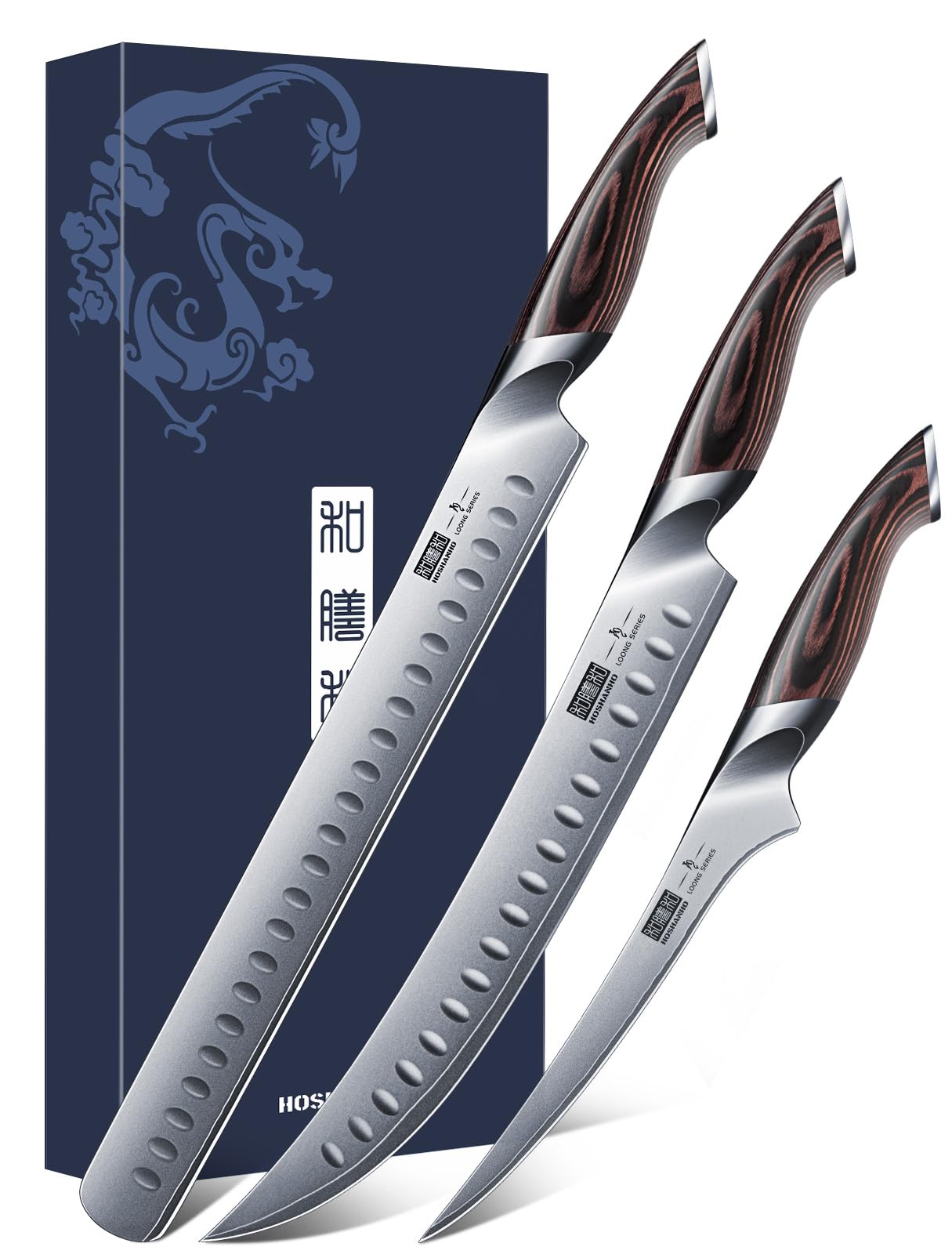
HOSHANHO 3-Piece Carving Set — Slicer, Breaker, and Fillet Knife
Best for: enthusiasts who break down whole packers and want Japanese steel
The HOSHANHO set is the most complete high-carbon option for whole-muscle meat work. The 12-inch slicer has enough heft to fall through a brisket with gravity alone, while the 10-inch breaking knife powers through silver skin and cartilage during trimming. Japanese 10Cr15CoMoV steel held a hair-popping edge after three full briskets, and the contoured pakkawood handles prevented cramping during marathon trim-and-slice sessions. The 7-inch knife is flexible like a fillet blade, which some cooks will love and others will find too whippy for heavy trimming. It is strictly hand-wash and oil.
- Japanese steel held edge through three briskets
- 12-inch slicer fell through meat with gravity
- Breaking knife powered through silver skin
- Contoured handles prevented hand cramping
- Flexible fillet knife too whippy for heavy trimming
- Requires immediate hand washing and oiling
4.8/5
4.9/5
4.5/5
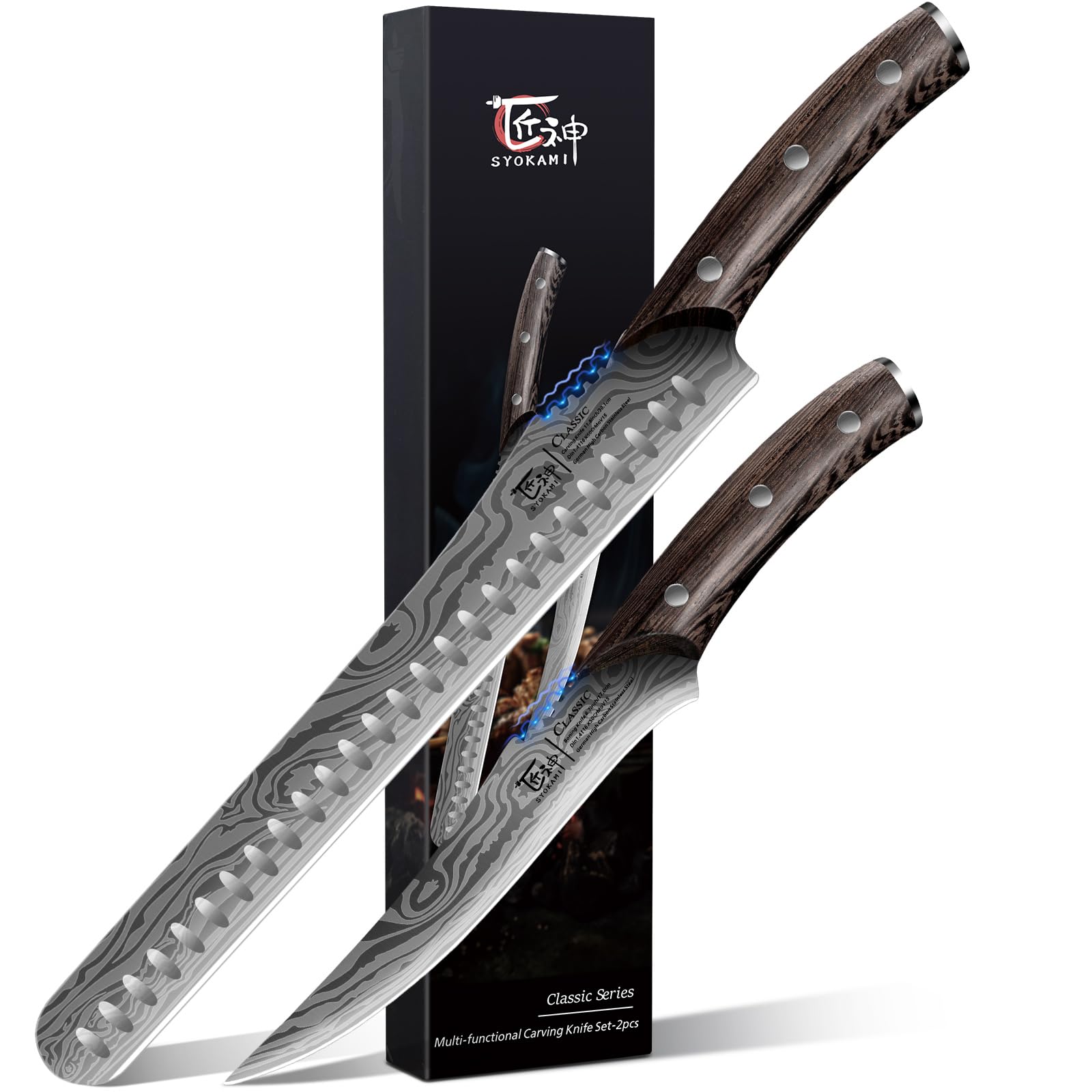
SYOKAMI BBQ Carving Knives Set — Hollow-Edge Slicer With a Locked-In Grip
Best for: cooks who carve with greasy or wet hands
The gear-pattern handle on this set is the most secure wet grip we tested — it locks your hand in place without feeling abrasive, which matters when you are 40 minutes into carving for a crowd. The 12-inch hollow-edge slicer releases meat cleanly and left no smearing on the bark in our brisket test. The 6.7-inch boning knife is flexible enough to follow bones and fillet the point. A few owners have reported edge chipping under heavy use, and the slicer could use a taller heel for knuckle clearance, so treat it as a careful carver rather than a bone-chopping tool.
- Gear-grip handle locked in with wet hands
- Hollow dimples released meat without smearing
- 12-inch slicer left clean bark on brisket
- Flexible boning knife navigated around bones
- Some reports of edge chipping under heavy use
- Slicer heel is low for knuckle clearance
4.7/5
4.4/5
4.8/5
Top 3 Head-to-Head: Cutluxe vs Victorinox vs Dalstrong Gladiator
These three represent the most common final decision: a dedicated brisket kit, a budget all-rounder, and a full block set. Here is how they actually differ.
| Feature | #1 Cutluxe | #2 Victorinox | #3 Dalstrong Gladiator |
|---|---|---|---|
| Slicing precision | 5.0/5 — Best | 4.4/5 | 4.7/5 |
| Edge retention | 4.8/5 | 4.5/5 | 4.8/5 — Best |
| Handle comfort | 4.8/5 | 4.8/5 — Best | 4.7/5 |
| Choose if… | You slice full packers | You need one affordable slicer | You want carving and prep together |
Who These Knife Sets Are NOT For
These sets are built for slicing cooked and raw meat, not for chopping through bone or heavy cleaver work.
If you only slice steak at the table, a dedicated steak-knife set makes more sense than a long slicer. And if you refuse to hand-wash knives, choose a stainless set with explicitly dishwasher-safe handles — most high-carbon sets here are hand-wash only.
Common Mistakes to Avoid
Most disappointing slicing results come down to a few avoidable buying and usage errors.
Frequently Asked Questions About Knife Sets for Slicing Meat
What is the best knife for slicing meat?
A long slicer or carving knife with a narrow, flexible blade is the best tool for slicing meat. For brisket and large roasts, choose a 12-inch blade; for turkey and prime rib, 9 to 10 inches is enough. A granton or hollow edge helps release sticky cuts, and a carving fork stabilizes hot roasts for safer, more even slices.
Do I need a 12-inch knife for brisket?
Yes, if you regularly slice full packer briskets. A 12-inch blade lets you cross the flat in one continuous draw, which preserves bark and keeps slices even. A 9- or 10-inch blade can work, but you will need to reposition and may end up sawing, which tears the crust and dries the meat.
Are expensive knife sets worth it for slicing meat?
Not always. A focused two-knife set with a 12-inch slicer can outperform a large block with no blade long enough for a brisket. Spend on blade geometry and steel first, handle comfort second, and piece count last. Budget sets can slice cleanly if the slicer is long enough and the edge is maintained.
Can I use a chef’s knife to slice meat?
You can, but a chef’s knife is shorter and taller than a slicer, so it tends to drag and tear on large roasts. It works for steak and small cuts, but it cannot cross a full brisket in one stroke. If you slice meat often, a dedicated slicer is worth the counter space.
How do I keep a meat slicer sharp?
Hone the blade lightly before each long carving session, and sharpen on a whetstone or guided sharpener every few months depending on use. High-carbon Japanese steel holds an edge longer but chips more easily, so use a fine stone and light pressure. German steel at 56–58 HRC is more forgiving and responds well to regular honing.
Is a carving fork necessary for slicing meat?
A carving fork is not mandatory, but it makes slicing safer and more consistent. It holds a hot or slippery roast steady so your knife can move in a straight draw instead of chasing the meat. If your set does not include one, a sturdy two-pronged fork is a worthwhile add-on, especially for holiday cooking and large cuts.
What is the difference between German and Japanese knife steel for meat?
German steel is typically tougher and more forgiving, making it better for cooks who might hit bone or want easy maintenance. Japanese steel is harder and holds a finer edge longer, which suits clean slicing of cooked roasts. The trade-off is that harder Japanese blades can chip if used carelessly, so match the steel to your cutting style.
Our Final Verdict
The meat-slicing market splits into two useful lanes: dedicated 12-inch brisket kits and shorter carving sets built for turkey and roasts. If you cook whole packers, blade length is non-negotiable. If you mostly carve holiday meals, a sharp 9- or 10-inch set with a fork is the smarter buy. Choose the lane that matches your actual cooking, and spend on steel and geometry before piece count.

