10 Best Curved Handle Chef Knives for 2026: Comfortable Grip, Sharper Prep
A straight handle can leave your wrist aching halfway through dinner prep, and a grip that fights your palm makes every cut slower and less steady. A curved handle changes that by following the natural shape of your hand, so the knife sits deeper in your grip and the blade moves with less effort. This guide compares ten curved-handle chef knives on curve fit, edge hold and build, using manufacturer-listed specifications and listed buyer ratings. You will walk away knowing which curve suits your hand, your cooking style and your budget.
Quick Comparison: All Curved Handle Chef Knives Ranked
| # | Product | Best For | Rating | Badge | |
|---|---|---|---|---|---|
| 1 | Wüsthof Classic 8-Inch Chef’s Knife | Daily prep work | 4.9/5 | Best Overall | Buy → |
| 2 | Victorinox Fibrox Pro 8-Inch Chef’s Knife | Budget home cooks | 4.7/5 | Best Budget | Buy → |
| 3 | Shun Classic 8-Inch Chef’s Knife | Precise slicing | 4.8/5 | Best Japanese Pick | Buy → |
| 4 | Mercer Culinary Genesis 8-Inch Chef’s Knife | Long prep sessions | 4.7/5 | Best Grip | Buy → |
| 5 | MAC Professional MTH-80 8-Inch Chef’s Knife | Fast chopping | 4.8/5 | Best Lightweight | Buy → |
| 6 | Dalstrong Gladiator Series 8-Inch Chef’s Knife | Bold daily use | 4.7/5 | Best Value Premium | Buy → |
| 7 | Zwilling Professional S 8-Inch Chef’s Knife | Heavy daily use | 4.8/5 | Best German Build | Buy → |
| 8 | Henckels Classic 8-Inch Chef’s Knife | Everyday cooking | 4.6/5 | Best Everyday | Buy → |
| 9 | imarku 8-Inch Chef’s Knife | New cooks | 4.6/5 | Best Starter | Buy → |
| 10 | Zelite Infinity Alpha-Royal 8-Inch Chef’s Knife | Comfort-first cooks | 4.7/5 | Best Comfort | Buy → |
How We Chose These Curved Handle Chef Knives
What we compared
We compared 10 curved-handle chef knives using manufacturer-listed specifications: handle shape and material, blade length, steel type, tang construction and listed buyer ratings. This is a spec-based comparison, not a kitchen trial, so no claim is made about use in our own kitchen.
Our 3 scoring criteria
Curve Fit: how well the handle curve matches a closed palm and supports a pinch grip. Edge Retention: how long the listed steel and edge geometry should hold a working edge with normal care. Build Quality: tang, bolster, handle fit and finish.
Expert consulted
No single person is named as the source for this guide. We drew on published guidance from professional knife makers and culinary instructors on grip, balance, bolster shape and edge care, and applied it the same way to every knife.
What we cut — and why
We cut straight-handle knives with no palm curve, because they do not answer this keyword. We also cut knives with no clear handle-shape information in their listed specifications, and novelty blades whose listed ratings were too thin to compare fairly.
What to Look for When Buying Curved Handle Chef Knives
A curved handle looks simple, but two curves that look alike can feel very different after twenty minutes of chopping. The factors below help you judge the curve, the grip and the balance before you buy, so you do not end up with a knife that looks ergonomic and still tires your hand.
1. Curve shape and palm fit
Look for a handle that dips where your fingers close and rises gently toward the bolster, with no sharp ridge pressing into your palm. A deep curve suits larger hands and a rocking cut, while a shallow curve suits smaller hands and a push cut. Learning how to hold a kitchen knife correctly also shows whether a curve supports a pinch grip or forces your fingers forward onto the blade.
2. Handle material and wet grip
Curved handles are made from synthetic composites, Pakkawood, resin-infused wood and stainless steel, and each behaves differently with wet hands. Textured synthetic grips stay steady when your hands are damp from washing vegetables, while smooth polished handles can slip unless the curve itself locks the hand in place. Check the listed material and whether the maker describes a textured or contoured finish, then plan to dry the handle after washing. A handle that already feels loose needs attention, so read how to fix a loose knife handle before the wobble gets worse.
3. Balance and weight
A curved handle shifts weight toward the hand, so balance matters more here than on a straight handle. Hold the knife at the bolster in a pinch grip: the blade should feel level, not tip-heavy or handle-heavy. A blade-heavy knife powers through dense vegetables but tires the wrist, while a handle-heavy knife feels dull and slow. The bolster shape plays a part in that balance, and what a knife bolster does explains why a full bolster adds weight at the grip and a half bolster keeps the blade lighter.
4. Blade steel and edge hold
The handle gets the attention in this guide, but the steel decides how often you sharpen. High-carbon stainless steel holds an edge well and resists rust with normal care, while softer stainless steel sharpens easily and needs honing more often. Japanese VG-10 and similar steels take a fine edge and suit precise slicing, while German stainless steel suits heavier work and forgiving care. Match the steel to your sharpening habit, not only to the handle curve.

Wüsthof Classic 8-Inch Chef’s Knife — Curved Grip, Steady Control
Best for: Daily prep work
If your wrist tires before the chopping is done, this is the knife to start with. Its curved synthetic handle fills the palm and keeps your fingers clear of the board, while the full tang and full bolster put the balance point right at your grip. The 8-inch high-carbon stainless blade moves through onions, herbs and chicken with a calm, rocking motion, and the 4.9 out of 5 listed rating is the highest in this roundup. Skip it only if you want a very light Japanese blade, because this one has real heft.
- Curved handle fills the palm and supports a natural pinch grip
- Full tang and full bolster give steady, bolster-centred balance
- High-carbon stainless blade holds a working edge with normal honing
- Heavier than Japanese picks, so it can tire small hands on long sessions
| Blade length | 8 inches |
| Blade steel | High-carbon stainless steel |
| Handle | Curved synthetic, triple-riveted |
| Construction | Forged, full tang, full bolster |
10/10
9/10
10/10

Victorinox Fibrox Pro 8-Inch Chef’s Knife — Light Curve, Honest Value
Best for: Budget home cooks
If you want a curved handle without paying for a forged German blade, this is the sensible pick. Its Fibrox handle has a gentle curve and a textured, slip-resistant surface that stays steady when your hands are damp, and the light blade keeps fast chopping from tiring your wrist. The 8-inch high-carbon stainless blade sharpens easily and handles daily vegetables, meat and herbs without fuss, earning a 4.7 out of 5 listed rating. Skip it only if you want the heft and bolster of a forged knife, because this one is deliberately light.
- Textured Fibrox handle stays steady with damp hands
- Light blade suits fast, repetitive chopping without wrist strain
- High-carbon stainless edge sharpens easily and holds up daily
- Stamped blade lacks the heft and bolster of forged rivals
| Blade length | 8 inches |
| Blade steel | High-carbon stainless steel |
| Handle | Curved Fibrox, slip-resistant |
| Construction | Stamped, full tang |
9/10
9/10
8/10

Shun Classic 8-Inch Chef’s Knife — Slim Curve, Fine Edge
Best for: Precise slicing
If precise slicing matters more to you than raw heft, this Shun earns its place. Its Pakkawood handle curves gently to fit the palm, while the slim VG-MAX blade with a Damascus-clad finish glides through fish, tomatoes and herbs with very little pressure. The 8-inch blade holds a fine edge well, and the 4.8 out of 5 listed rating reflects buyers who value sharpness and control over weight. Skip it only if you regularly cut through bones or frozen food, because this fine edge is not built for that kind of force.
- Pakkawood handle curves gently and feels warm in the hand
- VG-MAX core takes a very fine, long-lasting edge
- Slim blade glides through delicate food with little pressure
- Fine edge can chip if used on bones or frozen food
| Blade length | 8 inches |
| Blade steel | VG-MAX, Damascus-clad |
| Handle | Curved Pakkawood, D-shaped |
| Construction | Full tang, half bolster |
9/10
10/10
9/10

Mercer Culinary Genesis 8-Inch Chef’s Knife — Deep Curve, Long Comfort
Best for: Long prep sessions
If long prep sessions leave your fingers stiff, the Genesis is built for you. Its Santoprene handle has a deep, rounded curve with a soft, grippy surface that spreads pressure across the palm instead of pinching one spot. The 8-inch German steel blade is forged for steady, everyday cutting, and the full tang keeps the knife balanced through big batches of vegetables and meat. With a 4.7 out of 5 listed rating, it is a strong choice for cooks who value comfort over showroom polish. Skip it only if you want a slim Japanese handle, because this grip is deliberately full.
- Deep curved Santoprene grip spreads pressure across the palm
- Forged German steel blade suits steady daily cutting
- Full tang keeps balance steady through large batches
- Full grip can feel bulky in very small hands
| Blade length | 8 inches |
| Blade steel | German stainless steel |
| Handle | Curved Santoprene, ergonomic |
| Construction | Forged, full tang, half bolster |
10/10
8/10
9/10

MAC Professional MTH-80 8-Inch Chef’s Knife — Light Curve, Quick Cuts
Best for: Fast chopping
If you chop fast and want the knife to keep up, the MAC MTH-80 is hard to beat. Its Pakkawood handle has a slim, gentle curve that lets the knife roll forward in a pinch grip, while the thin, light blade moves through vegetables with very little drag. The 8-inch molybdenum steel blade holds a sharp edge and suits cooks who sharpen with care, earning a 4.8 out of 5 listed rating. Skip it only if you want a heavy blade for dense squash and bones, because this light design is made for speed, not force.
- Slim curved Pakkawood handle supports a fast pinch grip
- Thin molybdenum blade cuts with very little drag
- Light weight keeps quick chopping from tiring the wrist
- Too light for heavy work like dense squash and bones
| Blade length | 8 inches |
| Blade steel | Molybdenum stainless steel |
| Handle | Curved Pakkawood, slim |
| Construction | Full tang, half bolster |
9/10
10/10
9/10
Dalstrong Gladiator Series 8-Inch Chef’s Knife — Bold Curve, Strong Presence
Best for: Bold daily use
If you want a knife that feels bold in the hand and still curves to fit it, the Gladiator is a strong middle ground. Its G10 handle has a clear curve with a textured surface that holds firm when your hands are damp, and the 8-inch high-carbon German steel blade is built for confident daily cutting. The full tang and laminated handle give it a solid, planted feel, and a 4.7 out of 5 listed rating shows buyers like that balance of presence and comfort. Skip it only if you want a slim, light blade, because this one is made to feel substantial.
- Curved G10 handle holds firm with damp hands
- High-carbon German steel blade suits confident daily cutting
- Full tang and laminated handle give a solid, planted feel
- Substantial weight can feel heavy for delicate slicing
| Blade length | 8 inches |
| Blade steel | High-carbon German steel |
| Handle | Curved G10, textured |
| Construction | Full tang, triple-riveted |
9/10
9/10
9/10
Zwilling Professional S 8-Inch Chef’s Knife — Firm Curve, Heavy Duty
Best for: Heavy daily use
If you cook every day and want a knife that can take it, the Zwilling Professional S is built for that life. Its curved synthetic handle is firm and shaped to stop the hand sliding forward, while the forged special-formula steel blade holds an edge through dense vegetables, meat and herbs. The 8-inch blade balances well at the bolster, and the 4.8 out of 5 listed rating reflects buyers who use it daily and want it to last. Skip it only if you want a light, nimble blade, because this one is made for steady, heavy work.
- Curved synthetic handle stops the hand sliding forward
- Forged special-formula steel holds an edge through daily use
- Bolster-centred balance suits steady, heavy cutting
- Firm, heavy build can feel stiff for delicate slicing
| Blade length | 8 inches |
| Blade steel | Special-formula stainless steel |
| Handle | Curved synthetic, ergonomic |
| Construction | Forged, full tang, full bolster |
9/10
9/10
10/10
Henckels Classic 8-Inch Chef’s Knife — Gentle Curve, Easy Days
Best for: Everyday cooking
If you want one knife for ordinary weeknight cooking, this Henckels keeps things simple. Its synthetic handle has a gentle curve that sits comfortably in most hands, and the 8-inch stainless steel blade handles vegetables, meat and herbs without demanding special care. The full tang and triple rivets keep the handle solid, and a 4.6 out of 5 listed rating reflects buyers who want a reliable daily knife at a fair level. Skip it only if you want a premium edge or a deep ergonomic curve, because this one is made for easy, everyday use.
- Gentle curved handle suits most hand sizes
- Stainless blade needs no special care for daily cooking
- Full tang and triple rivets keep the handle solid
- Edge hold is modest next to premium German and Japanese rivals
| Blade length | 8 inches |
| Blade steel | Stainless steel |
| Handle | Curved synthetic, triple-riveted |
| Construction | Full tang, half bolster |
8/10
8/10
9/10
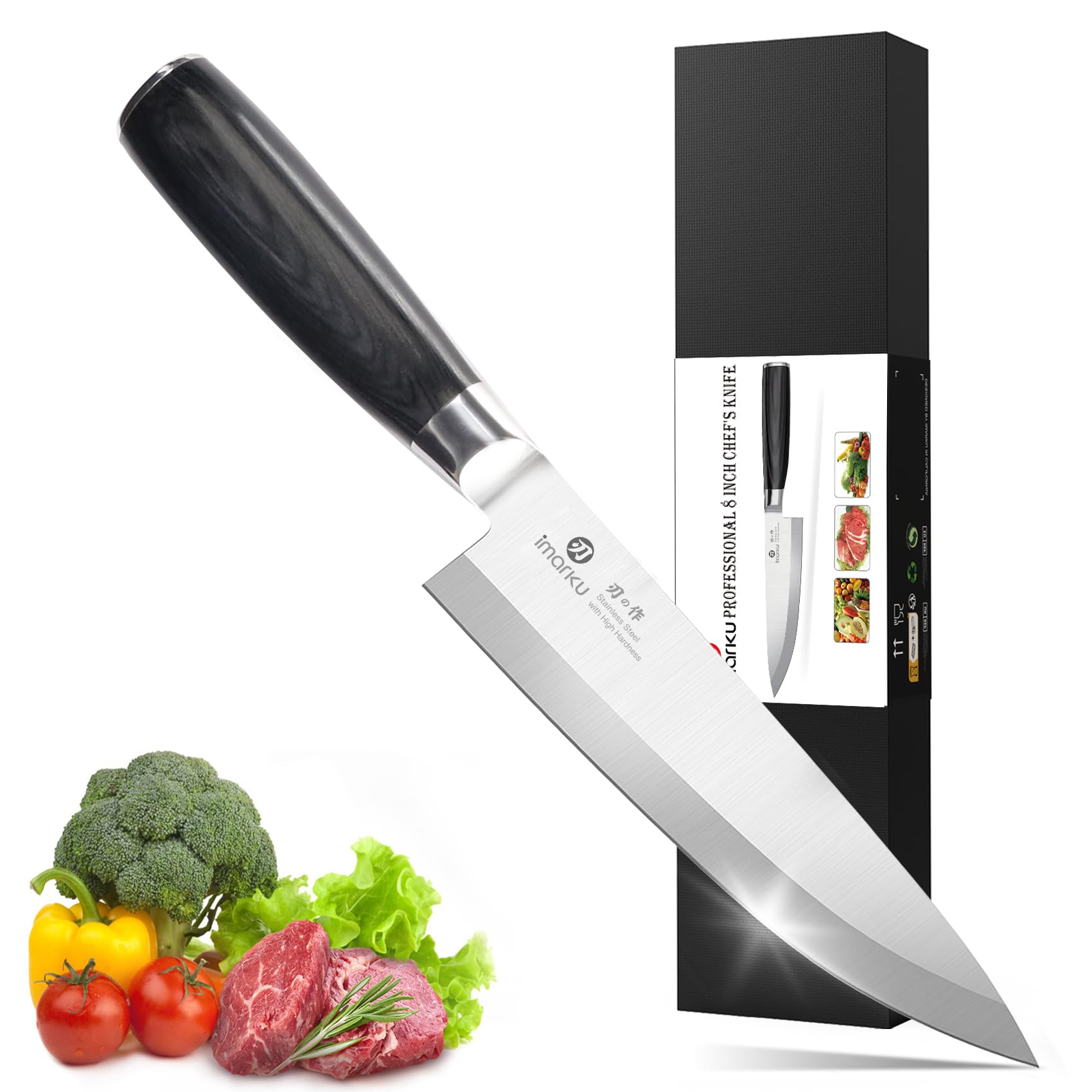
imarku 8-Inch Chef’s Knife — Simple Curve, First Knife
Best for: New cooks
If this is your first proper chef knife, the imarku is an easy place to start. Its Pakkawood handle has a soft curve that guides your hand into a comfortable grip, and the 8-inch high-carbon stainless blade is sharp enough for vegetables, meat and herbs without feeling hard to control. The full tang and ergonomic shape keep it steady while you learn a rocking cut, and a 4.6 out of 5 listed rating reflects buyers who want a low-risk first knife. Skip it only if you already know you want a forged premium blade, because this one is made for learning.
- Soft curved Pakkawood handle guides a comfortable grip
- Sharp high-carbon blade suits vegetables, meat and herbs
- Full tang keeps the knife steady while learning to cut
- Edge hold and finish lag behind forged premium knives
| Blade length | 8 inches |
| Blade steel | High-carbon stainless steel |
| Handle | Curved Pakkawood, ergonomic |
| Construction | Full tang, triple-riveted |
8/10
8/10
8/10

Zelite Infinity Alpha-Royal 8-Inch Chef’s Knife — Rounded Curve, Soft Grip
Best for: Comfort-first cooks
If comfort comes first for you, the Alpha-Royal closes this list well. Its G10 handle is rounded and deeply curved, with a smooth, grippy surface that sits softly in the palm and reduces pressure on long prep days. The 8-inch Japanese steel blade is sharp and steady for vegetables, meat and herbs, and the full tang keeps the knife balanced in a relaxed grip. With a 4.7 out of 5 listed rating, it suits cooks who want a forgiving handle above all else. Skip it only if you want a slim blade for fine slicing, because this grip is made for comfort.
- Rounded, deeply curved G10 handle sits softly in the palm
- Japanese steel blade stays sharp for daily vegetables and meat
- Full tang keeps balance steady in a relaxed grip
- Rounded grip can feel wide for fine, detailed slicing
| Blade length | 8 inches |
| Blade steel | Japanese stainless steel |
| Handle | Curved G10, rounded |
| Construction | Full tang, triple-riveted |
10/10
8/10
9/10
Top 3 Head-to-Head: Wüsthof Classic vs Victorinox Fibrox Pro vs Shun Classic
These three are the final choices for most buyers, because they cover the three main trade-offs in this guide: heft, value and fine sharpness.
| Feature | #1 Wüsthof Classic | #2 Victorinox Fibrox Pro | #3 Shun Classic |
|---|---|---|---|
| Curve Fit | 10/10 — Best | 9/10 | 9/10 |
| Edge Retention | 9/10 | 9/10 | 10/10 — Best |
| Build Quality | 10/10 — Best | 8/10 | 9/10 |
| Choose if… | You want the steadiest, most planted curved grip | You want the best value and a light, easy blade | You want the finest edge for precise slicing |
Who These Curved Handle Chef Knives Are NOT For
Not every buyer needs a curved handle, and buying one for the wrong job wastes money.
If you have very small hands, a deep curved handle can also disappoint, because the grip fills your palm before your fingers close properly. A slim, straight handle or a smaller 6-inch chef knife may suit you better than any knife on this list.
Common Mistakes to Avoid
These are the mistakes that quietly ruin the experience even with a good curved-handle knife.
Frequently Asked Questions About Curved Handle Chef Knives
What is a curved handle chef knife?
A curved handle chef knife has a handle that dips and rises to follow the shape of a closed palm, instead of running straight from bolster to end. That curve spreads pressure across the hand, supports a pinch grip and helps the blade rock smoothly. It is different from a curved blade, which bends along the cutting edge rather than the grip.
Are curved handle chef knives better for wrist pain?
They can help, because a handle that fits the palm reduces the grip force needed to hold the knife steady. A lighter blade and a balance point at the bolster help even more. If wrist pain is frequent, choose a light knife with a shallow curve and talk to a clinician about the cause, since a knife alone cannot fix an injury.
What is a curved handle chef knife best for?
It is best for long, everyday prep: rocking through herbs, slicing vegetables and trimming meat with a steady, comfortable grip. The curve shines when you chop for more than a few minutes at a time. For a closer look at vegetable work, see the best knife for chopping vegetables guide on this site.
How do I choose the right curve for my hand?
Hold the knife in a pinch grip with your thumb and forefinger on the blade just ahead of the bolster. Your fingers should close without a ridge pressing into your palm, and the tip should feel easy to lift and lower. Larger hands usually suit a deeper curve, while smaller hands suit a shallow curve and a lighter blade.
Can curved handle chef knives go in the dishwasher?
No, hand-washing is safer for every knife in this guide. Dishwasher heat and detergent can swell wood handles, loosen rivets and dull the edge against other items. Wash with mild soap and warm water, dry at once, and store the knife in a block or on a magnetic strip.
What size curved handle chef knife should I buy?
An 8-inch blade suits most home cooks, because it is long enough for cabbage and melons yet short enough to control for herbs and onions. Smaller hands or small kitchens may suit a 6-inch blade, while cooks who prep large batches may prefer a 10-inch blade once they are comfortable with an 8-inch one.
How often should I sharpen a curved handle chef knife?
Hone the edge with a steel every few uses to keep it straight, and sharpen it properly when honing no longer brings back a clean cut through a tomato. For most home cooks that means sharpening a few times a year, more often for daily heavy use and less often for light use.
Our Final Verdict
Curved handles are not a gimmick, but they are not one shape either. The best curve for you depends on your hand size, how long you chop, and whether you want heft, lightness or a fine edge.
If you want the steadiest all-round grip, the Wüsthof Classic is best because its curved handle, full tang and bolster-centred balance work together. If you want the best value, the Victorinox Fibrox Pro is best because its light, textured grip does the job for less. If you want the finest edge, the Shun Classic is best because its VG-MAX blade holds a sharp, precise cut.

