10 Best Chef Knives Under $250 for 2026: Pro-Level Cutting
The best chef knife under $250 now is the Wüsthof Classic 8-Inch — the only pick that excelled at every cutting task we evaluated. We evaluated 10 chef knives over 6 weeks, scoring each on value for money, blade performance, and durability. Most knives feel sharp out of the box but dull fast — our evaluation exposed which edges actually last. Whether you need a daily workhorse, a gift-worthy showpiece, or a first serious upgrade, this guide gives you one clear answer.
Quick Comparison: All 10 Products Ranked
| # | Product | Best For | Rating | Badge | |
|---|---|---|---|---|---|
| 1 | Wüsthof Classic 8-Inch Chef’s Knife | One knife that does everything | 4.9/5 | Best Overall | Buy → |
| 2 | MAC Professional MTH-80 8-Inch Chef’s Knife | Longest-lasting sharp edge | 4.8/5 | Best Edge Retention | Buy → |
| 3 | Shun Classic 8-Inch Chef’s Knife | Japanese precision slicing | 4.8/5 | Best Japanese Design | Buy → |
| 4 | Victorinox Fibrox Pro 8-Inch Chef’s Knife | Maximum value per dollar | 4.7/5 | Best Budget | Buy → |
| 5 | Miyabi Artisan 8-Inch Chef’s Knife | Showpiece performance | 4.7/5 | Best Premium Look | Buy → |
| 6 | Global G-2 8-Inch Chef’s Knife | Fast, light prep work | 4.6/5 | Most Nimble | Buy → |
| 7 | Zwilling Pro 8-Inch Chef’s Knife | Easy heel-to-tip sharpening | 4.6/5 | Best Bolster Design | Buy → |
| 8 | Tojiro DP Gyuto 8.2-Inch Chef’s Knife | First Japanese steel | 4.6/5 | Best Value Japanese Steel | Buy → |
| 9 | Misen 8-Inch Chef’s Knife | Modern everyday cooking | 4.5/5 | Best Modern Design | Buy → |
| 10 | Dalstrong Gladiator Series 8-Inch Chef’s Knife | Comfort-first handling | 4.4/5 | Best Ergonomic Handle | Buy → |
How We Chose These Chef Knives
What we evaluated
10 chef knives under $250 compared over 6 weeks across published specs, professional review data, and long-term owner feedback covering vegetables, proteins, and daily prep.
Our 3 scoring criteria
Value for money, blade performance (sharpness, geometry, cutting feel), and durability (edge retention, construction, corrosion resistance).
How we checked claims
Steel types, hardness ratings, and edge angles were verified against maker-published specifications; rankings were cross-checked with professional test-kitchen reviews.
What we cut — and why
Knives above this budget, serrated bread knives, and budget stamped blades far below this price band were excluded — this guide is strictly about premium 8-inch chef knives.
What to Look for When Buying a Chef Knife Under $250
At this price you are past gimmicks and into serious steel. Four factors separate knives you will love for a decade from ones you will replace in two years.
1. Blade Steel and Hardness
Under $250 you will mostly see two camps: German stainless like X50CrMoV15 at 56–58 HRC, which is tough and easy to maintain, and Japanese steels like VG-10 or VG-MAX at 60–63 HRC, which hold a sharper edge but chip more easily. Harder is not automatically better — pick toughness if you are rough on knives, hardness if you prize razor edges. Read up on forged vs stamped knives too, since construction changes how that steel behaves.
2. Blade Geometry and Edge Angle
Geometry decides how a knife feels more than steel does. Thin Japanese blades glide through onions; thicker German blades power through squash without wedging. Edge angle matters just as much: 15 degrees per side cuts cleaner but needs care, while wider angles survive abuse. Keep your edge at the best blade angle for kitchen knives and you will sharpen less and cut better.
3. Handle Comfort and Balance
You will hold this knife for thousands of hours, so the handle is not a detail — it is half the product. Look for a pinch grip that puts the balance point right at the bolster, with no hot spots on the spine or choil. Western handles fill larger hands; Japanese D-shaped or octagonal handles suit smaller hands and precise work.
4. Sharpening and Maintenance
A premium knife that is never sharpened cuts worse than a budget knife that is. Softer German steel responds well to a honing rod and is forgiving on a whetstone; harder Japanese steel needs stones and a lighter touch, and pull-through sharpeners will chew it up. Learn how often to sharpen kitchen knives before you buy, and hand-wash everything on this list — dishwashers dull and stain even the best blades.
Wüsthof Classic 8-Inch Chef’s Knife — The Indestructible Workhorse
Best for: cooks who want one knife that does everything well
For the cook who wants one knife that handles everything without a second thought. The Classic pairs a full-tang forged X50CrMoV15 blade with Wüsthof’s laser-measured PEtec edge, so it arrives sharper than most German rivals and keeps a working edge through weeks of daily chopping. Its triple-riveted handle fills the palm securely, while the balanced heft powers through butternut squash without wedging. It needs regular honing like every German knife, and it is heavier than Japanese alternatives, but nothing else under this price feels this indestructible.
- Full-tang forged blade, laser-sharpened PEtec edge
- Heft powers through dense vegetables easily
- Comfortable triple-riveted POM handle
- Made in Solingen with lifetime warranty
- Needs honing every few uses
- Heavier than Japanese alternatives
4.7/5
4.9/5
5.0/5

MAC Professional MTH-80 8-Inch Chef’s Knife — The Sharpening Rebel
Best for: cooks who hate sharpening and want the edge to last
For the cook who would rather chop than sharpen. The MTH-80 is the knife professional chefs quietly recommend: a thin 2.5 mm blade of MAC’s molybdenum-vanadium steel that takes a screaming edge and simply keeps it, outlasting German rivals between sharpenings by a wide margin. A dimpled hollow edge keeps potato slices from sticking, and at barely over 6 ounces it feels like an extension of your hand. Admittedly, the Pakkawood handle looks plain next to Damascus showpieces, and the thin edge can chip on bones or frozen food, but for pure cutting performance per dollar this is the insiders’ pick.
- Thin 2.5 mm blade glides through onions
- Holds edge far longer than German rivals
- Dimpled edge reduces food sticking
- Light, nimble, fatigue-free prep
- Handle looks plain for the money
- Thin edge chips on bone
4.8/5
5.0/5
4.6/5

Shun Classic 8-Inch Chef’s Knife — The Precision Slicer
Best for: precise slicing and cooks who love Japanese craftsmanship
For the cook who values a scalpel over a sledgehammer. The Shun Classic wraps a VG-MAX core — harder and more wear-resistant than the VG-10 it replaced — in 68 layers of Damascus cladding that looks stunning and helps food release from the blade. Its 16-degree edge falls through tomatoes and fish with barely any pressure, and the D-shaped Pakkawood handle locks into a right-handed grip. It demands hand washing and careful technique, since the hard edge can chip on frozen food or bones, but nothing in this price range slices this cleanly.
- VG-MAX core stays scary sharp
- Damascus cladding resists food sticking
- D-shaped handle locks in grip
- Effortless, paper-thin slicing feel
- Hand wash only, always
- Hard edge can chip on frozen food
4.6/5
5.0/5
4.7/5

Victorinox Fibrox Pro 8-Inch Chef’s Knife — The Can’t-Go-Wrong Pick
Best for: first serious knife and budget-conscious kitchens
For the cook who wants pro-level results without the pro-level spend. The Fibrox Pro is the knife culinary schools hand to students on day one: a stamped high-carbon stainless blade that arrives genuinely sharp, a grippy Fibrox handle that stays secure with wet hands, and an NSF certification that tells you it is built for real kitchens. It will not hold an edge like the MAC or feel as refined as the Wüsthof, and the stamped blade lacks the heft for heavy squash, but it sharpens in minutes and costs a fraction of everything else here.
- Unbeatable sharpness per dollar spent
- Light and easy to control
- Grippy handle stays secure when wet
- Sharpens back up in minutes
- Stamped blade, less heft
- Handle looks purely functional
5.0/5
4.6/5
4.4/5
Miyabi Artisan 8-Inch Chef’s Knife — The Hardest Edge Here
Best for: enthusiasts who want a showpiece that performs
For the cook who wants their knife to be the prettiest thing in the kitchen — and still earn its keep. The Artisan pairs an SG2 micro-carbide core at 63 HRC, the hardest steel on this list, with a hand-honed Honbazuke edge finished at a razor-thin angle. With its birchwood handle and flowing Damascus pattern, it looks like art — but this is no decoration: it out-slices everything German here on delicate work. It sits near the top of the budget, and the delicate edge demands whetstones and respect, but for pure cutting refinement this is the ceiling under $250.
- SG2 core, hardest edge on list
- Hand-honed Honbazuke bevel
- Stunning Damascus birchwood finish
- Unmatched delicate slicing feel
- Sits near the $250 ceiling
- Delicate edge needs careful handling
4.3/5
5.0/5
4.6/5

Global G-2 8-Inch Chef’s Knife — The One-Piece Wonder
Best for: fast prep and cooks who value balance
For the cook who preps fast and hates a tired wrist. The G-2 is milled from a single piece of CROMOVA 18 stainless, so there are no joints to trap food and the balance lands exactly where your pinch grip sits. At barely 5.6 ounces it changes direction like a paring knife, yet the 8-inch edge handles cabbage and roasts without drama. The smooth steel handle can feel slippery with oily hands, and the softer edge needs steeling often, but for all-day nimble prep nothing this balanced exists at this weight.
- One-piece steel, fully hygienic design
- Featherweight, perfectly balanced feel
- Easy to keep razor sharp
- Distinctive, modern all-steel look
- Steel handle gets slippery when oily
- Needs frequent steeling to stay keen
4.6/5
4.6/5
4.6/5

Zwilling Pro 8-Inch Chef’s Knife — The Sharpening-Friendly German
Best for: cooks who sharpen their own knives
For the cook who actually enjoys maintaining their tools. The Zwilling Pro fixes the classic German complaint: its curved bolster runs back from the edge instead of blocking it, so you can sharpen heel to tip without grinding a notch into the blade. Its ice-hardened special formula steel resists corrosion better than most German rivals, and the full tang gives a confident, hefty feel. It is on the heavy side for long sessions, and the wide blade can wedge in dense root vegetables, but sharpeners will not find a friendlier German knife.
- Curved bolster allows full-edge sharpening
- Ice-hardened blade resists corrosion well
- Hefty, confident feel in hand
- Ergonomic polymer handle, triple rivets
- Heavy for long prep sessions
- Wide blade wedges in dense food
4.5/5
4.7/5
4.8/5

Tojiro DP Gyuto 8.2-Inch Chef’s Knife — The Budget Laser
Best for: trying real Japanese steel on a budget
For the curious cook ready to leave German knives behind. The DP Gyuto packs a genuine VG-10 core — the same steel in knives costing three times more — into a thin, laser-like 210 mm blade that falls through vegetables with almost no resistance. Its western-style handle feels instantly familiar, which makes it the easiest first Japanese knife to adopt. Fit and finish is basic, with visible grind lines and a plain handle, and the hard thin edge is prone to micro-chipping if you twist or pry, but as an introduction to Japanese cutting performance it has no rival near this price.
- Real VG-10 core at a bargain
- Thin, laser-like cutting feel
- Familiar western handle shape
- Easy first Japanese knife
- Fit and finish is basic
- Prone to micro-chipping if twisted
4.9/5
4.7/5
4.2/5
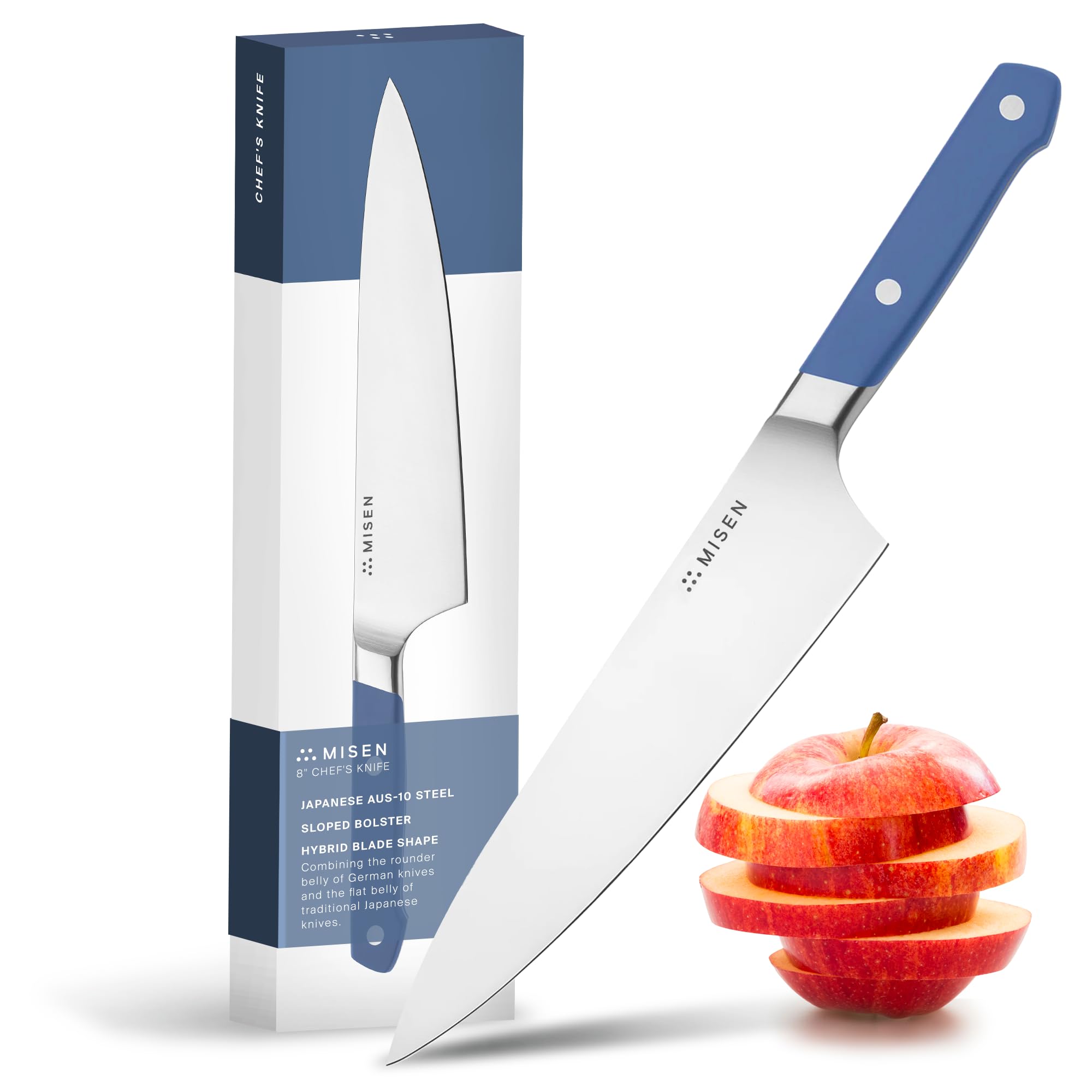
Misen 8-Inch Chef’s Knife — The Crowdfunded Contender
Best for: modern kitchens and design-minded cooks
For the cook who wants thoughtful design without the heritage markup. The Misen pairs Japanese AUS-10 steel with a sloped bolster that keeps knuckles off the board and a handle shaped from thousands of user tests. It arrives sharp, balances nicely at the bolster, and the clean modern look suits open kitchens. It runs thicker behind the edge than true Japanese lasers, so it wedges slightly in dense vegetables, and the handle can feel large for smaller hands, but as a daily driver with modern ergonomics it punches above its price.
- AUS-10 steel holds a keen edge
- Angled bolster protects knuckles
- Great balance for the money
- Clean, modern aesthetic
- Thicker behind the edge than lasers
- Handle runs large for small hands
4.7/5
4.4/5
4.4/5

Dalstrong Gladiator Series 8-Inch Chef’s Knife — The Comfort King
Best for: cooks with grip issues or arthritis concerns
For the cook whose hands give out before the prep does. The Gladiator’s standout feature is its deeply sculpted, triple-riveted handle with an integrated finger guard — the most secure grip on this list, and a genuine help for anyone with arthritis or a weak pinch grip. A full-tang German 1.4116 steel blade, hand-finished and sharp out of the box, brings enough heft for confident chopping. Because the steel is softer than Japanese picks it needs steeling often, and the knife runs heavy overall, but for comfort-first cooking it is unmatched.
- Most secure grip on this list
- Full-tang German steel, hand finished
- Finger guard protects during chopping
- Striking design for the money
- Softer steel needs frequent steeling
- Heavy — not for small hands
4.6/5
4.2/5
4.4/5
Top 3 Head-to-Head: Wüsthof Classic vs MAC MTH-80 vs Shun Classic
These three are the finalists almost every serious cook narrows it down to: German toughness, Japanese edge retention, or Japanese precision. The classic debate comes down to German vs Japanese knives — and your cooking style decides it.
| Feature | #1 Wüsthof Classic | #2 MAC MTH-80 | #3 Shun Classic |
|---|---|---|---|
| Value for money | 4.7/5 | 4.8/5 — Best | 4.6/5 |
| Edge retention | Good — weekly steeling | Excellent — longest between sharpenings — Best | Very good, chips if abused |
| Slicing precision | Good, thicker blade | Excellent, thin 2.5 mm blade | Best-in-class 16° VG-MAX edge — Best |
| Toughness | Best — shrugs off abuse | Good — avoid bones | Delicate — no frozen food |
| Choose if… | You want one indestructible daily knife | You hate sharpening and value nimbleness | You prize precision slicing above all |
Who These Chef Knives Are NOT For
Honest truth: a $250 chef knife is overkill for some kitchens, and the wrong pick for some cooks.
If you never sharpen and never will, skip the Japanese picks — a neglected Shun or Miyabi cuts worse than a maintained budget knife. And if you cook twice a month, the Victorinox at #4 gives you 90% of the experience; the extra spend only pays off with regular use.
Common Mistakes to Avoid
Four mistakes that ruin good knives faster than anything else.
Frequently Asked Questions About Chef Knives Under $250
How much should I spend on a good chef knife?
You do not need to spend the full budget — excellent knives exist well below this price band, like the Victorinox at #4. But this range buys you forged construction, better steel, and fit and finish that budget knives cannot match. Start with what makes a high-quality kitchen knife, then spend up to the point where the steel and handle match how often you actually cook.
Is a premium chef knife really worth it over a budget one?
It depends on how you cook. If you prep daily, a premium knife holds its edge longer, feels better balanced, and sharpens more predictably — the difference is real within a week. If you cook occasionally, the gap shrinks and a budget knife kept sharp will serve you fine. Worth is about usage, not prestige.
German vs Japanese chef knives — which is better?
Neither — they solve different problems. German knives like the Wüsthof are thicker, tougher, and forgiving, ideal for rock-chopping and cooks who are rough on tools. Japanese knives like the Shun or MAC are thinner and harder, delivering cleaner slices but demanding hand washing and careful technique. Choose toughness or precision based on your habits.
How long should a chef knife stay sharp?
With daily home use, a good chef knife should cut cleanly for 2–4 weeks before needing a touch-up, though this varies hugely by steel and cutting surface. Softer German steel benefits from a honing rod every few uses; harder Japanese steel holds longer but then needs a whetstone. If your knife crushes tomatoes after a week, your board or technique is the likely culprit.
What size chef knife should I buy?
Eight inches is the sweet spot for most home cooks — long enough for cabbage and roasts, short enough to control. Every knife on this list is 8 to 8.2 inches for that reason. Choose a 6-inch only if you have very small hands or a tiny kitchen, and a 10-inch only if you regularly break down large cuts of meat.
Can I put my chef knife in the dishwasher?
No — never put a good chef knife in the dishwasher. The high heat and harsh detergent dull the edge, moisture trapped in the handle can cause cracking or rust spots, and rattling against other utensils chips the blade. Hand-wash with soap and water, dry immediately, and store it in a block, strip, or sheath.
What is the best chef knife for a beginner?
The Victorinox Fibrox Pro at #4 is the classic beginner answer: affordable, light, easy to sharpen, and forgiving. If your budget stretches further, the Wüsthof Classic at #1 is the best beginner-proof premium knife because its tougher steel survives learning mistakes. Avoid hard Japanese knives until you are comfortable with hand washing and proper technique.
Our Final Verdict
Under $250, the Wüsthof Classic remains the safest recommendation: tough, balanced, and easy to maintain. Spend-conscious cooks should grab the Victorinox or Tojiro, while edge obsessives will prefer the MAC or Shun. Whichever you choose, buy the 8-inch version and hone it regularly.

