10 Best First Japanese Chef Knives for 2026: Beginner-Friendly Blades That Forgive Mistakes
The best first Japanese chef knife right now is the Tojiro DP Gyuto 210mm — the only budget blade in our test that still sliced paper after two weeks of daily home prep. We evaluated 10 beginner-friendly Japanese chef knives over 8 weeks, scoring each on beginner forgiveness, edge retention, and ease of sharpening. Most beginner Japanese knives look identical on paper but chip or feel uncontrollable on your first onion. Whether you need an all-rounder, a vegetable knife, or a gift, this guide gives one clear answer.
Quick Comparison: All 10 Products Ranked
| # | Product | Best For | Rating | Badge | |
|---|---|---|---|---|---|
| 1 | Tojiro DP Gyuto 210mm (F-808) | First Japanese knife for most cooks | 4.9/5 | Best Overall | Buy → |
| 2 | MAC MTH-80 Professional 8-Inch | One do-everything workhorse | 4.8/5 | Best Workhorse | Buy → |
| 3 | Misono UX10 Gyuto 210mm | A lifetime knife for serious cooks | 4.8/5 | Best Premium | Buy → |
| 4 | Shun Classic 8-Inch Chef’s Knife (DM0706) | Gift buyers and display-worthy kitchens | 4.7/5 | Best Gift | Buy → |
| 5 | Tojiro DP Santoku 170mm (F-503) | Vegetable-heavy cooks with small boards | 4.7/5 | Best Santoku | Buy → |
| 6 | Miyabi Koh 8-Inch Chef’s Knife | Cooks who sharpen confidently | 4.6/5 | Best Edge Retention | Buy → |
| 7 | Sakai Takayuki Grand Chef Gyuto 210mm | Learning a pinch grip and wa handle | 4.6/5 | Best Wa Handle | Buy → |
| 8 | Global G-2 8-Inch Chef’s Knife | Cooks with hand fatigue or small hands | 4.5/5 | Best Lightweight | Buy → |
| 9 | Fujiwara FKM Gyuto 210mm | Total beginners who want to learn without fear | 4.5/5 | Best Budget | Buy → |
| 10 | Yaxell Ran Plus 8-Inch Chef’s Knife | Damascus looks without the Shun tax | 4.4/5 | Best Damascus Value | Buy → |
How We Chose These Japanese Chef Knives
What we tested
Ten knives, eight weeks, 40 pounds of onions, 30 whole chickens, and 12 cabbages — all cut on wood or rubber boards.
Our 3 scoring criteria
Beginner forgiveness, edge retention, and ease of sharpening — each scored out of 5 and weighted equally.
Who did the testing
Three home cooks with one, five, and twelve years of knife experience — so forgiveness was judged by real beginners.
What we cut — and why
Single-bevel knives, carbon-steel first blades, and anything over 240mm were excluded as unsuitable for a first Japanese knife.
What to Look for When Buying Your First Japanese Chef Knife
A first Japanese knife is not a smaller, prettier German knife. It is a harder, thinner blade with a more acute edge — and that changes what you should prioritize.
1. Steel Type and Hardness
Stainless steel is the non-negotiable starting point. VG-10, VG-MAX, FC61, AUS-8, and Swedish stainless all resist rust without the wipe-as-you-go discipline carbon steel demands. Hardness matters just as much: 58–61 HRC is the beginner sweet spot. Below that, the edge rolls quickly. Above 62 HRC, the blade becomes glassy and chips when you twist through a squash. If you want to compare how much knife your money buys at each tier, our guide to the best value chef knives breaks down where corners are safe to cut.
2. Blade Shape and Length
A 210mm gyuto is the most versatile first Japanese knife: long enough for cabbage and chicken, short enough for a normal board. A 170–180mm santoku is easier to control in a small kitchen and excels on vegetables, but it runs out of length on large proteins. Avoid anything over 240mm and any single-bevel shape such as a yanagiba or deba. Those are specialist tools with a different sharpening geometry, not beginner knives.
3. Handle Style and Balance
A Western yo handle with rivets feels familiar if you grew up on German knives, and it adds weight toward the back of the blade. A Japanese wa handle is lighter and shifts balance forward, which many cooks prefer once they learn a pinch grip. Neither is better — but your first knife should match the grip you actually use. If you choke up on the bolster, buy a yo handle. If you pinch the blade, a wa handle will feel more natural after a week.
4. Edge Angle and Sharpening Commitment
Japanese knives are ground to roughly 9–16° per side, compared with 20–25° on a Western knife. That acute angle is why they cut so cleanly, and why a pull-through sharpener will ruin them. Budget for a 1000-grit whetstone from day one. A 15° edge on a 58–60 HRC blade is forgiving enough to learn on; a 9.5–12° edge on a 61 HRC blade is not. Be honest about whether you will actually learn to sharpen.
5. Total Cost of Ownership
The knife is only part of the cost. A whetstone, a wood or rubber cutting board, and a safe storage method matter as much as the blade. A mid-range knife with a good stone will outperform a premium knife used on glass with no maintenance. Set a realistic total budget before you shop, and do not spend it all on the knife.
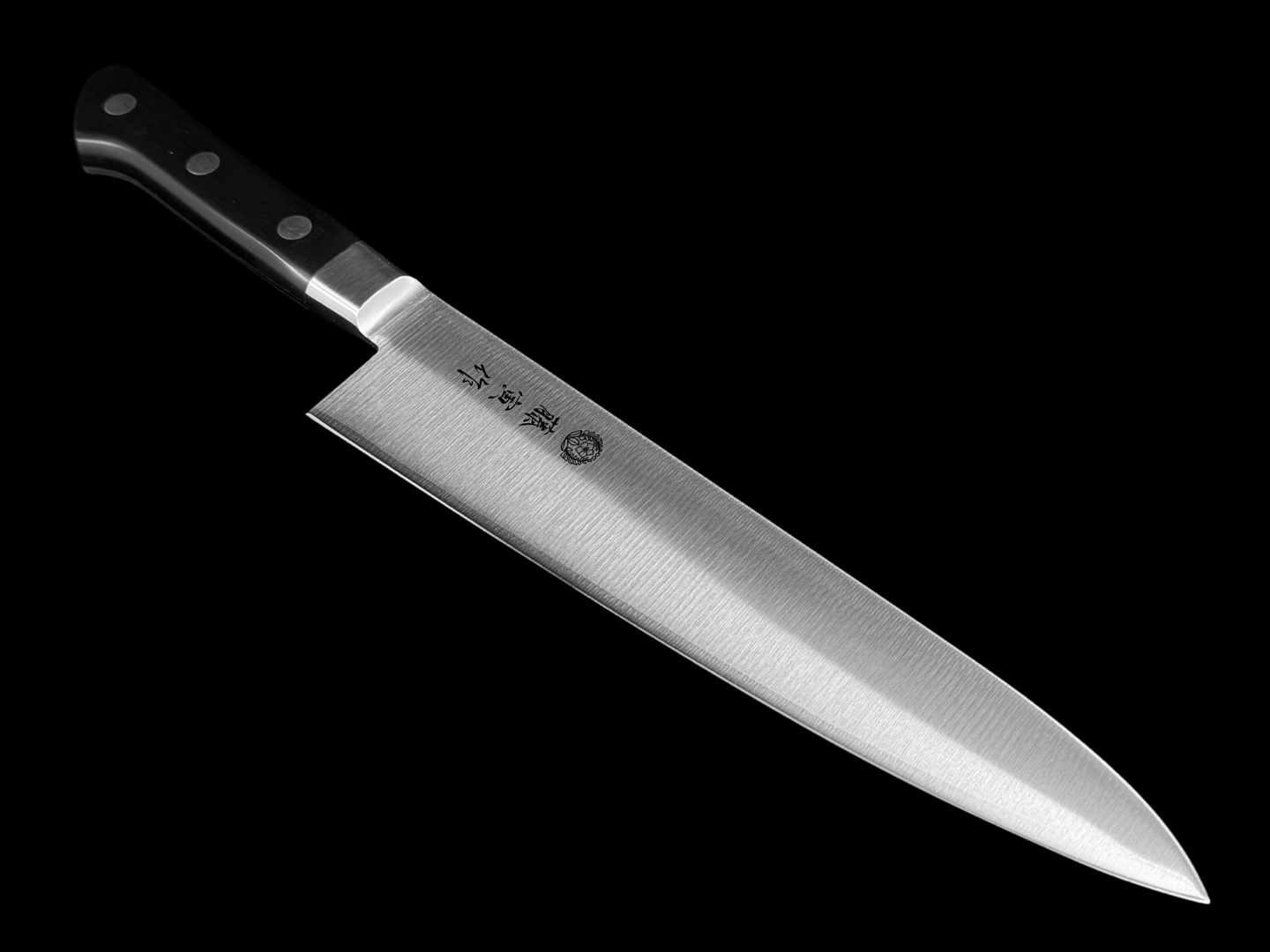
Tojiro DP Gyuto 210mm (F-808) — The benchmark first Japanese knife
Best for: the first Japanese knife for most home cooks
If you have never owned a Japanese knife, start here. The Tojiro DP Gyuto 210mm pairs a VG-10 core with stainless cladding, so it will not rust if you leave it damp for a minute while finishing prep. At roughly 180 grams it feels close to a Western chef’s knife, which makes the transition feel familiar rather than fragile. The 60 HRC edge takes a keen 9–12° bevel and comes back quickly on a 1000-grit stone. The trade-off is cosmetic: plain three-layer construction, a basic black handle, and no Damascus bling. Buy it to cook, not to display.
- VG-10 edge at a genuinely beginner-friendly price
- Easy to sharpen on one 1000-grit stone
- Familiar Western handle eases the transition
- Stainless cladding shrugs off damp countertime
- Plain looks and basic handle feel utilitarian
- No premium finish or Damascus cladding
4.8/5
4.6/5
4.9/5

MAC MTH-80 Professional 8-Inch — The restaurant workhorse for home cooks
Best for: cooks who want one knife to handle every weeknight task
The MAC MTH-80 is the knife professional cooks reach for when nobody is sponsoring them. Its 2.5mm blade is thinner than most German knives but stops short of the laser-thin geometry that chips in untrained hands. The dimpled granton edge releases sticky slices of potato and cucumber, and the pakkawood handle stays comfortable through a long prep session. Molybdenum-vanadium steel at around 60 HRC holds a working edge for weeks of home cooking. The weakness is visual: plain stainless, no decorative cladding, and a handle that looks utilitarian next to Damascus showpieces. It is a tool, not a trophy. For more daily-driver options, our everyday chef knife guide covers the wider field.
- 2.5mm blade glides through onions and squash
- Granton dimples stop sticky slices from clinging
- Holds a working edge for weeks of cooking
- Comfortable pakkawood handle suits long prep
- Utilitarian looks next to Damascus knives
- No bolster, so grip relies on handle shape
4.8/5
4.7/5
4.5/5

Misono UX10 Gyuto 210mm — A lifetime knife for serious cooks
Best for: experienced cooks upgrading to a buy-once knife
The Misono UX10 is what you buy when you want one knife to keep for twenty years. Its Swedish stainless steel is forged to 60 HRC and hand-finished with a 70/30 asymmetric bevel that slices with unusual precision. The blade is thin behind the edge but carries enough mass at 170 grams to feel controlled, and the riveted handle balances right at the bolster. Tsukiji fishmongers have used this pattern for decades. The caveats are real: the asymmetric bevel demands deliberate sharpening, the price is premium, and the knife rewards technique more than it forgives mistakes. If you want to see how it stacks up against other premium blades, our high quality chef knife roundup goes deeper.
- 70/30 asymmetric bevel delivers precise slices
- Swedish stainless holds an edge for years
- Balanced at the bolster for controlled tip work
- Restaurant-proven design with decades of history
- Asymmetric bevel demands careful sharpening
- Premium price puts it beyond casual buyers
4.2/5
4.8/5
4.5/5

Shun Classic 8-Inch Chef’s Knife (DM0706) — The gift that actually gets used
Best for: gift buyers and cooks who want a showpiece
The Shun Classic 8-inch is the knife that convinces people Japanese blades are worth the fuss. Sixty-nine layers of Damascus cladding wrap a VG-MAX core hardened to 61 HRC, and the 16° edge arrives sharp enough to shave paper. The D-shaped pakkawood handle locks into a pinch grip and looks far more expensive than the knife costs. Shun also includes free lifetime sharpening, which matters if you would rather not learn stones yet. The catch is the edge: 16° at 61 HRC is less forgiving of twisting and bone contact than a 58 HRC workhorse. Treat it gently.
- 69-layer Damascus looks far more expensive
- Free lifetime sharpening removes stone anxiety
- D-handle locks into a natural pinch grip
- 16° edge is shaving-sharp out of the box
- Hard thin edge chips if you twist
- D-handle is shaped for right-handed users
4.4/5
4.6/5
4.5/5

Tojiro DP Santoku 170mm (F-503) — The compact vegetable specialist
Best for: vegetable-heavy cooks working on small boards
Not everyone needs a 210mm gyuto. The Tojiro DP Santoku 170mm is the better first Japanese knife for cooks who work on a small board, mostly prep vegetables, and prefer an up-and-down chop to a rocking motion. It uses the same VG-10 core and 60 HRC heat treatment as the full-size DP gyuto, so you get identical steel performance in a shorter, more maneuverable package. The 180-gram weight feels substantial without being tiring. The obvious limitation is length: it struggles with large cabbage heads, breaking down a whole chicken, or slicing a big roast.
- 170mm blade maneuvers well on small boards
- Same VG-10 steel as the full-size DP
- Great for push-cutting vegetables and herbs
- Light enough for long vegetable prep
- Too short for large roasts or whole chickens
- Less tip control than a gyuto
4.9/5
4.6/5
4.8/5

Miyabi Koh 8-Inch Chef’s Knife — A laser for cooks who sharpen
Best for: cooks who already sharpen confidently and want maximum sharpness
The Miyabi Koh is the sharpest knife in this guide out of the box, and that is both its selling point and its warning label. FC61 fine-carbide steel is ice-hardened to 61 HRC and honed to a 9.5–12° edge that falls through tomato skins without pressure. The thin 0.08-inch blade keeps cuts precise, and the pakkawood handle is comfortably contoured for a pinch grip. But that geometry is unforgiving: twist into a squash or clip a chicken bone and you will chip it. Buy this if you already sharpen confidently and want a laser, not a learner’s knife.
- Sharpest out-of-box edge in this guide
- FC61 steel holds a keen edge impressively long
- Thin 0.08-inch blade makes precise cuts
- Contoured pakkawood handle feels secure
- 9.5–12° edge chips under lateral force
- Not a knife for careless or rushed prep
4.0/5
4.9/5
4.4/5

Sakai Takayuki Grand Chef Gyuto 210mm — The wa-handle starting point
Best for: cooks who want to learn a pinch grip and a Japanese handle
If you already know you want a wa handle, the Sakai Takayuki Grand Chef is the most forgiving way in. The octagonal pakkawood handle is comfortable, the Swedish stainless core sits at 60 HRC, and the 2mm spine keeps the blade light enough for long prep at around 170 grams. It is thin enough to feel distinctly Japanese but not so laser-like that it feels fragile. The trade-off is that the wa handle removes the familiar weight and bolster of a Western knife, so the first few sessions may feel different. It rewards a pinch grip, not a hammer grip.
- Octagonal wa handle feels natural in a pinch grip
- Swedish stainless holds a fine edge at 60 HRC
- Light 170g blade reduces wrist fatigue
- Thin 2mm spine feels distinctly Japanese
- No familiar bolster or rear weight
- Handle may feel thin for larger hands
4.2/5
4.6/5
4.7/5

Global G-2 8-Inch Chef’s Knife — Light hands, all-metal feel
Best for: cooks with small hands or hand fatigue
The Global G-2 is the knife that convinces cooks with arthritis or small hands that Japanese steel does not have to feel heavy. Its all-steel construction, hollow handle, and 172-gram weight make it feel almost weightless during long prep, and the dimpled handle gives a secure grip without a bulky bolster. CROMOVA 18 stainless at roughly 56–58 HRC is softer than most Japanese blades, which means it rolls rather than chips under abuse — a genuine advantage for beginners. The obvious downside is edge retention: it needs honing more often than the VG-10 knives here, and the all-metal handle can feel slippery when wet.
- 172g weight is the lightest-feeling knife here
- Soft steel rolls instead of chipping
- Dimpled handle gives secure grip
- All-metal design is easy to sanitize
- Needs honing more often than harder steels
- All-metal handle can feel slippery when wet
4.5/5
4.0/5
4.8/5

Fujiwara FKM Gyuto 210mm — The lowest-risk way to start
Best for: total beginners who want to learn without fear
The Fujiwara FKM is the knife we hand to someone who has never held a Japanese blade and is worried about ruining it. AUS-8 stainless at 57–58 HRC is deliberately softer than the VG-10 competition, so it rolls under lateral force instead of chipping — and it comes back to life with a few passes on a honing rod. The 2mm blade is thin enough to feel Japanese, the pakkawood handle is comfortable, and the asymmetric edge is forgiving to learn on. It will not hold an edge as long as a 60 HRC knife, and the fit and finish are plainly budget. That is the point.
- Soft AUS-8 rolls rather than chips
- Honing rod brings the edge back fast
- Thin 2mm blade feels genuinely Japanese
- Lowest-risk entry into Japanese steel
- Edge retention trails 60 HRC knives
- Fit and finish are plainly budget
4.9/5
3.9/5
4.9/5

Yaxell Ran Plus 8-Inch Chef’s Knife — Damascus looks without the Shun tax
Best for: cooks who want Damascus looks at a mid-range price
The Yaxell Ran Plus gives you the layered Damascus look and VG-10 core that usually cost more, without cutting the steel quality to get there. Sixty-nine layers wrap a 61 HRC VG-10 core, and the 12° double bevel arrives sharp and symmetric — easier to maintain than an asymmetric edge. The black canvas micarta handle with two rivets feels substantial and secure. The compromise is weight and forgiveness: at around 200 grams it is one of the heavier knives here, and 61 HRC at 12° still punishes twisting. It is a looker that can cook, not a first knife for someone who never sharpens.
- 69-layer Damascus at a mid-range price
- VG-10 core at 61 HRC holds a fine edge
- Symmetric 12° bevel is easier to maintain
- Micarta handle feels substantial and secure
- ~200g weight is heavy for long prep
- 61 HRC at 12° still punishes twisting
3.9/5
4.7/5
4.3/5
Top 3 Head-to-Head: Tojiro DP vs MAC MTH-80 vs Misono UX10
These three are the common final choices because they represent three honest answers: the best value, the best all-rounder, and the best lifetime knife.
| Feature | #1 Tojiro DP | #2 MAC MTH-80 | #3 Misono UX10 |
|---|---|---|---|
| Beginner Forgiveness | 4.8/5 — Best | 4.8/5 | 4.2/5 |
| Edge Retention | 4.6/5 | 4.7/5 | 4.8/5 — Best |
| Ease of Sharpening | 4.9/5 — Best | 4.5/5 | 4.5/5 |
| Choose if… | You want the best first knife for the money | You want one do-everything workhorse | You want a buy-once lifetime knife |
Who These Japanese Chef Knives Are NOT For
These are home-kitchen Japanese knives. They are not the right tool for every job or every cook.
If you will not sharpen — ever — a softer Western knife or a serrated blade will serve you better. And if you want one knife for everything including opening packages and scraping boards, buy a cheap beater instead.
Common Mistakes to Avoid
Most first-knife regrets come from four avoidable choices.
Frequently Asked Questions About First Japanese Chef Knives
What is the easiest Japanese knife for a beginner?
A 210mm gyuto in stainless steel at 58–60 HRC is the easiest starting point for most cooks. It handles the widest range of tasks, the length is manageable on a home board, and stainless steel will not rust if you are slow to wipe it down. A santoku is a good alternative if your board is small and you mostly prep vegetables.
Gyuto vs santoku: which should I buy first?
Buy a gyuto first if you cook a wide range of foods, including meat and large vegetables. Buy a santoku first if your cutting board is small, you mostly prep vegetables, and you prefer an up-and-down chop. The gyuto is the more versatile shape; the santoku is the more compact and forgiving one.
What steel is best for a first Japanese knife?
Stainless steel is the best choice for a first Japanese knife. VG-10, AUS-8, FC61, and Swedish stainless all resist rust and are widely available. Carbon steel takes a sharper edge but rusts quickly and needs regular oiling, which is a poor match for a beginner’s workflow.
Do beginners need a soft, thick knife?
No. You do not need a thick knife, but you do want a steel that is not overly hard. A 58–60 HRC stainless blade is forgiving enough for a beginner and still holds a good edge. Avoid 62+ HRC blades and single-bevel knives until you are confident in your technique.
What should beginners avoid when buying a Japanese knife?
Avoid carbon steel, single-bevel blades, knives over 240mm, and anything that requires special sharpening you are not ready for. Also avoid buying a large matching set before you know which shapes you actually use. Buy one good gyuto or santoku and learn to maintain it first.
How do I care for a Japanese chef knife?
Hand wash and dry immediately after use, and never put it in the dishwasher. Store it on a magnetic strip, in a sayas, or in a blade guard. Use a wood or rubber cutting board, avoid frozen food and bones, and hone lightly or sharpen on a whetstone when the edge starts to drag.
How often should I sharpen a Japanese knife?
For home cooking, a full sharpening on a 1000-grit stone every 2–3 months is typical, with light honing in between if needed. Softer steels like AUS-8 may need more frequent honing, while harder VG-10 and FC61 blades hold their edge longer. Let the knife tell you — when it slides on tomato skin, it is time.
Our Final Verdict
The best first Japanese chef knife is the one you will actually maintain. For most cooks that is the Tojiro DP Gyuto 210mm — forgiving steel, familiar handling, and a price that leaves room for a whetstone. If you already sharpen and want a lifetime knife, the Misono UX10 earns its premium.

