What Is the Purpose of a Chef’s Knife? Uses, Benefits & Limits
Quick Answer
The main purpose of a chef’s knife is to serve as an all-purpose food-preparation knife. Its broad, sharp blade is designed for everyday tasks such as chopping, slicing, dicing, and mincing vegetables, herbs, fruit, and boneless meat. Its length and curved profile also make controlled rocking and longer slicing motions practical.
A chef’s knife is usually the main cutting tool on a kitchen cutting board because it handles many preparation jobs without requiring a different knife for every ingredient. Unlike a paring knife, which is built for small precision work, or a serrated knife, which excels at foods such as crusty bread, a chef’s knife is designed around versatility.
What Is a Chef’s Knife Designed to Do?
A chef’s knife is designed to handle a wide range of cutting and preparation tasks efficiently. The broad blade provides a useful combination of cutting surface, control, leverage, and stability, while the curved profile allows many cooks to use a rocking motion on the cutting board.
The exact dimensions vary, but chef’s knives commonly fall into the roughly 6- to 12-inch range. The University of Nebraska–Lincoln describes the chef’s knife as a broad, tapered knife with a fine edge designed to rock on a cutting board. UNL Food’s guide to using a chef’s knife also explains how the blade shape supports common cutting motions.
That design makes the chef’s knife a generalist rather than a specialist. It does not perform every kitchen task better than every other knife, but it covers a large portion of everyday preparation.
What Can You Use a Chef’s Knife For?
 Save
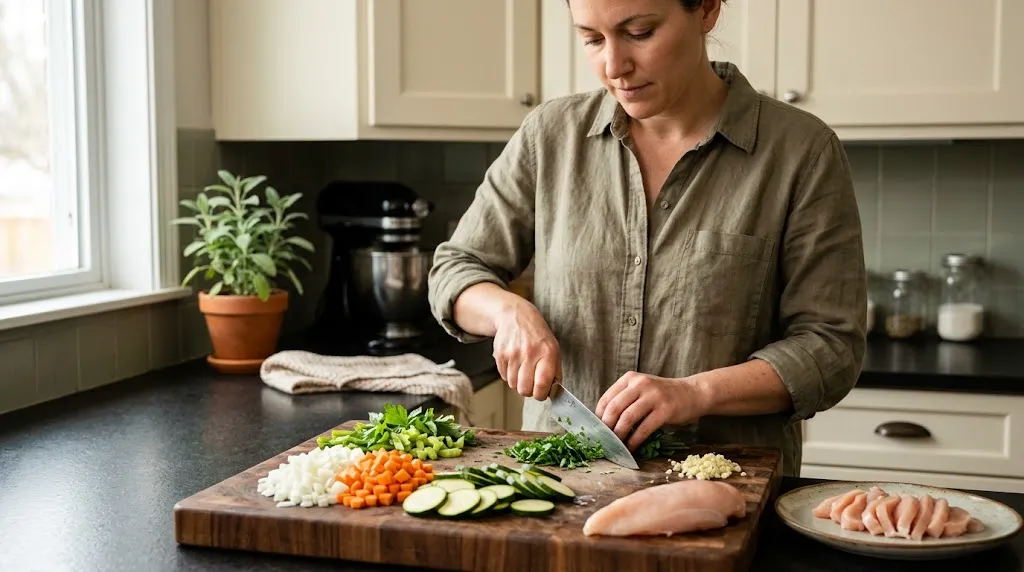
SaveThe most useful way to understand a chef’s knife is to look at the jobs its shape handles well. The core uses include chopping, slicing, dicing, and mincing.
Chopping vegetables and herbs
Chopping is one of the chef’s knife’s primary jobs. You can use it for onions, carrots, celery, potatoes, peppers, leafy greens, herbs, and many other vegetables. The blade’s length lets you cut across a relatively large ingredient without repeatedly repositioning a short blade.
For herbs and aromatics, the curved portion of the blade can also support a controlled rocking motion. The Culinary Institute of America identifies chopping, mincing, and other basic cuts as central knife skills and notes that the chef’s knife is particularly useful for larger ingredients. The Culinary Institute of America’s knife-skills guide provides additional guidance on choosing the right knife for different jobs.
Slicing food
A chef’s knife is also useful for slicing boneless meat, poultry, fruit, vegetables, and other foods. The longer edge allows a cook to make a longer cutting stroke instead of relying entirely on short up-and-down movements.
For example, a large tomato, zucchini, chicken breast, or melon can be easier to portion with a chef’s knife than with a small paring knife. The important condition is that the food should be appropriate for the knife’s construction. A chef’s knife is a preparation knife, not a substitute for a specialized carving, bread, or boning knife.
Dicing ingredients
Dicing means cutting an ingredient into relatively uniform pieces. A chef’s knife is well suited to this because its broad blade provides control while its length gives enough room for repeated, consistent cuts.
Uniform pieces are useful because they tend to cook more predictably. The goal is not simply to make the pieces look neat; consistent sizing can make the texture of a finished dish more predictable.
If you are learning to dice onions, carrots, potatoes, or similar vegetables, the knife should remain controlled rather than being forced through the ingredient. A stable cutting board and a secure grip matter as much as the blade itself.
Mincing garlic and herbs
The fine edge and broad blade also make a chef’s knife useful for mincing. Garlic, shallots, parsley, cilantro, and other herbs can be reduced into small pieces with repeated controlled cuts.
For very small or delicate ingredients, however, a smaller knife may provide better control. The point is not that a chef’s knife must be used for every preparation task; its value is that it can perform many of them competently.
Why Is a Chef’s Knife So Versatile?
The versatility comes from the relationship between the blade’s size, shape, edge, and balance. A broad blade provides leverage and makes it easier to move larger ingredients across a cutting board. The length gives the cook enough cutting edge for both short cuts and longer slicing motions.
The curved portion of many chef’s knives also supports rocking cuts. The tip can remain close to the board while the handle rises and falls. This is particularly useful for repeated chopping and mincing.
There is another practical benefit: the broad side of the blade can sometimes be used to move chopped ingredients from the board into a bowl or pan. If you need to scrape food from the board, use the spine rather than dragging the sharp edge sideways across the surface, which can unnecessarily stress the edge.
Key Insight
A chef’s knife is valuable because it is a strong generalist. Its purpose is not to outperform every specialty knife; it is to handle enough everyday preparation that you can complete most meals without constantly changing tools.
What Should You Not Use a Chef’s Knife For?
A chef’s knife is versatile, but versatility has limits. Using it for tasks that require a different blade can reduce control, damage the edge, or create an unnecessary safety problem.
- Cutting through bones: A standard chef’s knife is not a bone-cleaving tool. Use an appropriate butcher or cleaver-style tool when the task genuinely requires cutting through bones.
- Deboning meat: A narrow boning knife is better suited to following bones and working around joints.
- Cutting crusty bread: A serrated bread knife is designed to grip and saw through a crust without relying on a straight cutting edge.
- Peeling small produce: A paring knife usually gives better control for close, delicate work.
- Opening packages or cans: A kitchen knife should not be treated as a general-purpose pry bar or opener.
- Cutting extremely hard or frozen foods: Hard resistance can put inappropriate lateral stress on the blade and make loss of control more likely.
The basic rule is simple: use the chef’s knife for ordinary food preparation, and switch to a specialty knife when the ingredient or task demands a different blade shape or edge.
How Does a Chef’s Knife Compare With Other Kitchen Knives?
| Knife | Main purpose | Why it differs |
|---|---|---|
| Chef’s knife | General chopping, slicing, dicing, and mincing | Broad, versatile blade for everyday prep |
| Paring knife | Peeling and small precision work | Shorter blade provides close control |
| Serrated knife | Bread and foods with delicate interiors | Teeth grip surfaces that a straight edge can struggle with |
| Boning knife | Separating meat from bones | Narrow blade reaches around bones and joints |
The comparison shows why a chef’s knife is often the first major kitchen knife people learn to use. It occupies the broad middle ground between highly specialized blades. The University of Nebraska–Lincoln and Virginia Tech Extension both describe the chef’s knife as a general-purpose tool for tasks such as chopping, slicing, dicing, and mincing.
Does the Chef’s Knife Make Cooking Faster?
It can, particularly when several ingredients need to be prepared in succession. A single versatile knife means you can move from chopping vegetables to slicing herbs without repeatedly switching tools.
The benefit depends on technique, sharpness, and control. A dull or poorly handled knife can make preparation slower because the cook must apply more force and may need additional passes through the food.
For that reason, knife skill is part of the purpose of a chef’s knife. Learning a controlled grip, keeping the guiding hand’s fingertips curled away from the blade, and using a stable cutting board can make the tool considerably easier to control.
NC State Extension recommends a pinch grip for control and a claw-style position for the guiding hand. It also emphasizes using a sturdy, non-slip cutting board and keeping the cutting motion controlled. These fundamentals matter more than simply owning a particular knife.
What Makes a Chef’s Knife Good for Everyday Cooking?
A useful chef’s knife should feel controllable for the person using it. Blade length, weight, handle shape, balance, and edge geometry all influence how comfortable the knife is during repeated preparation.
There is no single size that is ideal for every cook. An 8-inch chef’s knife is a common general-purpose choice, while a 6-inch blade may feel easier to control for someone who prefers a smaller knife. Larger blades provide more cutting length but can feel cumbersome if they do not suit the user.
Sharpness is also important. The American Heart Association notes that a sharp knife can require less pressure to cut food smoothly than a dull knife. That does not make knife use automatically safe, but maintaining a functional edge can help the cook avoid forcing the blade through food.
Tip
Choose a chef’s knife based on control and comfort rather than simply choosing the largest or most expensive blade. A knife that fits your hand and cutting style is more useful than one that looks impressive but feels awkward.
How Should You Maintain a Chef’s Knife?
Basic maintenance protects the edge and keeps the knife ready for its intended work. Hand washing and immediate drying are simple habits that help prevent unnecessary corrosion and edge damage. Safe storage also prevents the blade from banging against other utensils.
Honing and sharpening are different jobs. Honing can help realign an existing edge, while sharpening removes material to create a new cutting edge. How often either is needed depends on the knife, the steel, how frequently it is used, and how it is handled.
For a more detailed maintenance routine, CookingFlavour’s kitchen knife cleaning, sharpening, and maintenance guide covers cleaning, sharpening, storage, and common care mistakes.
It is also worth protecting the cutting edge by using an appropriate cutting board. Hard surfaces such as glass or stone can be unnecessarily harsh on a knife edge, while suitable wood or plastic boards are more practical for routine food preparation.
What Is the Main Benefit of Having a Chef’s Knife?
 Save
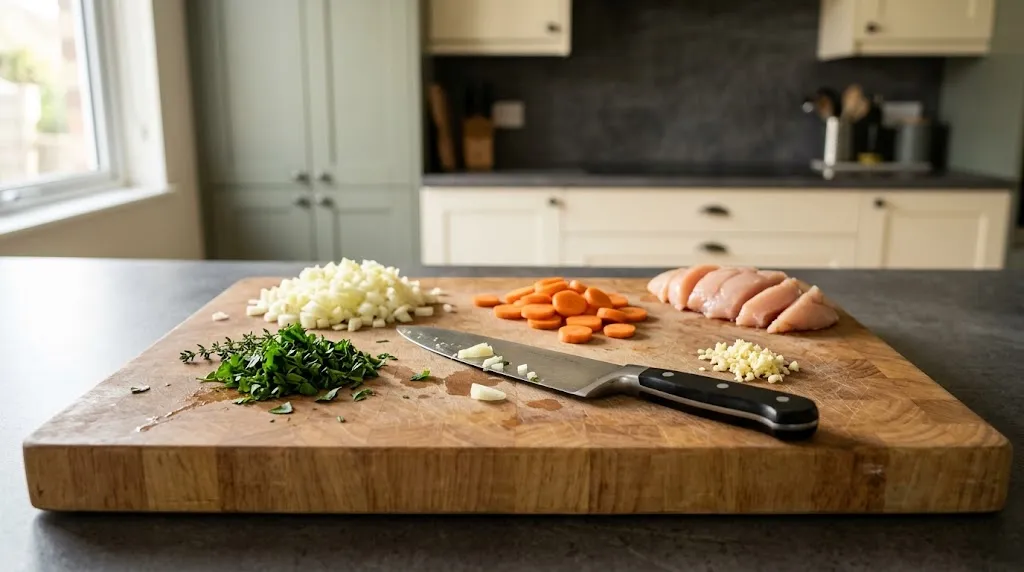
SaveThe main benefit is versatility. One well-suited chef’s knife can handle much of the chopping, slicing, dicing, and mincing involved in everyday meals. That reduces the need to reach for a specialty knife every time the ingredient changes.
Its real value becomes clearer when you think about a typical preparation session: an onion needs dicing, herbs need chopping, a carrot needs slicing, garlic needs mincing, and boneless chicken needs portioning. A chef’s knife can handle all of those jobs reasonably well.
That does not mean it replaces every other knife. Instead, it serves as the central general-purpose blade, while specialized knives fill the situations where their particular geometry provides a meaningful advantage.
Frequently Asked Questions
Is a chef’s knife only for chopping?
No. Chopping is one of its main uses, but a chef’s knife is also designed for slicing, dicing, and mincing a wide range of ingredients.
Can you use a chef’s knife to cut meat?
Yes, a chef’s knife is suitable for many boneless meat-preparation tasks. It is not the right tool for cutting through bones or specialized deboning work.
Why is a chef’s knife curved?
The curved portion of many chef’s knives allows a rocking motion on the cutting board, which can make repeated chopping and mincing efficient.
What size chef’s knife is best for most people?
There is no universal best size. An 8-inch chef’s knife is a common general-purpose option, while smaller or larger blades may suit different hand sizes, preferences, and cutting tasks.
Is a chef’s knife better than a paring knife?
Neither is universally better. A chef’s knife is better suited to medium and large preparation tasks, while a paring knife is more useful for small, close, and delicate work.
Do you really need a chef’s knife?
You can prepare food without one, but a chef’s knife is one of the most versatile kitchen knives because it covers many common cutting tasks with a single tool.
Conclusion
The purpose of a chef’s knife is simple: it is the kitchen’s general-purpose cutting tool. Its blade is designed to handle the everyday work of chopping, slicing, dicing, and mincing without requiring a separate knife for every ingredient.
The biggest advantage is versatility, but knowing its limits is just as important. Use specialty knives when a task involves bones, delicate precision work, or foods better handled by a serrated edge. Keep the chef’s knife sharp, use a stable cutting board, and focus on controlled technique. With those basics in place, one well-fitting chef’s knife can cover a surprisingly large share of everyday food preparation.